

Group wants to see more, many more, national parks.
There are those who either disagree the climate is changing due to human behavior, or that there's nothing that can be done regardless of the driver, as well as those who would love to see more national park lands and those who believe such a move would tie up federal lands from multiple resource activities, such as logging or mining.
Michael Kellett believes more national park lands -- roughly three times the current 85+ million acres in the National Park System -- would help in the battle against climate change, improve biodiversity, and provide Americans with more recreational outlets.
"What national parks do, what they accomplish, is something we need a lot more of," explains Kellett, the executive director of RESTORE: The North Woods, a nonprofit organization that for years campaigned for a multi-million-acre Maine North Woods National Park, who more recently has been lobbying for a greatly expanded system of national parks. "They can store carbon, maintain intact ecosystems, and they can provide green space for people, for public health and well-being, all things that we need a lot more of if we’re going to address the current crises that we’re facing.
“There are other ways that potentially could address some of these problems, but national parks can do all three of those things at once."
While Kellett's drive for a sprawling national park in Maine didn't succeed, it did pave the way for Katahdin Woods and Waters National Monument, which President Obama established in December 2016 with his authority under The Antiquities Act.
Pushing now for a massive expansion of the park system seems beyond possibility. Or does it?
Look around the country, Kellett tells me, and there are literally millions of acres already in the public domain, the kingdom of the country if you will, that could rather easily be slipped into the park system.
"You’ve got places like Yellowstone, where we are talking about bison being shot and hunted, grizzly bears are on the verge of being delisted, wolves are already getting delisted, pronghorn are more and more threatened as they travel between highlands and lowlands," says Kellett. "Yellowstone protects all of these species. It’s when they leave the park that they are in danger. And Yellowstone National Park is surrounded by millions of acres of existing public land where these animals are threatened, so why not expand Yellowstone? Let’s triple the size of Yellowstone to take in all these national forests and BLM lands around the park. That could be done."
There are around the country grassroots efforts to establish "national parks," and not simply by renaming existing units of the National Park System or expanding parks.
There's the High Allegheny National Park and Preserve proposal, which would protect parts of the Monongahela National Forest, along with the Spruce Knob-Seneca Rocks National Recreation Area, the Dolly Sods Wilderness, and the Otter Creek Wilderness in West Virginia. The mountainous, heavily forested, and river-cut landscape is spectacular; I spent quite a bit of time exploring it during my college days and early professional career in West Virginia.
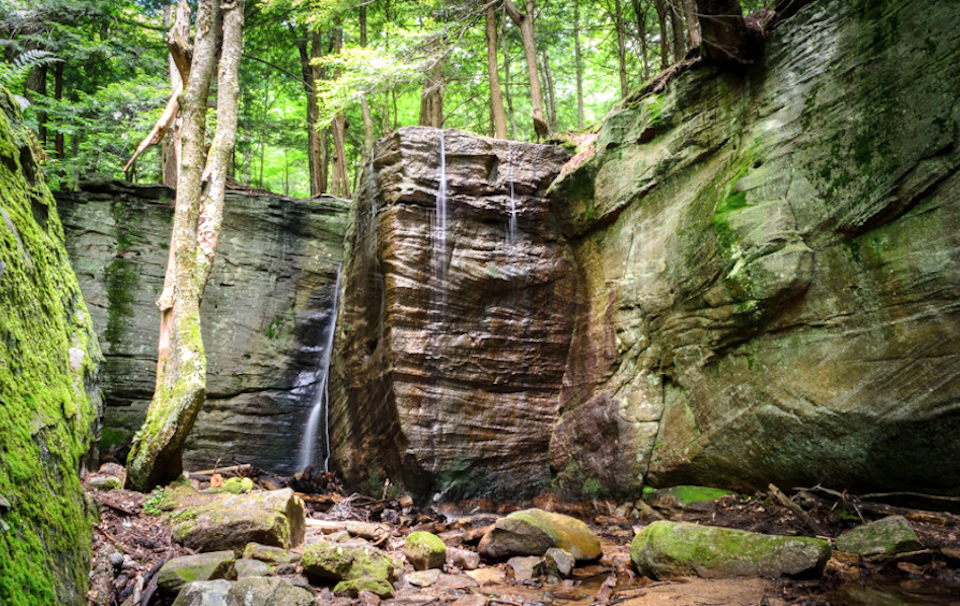
Landscape within the proposed Allegheny National Park/alleghenynationalpark.com
Then there's the Allegheny National Park proposal, which calls for a rural swath of northwestern Pennsylvania and southwestern New York state to be added to the National Park System. Part of the park could come from the Allegheny National Forest, its proponets say.
The Ancient Forest National Park proposal calls for combining parts of Northern California and southern Oregon to "biologically join together wilderness areas, roadless areas, a national recreation area, and wild and scenic rivers into one cohesive land management unit..."
There are other areas, argues Kellett, landscapes of existing federal lands, such as national forests or Bureau of Land Management acreage, that could be added to existing national parks, as well as other federal properties that could be protected as stand-alone units in the park system.
"This is the thing," he tells me. "We’ve got a global emergency in terms of climate change, we’ve got a global emergency in terms of species extinction, and I would argue that we have at least a national emergency in terms of open green space for our population in cities. So why do we think it’s a radical idea to address these problems directly by protecting lands that would help?"
He then proceeds to tick off other locations, places such as the Cascade Range in Oregon and Washington where "there was a recent study done that found that if you protected, at the very least, the most carbon dense forests in the Cascades and the coastal ranges it would have a huge impact on sequestering carbon, yet we continue to log these forests."
"We could expand North Casades National Park, we could create a Mount St. Helen’s National Park that takes in a good chunk of the Gifford Pinchot National Forest, we could create a Mount Hood National Park that takes in the whole national forest," Kellett continues. "And then there was Volcanic Cascades National Park, was proposed by John Muir, basically, originally, and could go from Mount Hood down to Crater Lake or near Crater Lake or the Three Sisters and then expand Crater Lake National Park."
Look to the East Coast and Kellett says Katahdin Woods and Waters could be expanded, that Cape Cod National Seashore could be increased in size and grown to encompass Stellwagen Bank National Marine Sanctuary, and that both the White Mountain National Forest and Green Mountains National Forest could be transformed into national parks.

The Dolly Sods Wilderness Area in West Virginia has been envisioned as part of the proposed High Allegheny National Park/www.forestwander.com
"Then in the center of the country, of course, they’ve been hugely cheated out of national parks," says Kellett. "I’m from Michigan originally, we could create a Three Great Lakes National Park that borders on Lake Huron, Lake Superior, and Lake Michigan. You could create a North Woods National Park that takes in forests in the western Upper Peninsula in northern Wisconsin. ... We could address some of the threats to public lands directly by turning lands that are now open to logging, mining, fracking, whatever, into national parks. That automatically gets rid of that threat. If it’s a national park it’s not going to happen."
Gaining momentum, Kellett points to the Boundary Waters Canoe Area Wilderness, a U.S. Forest Service property, that he believes should be combined with Voyageurs National Park so as to block hard-rock mining and logging; looks to the Southwest, where a Sonoran National Park could encompass existing Organ Pipe Cactus National Monument with neighboring Cabeza Prieta National Wildlife Refuge, and; talks about a multi-unit park protecting the Lower Rio Grande Valley in Texs, where there's another national wildlife refuge.
The trick, of course, is getting the political support for such additions to the park system.
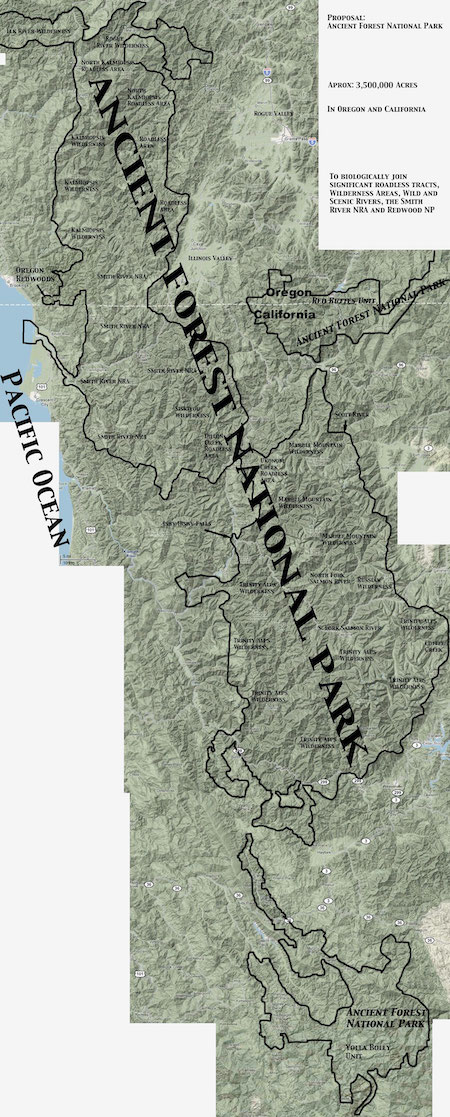
Map of proposed Ancient Forest National Park/ancientforestnationalpark.org
“The only way to expand the National Park System is to get broad public support. And that’s why we think that an omnibus federal bill that lumps a bunch of national parks in one big bill is the way to go, because then you start bringing constituencies from all over the country," Kellett says. "It would be like the Alaska lands act was. It was so big that there was support from every state in the country for that bill. Otherwise, you end up fighting individual state political establishments.
“Education is key, and then getting people to realize we can do something. Because the opponents of protecting land want us all to think there’s nothing we can do, it’s too late, we’re totally overwhelmed, we can’t not drill, and log and graze because our country will collapse," he adds. "That’s what they thrive on, is getting people to think it’s hopeless that there’s nothing that can be done.”
While the National Park Service currently is hamstrung by a maintenance backlog of roughly $12 billion and an annual budget that has been relatively flat in recent memory, Kellett doesn't believe that should be an impediment to protecting more land for the good of the country.
"The amount of money we’re talking about is a tiny sliver of the total federal budget. When it comes down to it, the Congress and the president will do what the public demands they do if there’s enough public support," he maintains. "Here we had this giant tax cut for rich people and corporations; the entire budget for the National Park Service wouldn’t even appear as a dot in the size of that bill. It’s not that we don’t have the money, it’s the politics have not been right.
“I don’t pooh-pooh the reality of that problem, but that’s not an insolvable problem. What we need to do is prioritize protecting these places and these ecosytems and these landscapes, because once theyr’e gone they’re gone. Short-term budgetary problems should not hold us back from giving these areas this protection."
Traveler footnote: Listen to my full interview with Michael Kellett in National Parks Traveler Episode 47.
Stories about:
Story Categories:
A copy of National Parks Traveler's financial statements may be obtained by sending a stamped, self-addressed envelope to: National Parks Traveler, P.O. Box 980452, Park City, Utah 84098. National Parks Traveler was formed in the state of Utah for the purpose of informing and educating about national parks and protected areas.
Residents of the following states may obtain a copy of our financial and additional information as stated below:
- Florida: A COPY OF THE OFFICIAL REGISTRATION AND FINANCIAL INFORMATION FOR NATIONAL PARKS TRAVELER, (REGISTRATION NO. CH 51659), MAY BE OBTAINED FROM THE DIVISION OF CONSUMER SERVICES BY CALLING 800-435-7352 OR VISITING THEIR WEBSITE. REGISTRATION DOES NOT IMPLY ENDORSEMENT, APPROVAL, OR RECOMMENDATION BY THE STATE.
- Georgia: A full and fair description of the programs and financial statement summary of National Parks Traveler is available upon request at the office and phone number indicated above.
- Maryland: Documents and information submitted under the Maryland Solicitations Act are also available, for the cost of postage and copies, from the Secretary of State, State House, Annapolis, MD 21401 (410-974-5534).
- North Carolina: Financial information about this organization and a copy of its license are available from the State Solicitation Licensing Branch at 888-830-4989 or 919-807-2214. The license is not an endorsement by the State.
- Pennsylvania: The official registration and financial information of National Parks Traveler may be obtained from the Pennsylvania Department of State by calling 800-732-0999. Registration does not imply endorsement.
- Virginia: Financial statements are available from the Virginia Department of Agriculture and Consumer Services, 102 Governor Street, Richmond, Virginia 23219.
- Washington: National Parks Traveler is registered with Washington State’s Charities Program as required by law and additional information is available by calling 800-332-4483 or visiting www.sos.wa.gov/charities, or on file at Charities Division, Office of the Secretary of State, State of Washington, Olympia, WA 98504.


Comments
I'm a conservationalist and I like this idea with a few caveats.
1. First and foremost Americans must not be locked out of their Public Lands. If Yellowstone or Yosemite or other parks expand into adjacent National Forest and Wilderness Areas then these parks must be Yellostone National Park and Preserve. Hunters, anglers, ATV's, others must not be locked out.
2. Merge US Forest Service into Interior Department with areas appropriate for logging. Hence protect rest of American old growth stands and selective harvest second growth, etc.
3. Remove more dams where appropriate.
So, Joshua Israel, I feel compelled to shed some light on exactly where the part about you being "a conservationalist" comes in? The term "conservationalist" as opposed to "conservationist" is actually most commonly used as extremist rightwing code denoting the twisted far right "poseurs" whose agenda is to insert themselves into and infiltrate genuine conservation discussions in order to spread confusion. I have no way of knowing whether you meant to use the term in this way; but, that's how it is generally used. The particular end of the far right spectrum that coined the term "conservationalist" also tends toward rabid anti-semitism; so, your use of the name "Joshua Israel" would also fit their kind of thing.
As far as your proposal goes, what you're proposing actually looks as much like a camouflaged effort to expand the exploitation of protected lands as it does a genuine proposal to expand their protection. I don't know; but, your proposal really does sound like a "Trojan Horse" kind of deal that wouldn't further true conservation at all. All of that fits the mode of operation of a twisted far right extremist, a few grains of seductive truth mixed into a bigger overall lie, just the way Mein Kampf or the John Birch Society teaches.
Given the tremendous level of political intrigue and corruption that the GOP has been nurturing for decades, there are now so many twisted "poseurs" desparately trying to insert themselves into and infiltrate genuine conservation discussions that I'm afraid I take everything anyone says nowadays with an extra large grain of salt. Perhaps the NPT team should do the same, try to heighten their awareness, and try to recognize and block these folks (no pun intended) as they crop up.
Someone please buy rump some tin foil.
So, ecbuck, do you know this Joshua Israel fellow; how well do you know him; and did I misread or misjudge him? Do you think I misunderstood his proposal? Do you have any further information or insight into his proposal, beliefs, or associations that might help to better explain him, his proposal, his thinking, or his affiliations?
No, I don't know him. But you took what I believe was an inadvertent addition of "al" to convervationist and turned him into an alt-right, swatiska wearing anti-semite purvaying GOP corruption. Could you please tell us who (specifically) has used "conservationalist" as "extremist rightwing code denoting the twisted far right poseurs"? I did a google search on the term and didn't get a single hit. {edit} The google search defaults to "conservationist" Forcing it back to conservationalist, you get one Urban Dictionary definition that makes no sense and a story about Teddy Roosevelt.
First and foremost, I use my full name. I have nothing to hide. Second, I serve in the United States Army, again nothing to hide. Third, I grew up out west in Central Oregon and I have seen the goods and bads of the logging and mining industries. Yes, as a conservationist, I have always believed in proper conservation with proper development. My family has donated to many conservation causes to include the inclusion of Antelope Flats into Grand Teton National Park, and other land preservation causes. I have been in the dirt planting sitka spruce, Douglas Fir, etc to help with increased Salmon runs in the decades to come. Most importanrly, I'm an American as you all are. Our public lands are a gift to us all. I want the parks expanded but traditional uses kept as well. I want more derelict dams torn down across this country while preserving hydro producing dams, flood control, recreation, etc. Do I believe in Climate Change, not really. Our sun has a lot to do with the warming of the planet. Contact me 'Rumpelstilskin' or anyone else. Well have a great conversation on the future of our parks. Im currently based near Grafenwoer, Germany.
Be well and Happy New Years
Joshua Israel
910-709-2109
[email protected]
Hello Joshua,
I came across this article while researching for a paper I must do on climate change. I first and foremost want to thank you for your service in the United States Army. I commend you for speaking the truth and defending what you believe in. My feelings on climate change are exactly what you mentioned in you comment. I actually had an argument with someone who said the sun doesn't contribute at all to warming the earth. I was so baffled by this I had to educate him on how ignorant he was. It doesn't made if we're on the uneducated left side or the know it all right side. In my opinion it's just simple common sense that the sun warms the earth and climate change is not caused by humans it happens with or without us. I agree with what you wrote and I had to reply. We can only do so much. We can adapt and learn but I'm a strong believer that we cannot change the climate. We can only change how we deal with it.
Perhaps this is he: https://www.researchgate.net/profile/Joshua_Israel
Not everyone feels obligated to hid behind a fictional alias.
Ecbuck, great work, but unfortunately that's not me. I keep a very low social media profile, hence I don't use social media. I comment on NPT because all of us here have a common theme in loving our public lands. Rumple included. I currently serve in the United States Army. I grew up in Central Oregon and I do understand the goods and bads of the extraction industry of timber and mining. I remember the issues with the spotted owl and very interesting people chaining themselves to redwood trees, spiking redwoods, and the like. Kurt Rephanshak is correct we need more parks, but not at the expense of other traditional uses. Final thought, Rump, I forgive you. I'm an actual person, I don't hide behind pseudonym names.
Be blessed this New Years
Well, I apologize for misreading you, Mr. Israel. Too much news of recent "alt-right" activities have left me unsettled to the point of leaving the lights on in unoccupied rooms. The last time I heard the very unusual and arcane "conservationalist" label used was in Oregon ironically and it wasn't pleasant. When I saw you use it and read the counterintuitive mix of comments in your post, I made an overreaching assumption. Again, i apologize and I'm now drinking lots of liquids to clear the extra grains of salt out of my system.
Last question for 'Rumple." What hurts the most in your above comment is the implied nature that NPT should censor the people on here. Do you care about one another's 1st Amendment Rights? I care. I have read many comments on NPT through the years and the majority of comments show dignity and respect. I consider NPT as one of the last best hopes to inform the American people of their natural heritage birthright. Last month Kurt wrote a great articket on the MSM not reporting on park issues. I consider the majority of us on NPT to be informed on our love and admiration of our parks and wild areas. I would hope in the future as you post you remember this interaction between you and I. Both of us have much to learn. You know how to reach out to me. May you be blessed this New Years.
Mr. Israel, I sent an apology a couple of hours ago; but, it doesn't seem to have been posted. I do apologize for my overreaching assumption. Your unusual use of the "conservationalist" label, which ironically I first encountered in Oregon a while back, combined with a somewhat counterintuitive mix of comments in your post led my to misread you and, again, I apologize.
Rumpel all is well. I appreciate your apology, I really do. The auto spell check doesn't help on i-phones either. Ok, this is my last post on this article written by Kurt. Hopefully, in future articles we can all remember the great comments on here. Hopefully, all of us have added credibility as well in the future posts we share. I think it's well established we all love and appreciate our Public Lands.
1. As mentioned before, our parks need to expand. Yet, we can't cut out traditional uses. Teddy Roosevelt did a lot for conservation. The northern Yellowstone Arch near Mammoth says, "For the benefit and Enjoyment of the People." This must be maintained in future Park expansions. in my spare time I love to bow hunt (ironically Army takes up to much time to bow hunt effectively), and as a bow hunter, I don't want to be shut out of our wild areas. That's why in my first post, I mentioned a National Park and Preserve Model (kinda like the Alaskan model for parks).
2. Rumple is correct in his first post, Republicans have gone very far away from the Teddy Roosevelt conservation model. Utah has gone way of kilter in their lack of advocacy for public lands. I wish Bears Ears and Grand Escalante we're kept more intact, but they weren't. Wyoming still deals with its checkerboard lands from the railroad land grants of the late 1800s (what a mess). Americans support land conservation, I wish the Republican Party could see this as well.
3. We need more habitat connectivity from appropriate dam removals that links riparian buffers and cools stream temperatures. We need more wildlife bridges across our roads to effectively bridge habitats for our ungulate and carnivore populations. The west is building more wildlife bridges, but we need more. Thus, we start to solve our habitat linkage issues and genetic viability issues. Klamath Dam Removal will be interesting over the next few years. I hope salmon return.
4. Our Government is not going to pay for all land or habitat conservation. That's why within our own personal means we may have to open our own pocket books to donate for land preservation. Why or why doesn't our Government fully fund the Land and Water Conservation Fund?????
5. Logging, mining, etc will continue to play a role in our economy. Clearly, the mining law of 1872 needs to be updated. Reclamation must occur after logging or mining an area. ATVs and bicyclists have a role to play in our public lands. Yet, ATVs, bicyclist must show good ethics and stewardship on our public lands (my father rides an ATV on the Deschutes National Forest Lands where ATVs are allowed on the designated forest service roads. He and his friends keep to the roads, they don't tear up the hillsides or go off-road). Logging, predominantly has ceased on our old growth lands (Some old growth logging may still occur. I'm concerned about increased logging on the Tongass if Old growth logging is allowed). Second grow the logging on forests, I'm ok with as long as logging is done correctly. Stop logging on steep hill sides where clear cut slopes can slide into our streams.
6. This is what I meant for my family being conservationists (proper conservation, recreation, and development). If we expand our parks (I hope we do, 10 fold), but in the process limit or cease traditional uses (as indicated above) we risk losing our public lands for good to the developers, extraction industry, etc. Yes, there's even a place for the oil and gas industry, but not in our roadless lands.
May you all be blessed this New Years
Of course national parks shoiuld be expanded if we're serious about preventing the premature extinction of the human race. The coming backlash against the KluKlux Trumpublicans might be a fortuitous time to do it too. I'm a retired national park ranger who's well aware of the weaknesses, including gross underfunding, of our current parks. Americanalps.org here in my North Cascades backyard is a good example of well organized support ready to do just that.
This is a terrible idea. More than a quarter of land in the US is public lands. The NPS mismanages their budget wildly and is understaffed in key parks, yet has a bloated bureaucracy. The NPS is very well situated with funding; but, they waste it at HQ. Employees fly across country all the time for junkets and stay in Ritz Carlton and Intercontinental hotels. Desk staff heads to Cambodia and London for training. Check it out. Most of the new parks and designations are 'rewards' for Congressmen and lawmakers. Everyone wants a national park in their backyard, yet no one wants to upkeep and manage it. They should fix the deferred maintenance problem first and upgrade existing parks first.
Yesterday, January 10, 2020, The Guardian ran a short opinion piece entitled "The great dismantling of America's national parks is under way" by Jon Jarvis and his brother (https://www.theguardian.com/environment/2020/jan/10/us-national-parks-di...). It's a bluntly direct editorial on this very topic, worth reading and even quoting.
And yet it didn't identify any actual "dismantling". As I commented earlier, raising more money for the parks, eliminating expensive and ineffective climate change regs and cleaning out the deadwood at the top are all positives for the parks not dismantling them.
America's national parks are “America’s Best Idea” and it is the idea, even more than the individual parks themselves, that is the institutional core that serves as the foundation of our parks. Often the best way to undermine an idea is to harass, intimidate, stifle, and retaliate against individuals who defend that idea and, according to the editorial in The Guardian (https://www.theguardian.com/environment/2020/jan/10/us-national-parks-di...), former NPS Director Jon Jarvis believes that undermining the institution by attacking individuals who defend the idea behind it is just what this administration and the party that backs it have been doing.
As their editorial in The Guardian indicates, former NPS Director Jon Jarvis and his brother lament that this administration and the party that backs it have "moved seasoned senior national park superintendents around to force their retirements" in order to replace them with "unqualified political hacks" who will kowtow to "anti-public land sycophants" and willingly do the bidding of a "Department of the Interior dominated by extractive industries and anti-public land crusaders." Former NPS Director Jon Jarvis believes this chronic infliction of banal villainy constitutes "a systematic dismantling of a beloved institution, like pulling blocks from a Jenga tower, until it collapses."
Those don't sound like "positives for the parks" at all and one might expect former NPS Director Jon Jarvis to know something about what's good for the parks. In fact, what former NPS Director Jon Jarvis is describing sounds like an actual "dismantling" to me, but then I'm not one of those all too common "anti-public land sycophants" that we have strutting around and blithering nonsense nowadays.
The Guardian was an opinion - with no details to back it. Jarvis has his opinions as well. Yet where are the facts? What has been "dismantled"? Given the parks are being visited in record numbers, it is hard to conclude the general public believes the parks are in a state of deterioration. Is Robert G one of those "anti-public land sycophants''?
I remember the issues with the spotted owl and very interesting people chaining themselves to redwood trees, spiking redwoods, and the like. Kurt Rephanshak is correct we need more parks, but not at the expense of other traditional uses.