
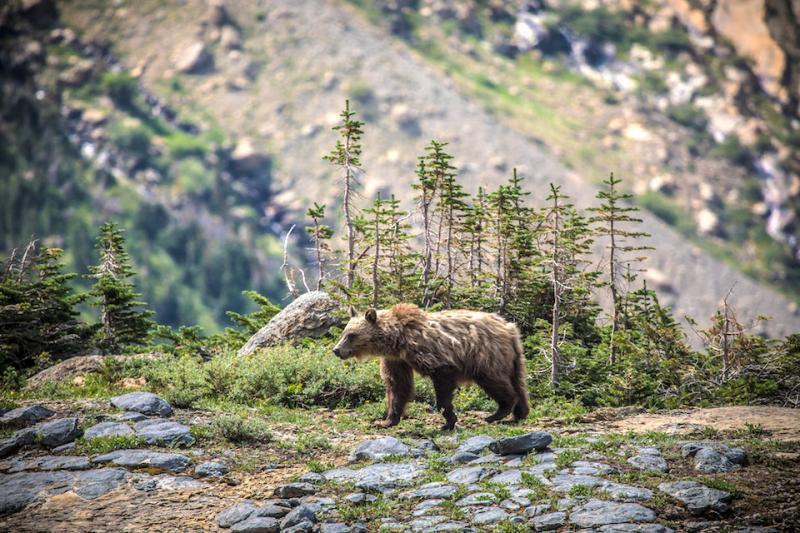
A lawsuit will be filed against BNSF Railway in connection with the deaths of grizzly bears killed by trains or "rail activities"/NPS file
BNSF Railway Company is the target of a forthcoming lawsuit accusing the railroad of negligently killing grizzly bears, which are protected under the Endangered Species Act, near Glacier National Park in Montana.
Wildlife Guardians, supported by Western Environmental Law Center, late in October notified BNSF of its intent to sue over the bear deaths. The notice came shortly after two bear cubs were killed by a train near Whitefish. Back in June three bears -- a sow and her two cubs -- were hit and killed by a train near Marias Pass just south of Glacier National Park.
According to Wildlife Guardians,five grizzlies were killed by "railway activities" near East Glacier in October. A train struck and killed a cow, which then attracted five bears to the tracks. In five separate incidents, two died in train collisions and three were killed by cars on Highway 2, the group said in a release.
“While Burlington Northern has twiddled its thumbs for 15 years rather than taking essential measures to protect grizzly bears, trains have killed dozens of grizzlies, including at least four cubs,” said Sarah McMillan, conservation director at WildEarth Guardians. “This neglect, that has such lethal impact on protected bears, is simply unacceptable.”
The advocacy group said that, according to best available data, from 1980-2018 trains killed or contributed to the deaths of approximately 52 grizzly bears from the Northern Continental Divide Ecosystem.
Approximately 1.2-1.5 BNSF trains run per hour on these railways in Montana, averaging 35 miles per hour. There is a slight increase in train frequency at twilight, when grizzly bears often feed, the group said.
“The 67-mile stretch of railway between West Glacier and Browning is where trains reportedly killed 29 grizzlies between 1980 and 2002,” said Pete Frost, attorney at the Western Environmental Law Center. “Slowing the trains down, ensuring carrion are promptly cleared from tracks, and perhaps scheduling trains to run during the day and not at feeding time might reduce trains killing grizzlies.”
“The deaths of these grizzly bears and cubs was entirely preventable and there is no excuse for Burlington Northern’s continued failure to safeguard the railroad from these lethal collisions,” said Josh Osher, Montana Director for Western Watersheds Project. “Whether it’s a lack of concern, laziness or just plain greed, it’s time for BNSF to be held accountable and to take immediate steps to stop further killings.”
When a company’s activities kill threatened species like the grizzly bear, it is legally required to propose solutions in a habitat conservation plan that then can lead to an incidental take permit, the groups said.
BNSF officials told The Associated Press that crews work to remove carrion and spilled grain, which attracts bears, from the tracks.
Stories about:
Story Categories:
A copy of National Parks Traveler's financial statements may be obtained by sending a stamped, self-addressed envelope to: National Parks Traveler, P.O. Box 980452, Park City, Utah 84098. National Parks Traveler was formed in the state of Utah for the purpose of informing and educating about national parks and protected areas.
Residents of the following states may obtain a copy of our financial and additional information as stated below:
- Florida: A COPY OF THE OFFICIAL REGISTRATION AND FINANCIAL INFORMATION FOR NATIONAL PARKS TRAVELER, (REGISTRATION NO. CH 51659), MAY BE OBTAINED FROM THE DIVISION OF CONSUMER SERVICES BY CALLING 800-435-7352 OR VISITING THEIR WEBSITE. REGISTRATION DOES NOT IMPLY ENDORSEMENT, APPROVAL, OR RECOMMENDATION BY THE STATE.
- Georgia: A full and fair description of the programs and financial statement summary of National Parks Traveler is available upon request at the office and phone number indicated above.
- Maryland: Documents and information submitted under the Maryland Solicitations Act are also available, for the cost of postage and copies, from the Secretary of State, State House, Annapolis, MD 21401 (410-974-5534).
- North Carolina: Financial information about this organization and a copy of its license are available from the State Solicitation Licensing Branch at 888-830-4989 or 919-807-2214. The license is not an endorsement by the State.
- Pennsylvania: The official registration and financial information of National Parks Traveler may be obtained from the Pennsylvania Department of State by calling 800-732-0999. Registration does not imply endorsement.
- Virginia: Financial statements are available from the Virginia Department of Agriculture and Consumer Services, 102 Governor Street, Richmond, Virginia 23219.
- Washington: National Parks Traveler is registered with Washington State’s Charities Program as required by law and additional information is available by calling 800-332-4483 or visiting www.sos.wa.gov/charities, or on file at Charities Division, Office of the Secretary of State, State of Washington, Olympia, WA 98504.


National parks and their natural resources belong to you. The National Parks Traveler works to ensure you know how these essential places are being cared for.
Sign Up For Our Weekly Newsletter
Unsubscribe at any time.
INN Member

The easiest way to explore RV-friendly National Park campgrounds.

Here’s the definitive guide to National Park System campgrounds where RVers can park their rigs.
Our app is packed with RVing- specific details on more than 250 campgrounds in more than 70 national parks.
You’ll also find stories about RVing in the parks, tips helpful if you’ve just recently become an RVer, and useful planning suggestions.


Comments
Less than two bears a year out of a population of 40,000+. Really?
What is the source for your 40,000+ population number? I'm sure you're more of a "lumper" than a "splitter" when it comes to taxonomy; but, that number is far higher than any credible number I've ever heard for that DPS.
You are right rump, my number was off. Low by about 50%
1,200+ US, 25,000 Canada, 40,000 Alaska
https://alaskatrekker.com/alaska-wildlife/alaska-bear/
https://www.tourguidecanada.com/grizzlies-in-canada.html
http://igbconline.org/conserving-grizzly-populations-2/
So, 1,200+ is the closest thing to a credible number relevant to the topic of the article. The other two numbers are not even remotely peer reviewed, come from highly questionable sources that are very likely tainted by conflict of interest, and are purported to describe populations that are only marginally linked to the DPS addressed in the article.
When a guy who makes his living boosting bear hunting trips to Alaska tells me there's 40,000 grizzlies to hunt up there or when some Canadian tour guide tells me to come up to see the 25,000 grizzlies his associates can show me, I'm not going to just take their word on what might be horrendously or even dishonestly exaggerated numbers. But, far more important, wildlife populations are not all the same, even within what taxonomic "lumpers" might like consider the same species. Yes, Glacier is more connected to the more northerly populations than Yellowstone; however, even that genetic exchange rate is very low due to distance, terrain, and human interference. And, that's not all bad. Populations that get genetically isolated, by distance or terrain or climate, can be the trailbreakers of evolution. As long as their gene pool stays large enough to counteract inbreeding problems, isolated populations can be the ones to evolve adaptations to changing conditions, like climate change.
Unfortunately, a nominal gene pool of 1,200+ is far too small and, in the case of the Glacier DPS, there is really not enough genetic exchange with other populations to reliably avoid inbreeding, which means that anything causing the needless loss of even a few bears out of this small population needs to be looked at closely to see how the losses could be avoided. I have BNSF in my portfolio and want to see it do well; however, the Western Environmental Law Center thinks “Slowing the trains down, ensuring carrion are promptly cleared from tracks, and perhaps scheduling trains to run during the day and not at feeding time might reduce trains killing grizzlies.” And, I support exploring these ideas, especially since, if we are successful in expanding the Glacier population as a means to prevent inbreeding, the kill rate on the tracks will likely increase unless we start working on solutions now.
So, why did I take the time to make a big deal over bear population numbers? Because, as I have said before and will obviously need to continue saying, there are a lot of young or otherwise poorly educated folks out there who get exposed to your nonsense and actually start believing it. In that sense, you are much more than just a useless crackpot; you genuinely constitute a conservation menace.
Ha. Schedule trains during the day? People do not understand railroads XD.
So Rump, provide us sources other than your need to speculate to not look foolish that the Alaskan and Canadian numbers cited are wrong. This one says 25-29k in Canada. It is biased? https://www.thecanadianencyclopedia.ca/en/article/grizzly-bear
Is the Alaska Department of Wildlife lying? http://www.adfg.alaska.gov/index.cfm?adfg=brownbearhunting.main
Well, you sure dialed the wrong number on that one. Yes, I actually do understand railroads, far more thoroughly than you might imagine; I probably understand them and their operations at both a much higher, as well as more detailed, level than most railroad veterans; and railroads most certainly can be scheduled to run during the day or, at the very least, to reduce the traffic traversing the stretch near Glacier during the twilight hours. Will it be inconvenient and perhaps a bit less profitable to do so? Absolutely yes; but, as I have already pointed out, I have BNSF in my portfolio and I, for one, would accept the hit.
So, again, I have to point out that perhaps the most lamentable aspect of the "truth by emphatic assertion" that spews from so many of the poseurs we have today is that there are a lot of young or otherwise poorly educated folks out there who read or listen to what is really nonsense and start believing it. In that sense, these characters are much more than just harmless crackpots; they genuinely damage and pervert rational discussions that truly do need to take place.
Bucky, the Alaska Department of Fish and Game website you offered cites an estimated 30,000 brown bears in Alaska, rather than the 40,000+ number you quoted earlier. That 30,000 number does seem to be recent and therefore credible, but only if you "lump" all brown bears in Alaska into a single gene pool and, for the purposes of this discussion, assert that the Glacier bears fall into that same gene pool. Most conservation biologists would balk at that much "lumping" of taxonomy.
I don't want to throw too many rocks at the Canadian Encyclopedia. It's a good general source; I like it; and it does offer numbers close to yours, but, those numbers are a bit dated. The most recent credible original sources for those kinds of numbers all seem to be close to twenty years old and there have been some declines in the bear populations up there since then.
The issue remains what you "lump" together in the same taxonomic bin. To assert that the brown bears in Alaska and Canada should somehow be counted in the same DPS or gene pool with Glacier grizzlies would mean that you consider the Kodiak bear (Ursus arctos middendorffi), characterized by 1,400 pound relatively docile boars, to be the same as grizzlies in Glacier and Yellowstone (Ursus arctos horribilis), known for 700 pound boars that have much, much "hotter" dispositions. Again, aside from the usual "nurture or nature" arguments, most conservation biologists would balk at that assertion.
Do you not "get" this concept?
None of this discussion about how many grizzly bears live in Alaska and Canada matters at all. Only one subspecies - Ursus arctos horribilis - is listed as a federally endangered species. Moreover, only Ursus arctos horribilis living in the lower 48 states are listed as a federally endangered species. Grizzly populations living in Canada and Alaska (and there are additional subspecies besides Ursus arctos horribilis that live in Alaska) are not listed. So yes, it is only the 1200 or so grizzly bears that live in Montana, Wyoming, and Idaho that count. 50 CFR § 17.11
Rump - does the train care about "lumping". My claim was that there are better than 40,000 grizzlies total - not just in Alaska, the links I provided add up to far exceeding that number. You are the only one making empahatic assertions that are unsubstantiated by the facts. 1.3 grizzles per year is hardly anything to get upset about.
Bucky, in jargon of taxonomy, "lumping" and "splitting" refer to whether you tend to "lump" diverse strains/subspecies of a species together and treat them all as a single gene pool or population or try to maintain that diversity by "splitting" consideration of them into separate concerns. The concept doesn't involve the trains; but, it is key to this discussion. I thought you understood the concept at least well enough to have an informed discussion. I apologize for misreading your knowledge of the topic. It would also be helpful if you could please try to carefully read what Anonymous posted at 4:30pm and then at 4:46pm above. He is correctly pointing out that the Glacier and Yellowstone grizzlies (Ursus arctos horribilis) are a separate subspecies from many of the brown bears in Alaska and Canada and that only this subspecies and only in the lower 48 states is covered under the ESA and only due to its reduced range and diminished gene pool size. Please try, try, try to understand that not all brown bears are the same, despite how similar they might look to you from a distance or in a photograph. The article and this discussion on Glacier bears and the BNSF impacts on them only involves the Distinct Population Segment of the subspecies Ursus arctos horribilis that is in the Glacier area. Again, please try, try, try to understand what is being discussed.
Rumple. For all the comments in lumping. I assume you are familiar with the controversy over "splitting" as well? How often populations split into sub groups even though the species are genetically equal and stable. When you split a species into all of these tiny sub populations certainly the loss of one animal looks substantial. However if that group is part of a much larger and genetically equal population its just fun with numbers and has no actual impact on the broader genetic diversity. By every legitimate study i have seen a few hundred bears yet alone seven hundred bears is more than enough to maintain a viable population and genetic diversity. Sadly these lawsuits rarely have a thing to do with the actual bears. But a nice chunk of change covering inflated legal fees and punitive damages going to the coffers will be appreciated. If you actually look into it you will find that BNSF has implemented programs already to help address this issue but they will still be sued for some fully unreasonable solution only to be settled for a pile of cash because that is all the WELC wants anyway. Plenty of species that are under much greater pressure than the grizzley, but they do not have the broad fundraising appeal that charismatic megafauna like the grizzly do so nobody cares.
The northern continental divide ecosystem, of which glacier national park is a part, only has ~700 grizzlies. Killing one is a federal felony in the lower 48 by the measure of the endangered species act. The CEO of BNSF should be arrested without bond, until a functional cure for mortalities on the railroad right-of-way are implemented.
Please avoid personal attacks - Moderator
Silvertip - your number is the NCD alone and exludes the Greater Yellowstone population of about 600 bears. Further, these populations are growing 3-7% per year (30-70 bears) despite the infrequent kills by BNR.
https://ecos.fws.gov/docs/five_year_review/doc3847.pdf (page 24)
What exactly do you propose that would eliminate these mortalities on the right of way?
Glad - what was my mistake? And what do YOU propose BNR do?
EC - my mistake is that I did not enter my name to my comments/answers to your question and thus it shows as anonymus. Mine is the firsr response immediately following your question - with links to the FWS report and the article by Ecowatch
EC - your simple mistake was to state that the bears killed by the train(s) came from a population of 40,000. Rather than to correct it and state that you were trying to provide a global count of grizzlies you just dredge up crap numbers from outfitters in Alaska and Canada - and those populations have zero to do with the population of bears in the Northern Rockies. As for what the railroads could do about it, there are no simple answers but several different approaches have shown some merit - whether they are economically viable or whether the "cure" would be worse than the disease has yet to be determined.
https://www.fws.gov/mountain-prairie/es/species/mammals/grizzly/2018GB_A...
https://www.ecowatch.com/wildlife-train-collisions-2634014954.html?rebel...
I share silvertip's irritation, but don't believe arresting the BNSF CEO would be productive ...probably backfire. However, the Western Environmental Law Center thinks "Slowing the trains down, ensuring carrion are promptly cleared from tracks, and perhaps scheduling trains to run during the day and not at feeding time might reduce trains killing grizzlies." And, again, I know that all of these actions are possible, at least to some extent. Doing so will it be inconvenient and perhaps a bit less profitable, which is why BNSF management, beholden to their shareholders as they are, won't want to be seen as voluntarily agreeing or even giving in too easily. But, this lawsuit, filed by Wildlife Guardians, might give those jerks the cover they need to do the right thing. I support the lawsuit and hope it results in the creation of a very tight and specific corrective action plan, with tight enforcement mechanisms, and some funding for additional fencing or other infrastructure to keep both livestock and wildlife off the tracks along especially sensitive areas of this seventy or so mile stretch. All I can add at this point is that it isn't just carrion that needs to be promptly cleared from the tracks. Some of the worst problems have been caused be grain spills. When spilled grain or other "fermentable" cargo has been left out in the wet weather, there have been not only a few bears, but gangs of drunken bears, on the tracks and that was worse.
This article made no distinction regarding species, the court decision re relisting in Yellowstone made no mention. This extensive teatise (329 pages) discussing the Northern Continental Divide Ecosystems (which dives deep into Canada) makes no distinction. http://igbconline.org/wp-content/uploads/2018/06/180615_NCDE_Conservatio... Do a google search on grizzly bears and you will be hard pressed to find a mention of subspecies in any of the top results. The fact is most people can't and don't make the distinction and propably don't care.
But, I will humor you. Lets use the count of 1200 and see if that refutes my point. (spoiler alert - it doesn't) About 50 of these are killed each year by various means which puts trains at about 2 percent of these mortalities. Meanwhile the population is growing by 30-50 bears each year ( https://ecos.fws.gov/docs/five_year_review/doc3847.pdf%C2%A0) despite these mortalities. Trains killing 1.3 bears per year in a population of 1200 bears and growing is insignificant either to the population of bears or the survival of the grizzly.
Yet you want to impose $10s of millions of additional expenses or expanded overhead on the RR which will have far more negative impact on the employees and consumers than it will on the shareholders.
Just how out of touch can people be?
Strange that they aren't suing to ban motor vehicles which seems to be a far bigger problem. https://www.kpax.com/news/montana-outdoors/2019/05/01/mdt-wildlife-offic...
Or, could it be that like many not for profits that even when there aren't real problems, they feel the need to manufacture one so the money keep rolling in?
After all, what would all those people do for work if they actually managed to solve a problem for once.
While I am not one to dispute any of the numbers of grizzley bear populations in the lower 48, Canada, or Alaska I will say I think you might be missing the point. I am all for the welfare of grizzley bears and the death of any of these magnificant creatures is a shame. I also understand that the BNSF can undoubtedly do more to help in avoiding train bear collisions. Lawsuits against the railroad, seem to set a bad precident. What's next? The next time I am in Glacier and I unavoidably hit a bear. Will I also be sued? This would help in cutting down the number of visitors to the park!