

Editor's note: In a summer-long series, National Parks Traveler's writers and editors are going beyond the numbers to describe the National Park System's $11.6 billion maintenance backlog. This article looks at the increasing role some national park friends groups are shouldering to address deferred maintenance, a role that changes the long-held view that they provided a "margin of excellence" for parks.
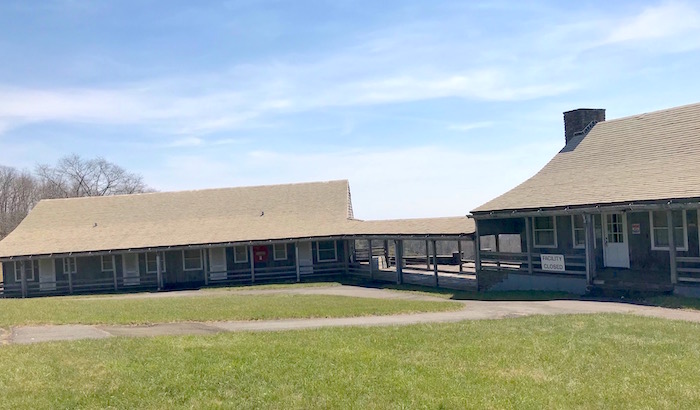
For eight years, families whose memories of the Blue Ridge Parkway were nurtured around summer evenings chasing fireflies on the rolling highland meadows below Bluffs Lodge at Milepost 241 have wondered when it might reopen. Perhaps a question to ask of the charming, 24-room lodge at Milepost 241 is whether it ever will reopen or instead be razed, a victim of demolition by neglect.
When the Bluffs Lodge opened in 1949, its low-slung, gray weathered buildings that were part of one of the first developed lodges along the Parkway. It closed in 2010 after the concessionaire's contract expired and they walked away. Stop there today and you'll find that weeds haven't infiltrated the flagstone patios, the lawns are nicely cropped, and the panoramic views range as they always have across the rolling North Caroline countryside within the Parkway.
But inside the lodge there's an infestation of dangerous mold, so dangerous that no one is allowed inside. To reopen the lodge, just a short walk from the Wildcat Rocks Overlook, might take more than $3 million to remove the mold and rebuild the interior.
Across the country in Yosemite National Park, meanwhile, the Mariposa Grove of Sequoias is scheduled to reopen this June after a three-year, $40 million revitalization designed to restore the health of the grounds that the soaring trees tower over. And, the first substantial makeover of visitor facilities and interpretive panels at Bridalveil Fall in 50 years is expected to kick off this year, with a price tag of $13.6 million.
At Grand Teton National Park in Wyoming, this summer marks the culmination of a four-year, $18 million project to rehabilitate the trails on the mountains above Jenny Lake and the front country areas that greet vistiors to this, the park's most popular area.
Each of these cases points to the backlog of maintenance and upkeep throughout the National Park System. Though it is Congress's responsibility to pay for this maintenance, it has chosen not to properly fund the National Park Service so it can properly conserve the parks for future generations while leaving them “unimpaired.”
Indeed, many millions of dollars that helped pay for this work came from philanthropic sources corralled by park friends groups. That reliance has twisted the long-held view that these nonprofit organiations provide a “margin of excellence” for the parks they support. These days, more and more park superintendents are turning to friends groups for dollars, millions of dollars in many cases, to address operational needs, such as trail and campground work and historic building restoration.
“It’s one thing to want to put the icing on the cake, it’s another thing when the cake is crumbling. Putting icing on that cake doesn’t make sense anymore,” said Carolyn Ward, chief executive officer of the Blue Ridge Parkway Foundation.
The National Park System has an estimated maintenance backlog of $11.6 billion, and you’ll find many friends groups putting their donated dollars into bone and muscle needs, not simply frosting.
- The Yosemite Conservancy raised $20 million towards the $40 million needed to restore the Mariposa Grove of Sequoias, and this year committed $12.5 million to the park, including $6.6 million against the $13.5 million cost for the Bridalveil Fall project.
- Zion Natl Park Forever helped obtain a $1 million grant to rebuild the park’s Middle Emerald Pools Trail.
- Washington’s National Park Fund supplied $32,000 back in 2014 to make repairs to the Sahale Arm Trail in North Cascades National Park, and has helped restore historic structures and outfit backcountry rangers.
- The Grand Teton National Park Foundation raised more than $14 million to help the park afford the $18 million rehabilitation of backcountry trails and front country visitor facilities at Jenny Lake.
- Friends of the Smokies worked to help raise $2.5 million to replace the obsolete radio system rangers at Great Smoky Mountains National Park have had to rely on to stay in touch across the sprawling, mountainous park.
- Friends of Acadia has endowed funds both to address trail maintenance and repairs to Acadia National Park’s carriage roads.
- The Conservancy for Cuyahoga Valley National Park has raised $5.8 million to rehabilitate the park’s Boston Mill Visitor Center and helped stabilize 7,000 feet of the Dickerson Creek bank.
Many, many examples of such largesse can be found throughout the National Park System. Unfortunately, such gifts divide the park system’s more than 400 units into the haves and have-nots: Those with strong, well-established friends groups gain millions of additional dollars for projects and maintenance, while those without such support go with much less, if not entirely without.
“Some would call that the margin of survival,” Glacier Superintendent Jeff Mow said when asked about the role of today’s park friends groups. “(Former Interior Secretary) Sally Jewel used that term, talking about friends groups, what they can do for that margin of excellence. Some of our park units, they really don’t have much more capacity than to just keep a visitor center open or do a few walks. They’re really minimally staffed.
“Quite honestly, depending on the budgets, some years they can barely make payroll, let alone pay for the lights and pay for other needs and publications and things like that,” he said. “You can go to places where I think the friends groups literally become part of that margin of survival for units.”
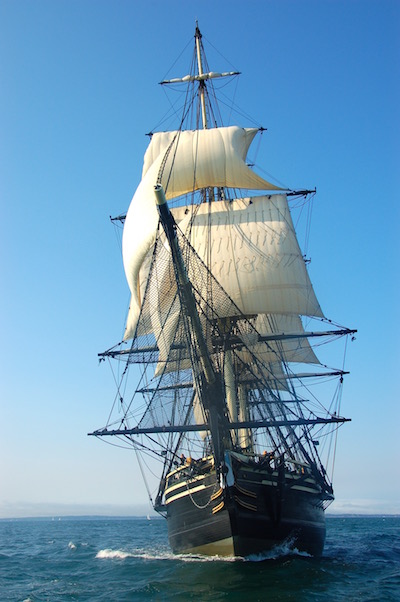
Salem Maritime National Historic Site up the Massachusetts coast from Boston encompasses just 9 acres, yet its deferred maintenance list still runs to about $6 million. The bulk of that is tied to four wharf systems, though the park also has an 1819 brick customhouse, another historic house that dates to 1675, and a replica 18th century full-rigged ship, the Friendship of Salem, to maintain.
“All of these buildings are historic structures,” said Superintendent Paul DePry. “I think you’re familiar with the additional expenses associated with a non-standard kind of a space.”
The Friendship of Salem also is pretty atypical of what you’d find in the park system, outside of San Francisco Maritime National Historical Park, and the superintendent relies heavily on volunteers to both maintain it and sail it.
Over the next five years the park staff will work with the Salem Partnership to determine what big ticket items need to be performed on the ship, as well as "some of the lower, some of the more easily supported operation needs," said the superintendent. “That’s going to help us inform what our additional deferred maintenance is going to be for the Friendship. That will also change the (park’s overall deferred maintenance) number.”
At National Park Service headquarters in Washington, D.C., spokesman Jeffrey Olson acknowledged many smaller parks are at a disadvantage, financially, in trying to address their needs because they might not collect entrance fees or have a vigorous friends group to aid them. He also acknowledged the increasingly vital role these organizations play.
“Friends groups are important partners for parks that often raise funds for park projects, including enhanced educational opportunities and facility rehabilitation or construction,” he said. “These funds can often contribute to addressing deferred maintenance. For example, the Centennial Challenge program leverages private funding to match federal funds for projects that often will address trail restoration and other facility rehabilitation projects.
“In FY 2017, the Centennial Challenge program was appropriated $20 million and matched with $32.5 million in partner contributions. Of these projects, $32 million involved deferred maintenance,” said Mr. Olson.
Back on the Blue Ridge Parkway, the Foundation has already raised nearly $830,000 to pay for mold mitigation on the Bluffs Coffee Shop and Camp Store. The Park Service currently is casting about for entities that might be interested in putting them back in business. As for the adjacent lodge, its future seems up in the air.
“Our commitment is to the rehabilitation and preservation of the lodge,” Parkway spokeswoman Leesa Brandon said. “We will obviously be focused first on the necessary cleanup of the mold, but then we will shift to the rehabilitation of the facility for future use. “
Ms. Ward said estimates to remove the mold from the lodge and rehabilitate the buildings range upwards of $3.1 million.
“My hope is that it’s not too late. But again, it’s the example of why we’ve raised almost $2.1 million, and shooting for the target of $3 million, to fix the (Moses H.) Cone Manor house, because if we don’t, that same situation will happen to that historic structure,” she said. “And so how can you, as a partner group, think about what our mission is, how can we sit back and say, ‘Oh, we’re just supposed to do added value,’ when you watch the infrastructure falling apart?”

At the Yosemite Conservancy, President and CEO Frank Dean agreed that friends groups are being asked to help fund projects they wouldn’t normally do in the past. “So far we haven’t had to make a choice where we’ve had to say, ‘Boy, we’d really like to fund this interpretive program for youth or something and instead we’re going to have to fix something over here,’” he said. “Maybe we’re just fortunate that we’re at a scale that we can do both.”
While these nonprofit organizations do their best to raise funds for park projects, they remind their congressional delegations that those dollars shouldn’t offset federal appropriations. After all, said David McDonald, CEO and president of Friends of Acadia, it does little good to spend on deferred maintenance projects if the park in the end doesn’t have the budget to maintain them.
“Our message has always been to Congress that we do aspire to add a margin of excellence. We are not interested in letting Congress off the hook, or filling a hole that they’ve created,” he said. “The public-private partnership is a really strong model, that’s what we like to talk about, that’s what they like to talk about. But we need to make sure that it stays in balance, and that the fundamental responsibility, the fundamental asset, is carried by Congress.”
At the Conservancy for Cuyahoga Valley National Park, Deb Yandala said her group’s donors ask about the risk of declining federal appropriations in the face of increasing philanthropic support.
“I think it’s a creative tension that we all live with,” said Ms. Yandala, who not only is CEO of the conservancy but also the president of the Friends Alliance, the confederation of national park friends organizations. “I think, though, that it’s up to us as a friends group community, friends group leaders, to make sure that that doesn’t happen. I think it’s a risk.
“I know with my congressional delegation, we talk about that. And when I go to D.C., or when I’m here with them locally, I make that very clear, that anything we do is not to get Congress off the hook, and that we’re unhappy with this trend of operating budget cuts and maintenance budget cuts,” she added.
At the Blue Ridge Parkway, Ms. Ward sees the role of her organization as a rallying force for the parkway.
“The National Park Service receives one-tenth of 1 percent of our federal budget, if not less. And our parks and our public lands are our nation’s history. They are our great cathedrals,” she said, adding that the public, through volunteerism, donations, and sheer commitment, needs to ensure they are not left to molder away.
At day’s end, Ms. Ward is ever hopeful,”(T)hat we will save them from the potential deterioration when they could not be saved. That in the future, that they will receive the level of support from the federal government that they deserve.”
Support for this reporting was provided by The Pew Charitable Trusts.
Stories about:
Story Categories:
A copy of National Parks Traveler's financial statements may be obtained by sending a stamped, self-addressed envelope to: National Parks Traveler, P.O. Box 980452, Park City, Utah 84098. National Parks Traveler was formed in the state of Utah for the purpose of informing and educating about national parks and protected areas.
Residents of the following states may obtain a copy of our financial and additional information as stated below:
- Florida: A COPY OF THE OFFICIAL REGISTRATION AND FINANCIAL INFORMATION FOR NATIONAL PARKS TRAVELER, (REGISTRATION NO. CH 51659), MAY BE OBTAINED FROM THE DIVISION OF CONSUMER SERVICES BY CALLING 800-435-7352 OR VISITING THEIR WEBSITE. REGISTRATION DOES NOT IMPLY ENDORSEMENT, APPROVAL, OR RECOMMENDATION BY THE STATE.
- Georgia: A full and fair description of the programs and financial statement summary of National Parks Traveler is available upon request at the office and phone number indicated above.
- Maryland: Documents and information submitted under the Maryland Solicitations Act are also available, for the cost of postage and copies, from the Secretary of State, State House, Annapolis, MD 21401 (410-974-5534).
- North Carolina: Financial information about this organization and a copy of its license are available from the State Solicitation Licensing Branch at 888-830-4989 or 919-807-2214. The license is not an endorsement by the State.
- Pennsylvania: The official registration and financial information of National Parks Traveler may be obtained from the Pennsylvania Department of State by calling 800-732-0999. Registration does not imply endorsement.
- Virginia: Financial statements are available from the Virginia Department of Agriculture and Consumer Services, 102 Governor Street, Richmond, Virginia 23219.
- Washington: National Parks Traveler is registered with Washington State’s Charities Program as required by law and additional information is available by calling 800-332-4483 or visiting www.sos.wa.gov/charities, or on file at Charities Division, Office of the Secretary of State, State of Washington, Olympia, WA 98504.


Comments
I for one am so thankful for the various friends groups. I love the National Parks and hate to witness the rough condition caused by the lack of federal funding. On the other hand when the national debt is already around 20 TRILLION I find it hard to be as critical as the authors of the various articles at The Traveler.
Thank you for this well done story. It is a big issue and taking a deeper dive into the numbers is always interesting.
Some opinions.
The Friendship at Salem while a nice attraction is drain on NPS resources. It should be sold to a not for profit or given to one. The NPS has no business operating that ship. I am shocked that the true costs of that ship have never been fully told. The NPS should not operate a sea-going Navy. If the goal is to keep the ship in port as a static exhibit fine but the goal to keep that a sea-going vessel is foolish and costly and not based in reality - it has been based on past superintendent preference. Let's get a little pragmatic and reasonable. That is a wonderful park and city with some great partners. NPS should get out of maintaining and operating that ship rather than waste time finding out who should pay for what.
You mentioned the "haves" and "have nots" of the system as well. This is so true. What makes it even worse is when those parks (e.g. Yosemite) that pull in millions of dollars of fee revenue compete for the same scarce appropriated dollars for repairs and construction that small and medium/non high revenue generating parks compete in. When you look at the top 20 or so parks in deferred maintenance and look at the top revenue generating parks you see many of the same names. Superintentdents of these large fee generating parks can continue to build new things and not be required to address their deferred maintenance with their fee revenue (beyond 55%). I think that needs to change so the appropratied dollars can go further and impact the rest of the system. Why do parks like Yellowstone have new buidlings and campuses being built by partners and federal dollars when their deferred maintenance is over 500 million dollars? It seems to appear that in some places in the system the culture of "build it and they will come" is alive and well rather than a culture of maintain and improve what we have and get rid of assets and liabilities that don't make sense for NPS to own/operate.
Once again, great article.
Having not been to Salem Maritime, I am wondering why it would not be appropriate to have a ship as part of the park. Seems like that is an obvious thing to have. Friends groups are not going to have the resources to keep such a thing maintained. They might provide volunteers for various specific tasks, though. Frequently the situation is the other way around, friends groups that can't maintain are asking the federal government to take it over.