
December 7, 1941. That day that lives in infamy. I was 11 months and five days old. I don’t remember that day, but do have a jumbled assortment of vague recollections of a time I thought I understood. My uncle in an air raid warden’s helmet. Sitting in the dark because my mother told me it was something called a blackout. Carrying buckets of bacon grease to a collection center to be used in making ammunition my father could fire from his tank in Italy. My uncle’s car sitting on a jack with a flat tire while he and my aunt walked to work because new tires were needed somewhere else. And frightful posters bearing portraits of scary people my mother said were our enemies.
Or at Fort Knox when my mother sent me with lemonade for Italian prisoners of war who were mowing our lawn and the GIs who were guarding them. One of those scary men grabbed me and hugged me and said in a strange accent, “I’va got a leettle boy like you!” Mostly I remember his tears and how the soldier guarding him came running until he realized what was happening.
I thought I understood that time. I’d studied history, after all, in high school and in college. I’m an American and our history is known to all of us . . . isn’t it?
Then came this week. A week when I realized — again — how little I really understand and how much I’ve forgotten.
Driving south from Tahoe on Highway 395 listening to NPR and a program about how it was once members of the Democratic Party who tried with all their might to terrify and even kill those who believed Black people should vote. I heard voices reading words spoken and written by some brave people before they were beaten or lynched for daring to push for change. I had completely forgotten that Democrats were once the party of hate in our South. I’ve also almost forgotten how it was once Republicans who stood up for labor, for unions, and for common people. I dimly recalled how roles reversed when I and other Americans became distracted and stopped paying attention.
I pulled into a roadside rest and found a panel telling the story of how Paiutes from the Owens Valley had been marched 250 miles to displace them from lands then coveted by others. I’ve heard other stories like that. The Long Walk of the Navajo and Cherokee Trail of Tears. But those memories rest somewhere in shadow. Then I found another panel that told the story of Europeans who replaced the Paiutes and who were themselves forced from their homes when the City of Los Angeles took the valley’s water to quench its endless thirst.
I recall stories of my Irish ancestors and their tales of signs that said “No Irish Need Apply.” I used to hear all the Italian jokes. And now every night on TV news I hear more about the horrible Mexicans and fearsome Muslims who are invading our great nation.
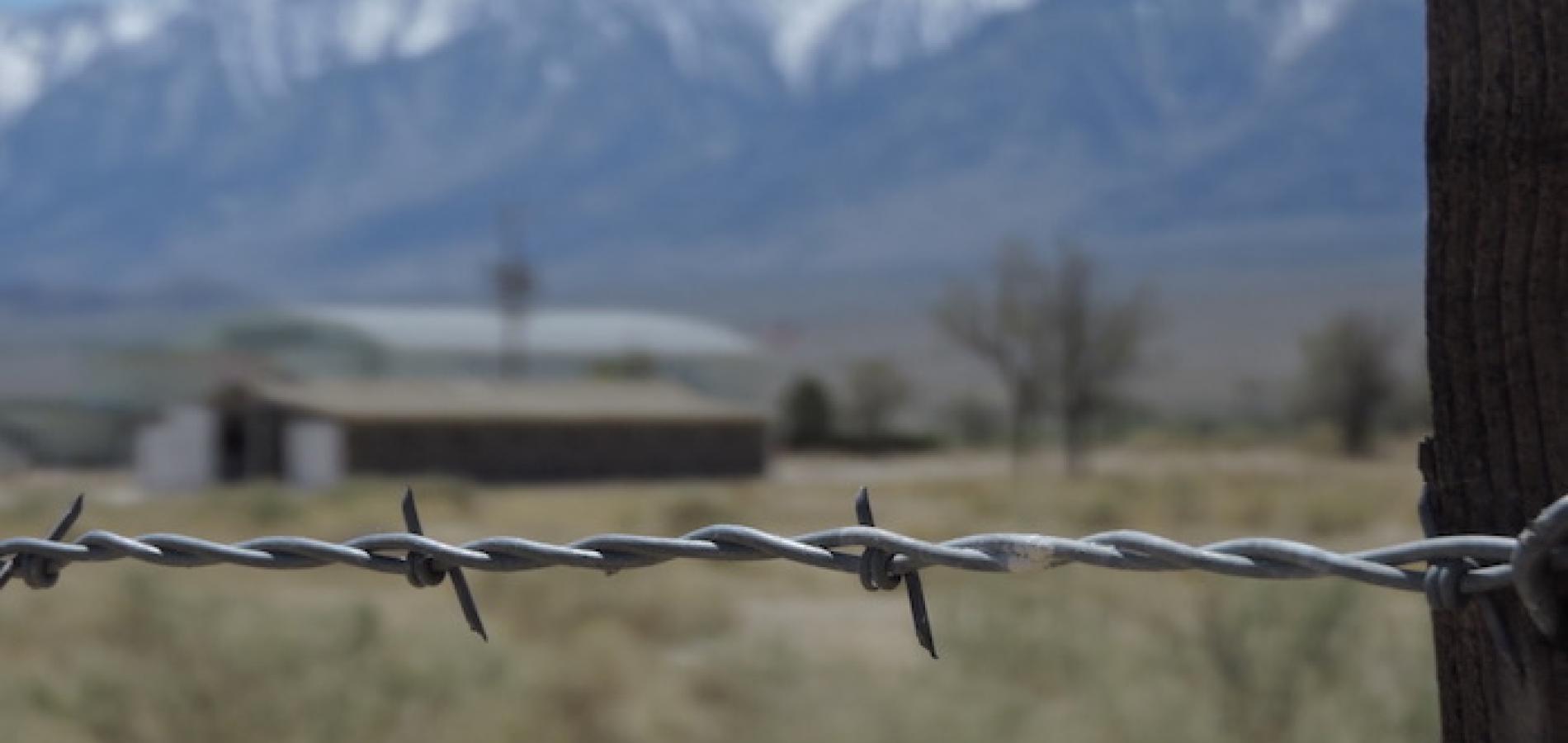
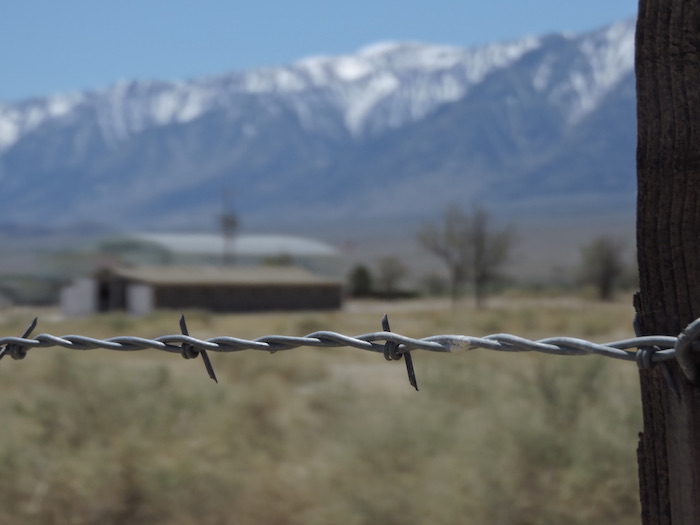
Then I pulled into the parking lot at Manzanar. Some places capture your eyes with spectacular scenery. But Manzanar National Historic Site captures your heart.
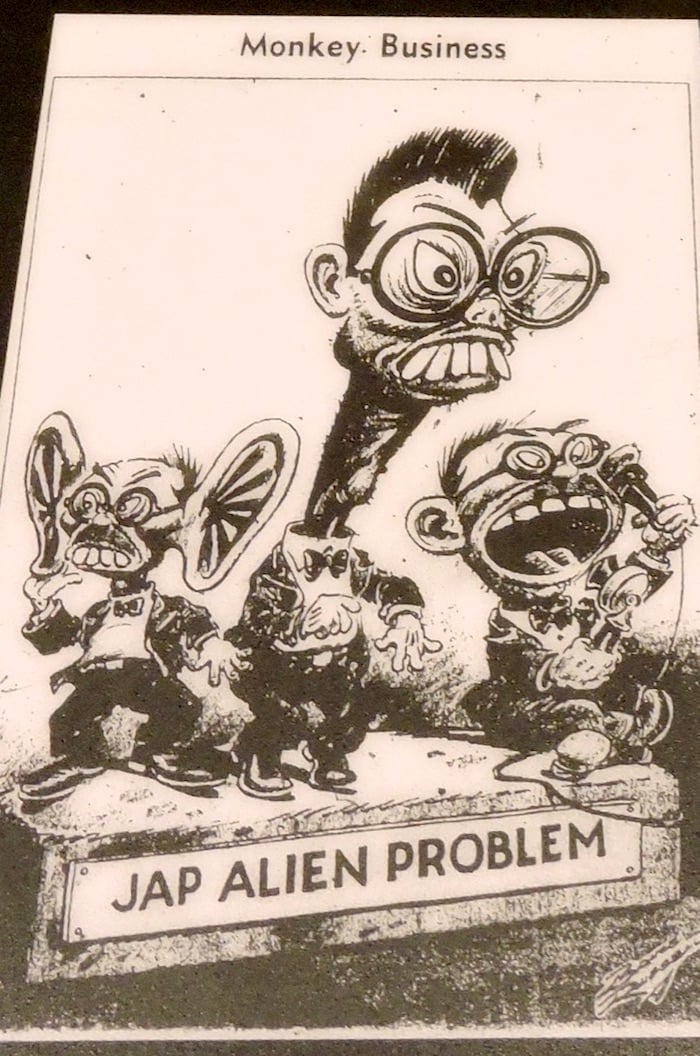
At Manzanar, we walk through story after story of an American tragedy. We witness pictures and words of people who experienced a time when fear and hatred took possession of our nation in one of the dark chapters of our history. Manzanar is one of the places where thousands of people were sent for one reason only.
They were Japanese.
I’m sure you’ve all heard tales of what happened after December 7, 1941. How tens of thousands of Japanese merchants, teachers, fishermen, businessmen, clergy, children, and even Catholic nuns were rounded up and sent with only what they could carry to ten “internment camps” well away from the West Coast. One more shameful story not much different than others like the Trail of Tears, the Long Walk, and those Paiutes who had lived once in the very place to where these Japanese were hauled.
It’s a story that was long neglected. Some of us didn’t want to teach this to our kids in their history books. Maybe because some feared it might not grow proper pride and patriotism in their young minds. Besides, these people — these Japs — were different. Always had been. Always would be.
Once upon a time our own Supreme Court had ruled that Japanese who came to America could not become citizens. Although our Constitution assured that their children who were born here were citizens. There were efforts made in high places to find a way to stop that, too. It was even against the law for a Japanese — or Chinese, or Black person for that matter — to marry a Caucasian American.
But now those stories — and others like them from our history — are finally being told. Even right now at a time when measures were recently introduced into Congress that could deprive some other Americans of their place and citizenship here and send them off to the south.
Exhibits in Manzanar’s visitor center and throughout the rest of the site are some of the best I’ve seen our parks. There’s nothing really fancy. Very little electronic gadgetry. But lots of pictures. And, I think, most effective of all, the words of people who actually lived the story told here.
This wasn’t long ago. Although they are rapidly leaving us now, these people were able to tell their stories firsthand. We see their faces and hear their voices. Some of the most moving and effective are a series of simple watercolor portraits of people with names like Yoshinaga or Hayashida. Below each portrait are just a few words that, if you take time to think while reading them, hit you like a jolt right in the gut and in your heart. Or at least they should.
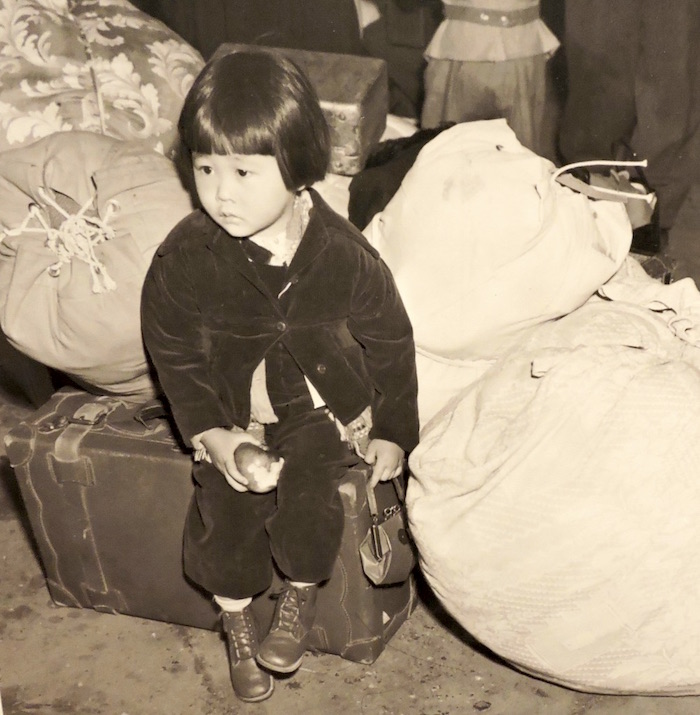
I even learned in the bookstore that our beloved Dr. Seuss had been a political cartoonist before the war and his cartoons had fanned flames of hate and distrust.
There’s no way to do justice to the story of Manzanar. It’s something you have to experience and if it doesn’t touch your heart and leave you angry or perhaps even tearful then there has to be something wrong with you . . . . .
Manzanar Superintendent Bernadette Johnson talked with me for a long time after I met her at the information desk. She’s a tiny woman. Obviously Hispanic with a Scandinavian name. It took about 30 seconds for me to realize that I’d just met one of those remarkable folks I wish everyone could meet and learn from. She shared some personal stories that explain why the story told here is so precious to her. Stories of her own adoption that had me fighting down tears right there in front of the visitor center desk.
One of her ambitions for Manzanar is to find a way to set up some kind of interpretive wayside or something that will tell the story of the Children’s Village here. She says this is one of the most tragic tragedies of the internment. Orphans who had been living in orphanages in West Coast communities who happened to be Japanese were also rounded up and shipped here. Some, who had been in foster care or were in the process of being adopted were taken from their homes and sent to the Children’s Village at Manzanar. They were orphaned twice!
We talked of how the staff here are all dedicated to trying to tell a story that portrays a time in our history that was not our best. She says it’s rewarding to watch as visitors actually have their minds and ideas changed by what they learn here.
She told of an entry in the large comment book that’s set out for visitors. It said, “I am 77 years old. I’ve always hated the Japanese but what I learned here taught me how wrong I was. I’m sorry. Please forgive me.”
I asked if the current political climate and racial divisiveness that seems to be growing and gripping us again today causes problems for interpreters here. “No,” she replied. “We just tell the story of what happened and let people make up their own minds.”
She reminded me that Manzanar actually tells three stories of personal tragedies for Americans. The first came in the late 1800s as European settlers began displacing Paiutes. Original Americans. As had happened before in other places, there finally came the Long Walk of the Paiutes when they were forced to march some 250 miles away. Several of them died along the way. Descendants of some of them are the Button family who live nearby and whose civic efforts now help support the park.
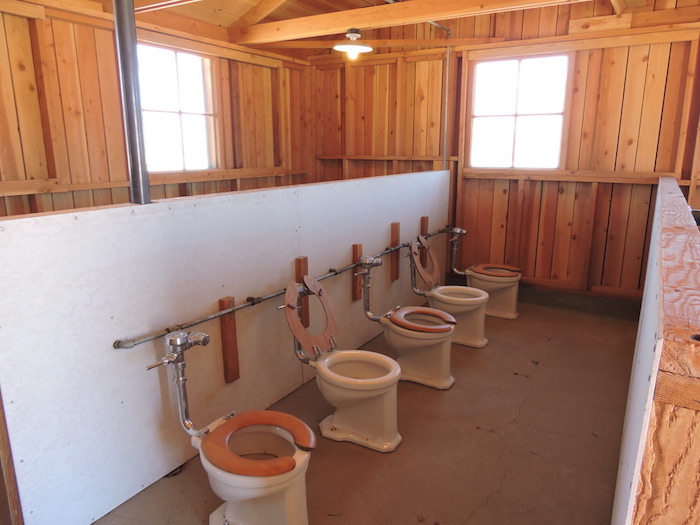
There had once been a thriving town around apple orchards named Manzanar. The people who settled here and planted the trees were driven away by wind. Wind that stripped blossoms and young fruit from trees. Manzanar was abandoned and the land was sold to Los Angeles. While in other parts of the Owens Valley, European settlers were often forced from their homes as the growing city gobbled up water rights to slake its thirst. Without water, there wasn’t much left for anyone here.
And finally, when the government needed an empty place to build a camp for Americans whose eyes were different than the rest of us, the square mile that had been Manzanar was the spot. Then, after a pause the Hispanic superintendent quietly asked, “So who could be next? It could be me . . . or even you.”
When Japanese young men were finally allowed to join the U.S. Army, thousands volunteered from Manzanar and Topaz, from Minidoka and all the others. They became the 442nd Infantry. The Purple Heart Brigade. The most decorated outfit in the Army. Sadao Munimori from Manzanar was awarded the Medal of Honor after he threw himself on a German grenade to save his buddies in Italy.
One of the most moving exhibits is that collection of watercolor portraits of people who were interned here. One stood out to me. Jack Kunitami wearing an American Legion cap and his words: “I did my share. I had complete faith in America.”
As they were loaded into trucks for transport, internees could take only what they could carry. A mother named Fumiko Hamashida wrote: “My suitcase was full of diapers and children’s clothes.”
In one of the barracks, visitors may push buttons and listen to voices of real people who once lived and experienced Manzanar. I watched a woman listening and wiping tears from her eyes. When I listened, I had to wipe my eyes, too. I spent a long time turning pages in that big book where visitors are invited to write and gave thanks that I saw note after note from other Americans — apparently of all colors and heritages — who were disgusted and ashamed after they had wandered and read the words and looked at those countless photos on panel after panel of displays. It’s good to know there’s a sense of alarm out there now — at a time when some people in power are trying to fan and use fear of other people to support whatever their goals may be.
This is a place that obviously touches the hearts and minds and consciences of many thoughtful people. It’s a powerful antidote for ignorance that fuels the stupidity of fear and hate.
And that, to my simple mind, is a wonderful thing to behold.
As long as the world lasts there will be wrongs, and if no man rejected and no man rebelled, those wrongs would last forever. — Clarence Darrow
Stories about:
Story Categories:
A copy of National Parks Traveler's financial statements may be obtained by sending a stamped, self-addressed envelope to: National Parks Traveler, P.O. Box 980452, Park City, Utah 84098. National Parks Traveler was formed in the state of Utah for the purpose of informing and educating about national parks and protected areas.
Residents of the following states may obtain a copy of our financial and additional information as stated below:
- Florida: A COPY OF THE OFFICIAL REGISTRATION AND FINANCIAL INFORMATION FOR NATIONAL PARKS TRAVELER, (REGISTRATION NO. CH 51659), MAY BE OBTAINED FROM THE DIVISION OF CONSUMER SERVICES BY CALLING 800-435-7352 OR VISITING THEIR WEBSITE. REGISTRATION DOES NOT IMPLY ENDORSEMENT, APPROVAL, OR RECOMMENDATION BY THE STATE.
- Georgia: A full and fair description of the programs and financial statement summary of National Parks Traveler is available upon request at the office and phone number indicated above.
- Maryland: Documents and information submitted under the Maryland Solicitations Act are also available, for the cost of postage and copies, from the Secretary of State, State House, Annapolis, MD 21401 (410-974-5534).
- North Carolina: Financial information about this organization and a copy of its license are available from the State Solicitation Licensing Branch at 888-830-4989 or 919-807-2214. The license is not an endorsement by the State.
- Pennsylvania: The official registration and financial information of National Parks Traveler may be obtained from the Pennsylvania Department of State by calling 800-732-0999. Registration does not imply endorsement.
- Virginia: Financial statements are available from the Virginia Department of Agriculture and Consumer Services, 102 Governor Street, Richmond, Virginia 23219.
- Washington: National Parks Traveler is registered with Washington State’s Charities Program as required by law and additional information is available by calling 800-332-4483 or visiting www.sos.wa.gov/charities, or on file at Charities Division, Office of the Secretary of State, State of Washington, Olympia, WA 98504.

Comments
My favorite subject in school was of history, particularly, California history. As an adult, I travelled across California, taking home photos, and books, and memories. On one such trip, I traveled north on US 395 from Los Angeles, and pulled off the road at a historical marker at the place called Manzanar. As I read, I was puzzled. What were they talking about? What Japanese interment camps? I had never heard of that bit of U.S. History.
I remember glancing around me at the barren, windblown high desert, with the gorgeous eastern Sierras in the distance, and wondered what this was all about. This was in 1982, and all there was of Manzanar back then was the burial monument at the end of a gravel driveway. No relics, no restorations, no visitor centers--nothing. I later stopped at a place in Independence, CA, down the road a few miles, that had numerous displays of the camp. I bought several books about the region, and about Manzanar, and read as much as I could.
When I think of Manzanar, I think of the Japanese Americans, and their non-citizen parents and grandparents, who had everything confiscated from them, then were loaded onto buses and trains, and hauled off to the most god-forsaken places in the country. They were brave people who exhibited patience, and courage, and a determination to survive despite the odds. Their sons, highly decorated U.S. soldiers, bravely fought, and many died for, the very nation that betrayed them.
I still feel outraged that such a significant piece of our American history would be left out of the classroom.
It's been a few years since my latest trip to Manzanar, and I anticipate the restorations and other interpretive displays now available.
The victims of WWII were not the internees, whose families were kept intact and cared for. The victims were those who were forcibly sent to war to suffer and die, and those who had to endure the hardships and sacrifices on the home front. This is a gross misunderstanding of history which is perpetuated by the NPS. You get satisfaction by calling your parents and grandparents racists? You will get similar treatment when your grandchildren judge you for destroying their planet.
Your take on the history and injustice of the WW ll imprisonment is not even partially correct, it is all wrong. I know because my family survived it.
Don’t even try to spin it one inch.
Rob--
Speaking for myself, no I don't get _satisfaction_ from stating that my dad's parents were racists (not just about Japanese during WW2, but into the 1960s when I knew them), but I don't deny or lie about it either. I can be proud of other aspects of who they were and what they did, but I can acknowledge aspects of them I am not proud of.
From my perspective, it is your "history" that is a gross misunderstanding. Native born and naturalized US Citizens of Japanese ancestry lost their lands and their possessions, and were forcibly shipped off to camps in the harshest areas of the intermountain west. [Non-citizen residents of Japanese ancestry, too.] The vast majority from Southern California lost everything and were never able to return here after the war. Some from Seattle and the San Francisco Bay area were able to return to those areas after the war (see Minidoka on Bainbridge Island), but they still lost nearly all of what they had as well as the years spent locked up in the camps.
What is this "cared for" you speak of? The internees had to farm in those harsh conditions for much of their food; they had shops to try to build basic furniture. Their hardships and sacrifices were much greater than that of my grandparents, aunts, & uncles (on both sides of my family) on the home front. Those in my family too old or too female to fight worked in shipyards and aircraft factories, but were able to buy houses and get paid good salaries and go to occasional dances. I'm proud of their contributions, sacrifices, and hardships, but their fellow citizen internees had greater hardships and sacrifices on the home front.
Despite their treatment, many of the young men in the camps signed up for the 442nd, then suffered high casualty rates in part because they felt that they had to prove to people like you that they were as patriotic and loyal US citizens as any other citizens. How does that not qualify as your "suffer and die", because they weren't drafted? Many other US Citizens volunteered before they would have been drafted, so they, too, weren't "_forcibly_ sent to war" if that is your criterion. I respect and honor all of those who fought for us, no matter their ancestry or citizenship status.
I'm a natural resources wild lands kind of guy, but I am very happy that NPS has Manzanar and Minidoka and soon Honouliuli as well as Rosie the Riveter, Port Chicago, Valor in the Pacific, War in the Pacific, American Memorial, and the WWII Memorial in the Mall. They are all aspects of our heritage from that era, preserved for ourselves and future generations.
To liken the internment of US Citizens who broke no law to caring for children who either independently or abetted by their parents/relatives illegally entered the US is a massive disservice to the true injustice to the former.
EC--
While I suspect you and I probably disagree about the morality and appropriateness of separating detainee children from their parents even for those requesting asylum, we agree that is very different than the subject of this post.
However, I don't see anyone here likening the two. I re-read Lee's post from June 8, well before the current wave of news interest and outrage. He mentions more general anti-immigrant sentiment and policies over the decades, but he doesn't mention the current issue of childhood arrivals. I didn't mention it. If you were worried/offended by my honoring all those who fought for us irrespective of their ancestry or citizenship status, that's not about Mexican Americans. I was actually thinking of the many Filipinos who fought with us in WW2, and ended up in San Diego; I grew up and went to school with their (US born) children.
I didn't respond to Ron's final line, but I will now. If future generations hold me in contempt or scorn because of the current immigrant and asylum policies, that may be deserved. [On planet destruction: I work hard to minimize & mitigate ecosystem destruction, carefully separating on the clock from off the clock activities, so on that topic they may judge me a failure, but they can't say I ignored it or didn't try.]
https://www.cnn.com/2018/06/19/politics/george-takei-family-separation-o...
tomp2,
It is good that NPS has sites to tell the WWII stories. The problem is that the interpretation is done by looking at history from today’s perspective, and not from the perspective of those who lived it.
To truly understand history one has to understand all the aspects of living in that time. It takes much study of life in that era. WWII suddenly transformed every aspect of life, and profoundly affected everybody. And it should go without saying that they didn’t have the time machine into the future like we do.
Anyone who says the Japanese were interned for racial reasons has not done their homework. They are simply making a social justice judgment, as is so popular in today’s culture. You might also think we fire bombed Tokyo and nuked Japan for racial reasons.
Many internees were proud to do their part for the war effort. Yes they made sacrifices, as did everybody else.
Go read National Geographic from 1940 to 1942 to see what people saw who didn’t know the future. Nobody wanted the war, but they rose to the occasion. It was not about racism.
The Manzanar displays distort history to fit today’s culture. So people go away like you did, with no sense of what really happened. And, as we see in this thread, people are so quick to mindlessly tie it into current headlines.
You may think you are doing the best you can for the environment today, just as our parents did the best they could to fight WWII. But your grandchildren will condemn you anyway. Their perspective in the future will be much different from yours today.
Rob,
Have you been to Manzanar in recent years? We strive to give voice to the past through multiple perpectives and from both sides of the fences.
Alisa
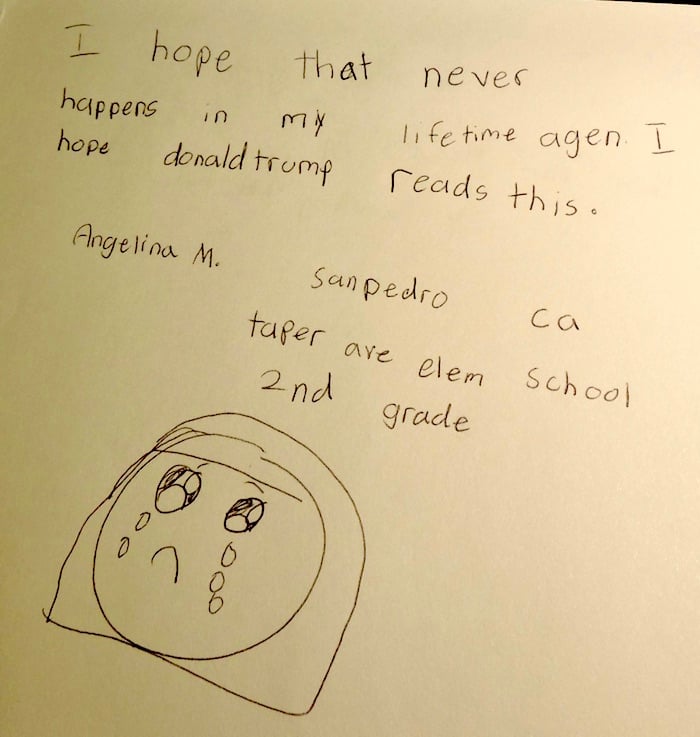
tomp2 - You do not see anyone likening the two? Did you not see the picture at the end of the story? If you think Lee submitted this at this time for any other purpose than to liken the two you are very naive.
https://cdn.cnn.com/cnnnext/dam/assets/180621135932-time-cover-07022018-...
Let's hope that Americans are finally beginning to wake up and that the photo and many, many other similar comments by both adults and children in the book at Manzanar are an indication that there will be a yuge backlash at the polls in November.
"Anyone who says the Japanese were interned for racial reasons has not done their homework." So they were interned for the same reasons as why Italian and German citizens of the U.S. were interned? Gotcha.
Dupped once again, Lee.
http://www.dailymail.co.uk/news/article-5869829/Father-two-year-old-face...
Before I read your link, EC, could you tell me what "dupped" means? I haven't heard that term before and just wanted to make sure I understood the context in your comment to Lee.
Rob--
While I think that Gallopingphotog said it well (my comparison is that 7 our of 8 of my great-grandparents were born in Germany, so my grandparents were all first generation US born citizens who moved to Richmond & San Diego to work during the war), I will respect you with a more factual reply, showing my work if not my homework.
My comments are not because I've been brainwashed by the interpretation at Manzanar; I haven't been there in a couple of decades. My comments are based on growing up in San Diego, where there was no visible Japanese-American community in the 1960s & 1970s, but yet I kept coming across remnants here or there across the county. The local commercial tuna fishing industry was started by Japanese immigrants who introduced the technology of stout bamboo poles, and was >50% Japanese in the early 1900s. The first farmers to grow citrus in San Diego were Japanese, the same for strawberries. Japanese farmers established Chula Vista as the big winter celery source for the US, and had most of the truck farms for fresh vegetables in the county. By my time that was all gone with just a few historical notes, and a scattering of old Japanese-American nurserymen and gardeners. The tuna industry in the 1950s & 1960s was dominated by Portugese-Americans (by way of the Azores) even before it changed from poles to seines.
It wasn't just the WW2 internment; there was a long record of racial animosity here. In 1913 California passed the Heney-Webb Alien Land Bill that prevented "aliens ineligible for citizenship" from owning or leasing farm land. CA fish & game established a parallel regulation that "aliens ineligible for citizenship" could not obtain commercial fishing licenses. [Japanese and Chinese immigrants were legally ineligible for citizenship.] Look up Morrison v. California 1933 on the farm lands, and T. Abe v. Fish and Game Commission, 9 Cal. App. 2d 300, September 27, 1935 on the commercial fishing licenses (yes, I had to look those specifics up). It was also against the law for Japanese-Americans to marry non-Asians. When in 1942 the local Japanese-Americans were hauled off to the internment camp at Poston, Arizona (via a few months at the Santa Anita racetrack barns), that wasn't a unique event, it was a continuation or expansion of the ongoing dominant pattern. Racism was at least as large of a factor as fear and uncertainty during wartime, and the decades of pre-war racism were a big factor in why so few internees from San Diego returned to the area after the war.
I agree with you that times and mores were different then, but I disagree with you if you still assert it wasn't primarily about racism. Next thing you'll be telling me that the "Zoot Suit Riots" in LA weren't about racism, either. Some folks recognized it even back then: in 1935 Carey McWilliams called the anti-Japanese actions "offensive stupidity".
I hope that future generations will judge me honestly: both the good and the bad, not whitewashing me nor demonizing me. That's how I approach previous generations, including FDR who signed executive order 9066, and Theodore Geisel. I saw the original of that Theodore Geisel "Monkey Business" cartoon when it was part of an exhibit at the San Diego History Museum (I graduated UCSD long before their Dr. Seuss special collection). Yes, that piece is as critical to understanding Dr. Seuss as his anti-Hitler and anti-racism cartoons (or my personal favorite book: "The Seven Ladys Godiva"); yes it is racist. That Geisel could produce such cartoons along side anti-fascist, anti-racist, pro-tolerance cartoons & subsequent books, tells me something about the likely motes in my eyes and my feet of clay. [See https://library.ucsd.edu/speccoll/dswenttowar/ for the complete set with minimal commentary.]
If you want to show me your homework now, the basis for your assertion that the internment of Japanese-Americans _wasn't_ about racism, I will read it thoughtfully, and I hope others will, too.
EC: if Lee was _really_ trying to tie Manzanar to the current arguments about handling immigrant & asylum-seeking children at the border, he should have paired the Monkey Business cartoon with this one:
https://library.ucsd.edu/speccoll/dswenttowar/index.html#ark:bb4642496p
tomp2 ---
I'll link the two insofar as the ugliness of the apologists' racist rhetoric defending both have the same vile nature.
Of course you will Rick, because you see no difference from detaining US citizens who have done nothing illegal from non-US citizens who have illegalled tried to enter our country - sometimes, as in the case of the Times cover - while taking children away from one or more of their parents. There is nothing racist about wanting to stop the latter. But for those on the left that lack rational arguments, calling people racist is the classic fall back.
Trumps word and actions speak for themselves.
It isn't accusing people of being racists - it's noticing what they show. I guess some folks are just comfortable with that. And you are right - I believe that basic human rights - like not ripping children from their parents - are universal.
So if they are racist, why is it that 200,000 immigrate from Mexico and Cuba LEGALLY each year. That is more than any other country. Your accusation (or observation) of racism is absolutely baseless. As to ripping children from their parents, it is no different than the way we treat criminals that are US Citizens, regardless of race. You commit a crime, you go to jail and your child doesn't come with you.
Just as has been true with other despots through history, trump depends upon being able to "dupp" gullible people into supporting him and his actions. (I like that new word. It goes well with trump.) It's unfortunate, though, that despite lessons we should have learned, there will always be people who will allow themselves to be used by despotic leaders because they believe that somehow their own selfish desires will be in some way rewarded if they do. It's happened time and again in history, and it's happening to us right now.
But I'm an American who grew up on military bases in Texas and North Carolina when those states were still divided by segregation and hate. And as an American who once marched in the south with police dogs' teeth snapping just a few inches from my arms and legs and firehoses trying to bowl us over while some of our fellow citizens shouted, spat, threw bags of urine and human feces at us as hatred twisted their faces, I simply cannot stand silent now.
As recently as 1971 when I was a park ranger at Greenbelt Park in Maryland, I saw it again. One day I accompanied a U.S. Park Police officer as we delivered a Black man arrested on suspicion of car theft to the Prince Georges County jail. The jailer there looked at the handcuffs on the man’s wrists and said, “He gave you a hard time, huh?” He took a slapjack out of his pocket and began slapping it against his leg and added, “Well, we get his black ass downstairs and we’ll teach him a thing or two.” That’s when I pulled out the little notebook from my pocket and wrote my name and phone number on it to give to the man with the promise that if anything happened to him downstairs, I’d go with him to the FBI.
I've personally seen the ugliness of evil hate and because I recognize it oozing through our country again, I will do all I can possibly do to resist it.
As someone posted above, trump's words and actions speak for themselves. That Time Magazine cover is a powerful portrayal of what's happening to us today -- even if some of the details behind it were not what they first seemed to be. It is -- and should continue to be -- something that will stir the consciences of people who care and raise them to action in opposition.
Perhaps that is why Manzanar and the story of what happened to other good people there hit me so hard.
We have been betrayed and our nation continues to be betrayed by political actors who place personal power and gain above the best interests of all of us and our country. Betrayed by both parties who gave us such terrible candidates in the last election that the majority of American voters stayed at home. Remember, it was the people who DIDN'T VOTE who elected the sleazy madman who now infests our White House.
Let's hope that it doesn't happen again. Let's hope that enough Americans who care about our futures will turn out next November and again in 2020 to send him and his enablers down in flaming defeat. Just because he managed to dupp some of us doesn't mean we must allow him to continue.
America's future depends upon it.
(And thank you, tomp, for your thoughful comments above)
Lee, the one that was dupped and gullible was you falling for the Time mag front cover. BTW, I think you need to look up the meaning of despot. You clearly don't understand what a despot is.
des·pot
ˈdespət/
noun
a ruler or other person who holds absolute power, typically one who exercises it in a cruel or oppressive way.
synonyms:
tyrant, oppressor, dictator, absolute ruler, totalitarian, autocrat;
informalslave driver
"when one despot is deposed for another, the cycle of repression continues"
Nope. I know exactly what it means. Happily, I can hope that our Constitution and good sense of enough other Americans will ensure that he's unable to continue trying to become more than a wannabe despot for very much longer. We are at a crossroad right now, and which way we turn will depend upon how many are willing to follow him without question.
Sorry, Kurt. Rick is right.
Don't forget, Lee - as has been demonstrated both in this thread and over many years now - no one understands the truth but Buck.
OK guys, please bring your comments to an end if they're not contributing something substantitive.
To compare Manzanar to what is taking place at our borders today is an insult to those inturned at Manzamar. Our lack of immigration enforcement is also a tragedy to those who really are fleeing countries where they have no other options. Like him or hate him at least we finally have a President who has the courage to want to fix our terribly broken and nonsensical immigration laws and lack of enforcement. Everyone should be happy about that unless they only want to use immigrants for their own political purposes.
Mr. W. Places:
We should check with Mr Takei, who was in fact interned.
"Japanese-Americans imprisoned at Texas internment camp in 1940s watch border crisis unfold with heavy hearts"
https://www.texastribune.org/2018/06/22/texas-immigration-japanese-ameri...
Darrell - Not sure who your comment was directed towards but I would be interested in hearing your perspective rather than just saying someone elses (the author's?) is wrong.
Alisa,
Yes, I have visited all the WWII NPS sites recently, including Port Chicago NM. While there were generally good historical explanations, in every case the take-away emphasis was on racial injustices. Every NPS interpretation made it difficult to get beyound this bias in the presentation.
Of course there were injustices in history, as there are today. WWII America was a massive injustice for most people. But few understand the profound influences those times had on peoples lives. It is necessary to see the world as they saw it, not as we see it looking back, knowing the outcomes.
Think of the injustice of men taken from their families, stripped of all their freedoms, and sent away to suffer hardships and death. Think of the broken families left behind, the children raised without fathers. Think of the women who had to work, in a time that women didn't work. Millions of Americans, of all races, including Japanese, suffered extreme hardship during the war.
You can be sure the Americans of today will never again sacrifice like they did then. Wouldn't it be valuable if people leaving the visitor center came away with the same understanding of that time as the people who lived it? Instead, they come away feeling self-righteous or even angry about why people in the past didn't do what they should have done, and want the past to be like the present. It would be much more educational if the visitor could be tranported to the past than to be told right up front that Manzanar is just a monument to the racism of our grandparents.
Of course there is no way to make Manzanar "right". And there is no way to make WWII "right". All those who suffered deserve our compassion.
To someone thinking rationally, it might be helpful to imagine what would have happened if the Japanese did not make a surprise attack on Pearl Harbor. Would there be any reason for the internment? Would people still be in fear of a surprise attack on Los Angeles? To someone thinking in today's social justice mindset, you will see racism everywhere you look in history. You must get over this to fully understand history. To fully understand history is actually a much more rewarding experience than to judge it through the lens of our time-machine.
As Churchill said, history is one damn thing after another.
I would like to see at least one exhibit at Manzanar that attempts to provide that perspective as a take-away. I have observed how the NPS has morphed over the years from telling the factual history of its sites to revising history to suit the current culture. As evidence, compare the park brochures of the 1980s and 1990s with the brochures for the same sites today.
Bob - I agree 100% I have never believed we should judge the actions of people in the distant past by the mores of the current time.
But shouldn't we try to learn from their mistakes? And if modern kids and adults are unaware of past mistakes, it's pretty tough to learn anything. I disagree that our parks have somehow changed how they tell the stories or is placing unbalanced emphasis upon such things as slavery or struggles faced by original Americans as they were forcibly displaced by Europeans.
One need look only to the fact that not too many years ago, the word slavery was very rarely seen in any of our cannon ball parks. Even school textbooks often hesitated to use the word. In fact, look back just a couple of years to the time when the Texas Textbook Committee tried to turn the word slave into something like immigrant acricultural worker.
Or just the name change from Custer Battlefield to Little Bighorn National Monument. It's only been a recent development that there are now red marble stones marking places warriors fell mixed in among the white stones recording where Custer's bluecoats fell.
Just north of here in Idah, a long fight has finally come to an end as the story of how a village of peaceful Shoshoni were attacked and slaughtered by Utah militia men who mistook them for a band that had been accused of stealing livestock in Utah.
It's not been long since there were real efforts to deny that our history has more than just a few instances when our ancestors made some very ugly mistakes.
It's much easier to forget history if our kids simply never learn of it.
If their "mistakes" (a anachronism in itself) is relevant to the current situation. It isn't. The two couldn't be more different.
Whew! Whiplash! Right into opinion without even stopping to coordinate pronouns, and not a single "in my opinion", "the way I see it", or even the slightly stilted "if you will...".
Try that for a while - whenever you depart from clearly documented data, put a "in my opinion" into every sentence. It's a damn nuisance, but so are most needed disciplines.
I'm afraid that a comment like yours, above, would have been laughed out of every college course I took, except for the electives of fencin & ballet. Proclaiming something to be true ex cathedra like that has absolutely no credibility.
Sorry Rick, I thought the differences were self evident. It appears they are beyond your comprehension. We were visiously attacked by the country of Japan. We haven't been bombed by Mexico. We declared war on Japan, we haven't declared war on Mexico. The US Government was fearful that Japanese citizens would perform subversive acts to aid Japan's war, there is no such fear with our current illegals. The interred Japanese were US Citizens legally inside the boarders of the US. The interred illegals, are illegal, having entered the country against the law. All documented data and two very different scenerios.
https://www.nytimes.com/2018/06/26/us/korematsu-supreme-court-ruling.html
Korematsu, Notorious Supreme Court Ruling on Japanese Internment, Is Finally Tossed Out...(Internment Based on Lie)
A Japanese internment camp in Manzanar, Calif., in 1942. In upholding President Trump’s travel ban on Tuesday, the Supreme Court also overruled the case that had allowed the World War II internments as constitutional.CreditBettmann Archive
By Charlie Savage
June 26, 2018
"But on Tuesday, when the Supreme Court’s conservative majority upheld President Trump’s ban on travel into the United States by citizens of several predominantly Muslim countries, Chief Justice John G. Roberts Jr. also seized the moment to finally overrule Korematsu."
“The forcible relocation of U.S. citizens to concentration camps, solely and explicitly on the basis of race, is objectively unlawful and outside the scope of presidential authority,” he wrote. Citing language used by then-Justice Robert H. Jackson in a dissent to the 1944 ruling, Chief Justice Roberts added, “Korematsu was gravely wrong the day it was decided, has been overruled in the court of history, and — to be clear — ‘has no place in law under the Constitution.’”
"In a dissent of the travel ban ruling, Justice Sonia Sotomayor offered tepid applause. While the “formal repudiation of a shameful precedent is laudable and long overdue,” she said, it failed to make the court’s decision to uphold the travel ban acceptable or right. She accused the Justice Department and the court’s majority of adopting troubling parallels between the two cases."
m13 - I agree, if the government had stuck to the Constitution, Manzanar whould not have happened. That is the danger of a "living Constitution".
I also agree with the self-evident truths that Justice Sotomayer mentions.
Lee, this is a wonderful, moving, and important essay on Manzanar. As a professional historian, though, I need to respond to Rob Richmond's comment that "Anyone who says the Japanese were interned for racial reasons has not done their homework," which is simply wrong. Actually, the notion that "the Japanese were interned for racial reasons" was the judgment of the Reagan administration in 1982 in the report issued by the federal government titled "Personal Justice Denied: Report of the Commission on Wartime Relocation and Internment of Civilians." The commission did extensive "homework" and concluded that the measures taken against Japanese Americans in WWII "were motivated largely by racial prejudice, wartime hysteria, and a failure of political leadership.” The report is available from the National Archives at https://www.archives.gov/research/japanese-americans/justice-denied . The federal government subsequently acknowledged the injustice of the internment camps when Congress passed and President Reagan signed the 1988 Civil Liberties Act that apologized for the internments and paid compensation to the victims.
Also, Rob, I find it a matter of concern when I read someone's long polemic which [a] minimizes a focus on past racial injustice as a negative bias, [b] and also expresses the dangerous opinion that "few understand" things as you do.