
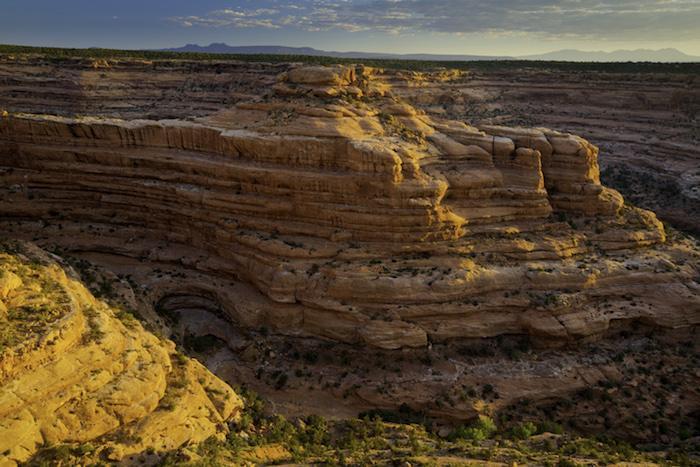
Editor's note: The following essay by Douglas Brinkley initially appeared in the New York Times Book Review section. It is reposted here with the author's permission.
In a 1973 TV spot, the United States Forest Service sage Smokey Bear admonished that “one careless second with a match and America the beautiful becomes America the ugly.” So what would Smokey say now when a few careless seconds with a pen allowed President Trump and Interior Secretary Ryan Zinke to remove protections from two million acres of precious American wilderness? If courts uphold Trump’s executive orders of last December, they would reduce southern Utah’s Bears Ears and Grand Staircase-Escalante monuments by 85 and 46 percent, respectively, constituting the biggest rollback of federally protected land in American history.
But fear not, lovers of the Utah canyon country, for the ghost of free-spirited eco-warrior Edward Abbey once again gallops to the rescue via his eloquent and funny memoir “Desert Solitaire: A Season in the Wilderness,” first published 50 years ago this month and reviewed by The Times on this exact day in 1968. Set among the very Colorado Plateau ecosystem targeted by Trump’s executive orders, every gleaming page of Abbey’s autobiography virtually shouts out the necessity of protecting our public lands from desecration, and sings the nobility of wilderness defenders whose intrinsic value system rejects the “sweating scramble for profit and domination.” While at various junctures Abbey delineates on John Wesley Powell’s Geographic Expedition of 1869, the history of Mormonism and the night life at bars from Moab to Mexican Hat, it’s his fierce stewardship of the desert environment that continues to shine brightest.
When “Desert Solitaire” first appeared in 1968, its prose galvanized environmentalists toward bold action to save the American Southwest from the maw of hyper-industrialism. Only Aldo Leopold’s “A Sand County Almanac” and Rachel Carson’s “Silent Spring” equal “Desert Solitaire” in transforming the genre of naturalist studies into manifestoes for social change. Paradoxically gruff and tender, starkly Darwinian in scientific exactitude yet brimming with mystical flourishes, Abbey’s enlivening nonfiction storytelling — anchored around his two compressed seasons as a ranger in Utah’s Arches National Monument during the late Eisenhower era — is a perfectly rendered hybrid of transcendental joy, coyote humor, in-your-face wrath, field science detail, philosophical righteousness, and moral clarity. Half a century after its debut, it retains its potency as a motivational weapon of resistance, a polemic against despoilers and a reasoned paean to biological diversity, priceless petroglyphs and the heavenly solitude of wilderness. Facing Trump’s short-term vision of America’s public lands, it takes little imagination to read Abbey’s masterpiece today as a prescient counter-statement for defending not only Bears Ears and Grand Staircase–Escalante, but the entire slickrock Colorado Plateau.

Abbey’s detailed journals and notes from his time in the unfenced Utah backcountry formed the basis of “Desert Solitaire.” When out-and-about as a ranger he felt intoxicated, as if time were suspended. Awed by the eternal beauty all around him, mirthful and full of delight, he melted into the landscape, living in rustic simplicity and natural fellowship with the desert’s wildlife while developing a firm foundation in desert ecology. Inspired by Walt Whitman’s dictum “Resist much, obey little,” Abbey became an aggressive watchdog of Arches and the surrounding Utah canyonlands held sacred by the Hopi, Navajo, Ute and Pueblo of Zuni tribes. Patrolling in a Park Service pickup, often in uniform, he came to revile the bulldozers, dams, paved roads and industrial tourism that define Southwest development, and to channel that revulsion into ferocious, and at times anarchistic, prose.
In “Desert Solitaire” he denounces the mere thought of large-scale uranium mining in Utah’s howling salmon-pink tableland, and he reminds a cynical and distrustful public — both a half-century ago and today — that the mission of the Park Service, from its 1916 establishment onward, is to preserve our treasured landscapes in an “unimpaired” fashion. “Wilderness preservation, like a hundred other good causes, will be forgotten under the overwhelming pressure of a struggle for mere survival and sanity in a completely urbanized, completely industrialized, even more crowded environment,” he warned. “For my own part I would rather take my chances in a thermonuclear war than live in such a world.”
There is a fine set-piece in “Desert Solitaire” where Abbey tacks a scarlet bandanna to a ridgepole outside his government-issued trailer house, then hangs Chinese wind-bells to chime in the dry breeze — a ritual of “poetry and revolution before breakfast.” Then Abbey, the ranger, dutifully hoists Old Glory up the flagpole at Arches’ entrance station, as mandated by the Park Service. Wishing “good swill” to all nations in a kind of off-handed prayer, he savages “swinish politics” for wrecking his beloved Southwestern landscapes. When he was writing, the Environmental Protection Agency, which oversaw decades of real improvement in protecting American lands and scrubbing pollutants from our air and water, still did not exist. It’s a reminder both of how activism can break over dark times, and how, after notching victories, it can again get darker still. Were Abbey alive to see Trump’s proposal to slash the agency’s budget by a third in 2018, he would be apoplectic.
It’s not too late for salvation. If Zinke would read “Desert Solitaire,” hike Comb Ridge and the Grand Staircase–Escalante as Abbey regularly did, run the awesome San Juan River around Slickhorn Canyon, or camp under the lonely sky of Cedar Mesa, he might undergo a miraculous awakening and push Trump to rescind his reckless executive orders — but that, of course, is unlikely. Instead, Zinke behaves like an errand boy for the coal and petroleum industries, a faux cowboy who made his showboat debut as interior secretary by riding a horse to his first day in office, where he got right to work ransacking national monuments and pillaging Native American shrines, all to further the president’s war on America’s natural legacy and ingratiate himself to Utah’s quick-dollar Senator Orrin Hatch.
Facing the most egregious rape of Western lands since the Glen Canyon Dam bisected the swift-flowing Colorado River, environmental crusaders are already fighting tooth-and-nail to preserve Bears Ears and Grand Staircase–Escalante. Within hours of Trump’s executive orders, the Grand Canyon Trust, the Sierra Club, the Wilderness Society and others filed suit. As these conservation heroes go to bat for us all, they’d do well to keep “Desert Solitaire” in their back pockets, providing a call to action or, at the least, uplifting smelling salts to boost their resolve.

Comments
I'd settle for our ignorant so-called President just reading his daily national security briefings.
Our "ignorant" President that built a multi-billion dollar empire, got himself elected President against all odds, who has virtually decimated ISIS and isn't sending billions to rogue nations. I don't know what he is reading, but what ever it is, or isn't, it works.
And then there's that staggering national debt that is turning into a national security issue...
http://thehill.com/policy/finance/373647-intelligence-chief-federal-debt...
And in light of the recent indictments, not sure Trump got himself elected "against all odds"....
Finally, why has the president ignored Congress's directive, under the law that Trump signed, to impose sanctions on Russia for its cyberattacks? (And why hasn't Congress pushed back?)
I agree 100% on the debt. Democrats and Republicans are failing the county on that issue. But it didn't seem to bother the liberals when it was Obama doubling the debt.
And as was indicated with the indictments, there was no evidence 1 of colusion and 2 that the Russian efforts had any impact on the results of the election. What the Russian's did was different from Obama's meddling in Israel only in its method and was no more effective.
As to santions - which are even farther afield from this topic or even tohama's off topic rant, you will find the admin's explaination in this article: https://www.reuters.com/article/us-usa-russia-sanctions/trump-administra...
Let's not spend too much time looking into the past to justify the present. That said, between 2009 and 2017, President Obama's actions generated a cumulative deficit of $983 billion. In his first year, President Trump and the GOP -- which once was a deficit hawk -- have approved a tax cut that will add an estimated $1 trillion to the deficit over the next decade. And Trump's budget proposal would add $7 trillion more over ten years. (Fortunately, it's DOA)
https://www.thebalance.com/national-debt-under-obama-3306293
https://www.nytimes.com/2018/02/12/us/politics/white-house-budget-congre...
As for the indictments, last time I checked Mr. Mueller was still at work...and those in the intelligence community have said there's no surefire way to say what impact the Russian efforts had on the election.
As to the administration's explanation for not imposing sanctions -- that the threat is just as good as actual sanctions -- that's pretty laughable, no? Especially when the administration is being warned that the Russians already are at work on the mid-terms. From your Reuters story:
Now, I apologize for this off-topic discussion. With that said, I would second Dr. Brinkley's suggestion that the president and Secretarty Zinke read Desert Solitaire. Though unlike the professor, I do fear it's too late.
With his well documented aversion to the printed word, I fear that this is a lost cause, and absolutely any off topic partisan fantasy of Cadet Bonespurs decimating ISIS is only that - a partisan fantasy.
Let's not forget that there are different forms of ignorance.
What alarms me is that Trump is totally ignorant of such things as Honesty; Integrity; Morality; Fair Play and virtually all the other virtues that allow others to trust and respect a person.
On the other hand, he is obviously very well acquainted with Lying; Cheating; Fraud; Immorality; Bullying; Conniving; Manipulation and a host of others that can do nothing but tear down, cheapen, weaken, and eventually destroy.
It scares the wits out of me that this man is smearing his excrement all across our land and over virtually every part of the fabric that has made this the great nation a place admired by most of the rest of the world. It completely baffles me that anyone, anywhere, anyhow could allow themselves to allow him to do that -- and, by failing to try to stand up against him, actually enable him.
Wrong, Obama added $10 trillion to the debt over his terms. As much as every President before him combined. But nice to see you are now becoming deficit hawk.
And Trump's budget proposal would add $7 trillion more over ten years.
That is total BS. We have never had a deficit created by a tax rate cut.
Which is $3 Trilllon less than Obama in 8 years. Nevertheless it is $7 trillion too much.
EC, read the first link I provided that describes three ways to measure Obama's impact on the deficit. And provide your own that claims $10 trillion.
Analysts seem to disagree with your view on tax cuts and deficits.
https://www.cnbc.com/2018/02/15/experts-rip-trumps-spending-spree-as-foo...
Trump's budgeting seems to match that as when he was a businessman, when he described himself as the "king of debt." Even you have defended his practice of declaring bankruptcy as a tool of business.
The U.S., however, is not a business, and let's hope we can avoid bankruptcy.
EC, your reply landed under a different story, but here's more belief that tax cuts can lead to deficits:
https://www.brookings.edu/blog/up-front/2017/12/08/what-we-learned-from-...
http://www.econdataus.com/taxcuts.html
https://www.nytimes.com/2017/06/02/upshot/a-tax-cut-might-be-nice-but-re...
http://money.cnn.com/2010/09/08/news/economy/reagan_years_taxes/index.htm
http://www.ushistory.org/us/59b.asp
You can believe it can all you want. It has never happened. (and it is tax RATE cuts not tax cuts) .
Yes, the debt wen up under Reagan. It had nothing to do with tax rate cuts. Tax collections soared after the rate cuts. The deficit went up because SPENDING went up.
Reading Desert Solitarie would seem to be beyond the President's 15 minute comprehension of reading material. EC is correct that the National Debt increased several trillion dollars during Obama's Presidency. To be fair, he inherited the Great Recession, and much of the early deficit spending was an effort to spend ourselves out of it largely with infrastructure projects. Both parties are equally at fault with the National Debt; the last time we had a budget surplus it was largely because President Clinton and Speaker of the House Gingrich, each from the other Party, were able to work together.
Some of EC's other postings are ludicrous. Trump has not "Virtually decimated ISIS". Not true. Trump has largely continued with Obama's strategy, which already had the ISIL "Caliphate" on the ropes and rapidly shrinking by the time Trump took office. And ISIS is not virtually decimated. Without territory to defend, it will probably resort to more random worldwide terrorist operations, and could be just as dangerous as before. EC posted that Mueller's latest indictments showed "There was no evidence 1 of collusion or 2 that Russian efforts had any impact on the results of the election". These issues were not even addressed in Mueller's indictments, and the investigation is far from over. I have little doubt that there is much more to come, especially from Mueller's forensic auditors, which may well bring down the Trump financial empire if not his Presidency.
I'll stop here because we've strayed far off-topic.
Wrong - he totally changed the rules of engagement which allowed our soldiers to actually fight.
They weren't addressed in the indictment because they didn't exist. Pay attention Glad, Kurt used these indictments to suggest Trumps election wasn't "against all odds" Rosenthal specifically said there was no evidence of knowing contact by Americans with these entities/people and that there is no evidence these activities had any impact on the election.
Been going on a year and nada yet evidence of Hilary collusion and other crimes is rampant. Why aren't they going after her?
"They weren't addressed in the indictment (sic) because they don't exist". That's your belief, but it has not been proven by any stretch. Mueller did not address, one way or the other, whether Russian interference affected the outcome of the election, which Trump won by a few thousand votes in a few key states. Nor has he cleared Trump of collusion as the President has falsely claimed.
"He totally changed the rules of engagement which allowed our soldiers to actually fight". That's quite an exaggeration. Trump did allow field commanders more independence to order airstrikes and operations, but the overall strategy remained unchanged. Most of the ground fighting is being done, as it was before, by local forces trained and advised by U.S. special forces, not U.S. combat troops.
"Been going on a year and nada yet evidence of Hilary collusion and other crimes is rampant". Yeah, Trump TV (formerly known as Fox News) resurrects that deflection whenever there are new revelations about Trump. Mueller has just turned another key Trump advisor into a cooperating witness. Mueller is going about this systematically, and I expect the end result will be something you won't like.
I'm going to end my participating on this thread considering your obsession with having always having the last word.
Glad, you still aren't paying attention. Kurt used the indictments to suggest the election wasn't on the up and up. Rosenthal explicited stated that there is no evidence the activities that are subject of the indictment had any influence on the outcome of the election. You are correct that there was no statement about ALL potential activities, but that wasn't the subject of our discussion nor the point I was making. However, given the investigation has been going on for a year with absolutely nothing indicating collusion or an altered outcome I feel pretty comfortable that nothing is going to come of it. Unfortunately, that nothing will likely include the blatant illegal activities of Hilary who lost the election all on her own.
As to ISIS - changing the rules of engagement was a major change in the strategy. It is amazing how you can win a war when you are allowed to fight.
This is so reminiscent of a little kid telling the adults that they aren't paying attention, because - of course - the Autobots are the 'good' transformers, and that the Decepticons are the 'bad' transformers.
And, folks, don't forget that the man here who is explaining anti-ISIS strategy is the man who, by his own choice, has zero military education or experience.
I'm sure glad ecbuck defends the president, particularly saying "it works". Yes, it does work when you remove environmental protections, decrease enforecement of pollution laws, and increase pollution. Pollution kills more than wars, you know? The president is killing his own people. Sure glad it works
Boys! Boys! Hillary lost. Get over it. As for this comment, I disagree:
"Let's not spend too much time looking into the past to justify the present."
There is your problem, good people. No one studies history anymore. Worse, no one believes in it--unless they're looking for Russians under every bush. What are we?--our history. What we are today is but a pittance of our existence. How we think, feel, and act has EVERYTHING to do with history.
Same for our country. The problems we have today have been decades in the making. Mr. Trump did not make those problems. Nor can he alone hope to solve them. You don't like what he did to the national monuments? Well, I didn't like it when my party in the 1960s wanted to dam Grand Canyon. Which party was that? Not the Republicans, I can assure you.
THE WALL STREET JOURNAL reports on Saturday that no one has filed oil, gas, or mineral claims in the affected monuments. Why not? Because they don't want the legal hassles. They would prefer to mine-dig-drill somewhere else. It's all for show. Trump is paying back his base. You see? I'm NOT a Democrat! Believe me, the Grand Canyon dams were NOT for show. Nor was the cutting of the old-growth redwoods in Redwood Creek.
You want purity--consistency--credibility--accountability--integrity? Don't look for any of those things in politics. It's still a sausage factory--and always has been. Just remember not to get ground up with the other rats. Read history. Read it until your eyes bug out. Then you might understand.
And oh, yes. Don't make it women's history, minority history, or any of the other so-called equity histories. Make it real history. Study war, politics--the give and take of nations. This isn't half pipe at the Olympics. When people screw up in real life other people die. A century ago, my family was dying on the battlefields of Belgium and France. You don't want your family to die? Then you had better know some history. And yes, there Mr. Trump--and Mr. Obama--and Mr. Bush--and Ms. Pelosi--and Mr. Schumer--have done a good job scaring the hell out of me.
Context, my good Dr. Runte, context. My comment about the past had to do with EC's implication that because "liberals," as he put it, didn't mind spending under President Obama, that it shouldn't be an issue today. It wasn't intended as a sweeping comment that we shouldn't learn from the past.
Too much deflection is used today to obscure what is transpiring. The old magic trick where you focus on the right hand while the left hand does something else.
I never said or implied any such thing. I explicitly stated that the $7 trillion deficit was $7 trillion too much. I have been consistent about having to reduce spending. My reference to the Obama $10 trillion was to highlight the Liberals haven't been consistent. When Obama added $10 trillion to the deficit the liberals happily sang along. Now that the deficit is growing under a Republican, they are horrified. We all should be horrified both then and now. But then when one won't admit that 2.52 is larger than 1.72 how intellecutally honest can we expect people to be.
Exactly. Context. Of course the deficit should be an issue, but does either party want the deficit explained? No. So why should President Trump always have to "explain" it as if he caused it all by himself? He's gambling with his tax breaks, no doubt about it. And now that "liberal" Seattle just raised my property taxes by 20 percent, I am hoping he is right. Seattle has already spent my tax "break."
I'm curious if anyone can explain to me, in simple, non patronizing partisan terms, the functional difference between tax rate cuts and tax cuts. Smoke and mirrors, for the rich kids.
Tax cuts would be aimed at reducing total taxes collected. Tax rate cuts are aimed at stimulating economic activity resulting in an overall increase in tax collections.
That may be the 'aim', but I've yet to see the difference, other than in the minds of partisans. I did not ask about intent, which could be anything [ask any kid who is punished by a parent who says, "This hurts me more than you. You need to see the error of your ways"]. I asked how it has played out on the ground.
Here in Washington State, tax rate cuts are used to keep Mr. Gates, Mr. Bezos, Mr. Allen, and Mr. Boeing "happy." After all, without them they threaten to leave. Not to make this partisan, but all tax rate cuts granted since January 1, 1985, have been approved/advanced by Democrat governors. Simply, January 1, 1985, was the last time a Republican governor held that office. The last Boeing tax rate cut in 2014, on the order of $7 billion, was justified so Boeing would not jump ship for Califronia to build the wing for the 777.
All Washington State companies--Boeing, Amazon, Microsoft, Vulcan--use this argument--and use it well. Why should we be paying taxes? We are the ones who create the jobs. Let the workers pay the taxes. They are the ones who need the jobs.
Comes Donald Trump into office and Jay Inslee, Democrat, insists that Washington State must raise its taxes because Mr. Trump is proposing cutbacks. Right! More to the point, the State Supreme Court wants another $7 billion to "equalize" teaching in the public schools. It's right on our tax statements this year "State School Two--McCleary," as in the Supreme Court's McCleary Decision finding the state legislature in contempt for ignoring schools in need.
Where will it end? Again, no one seems to want the truthful answer that it never should have started in the first place. That would require a knowledge of history and a willingness to understand how the culture works. These past 50 years, it has worked on the principle that we can afford anything we want. Money itself doesn't count. Just print more of it and shake the tree. Is that from Democrats? Or Republicans? No, it comes from each and every one of us. It was so wonderful going into the welfare state. Only no one thought how to get out of it.
On the ground, Rick, tax rate cuts have led to higher tax collections. Just as intended.
Where/when?
Rick - After each major tax rate cut. After Kennedy's, after Reagans, after Clinton's and after Bush's.
Well, EC. Not entirely. When Governor Inslee (D) cut Boeing's taxes there was no increase in the collection box. We just got to keep the company "here" instead of "there."
I find President Trump's tax cuts far more honest. If you want to sell it "here," you had better not make it "there." I will tax you wherever you are. Yes, your tax rate will be considerably lower, but finally your excuses end.
Everyone seems to be missing that--as they also seem to miss that "only $1,000" is a lot of money to working folks. Sure. The hairdos on TEE-VEE making millions find it only Trump change, er, Chump change. But tell that to my step niece, for example, trying to raise a child as a single parent. Or the senior whose meds have gone up $100 a month.
But no. Tax rate cuts aren't always "good" for us. There has to be a quid pro quo. So far, Washington State has been all quid and no quo. But hey? What's another 20 percent tax increase? It's all "for the kids," right?
Not quite the equivalent of a general cut in federal income taxes, but nevertheless, the tax collections were higher than they would have been had the taxes not been cut and Boeing left. But I get your point. That is a case of how to cut the pie. General federal income tax cuts are looking to expand the pie.
General federal income tax cuts are looking to expand the pie.
I do hope it works, EC. Here in Washington State, our "electeds" are doing everything they can to get our money before we get it.
Thanks for the polite answers. I don't believe a word of it but thanks for those broadly general answers. It is really sad to think that you believe this propaganda yourself, but that's really to be expected I suppose. Have a smurfy day.
I don't believe a word of it
You don't have to blindly believe it. Do some research. Look at the years the tax cuts were made and look at the tax receipts before and after. There is nothing broad or general about it. No propaganda, it is 100% specific and factual. Unfotunately for you, it doesn't support what you would like to believe.
Amazing how many respected economists feel that the Republicans repepitive chant of "tax cuts tax cuts" is a mistake, especially when it is mostly for the large businesses.
This is from the Coalition to Protect Our National Parks:
Department of the Interior
Secretary Promises Even More Changes In 2018
Secretary Zinke issued a one paragraph news release entitled “Promises Kept” on February 8th. Here it is in its entirety:
“At the Department of the Interior, we go to work every day for the American people. From California to Florida, to Alaska, to the Virgin Islands, we are listening to your voices and delivering on the promises we have made. All of us at Interior are working hard to deliver real, positive outcomes for real people across this great land. From public access to energy dominance, restoring trust, and regulatory relief, 2017 was an epic year at the Department, and we are just getting started.”
Secretary Zinke did not clarify who the “real people” are, or just who is excluded from that group, but it would appear to be anyone who doesn’t stand behind the president’s agenda. Those people would therefore be the opposite of real people. A check of antonyms includes, of course, both “false” and “unreal,” but also “counterfeit,” “unreliable,” “unfit,” and “immaterial.”
Has Trump ever even spent and time (much less hiked) in a national park or monument? His idea of "getting out there" seems to be to ride around in a golf cart.
Lee, LOL! How can Secretary Zinke claim that "All of us" at Interior are working hard to deliver positive outcomes "For real people", when he has publicly complained that "30%" of Interior employees are not loyal "To the flag"? You and I would most likely not be considered "Real people" by this narcissist. Zinke's self-contradictions and misconceptions are stunning, and his promise that "We are just getting started" is frightening. I especially like his boast about "Restoring trust" while he is under formal investigation for, and has a documented history of travel fraud.
Glad -- and others -- the highlighted paragraph is not mine. It came from the Coalition. It's a perfect description of this nonsense and that's why I shared it.
Lee. If you want to start piling up "nonsense" both political parties have much to offer. Let's see what the Dems are up to this morning in Olympia now that they hold a majority in the Washington State Legislature. Oh, no! They wish "to remove themselves from the state's Public Records Act," as just reported in The Seattle Times? Now, why would they want to do that? What do the Democrats have to hide?
Plenty, and the Republicans, so I would suggest we all stop getting our knickers in a knot. If Dems had been solid friends of our national parks, they would not have needed to wait for Donald Trump to come along. Two eight-year administrations--William Clinton and Barack Obama--could have solved the parks' problems long ago. I remember lobbying the White House when they were in office, too. "Thanks for coming, Al. Good to see 'ya. Now, which door do you want to leave by?" Truthfully, I never even got in the door. Now, read on about the Democratic Party (and the Republican Party) in what pretends to be a liberal state:
https://www.seattletimes.com/opinion/editorials/insistence-on-public-rec...
You're right, Al. BOTH parties have betrayed us -- but from my standpoint, it's the GOP that's most worriesome.
I dunno, Lee. I find Trump's honesty--if not his behavior--anything but worrisome. He tells you exactly what he thinks--and why. I thought he was great with the kids and parents the other day. He listened attentively while they cut their government a you-know-what. Down in Olympia today, the Dems are doing just the opposite. We want censorship--and you will like it. What do they have to hide? That they love living in the Swamp. I am proud of The Seattle Times today for calling that craven, no matter the party. Indeed, I had just about given up on the Times.
Alfred, as usual an interesing post. I was surprised about your comment on the current President, "I find Trumps honesty, if not his behavior, anything but worrlsome." I must admit I am perplexed by the statement.
The dictionary defines honesty as "chasitity, fairness and straightforwardness of conduct, adherence to the facts, integrity. I do think "saying what you think" is often considered a conotation but it is not honesty. I must agree with you and Lee on the issue of corruption in our political system. From what less than expert knowledge of history I have, we are approaching , if not already past, the roaring twenties.
Speaking of the President, I heard what he thought of climate change, and his reasoning why was something about icebergs, but it wasn't a real sentence. I have not heard why he wants to pollute the air and water yet, nor allow pesticides that should not be around to linger, but I'm sure he will have his own reasoning.
Probably didn't use models that predicted they would be all gone like Al Gore did.
ANYone finding Trump "honest" is beyond comprehension. He is a compulsive and inveterate liar.
Easy folks, easy...
Now, now. You should all live in Washington State, where our (honest) legislature--by whopping margins--just exempted itself from public scrutiny. Both of my (liberal) reps and (liberal) senator voted Yes!! No public hearings; no floor debate. It was introduced and passed in two days.
Ya gotta love it, right, especially when tomorrow they will be blaming Donald Trump for something totally beyond his authority. That's what I meant by honest. I don't expect my legislators to be saints. But I do expect them not to be hypocrites, Ah, well, There's always the November elections. Ha!
Thanks for the response Alfred, The above being the case, it simply is dishonest. Approaching 80 years, I must admit things have been good for me. Do have my share of spur marks, as the old timers I worked with used to say. I do think you have a point, in my own experience in public service, I do see an alarming trend in not complying with the approved ethical standards of the agencies. For an elected or appointed public official to feel they are above the law is disconcerting to say the least, It usually begins with the political appointtees but works it way down to the ranks. Do as I say not as I do never works well. Public service has a seperate function than that of the private sector. It needs to stay that way.