

A hiker atop Borestone Mountain gazes into a potential national park in Maine/George Wuerthner
Maine isn't all rocky coastlines. Travel to the Pine Tree State's interior and you'll find a mythical, verdant, forested woodland of hemlock and balsam that inspired Henry David Thoreau's treatise, The Maine Woods.
"Every creature is better alive than dead, men and moose and pine trees, and he who understands it aright will rather preserve its life than destroy it," wrote Thoreau in expressing his concern for the future. "The mission of men there seems to be, like so many busy demons, to drive the forest out of the country.'
Under vast stands of ancient trees there are many shades of green, giant mushrooms, and mattress-soft patches of moss. The forest is so dense in places that just small shafts of sunshine penetrate and illuminate the ground, almost like spotlights. Occasionally, a moose will amble in and out of the timber, its domain embracing countless hidden lakes and streams that dot the woodlands.
The forest seems timeless.
But these woodlands have also been where families found their livelihoods for generations. They affectionately call it their 'wood basket,' where outdoorsmen, loggers, anglers, and hunters work and play. But now the woods are in conflict. Traditional users and preservationists debate the merits of a proposed national park and recreation area. The original national park proposal of the 1990s was huge; more than 3 million acres, nearly a third of Maine's Great North Woods. It envisioned one of the country's largest national parks, larger by almost a third than Yellowstone National Park. This plan was not well-received. Opponents were especially critical of millionairess Roxanne Quimby, who was donating 150,000 acres of her own lands towards a park.
Quimby is co-founder of Burt's Bees, whose honey-based lip balm and other personal care products made her a millionaire many times over. After selling the company, she has applied her wealth to conserve Maine landscapes.
But now a smaller plan is seeing more support from the locals. The current Katahdin Woods and Waters National Park and National Recreation Area proposal is just 5 percent as large as the first plan, would offer a blend of allowed activities and, according to proponents, involve less than 1 percent of the state's timber resources.
Just two hours from coastal Acadia National Park, the proposed park abuts Baxter State Park and has spectacular views of Mount Katahdin, the northern terminus of the Appalachian National Scenic Trail.
Quimby is prepared to donate 75,000 acres along the East Branch of the Penobscot River for the park, and another 75,000 acres for a national recreation area along its west bank. The national recreation area might help sooth local opinion as it could be open to hunting, fishing, and snowmobiling.
Quimby's son, Lucas St. Clair, has become its primary advocate. St. Clair is the president of Elliotsville Plantation Inc. (EPI), a company created to manage the land. (The entity's name comes from the unorganized township where Ms. Quimby first purchased lands with an eye on conservation.)
Maine's North Woods is a sanctuary for wildlife and wild lands dotted by lakes and threaded by rivers/George Wuerthner
St. Clair's grassroots approach has brought the boil back down to a simmer. He spends much of his time hunting and fishing in these very woods and discussing the proposal with proponents and opponents alike.
'We've been able to hear voices from people that are greatly affected by the outcome of this and we've been able to shape the proposal to meet the cultural and historical heritage of the region so that it really enhances what is here already as opposed to creating something that has never existed in the past,' he says.
Some opponents say the National Park Service can't manage what it already owns, and they are also wary of the federal government. During a park informational meeting in March, locals questioned the park's economics. Lincolnville resident and Friends of the Maine Woods member Andrew Young was quoted in the Bangor Daily News, as saying, 'The economic numbers do not make sense. This park will not happen. There is no money to make it happen.'
Against that view, however, St. Clair and his mother have pledged to raise a $40 million endowment for the proposed park; half would come from Ms. Quimby, and the other half from a matching campaign.
At the same time, hundreds of business owners have voiced support, saying a national park would be good for the economy as it would bolster the tourism sector and showcase a part of Maine that has been overshadowed by the state's coastal amenities and attractions.
While national park status is the nation's highest level of protection, the designation can carry some baggage. National parks may bring in tourism dollars, create jobs, and set high conservation standards, but they can also impose stricter environmental standards on surrounding industries, set restrictions on heavy recreational usage, and lure low-paying jobs.
And yet there's recognition that logging is no longer the economic stalwart it once was.
David Farmer, an EPI spokesman, concentrates upon the positive.
'It's not an either/or,' he says. 'We do not see this as competition. Industry and the national park can co-exist.'
Proponents, noting that Acadia is one of the country's top-ten visited parks, believe that a park in Maine's interior would further burnish the state's status as a tourism destination.
'An inland park would really complement the highly-toured coastline park,' says Farmer. 'This would allow tourists to move inland after a visit to Acadia for a more holistic look at the cultural, educational, and recreational experiences centered on Maine's woodland heritage.'
As mills close and young people move away in search of jobs, there's a growing sense that something needs to change for the state's economy.
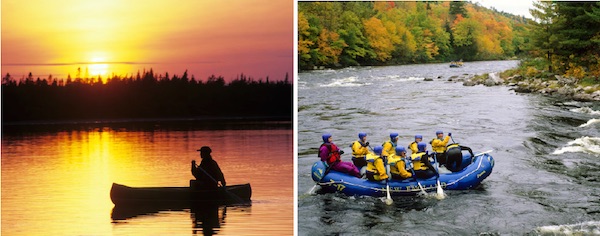
From peaceful backcountry paddling destinations to thrilling whitewater adventures, Maine's North Woods offers an array of recreational opportunities/George Wuerthner
Gail Sanjoy, president of the Katahdin Chamber of Commerce, says, 'The proponents of the national park don't believe that the national park standing alone will be our area's savior, but it will go a long way from where we are today. We need to explore all options, and keep all options on the table, and the national park happens to be the offer on the table right now.'
In March the Bangor City Council voted 7-2 to support the concept of a national park, joining the towns of Millinocket, East Millinock, and the Penobscot Indian Nation. In late March, more than 200 Maine business owners sent a letter of support to their congressional delegation, which has not as yet supported the concept, choosing to listen to their constituents. But it's obvious that support is growing.
Proponents see the land and its endowment as an incredible gift at a time when economic options are limited, and feel something needs to be done. For others, these woods are their home, which contribute much more than hiking trails for the occasional tourist.
Miri Gubler spent the spring semester as an editorial intern with the Traveler. She previously has written about Acadia National Park and California condors
Story Categories:
A copy of National Parks Traveler's financial statements may be obtained by sending a stamped, self-addressed envelope to: National Parks Traveler, P.O. Box 980452, Park City, Utah 84098. National Parks Traveler was formed in the state of Utah for the purpose of informing and educating about national parks and protected areas.
Residents of the following states may obtain a copy of our financial and additional information as stated below:
- Florida: A COPY OF THE OFFICIAL REGISTRATION AND FINANCIAL INFORMATION FOR NATIONAL PARKS TRAVELER, (REGISTRATION NO. CH 51659), MAY BE OBTAINED FROM THE DIVISION OF CONSUMER SERVICES BY CALLING 800-435-7352 OR VISITING THEIR WEBSITE. REGISTRATION DOES NOT IMPLY ENDORSEMENT, APPROVAL, OR RECOMMENDATION BY THE STATE.
- Georgia: A full and fair description of the programs and financial statement summary of National Parks Traveler is available upon request at the office and phone number indicated above.
- Maryland: Documents and information submitted under the Maryland Solicitations Act are also available, for the cost of postage and copies, from the Secretary of State, State House, Annapolis, MD 21401 (410-974-5534).
- North Carolina: Financial information about this organization and a copy of its license are available from the State Solicitation Licensing Branch at 888-830-4989 or 919-807-2214. The license is not an endorsement by the State.
- Pennsylvania: The official registration and financial information of National Parks Traveler may be obtained from the Pennsylvania Department of State by calling 800-732-0999. Registration does not imply endorsement.
- Virginia: Financial statements are available from the Virginia Department of Agriculture and Consumer Services, 102 Governor Street, Richmond, Virginia 23219.
- Washington: National Parks Traveler is registered with Washington State’s Charities Program as required by law and additional information is available by calling 800-332-4483 or visiting www.sos.wa.gov/charities, or on file at Charities Division, Office of the Secretary of State, State of Washington, Olympia, WA 98504.


Comments
Making the North Woods a National Park might bolster some towns' local economies but it wouldn't be good for the North Woods.
What about private property rights, EC? As I understand it, all the land for the proposed park would come from Ms. Quimby.
Curious to see some elaboration from EC as well. The article seemed to suggest the opposite. I am not familiar with the local politics of Maine. Looking forward to a more thorogh response.
Kurt,
Didn't say she didn't have the right to give her property or money away. Just saying it wouldn't be good for the North Woods to make it a National Park.
So perhaps you could explain why turning private property, which could in theory be sold for logging or development, into a national park, would not be good for the North Woods?
Because the alternative isn't to log and develop. She could put it into a land trust and let it sit as it is. Creating a magnet to draw more people with more infrastructure would not be good for the Woods. Admittedly this is a small area but the natural tendency would be to attempt to expand. Not to mention the additional burden on the NPS system.
Well, it would be a burden on the NPS, granted. That's Congress's fault.
But I think it could be a rich resource for science, introducing generations to a unique ecosystem, and encouraging healthy outdoor activities. Parks have the unique ability to do all three. I'm not sure lands in trusts do...particularly when trusts shut off public access.
As for "more infrastructure," you look at the landscapes of places such as Yellowstone, Glacier, Big Bend, even Shenandoah, and that aspect can certainly be controlled if not prevented outright. The establishment of Shenandoah was even good for the health of the Blue Ridge there in Virginia.
I definitely understand what EC is saying, and I tend to agree with some of his statements, but I still support seeing another large scale National Park on the scale of some of the western parks being created in the Eastern US. This is one of the last best areas this can be done, and it should be done. Large scale natural areas are a diminishing commodity in this country, and we should do whatever we can to protect what's left. However, I prefer more parks are created similar to how North Cascades was created, in that development of it is vastly limited, and the wilderness act is quickly applied. Unfortunately in this case, i'm not sure this could happen. It would have to become a park first, because it's currently not public lands. But, I do favor the opinion that development of the protected area should be vastly limited inside the National Park boundary. Meaning close some dirt logging roads, turn other dirt roads to trails, and attempt to minimize homo sapien consumaticus from devouring what's left of the area. If they turn this into a park, than build 50 paved roads to every overlook and unique feature in the forests ecosystem, then it's better off being left in something like the nature conservancy. North Cascades National Park should be the model for every new National Park with a large scale natural and scenic area.
No - when you ask for and take on obligations beyond your budget - its your fault.
Another strawman. There is no reason the land trust would have to "shut off public access". The access could be equal or even greater than it is now.
But, certain land trusts do have a tendancy to shut off access to land. It's quite common actually. I support what the Nature Conservancy does at times, but many times they don't open the lands in their trust to the public, or it's very limited access. At least with a National Park this usually isn't the case. Maybe there will be closures here and there to protect species, or certain resources, or maybe they limit access via permits, but rarely are areas shut off to the public outright.
I would like to think, Eric, that if the people decide a landscape should be included in the National Park System, Congress should acknowledge that and see that the Park Service has the funds to provide for that new site.
Of course, I also believe that if Congress decides on its own to add to the National Park System it should provide the money to the Park Service to administer that site, and I don't see that always happening.
And really, when you consider that the NPS budget is either 1/13 or 1/15 of 1 percent of the federal budget, I think the money exists to provide for these places.
The discussion here points to a deeper problem--the vanishing American worker. I sympathize that tourism may save northern Maine; then again, what if the new park only dilutes the market and the Park Service budget besides? Is tourism what we need to "save" America, or an economy that makes sense for everyone? The Maine woods? Why can't Maine save them, just as New York saved the Adirondacks? Do the Adirondacks lack for tourists? No. However, they will soon lack for them if upstate New York fails at rebuildng its rust-belt economy.
In this case, why let Congress off the hook? You have another trade bill before you promising us the Moon if we trade off American jobs to the "Pacific." Which is it? Do we get to keep our country or just keep making parks no one intends to fund?
Environmental Studies 101 starts with the admission that full employment is the prerequite for parks. Not hamburger flippers, either. After denuding these northern forests once, we realize that denuding them a second time bears enormous costs. In New York State, that led to state ownership of 2.5 million acres of the Adirondacks, and strict controls over 2.5 million more. The people who went there worked for Kodak, Xerox, IBM, Endicott-Johnson, Corning, Kroehler, Universal Instruments, Link Aviation, Ansco, Pittsburgh Steel, and many more. In 1960, New York still had 45 electoral votes. Buffalo's economy was the 10th largest IN THE WORLD.
Okay, I digress. We were talking about parks. But that is how you get them--a robust middle class. You don't get them--and certainly will not keep them--by selling tourism to local economies that are shot. Everywhere I travel, people are feeling pinched. They may still be spending, but they feel insecure. That is the problem we need to resolve before asking Congress for more national parks.
Thank you Kurt and Dr Runte. Actually a great blueprint for new parks after the railroad era of Directors Mather and Allbright was DOI Secretary Harold Ickes and his plan for Cedar Grove in Kings Canyon National Park. Except for campgrounds, concession facilities were extremely modest, nothing has changed. When you get to Cedar Grove it really strikes you as a National Park, campgrounds and trailheads, that is about it. No Ahwahnee Hotel, Yosemite Lodge, massive gift shops, super market, etc. An excellent book on this issue is "Righteous Pilgrim, The Life and Times of Harold L. Ickes, 1874-1952" by T.H. Watkins. In any case, thank you again Alfred, you are right on, as usual, in my view.
That isn't how our Constitution works. And you should be thankful for that.
Fully agree, put exactly what parks were established over NPS objections?
From Alfred:
Agreed, but I fear you and I would have different proposals on how to solve the problem.
Unfortunately, Dr. Runte is exactly correct.
The REAL foundation of America has always been its workers. They are the people who BUILT this country with their sweat and, sometimes, blood. Our farmers, miners, construction workers, teachers, bank tellers, housewives, sewer plant operators, firefighters, police, nurses, nurses aides and countless other hard working Americans. Without them, and their efforts, those at the top would be helpless and impoverished, for indeed they did not build it themselves.
Once upon a time, our national parks were playgrounds for the elite. Now they are, and must continue to be, places of respite for those whose hard work makes it possible for the elite to be elite.
Lee, I don't dismiss the contribution of the "workers" but they "did not build it themselves" either. Its a symbiotic relationship. We wouldn't have the great nation we have without both.
ec--
That isn't how our Constitution works. And you should be thankful for that.
No, it is not how our Constitution works. You and I don't have a vote in Congress. However, the National Park System is full of places that first were advocated by people like you and me and then established by the Congress.
Fully agree, but exactly what parks were established over NPS objections?
So, other than those areas created by a President using the authority of the Antiquities Act, all were created by the Congress so you must agree that the Congress has the obligation to adequately fund them. As to which parks were established over over the objections of the NPS, here's a story for you. When I worked in the Legislative Division of the NPS, I testified in front of the National Park Sub-Committee chaired by Rep. Phil Burton of California. I can't remember which area we were discussing at the moment, but I told the Committee that the area did not meet the national significance standards of the NPS. Burton peered over his glasses and responded, "Young man, the Congress of the United States will determine what is nationally significant. You just tell me how much it is going to cost."
Yes it is, but there are many places advocated by "people like you and me" that aren't in the system. Just because people like you and me advocate for them, doesn't mean they should automatically be included.
A story but no identification of a park that the NPS said "No" and Congress created anyway. Yes, Congress should fund parks it creates but the NPS should say no to parks that aren't/won't be funded.
And just how, pray tell, does the NPS say "NO" to Congress?
The Department of Defense, which is the darling of at least one side of Congress, tried to say NO to something called the F-35. What happened?
Well Lee, since none of you have come up with an example of where they said no and Congress went ahead and approved a park, I guess the answer is, the NPS can't say no.
Oh, and while there might be legitimate reasons to not want the F-35. Congress approved and FUNDED it.
Exactly my point. It's hard to say NO to the nine thousand pound gorilla. Which is probably why no one can come up with an example.
Yup. But talk about messed up priorities . . . . . .
The NPS initially opposed addition of Patterson Great Falls in New Jersey.
In fact, the Interior Department back in 2001 asked Congress not to do it until the NPS could whittle away its maintenance backlog.
/2007/10/new-jersey-delegation-unduly-forcing-great-falls-paterson-park-nps
One example out of 400 plus units. I see you used the term "initially". Did they change their stance? Did the unit get approved after that change?
Oh, and I kind of like the irony of your position then and now.
"If this is such a great site, why can't it stand on its own by drawing tourists without having to resort to the NPS logo and annual infusions of federal funds?"
BTW - Salazar seemed pretty delighted to have the unit when he spoke at its dedication.
No it is not. The Pentagon did just that. They may have not gotten their way, but at least they said "no".
EC, you wanted an example and I provided it.
How things transpired after the NPS said 'no' I can't say, just as with more than 400 units of the park system, and who knows how many studies, I can't immediately point to any other examples where the agency opposed a designation.
But I'd wager that some NPS eyes rolled when Ohio Congressman Regula pushed through the legislation to create the First Ladies National Historic Site in his home state. And despite Dr. Runte's fondness for railroads, Steamtown is another head scratcher.
In Traveler's Call for Papers, you might recall that we raise the question of whether the Park Service is more and more turning into a catchall for places that might better be cared for by the states, or perhaps a National Historical Service. I think that's a good and timely question to ask as the agency approaches its centennial.
But really, do you expect the NPS to say "no" to many -- if any -- proposed additions? Their job is to manage what they're given, and while it'd be nice if their position on prospective units would be accepted by Congress, that's politically untenable. Rick Smith made that quite clear.
I don't see any irony in my position on Paterson Falls and Maine North Woods. You can't compare the two sites; apples and oranges.
There are very few places left in the country where large expanses of natural landscape can be added to the National Park System, unless you start transferring national forests or BLM landscapes. As the NPS said, many other sites already in the system interpret what Paterson Falls offers.
As for Salazar's comments, what's he going to say? "This is an atrocious addition that's been foisted on us, but somehow we'll manage."
Frankly, I think the Interior Department position in 2001 was one that needs to be echoed today with some force, damn the politics.
Just for the record, the Park Service has said "no" to scores of potential units, especially in the 1920s under Stephen T. Mather. The point is: He was a millionaire and didn't give a damn what Congress happened to "think." Under Mather, the National Parks Association (which he formed) attacked so-called inferior units. As president of NPA, Robert Sterling Yard was good at it, too.
The trouble is: Yard also attacked worthy eastern units, since they did not live up to the geology of the West. He didn't like Shenandoah, for example, although he begrudingly came to accept Great Smokies and the Everglades. Nor did the NPA properly defend Olympic National Park, preferring to axe the trees. Jackson Hole, in Yard's view, "borrowed" its grandeur from the Tetons. With Yard it was all geology, just as it remains today for many folks.
Meanwhile, Mather told the states flat out that it was their responsibility to preserve "local" scenery. Of course, Washington State would NEVER have done with that the Olympic rain forests; its own congressional delegation was also opposed. Nor would Wyoming have spared Jackson Hole. Arizona would have dammed the Grand Canyon, no matter what the nation thought.
The issue before us with 407 units is a throwback to our past. As a country, we have never properly funded the national park system--never, never, never. Even when it was one unit--Yellowstone--Congress waited five years to fund it. In the end, the railroads wound up funding the parks, that is, developing them for tourist travel.
We always prefer the "fix." We'll "raise" the money from "outside." We'll find another Rockefeller, or a couple hundred Rockefellers. If not, we'll raise the fees at the gate. Why do we do this? Because we are broke, and always have been broke. We just don't admit it. We just keep issuing bonds in hopes that no one calls them "junk."
Today, according to THE WALL STREET JOURNAL, your government and mine is backing the bankie wankies to the tune of 26 TRILLION. Yes, TRILLION. And you want parks? Ha! Get to the end of the line--way to the end of the line. The very back of the line. There is no one in back of you. Everyone with a hand out is ahead of you, starting with the banks.
This is what Harry Butowsky has been trying to say. As for the Park Service not saying "no" enough, how do you say no to people who only know how to say yes? Congress just can't say no. The American people themselves don't want to hear it. In that case, we can hardly expect the Park Service to be immune, although yes, I think it is still reasonable to ask that they take the high ground and allow Congress to push them off the cliff. In the end, history will tell who did the pushing--just in case anyone at the back of the line really cares.
So, you can't say whether a park was in fact established over the NPS objection. The point here (Alfred) is not whether the NPS ever said no its whether it ever said no and had a park established anyway. The original complaint was that Congress was establishing parks and not funding them. My point was that NPS was happy to get these new parks despite their lack of funding.
A total mischaracterization of the issue. They aren't backing the banks the are backing your pensions, your deposits and your mortgages and are taking insurance payments to cover any losses. But I agree, the government should get out of the "guaranteeing" business.
Actually, the Park Service said "no" to Olympic National Park--and got it anyway. Nor were they "happy" to have it. Read Carsten Lien's book, OLYMPIC BATTLEGROUND.
Obviously, directors (and policies) come and go. But in general, Park Service employees have always "prioritized" the system, much like the faculty in universities. You don't want to move to a "career-ending" park. You rather want to stay in the Ivy League. That is probably the best indication, between the lines, of what the Park Service wanted and didn't want.
Do you say "no" in a Congressional hearing? Never. But directors often plead their case to the Secretary of the Interior. Remember. The Park Service director does have a boss. As boss, the President--through the Interior Secretary--determines what the agency will "want"--and not want. By the time Congress holds a hearing, the director has his marching orders. And they do not include embarassing the president in public. All of that discussion goes on behind the scenes.
As I said to retired Park Service Russ Dickerson years ago in response to his quip: "Why should I fall on my sword?" "Russ, I don' expect you to fall on your sword, but yes, I would like to see you flash it once in a while." In this administration--or any administration--we need to concede how difficult that is.
Some excellent observations by Dr. Runte. Unfortunately, he's right.
Thank you, Traveler, for the article to update us on the proposal I've been following for 25 years and to all the commenters for an excellent discussion.
Exactly right, Ron. And the two books you mention should be required reading for all of us who frequent Traveler.
Ron, the NPS - and much of the rest of the government needs more Robert Dannos.
Gonna have to agree with you on that one, ec. And so does Congress. But that second one is a completely forlorn hope as long as so many of them are controlled by their purchasers.
But we will have to disagree there. I believe they are controlled by the public whim. Too many are afraid to do what is right if it might alienate their voters. The RINO Republicans are a prime example.
Absolutely correct, Lee. Ever since Citizens United, and clearly since the visble rise of the Koch empire, there can be no doubt, at least among honest citizens of a three digit IQ.
Oh spare me, Rick B. Your found conscience is leading you far astray. Koch empire, Geez. Hmmm, Clinton BS empire off limits? So much BS out there under the banner of compassion. Yep, spare me!
Hey, I don't mean to put the breaks on discussion but there really is a world spinning out of control while you are discussing the small stuff. It's going to land in your lap at some point. As long as this bunch throws you a bone, that's enough? going to regret that strategy. Gotta buck up at some point. Getting pretty ugly every way you look.
Yeah. A lot of us like the parks to be a break from the fear mongering going on in much of the discourse nationally. I mostly avoided continuing that conversation because I promised Kurt I'd get out of the mud wrestling. Go ahead and rant on - I won't join in further with you.
Glad to see your latest article, National Parks Traveler 101, link to this update on the proposed Maine Woods national park or national monument. Missed this the first time around. Readers interested in this issue may also be interested in our recent blog post about the connections between Acadia and Baxter, and how that may help inform the debate over the proposed park: http://acadiaonmymind.com/2015/12/acadia-national-park-baxter-state-park/
Homo Sapiens Consumaticus --- love it!
Thoreau lived just out of town. His mother delivered a hot meal to him every Sunday,on foot, to Walden. He may have gone on a walk about in Maine, but he has been elevated far beyond his contributions to this world. The other falsehood in this is that Roxanne's scheme is all her land, it is not. It doesn't matter Quimby or Thoreau altruism is just hype and legend.
Normal
0
false
false
false
EN-US
JA
X-NONE
/* Style Definitions */
table.MsoNormalTable
{mso-style-name:"Table Normal";
mso-tstyle-rowband-size:0;
mso-tstyle-colband-size:0;
mso-style-noshow:yes;
mso-style-priority:99;
mso-style-parent:"";
mso-padding-alt:0in 5.4pt 0in 5.4pt;
mso-para-margin:0in;
mso-para-margin-bottom:.0001pt;
mso-pagination:widow-orphan;
font-size:10.0pt;
font-family:"Times New Roman";}
Greg,
These are the same old talking points that we have heard for years from anti-national park and wilderness advocates.
No one has denied that Thoreau's cabin was not near town. So what?
http://www.sierraclub.org/sierra/2015-5-september-october/green-life/def...
Of course, Thoreau did far more than go on a "walk." He spent weeks in the remote Maine wildlands, which is more than obvious to anyone who has read The Maine Woods.
Regarding the creation of a national park in the Maine Woods, the only hype and legend I have seen is coming from opponents, who have been spreading misinformation for many years.
Interesting how articles are not written correctly. The towns of Millinocket, East Millinocet and others "DID NOT SUPPORT" the creation of a Park or National Monument.