
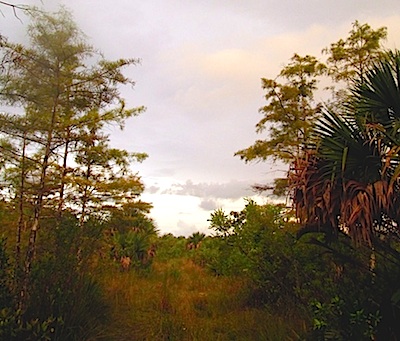
A federal judge has ruled the Park Service could place recreation interests above its preservation mandate at Big Cypress National Preserve/South Florida Wildlands Association
Editor's note: This updates with National Park Service Director Jon Jarvis's decision not to comment on the ruling.
A federal court has upheld the National Park Service's decision to place an emphasis on recreation above preservation in nearly 150,000 acres of Big Cypress National Preserve, a ruling seen by some as chipping away at the longstanding mandate that the agency put preservation first.
Whether that ruling (attached below) will be viewed as precedent-setting in other lawsuits seeking more access to national park lands remains to be seen, but onlookers fear it at least reflects a change in management philosophy in the Park Service.
"The bigger concern for the National Park System is that philosophy being embraced by top agency managers," wrote Jeff Ruch, executive director of Public Employees For Environmental Responsibility, one of the plaintiffs in the lawsuit, in an email to the Traveler. "The issue before the court was whether that imbalance of recreation over preservation was so egregious as to violate the Organic Act -- again, another high legal bar. This particular federal court ruling has no precedental value outside the judicial district. If upheld on appeal to the U.S. Circuit Court, it could give that ruling region-wide status."
No decisions have been made by PEER or the National Parks Conservation Association, another plaintiff, on whether to appeal.
"Overall, NPCA is disappointed with the judge's ruling. This decision will result in negative impacts to the endangered Florida panther due to excess off-road vehicle use," said John Adornato III, the Sun Coast regional director for the park advocacy organization, in an email. "The Addition Lands are a unique place filled with rare species, including the ghost orchid, and deserve adequate wilderness designation. At this time, though NPCA is evaluating its options and next steps."
Park Service Director Jon Jarvis declined through a spokesman to comment on the ruling and whether he was concerned that it might be used elsewhere in the National Park System to override the agency's preservation mandate as directed in the National Park Service Organic Act.
"Since this matter is the subject of ongoing litigation, we won't have a comment," said Jeffrey Olson, noting that plaintiffs have until Nov. 24 to appeal.
Rick Smith, a member of the Coalition of National Park Service Retirees, found the ruling disconcerting because of its possible outcomes across the park system. While he had not read the entire decision, and so couldn't say it whether it could be applied system-wide, Mr. Smith voiced concern just the same.
"For a long time our policies have said that preservation is the first priority. Now the court seems to be saying that we have to 'strike a balance,' whatever that means. I am sure that recreationists will seize that phrase to try to justify activities that are resource-damaging," he said.
The Big Cypress lawsuit, filed in 2011 by PEER, NPCA, the Sierra Club, the South Florida Wildlands Association and others, claimed that the management plan preserve officials adopted for the Addition Lands allowed for too much ORV use. The filing argued that widespread motorized traffic allowed for under the preserve's management plan would "degrade the unique natural resources" of the Addition Lands, "create conflict with non-motorized users, and fragment one of the last major wilderness areas in the eastern United States."
Species said to be at risk from increased ORV use include many of Florida's most iconic species, such as the critically endangered Florida panther (with an estimated 100-180 adult cats remaining in the wild), Cape Sable seaside sparrow, wood stork, red-cockaded woodpecker, Everglades snail kite, eastern indigo snake and the American crocodile.
"Obviously - with many years of work in this issue - I'm personally very disappointed in the ruling - and disappointed in the preserve administration's insistence in bringing motorized recreation to this very special piece of federal land," said Mathew Schwartz, executive director of South Florida Wildlands. "The NPS literally wrote the book on the negative consequences of ORV use in the preserve - it's called the Off-Road Vehicle Management Plan (2000) for the original preserve. According to the NPS itself, off-road vehicle use in the Big Cypress leads to destruction and compaction of fragile wetland soils, destruction of plants and roots, helps spread invasive plants such as Brazilian pepper throughout the preserve through soil disturbance and seed dispersal, disturbs native wildlife, fragments habitat, changes the hydrology, and creates user conflict.
"They easily could have honored their original wilderness eligibility assessment for the Addition Lands and left the vast majority of the area completely off-limits to what NPS itself refers to as a 'high impact recreational activity'," he added. "It would have benefited the vast majority of users - who are non-motorized - but more importantly, kept ecologically intact a vast area of great importance to native plants and animals of the Greater Everglades."
The Addition Lands are a swath of 147,000 acres (112,400 held by the NPS, the rest in private hands) that came to Big Cypress in 1996 as part of a land swap. At the time the Addition was added to the original preserve's northeastern corner, it was placed off-limits to ORV travel and hunting until a management plan could be developed. When Superintendent Pedro Ramos released the final version of that plan in November 2010, it called for up to 130 miles of ORV trails, and as many as 650 ORV permits annually. Along the way to developing that plan, his critics allege that the superintendent and his staff went around Director Jarvis' wishes and denied wilderness eligibility for 40,000 acres in the Addition section.
But in his ruling last month, U.S. District Judge John Steele ruled in part that Big Cypress officials both correctly analyzed the Addition Lands for wilderness eligibility and were within the law and not motivated by politics when they decided to remove 40,000 acres from wilderness consideration. "The Wilderness Eligibility Assessment has been made, and there is no suggestion that anything is in the works to change it," Judge Steele wrote in his 73-page opinion. "Judicial action will not inappropriately interfere with further administrative action regarding the Wilderness Eligibility Assessment, since no additional action is necessary as to that determination."
One aspect of the judge's ruling that particularly drew concern from conservation groups was his finding that, at least in the case of Big Cypress, the Park Service was within its perogative to place recreational use of the Addition Lands above preservation of those lands.
The overarching legal principles Plaintiffs seek to establish are simply not that easy. The conservation mandate of the NPS Establishment Act was tweaked by the subsequent Preserve Act and the Addition Act, both of which required multiple use management, which included the allowance of hunting and at least some recreational ORV use. As was previously stated, multiple use management is a deceptively simple term that describes the enormously complicated task of striking a balance among the many competing uses to which land can be put. The Court rejects Plaintiffs' argument that every NPS decision must favor preservation if there is a conflict with another goal. This would not be 'striking a balance.' The Court finds that the substantive decisions by the NPS did not violate the Organic Act or the Establishment Acts.
Stories about:
Story Categories:
A copy of National Parks Traveler's financial statements may be obtained by sending a stamped, self-addressed envelope to: National Parks Traveler, P.O. Box 980452, Park City, Utah 84098. National Parks Traveler was formed in the state of Utah for the purpose of informing and educating about national parks and protected areas.
Residents of the following states may obtain a copy of our financial and additional information as stated below:
- Florida: A COPY OF THE OFFICIAL REGISTRATION AND FINANCIAL INFORMATION FOR NATIONAL PARKS TRAVELER, (REGISTRATION NO. CH 51659), MAY BE OBTAINED FROM THE DIVISION OF CONSUMER SERVICES BY CALLING 800-435-7352 OR VISITING THEIR WEBSITE. REGISTRATION DOES NOT IMPLY ENDORSEMENT, APPROVAL, OR RECOMMENDATION BY THE STATE.
- Georgia: A full and fair description of the programs and financial statement summary of National Parks Traveler is available upon request at the office and phone number indicated above.
- Maryland: Documents and information submitted under the Maryland Solicitations Act are also available, for the cost of postage and copies, from the Secretary of State, State House, Annapolis, MD 21401 (410-974-5534).
- North Carolina: Financial information about this organization and a copy of its license are available from the State Solicitation Licensing Branch at 888-830-4989 or 919-807-2214. The license is not an endorsement by the State.
- Pennsylvania: The official registration and financial information of National Parks Traveler may be obtained from the Pennsylvania Department of State by calling 800-732-0999. Registration does not imply endorsement.
- Virginia: Financial statements are available from the Virginia Department of Agriculture and Consumer Services, 102 Governor Street, Richmond, Virginia 23219.
- Washington: National Parks Traveler is registered with Washington State’s Charities Program as required by law and additional information is available by calling 800-332-4483 or visiting www.sos.wa.gov/charities, or on file at Charities Division, Office of the Secretary of State, State of Washington, Olympia, WA 98504.

Comments
We have been losing access to public lands at an alarming rate. Finally, it is refreshing to see some common sense and a step in the right direction. The American people are loudly applauding this decision. We desperately need a change in NPS philosophy and the groups opposing this change should take thier fears elsewhere.
Some of the plaintiffs and intervenor's comments are laugable. The funniest comment is one by Mr Adornato - "The Addition Lands are a unique place filled with rare species, including the ghost orchid, and deserve adequate wilderness designation. At this time, though NPCA is evaluating its options and next steps." - with all due respect the Big Cypress and Addition are not really unique (one of a kind) since very similar habitat (woods ) are all over So Fla. As far as the "ghost orchid goes - they are all over the place including hundreds of them in the Fakahatchee Strand Preserve State Park to the West of Big Cypress, Ok Slough to the North, Picayune to the West - let's tell the entire story for a change Mr Adornato. Sometimes creative writers/speakers should open a dictionary once in a while so as not to "?unintentionally?" spoof people that might believe them.
Folks need to start accepting the Big Cypress and Addition are NOT National Parks they are the earliest Preserves which mean one can use them and use them hard - just not to hard. That is the balance which folks sometimes don't get too easily. Kind of like the word "trammeled" in the wilderness act; had to look that one up myself to find out they aren't referring to trampling. LOL
To ease the minds of those that worry a lot about ORVs in swamps let me tell you - the only area of the 729,000 acres in the Big Cypress swamp that ORVs can go are on ORV designated trails whether primary or secondary unless an emergency or gov't. ORV is involved. There will never be more than 7 or 800 miles of them ever authorized so maybe those who worry may now be able to sleep at night. Other than the area the trails take the whole place is a wilderness. Does anyone understand that - why heck they didn't even need any wilderness study since 728,200 acres are already wilderness without the process.
Anyone giving money to these obstructionists/plaintiffs ought to demand a refund due to them misinforming their vulnerable contributors since they knew the above scenario all the time. LMAO - but is sad to see well intentioned trusting people being robbed continually by these slick talking shysters along with other people's (Gladesmen"s) dreams being stolen or delayed.
My hope is that NPCA or Peer appeals and loses again as the truth slowly emerges from the swamp and the next legal decisions become precedent setting regionally or better yet nationwide.
I normally would not agree with Beachdumb and Mr. Denninger, but both of them raise a point. Environmentalists are losing perspective, i.e., consistency, when it comes to the public lands. One moment they are promoting them for the siting of renewable energy (a huge footprint) and the next they are attacking others for inappropriate access. Sorry, but I don't think ORVs have any place in preserves or national parks. Still, environmentalists need to look in the mirror. If the message they send allows their favorite intrusion, all the while attacking how others intrude, their credibility will be shot. If wilderness matters, then climate change is no excuse for altering it, either, whatever that wilderness is being called. All across the American Southwest, huge energy facilities are popping up like daisies. They worry me more than ORVs. I want Big Cypress to be a wilderness. But I want that for the desert, too.
Mr.Denninger--I worked in Everglades for 3 years before BICY had its own superintendent in the early 80's. EVER managed the Preserve. During all that time, I never heard the term "gladesmen" although I attended meetings in the Preserve on hunting camps and ORV use. I suppose "gladesmen culture" applies to those people who ride ORVs in the Preserve although they certainly didn't appear to be a distiinct culture while I was there. Maybe it has evolved since then.
Rick
Correct - I wouldn't agree that it evolved since your tenure in the Glades since it was there but invisible until 2011 when the study referenced below was finalized.
The Gladesmen culture was validated to exist due to extensive comments I made to the Comprehensive Everglades Restoration Plan's (CERP) Master Recreation Plan. At the link supplied here anyone who doubts my words can go to it and read the entire study and/or the letter I wrote in appendix A.
Link - http://www.evergladesplan.org/pm/progr_master_rec_plan_gladesmen.aspx
As the study describes the Gladesmen culture extends North to the Kissimmee River valley near Orlando Florida. The culture is a component or sub culture of the Cracker culture. We Gladesmen basically knew there was something more to our bonds with the Glades due to how hard we fight to maintain our access there but had problems pinpointing what it was - eventually some of us figured it out, I wrote the comments citing the US Army Corps violation of the National Historic Preservation Act as amended 2000 and the Corp took it upon itself to study us and did determine the Gladesmen Culture still exists and is alive but not as well as it could be if certain repeated federal plaintiffs (e.g. NPCA, Sierra, Sl Fl Wildlands whatever, biodiversity groups etc.) would go somewhere else to weave their misinformation into frivolous litigation that only saps tax dollars, wastes donors well intentioned gifts, steals other Americans dreams in the process.
I still can't understand why folks like Adornato, Schwartz and their monied organizations keep coming after us. I mean their predecessors saw to it that in excess of 22,000 miles of previously legal travel routes (understand the area the trails take is about 1.3 % of Big C) were denied us but instead of smiling over their victory and going to the next place to steal local residents dreams they keep fighting over relatively insignificant 100 or 200 miles here and there in Big Cypress. I can only conceive of two reasons they continue attempting to wreck and ruin a small cultural community's "quality of life" and they are pure 100% bigotry and milking the Big Cypress donation cash cow until it's completely dry.
One reading my comments might sense I have a bit of an attitude - they would be correct!
Interesting read. I'm curious if the gladesmen you know have overcome the anti-black racism endemic in their 'cracker' roots.
Many people in American society have overcome previous prejudices such as racism and others but I'm sure all Americans haven't and probably never will - what else is new. I wouldn't focus on cracker or gladesmen with an off topic comment like that.
Just to let you know - cracker culture actually refers to Florida cowboy/cattle culture that "crack"ed bull whips to move cattle out of cypress swamps hence the "cracker culture".
Now one who is more familiar with urban living might very well be confused with this Florida specific term. I do believe the term cracker in the urban setting is a negative racist term aimed at caucasians - big deal - water off a duck's back to me.
No, actually I did read the whole document including how it described that term and it's history. I wasn't throwing it out as an insult; it was a honest question in context.
Honest answer - I can't speak for others but I would guess that Gladesmen's attitudes on race would vary due to many variables (education, family, peers etc.) we all are subjected to through life. It is great to hear you took the time to learn about our Gladesmen culture hopefully others will also if given the opportunity.
Just for the record, every national park, preserve, historical site, etc., has had this debate. On Monday, in fact, the Seattle City Council voted to replace Columbus Day with Indigenous Peoples Day. Debate resolved. Everyone since Columbus in an interloper, and that goes for gladesmen and crackers, too. Here is what we forget. In the maintenance of a civilization, in this case one including the national parks, we all have to give up something, including what we perceive to be ancestral rights. Unfortunately, our colleges and universities stopped teaching that long ago. It is all about me, me, me. Given "the system," as it were, future historians will understand why so many agreed to participate, but yes, those historians will be equally obliged to report how our blatant selfishness destroyed the "best idea we ever had," including democracy itself.
Agreed that everyone should be willing to give up some but not all of their rights without 100% just cause. That's a large part of our debate over management - how much to give up. Gladesmen and other locals down here have already given up around 99.8% of previously legal access trails. My question is when is enough enough. ORV trail access in Big C doesn't amount to much percentage of the land mass (I know that's debatable) and on top of that they are available to everyone not just one type visitor.
Maybe at some point visitors will look upon them as an asset helping all to enjoy the wonders hidden deep in the Big Cypress Swamp since once you step off of them you are in a wilderness whether technically specified as or or not.
Why is it called "Big Cypress National Preserve" and not "Big Cypress National Recreation Area"? If Congress had intended recreation to have top priority, wouldn't they have chosen the latter name?
From what I've heard over the years they called it a Preserve to distinguish that it wasn't a Park thus coule be used hard just not too hard. The word is very confusing though and possibly responsible for the general public's confusion as to what can take place in a Federal Preserve.
Now here's a funny - When the State of Florida specifies a State Preserve such as the Fakahatchee down the street W of the Big C they mean that propewrty is like a National Park and not to be used for much human activities other than hiking.
Yes - words can be very confusing.
Why do you only go back to Columbus? The peoples before him were immigrants and conquerors too.
So true, EC. But tell that to the Seattle City Council. They ignore the war clubs on display in the Burke Museum, along with the rest of the history nobody likes. Of course, the war clubs and shields were only "ceremonial."
True and honest environmentalists should be beyond angry with these groups (Audubon, DoW, PEER, NPCA, the Sierra Club) for thier blatant dishonesty. They are turning the people against them and their once honorable cause. You have to be either delusional or dishonest to support these groups. The NPS are shed in a negative light because of thier association and alignment with these groups. Who are the real environmentalsts these days that understand the need for truth and balance? The evidence shows it is not these groups.
Beach, I heartily agree. So many times something starts out on the right path and then morphs. Time to re-evaluate focusing more on just what you suggested. Tough thing to do in this political environment but people will recognize truth when they hear it. Wished more people would try it.
Participating as respectfully as one can in as many forums such as this is one way to inform others as best we can of the details of very complicated and convoluted situations NPS finds themselves in due to political compromises that end up as laws such as the Enabling Act of the Big Cypress and it's Addition.
These inherint complexities set situations up that facilitate those with funding and publishing machines to spin the yarns that deceive members of their organizations who then actually wind up donating more money to them that fosters more of the same misinformation being dumped into these brains of the vulnerable folks that believe them.
It is a very tall order to reinform people in an accurate manner since their minds get made up based essentially on misinformation rather than accurate truth.
Is it a coincidence that these groups are all Democrat party supporters and it's members are also? Is this political party followers just more easily duped?
Examples of the simpleheadedness of party followers of all ilk abound, dumb.
When you have only a hammer in your own hand, you're going to see nails everywhere in a favorable light, and 'the other guys' will all appear to be phillips head screws.
NPCA doesnt want balance, they want thier way only. I see that this radical left wing organization is asking for a rehearing. I suspect they will continue litigation until they get thier way. Rick's dumb comment regarding balance of 'whatever that means' is getting a chuckle elsewhere.
http://islandfreepress.org/PivotBlog/?e=314#body-anchor
The ORV crowd doesnt want balance, they want thier way only. I see that this radical anti-wild organization isn't wise enough to realize what this decision could mean. I suspect they will continue litigation until they get thier way everywhere. Rick's wise comment regarding balance of 'whatever that means' isn't getting a chuckle everywhere.