
Is this your strategy for getting yourself out of a bind in the backcountry?
Do you skimp on backcountry preparations, figuring you've got your trusty personal locator beacon or cell phone to summon help at a moment's notice? It's tempting, no? Why prepare yourself equipment-wise and possibly skill-wise when help is just a button push away?
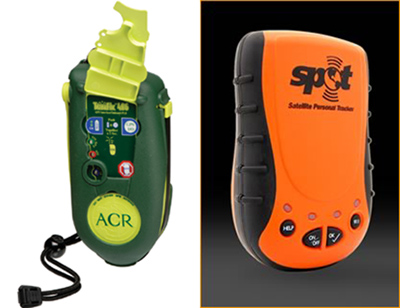
Heck, while you might think the hefty, $550 price of an ACR TerraFix PLB puts PLBs out of your reach, the more affordable Spot ($170 MSRP, plus a $100/year service plan) makes it easy to head off the beaten path with a locator that will help you out when the going gets tough and cell phone coverage gets lost. Another benefit it has is a function that allows you to alert either the authorities or your friends when you're simply running behind schedule but are not in trouble, thus averting a full-scale search-and-rescue mission.
Curious about the SAR professional's opinion on these gizmos, I turned to Butch Farabee, who during his 34-year National Park Service career participated in more than 1,000 SARs in such parks as Yosemite, Death Valley, and Grand Canyon, for his thoughts.
He'd didn't mince words.
"Most SAR people will tell you that this kind of technology is great from their perspective and when it is used appropriately and there is a connection, i.e. the cell phone gets the distress call into 911 or that the cell phone can be traced through the various cell phone towers and related sites, etc. That is the good news," says Mr. Farabee. "The bad news is that all too many people are now believing that all they need to take into 'the field' is their cell phone. Forget the rain gear or matches or whistle or tarp or mirror or checking the local weather forecast or letting someone know when to expect them back and where they were going, etc.
"All of this technology is doing a couple of things: Lots of people are leaving their car without anything else in their 'SAR prevention pack' AND it is also luring people into 'pushing the envelope,'" he adds. "Many people, laboring under the assumption that they are more invincible and more safeguarded with this cell phone technology, are now going to places and doing peaks and mountain biking and exploring where they would never consider doing this pre-cell phone. I do think there is a greater sense of no personal responsibility."
When I recently caught up with Mark Hnat at the National Park Service's Washington headquarters, he had mixed views on the value of PLBs and cell phones in the backcountry.
"Some folks will say, ‘Man, we’ve got people with cell phones. They’re going to be calling a lot more and a lot more often.’ I don’t really know," said Ranger Hnat, who at the time was on temporary detail as the branch chief of emergency services. "Some people think that they’re helpful because if you have cell phone coverage we’ll get better contact with somebody so we’ll know where they are sooner, or how to get to them. So I think there are some advantages to that. Whether it’s causing more that are false alarms or not, I don’t really know. I think there are probably some, but I don’t necessary say that it’s bad.”
Perhaps not, but perhaps so.
The May 2008 edition of National Geographic Adventure carries a letter-to-the-editor that tells a tale of a backcountry traveler who was more than happy to activate his PLB and let the rangers come to his rescue.
"This past January I went on a solo backpacking trip into California's San Bernardino Mountains that quickly turned from beautiful to disastrous. I woke up the first morning above a thick cloud cover and began to ascend Ontario Peak. I am an avid backpacker, but because bad weather had never given me serious trouble, I did not feel that I was in danger. I continued to climb, even as more foul weather approached. My logical mind drawing on years of problem-free hiking adventures told me that I would always find my way back to the trail. How untrue this turned out to be. My descent after the successful summit was blurred by a snowstorm and dense fog that left me disoriented and lost. I set off my personal locator beacon, made shelter, and waited for search and rescue crews to come. Luckily they were able to find me and lead me off the mountain."
Mr. Farabee was, suffice to say, taken aback by this letter.
"I know there may be things left out of the letter-to-the-editor, but this guy sets off his PLB and then sets up shelter? Whatever happened to setting up a shelter, getting in a sleeping bag, making something to drink, sleep the night away and see what the next morning would bring in regard to clear weather, finding the trail, seeing the highways below, etc.?" wonders Mr. Farabee. "This guy, it seems to me, has very quickly and all too readily called for the cavalry to come to his rescue. At the seemingly 'blink of an eye' he has put a great many people at risk and to a great deal of trouble. Whatever happened to a little personal responsibility, sucking in his gut and waiting a day or two?"
Regular Traveler readers might recall a story last July in which I recounted an incident in which a group of hikers who were beaten down by the heat near the floor of the Grand Canyon used a PLB to save themselves. The beacon's signal was detected from the canyon’s Surprise Valley, a remote area on the north side of the park, by the Air Force Rescue Coordinator Center at Tyndall Air Force Base in Florida.
Air Force personnel promptly called the park about 6:30 p.m. on July 2 to alert them to the signal. Rangers scrambled and used a helicopter to reach the location, where they found a hiking party of four. One of the hikers was suffering from dehydration and heat exhaustion and was taken out of the canyon by the helicopter. The other three remained in the canyon and were given ice and water by the rangers.
Now, obviously there are times when no matter how well-prepared you are accidents are going to happen miles from nowhere, and when they do it'd be nice to have a way to summon help. At the same time, as Ken Phillips, head of Grand Canyon National Park's chief of emergency services, put it at the time of this incident, "A person who carries a PLB should always take the proper measures to prevent themselves from ever having to use it."
Story Categories:
A copy of National Parks Traveler's financial statements may be obtained by sending a stamped, self-addressed envelope to: National Parks Traveler, P.O. Box 980452, Park City, Utah 84098. National Parks Traveler was formed in the state of Utah for the purpose of informing and educating about national parks and protected areas.
Residents of the following states may obtain a copy of our financial and additional information as stated below:
- Florida: A COPY OF THE OFFICIAL REGISTRATION AND FINANCIAL INFORMATION FOR NATIONAL PARKS TRAVELER, (REGISTRATION NO. CH 51659), MAY BE OBTAINED FROM THE DIVISION OF CONSUMER SERVICES BY CALLING 800-435-7352 OR VISITING THEIR WEBSITE. REGISTRATION DOES NOT IMPLY ENDORSEMENT, APPROVAL, OR RECOMMENDATION BY THE STATE.
- Georgia: A full and fair description of the programs and financial statement summary of National Parks Traveler is available upon request at the office and phone number indicated above.
- Maryland: Documents and information submitted under the Maryland Solicitations Act are also available, for the cost of postage and copies, from the Secretary of State, State House, Annapolis, MD 21401 (410-974-5534).
- North Carolina: Financial information about this organization and a copy of its license are available from the State Solicitation Licensing Branch at 888-830-4989 or 919-807-2214. The license is not an endorsement by the State.
- Pennsylvania: The official registration and financial information of National Parks Traveler may be obtained from the Pennsylvania Department of State by calling 800-732-0999. Registration does not imply endorsement.
- Virginia: Financial statements are available from the Virginia Department of Agriculture and Consumer Services, 102 Governor Street, Richmond, Virginia 23219.
- Washington: National Parks Traveler is registered with Washington State’s Charities Program as required by law and additional information is available by calling 800-332-4483 or visiting www.sos.wa.gov/charities, or on file at Charities Division, Office of the Secretary of State, State of Washington, Olympia, WA 98504.


Comments
Although I hope I never need it, I plan to carry something like a SPOT along with all my other backpacking stuff. There are just too many times when help is too far away and we must rely on ourselves and our preparation. To assume that we can "push the button" if we get into trouble is not very smart. "One-in-a-million" situations CAN occur; be prepared.
I just finished reading"The Last Season" , the story of Ranger Randy Morgenson's disappearance in King's Canyon N.P. If anyone would like to know just what all an SAR entails, this is a great education. Locator beacons are a great tool that can save life, time , and resources when used responsibly. But if you are the kind of slacker who would just lean on your "technology", you should realize every rescue mission endangers the lives of the people who come to save you. People, I might add, whose main jobs are probably way underpaid and not neccessarily geared toward search & rescue. As usual, people need to have that increasingly rare thing know as common sense. Be responsible for your own life.
Thanks for a great article. It's been featured on the front page of my website, http://www.scoutingwiththemouse.com (of course, with full credit given to you as the source) becuase I think this is very important information for folks to know.
PLBs will attain the same status as 911 operators, called routinely to give baking instructions or time of day. The good part of cell phones is that in much of the remote west, you may have six square feet of "coverage" in 2,000 square miles of desert. Which means if you aren't standing in just the right spot, the coyotes acquire a cell phone from someone with 21st century technical skills, and NO survival skills. Our pampered and pandering society no longer has the desire to take care of themselves, and that has NOTHING to do with political leanings, but everything to do with personal comfort, irrespective the impact on the society, or planet. I think it's time to give back to the coyote, or polar bears, or grizzly. DEPEND on your cell phone or PLB to protect you, make it easier for the scavengers to survive.
You tell 'em dtroutma !!
Iam a student of the basics and a believer in field craft over machine. I do not attempt to discredit advancements in technology nor there relative usefulness and am not some new age caveman living without electricty. I simply feel that we have become all too reliant on items like GPS, EPIRB's and have lost touch with the basics. I like alot of boys in my generation was a Boy Scout still carry with me their motto "Be Prepared". Some may say that they are being "Prepared" by having the EPIRB or GPS and they would be correct, right up to the point when I would ask them "Can you associate a compass to a map?" or "If the unit fails, do you know how or did you bring another method of signaling?". The worse case senario is the person that fore gos bringing extra food, water, means of fire and shelter because they have such items as the EPIRB, GPS, or cell phone. These are good addtions to have to a basic survival kit but they do not replace said kit nor the basics. My advice is if you have the knowledge do not fall prey to the "We won't need that its just a day hike" mentality. If you are lacking in the basic knowledge but love the outdoors my advice would be to obtain the information for basic compass use (Staying Found The Complete Map and Compass Handbook, June Flemming, the Mountaineers 1994) is an excellent source and is packable, carry a topo map of the area (USGS web sites, REI....), always hike in pairs, carry a survival kit (most outdoor stores have premade ones and their staff is often an invaluable source of what to buy if you want to build your own), obtain weather info for the area, and let someone at home and someone locally know where your going and when you will return. Make sure you let them know when you get back (I also leave a note on my vehicle with information as to where Iam headed and when I should be back. This allows passing hikers to know I am out there and if they go where I did and do not see me something might be wrong).
Be well my friends and Happy Trails
Shawn "Traverse" Baker