
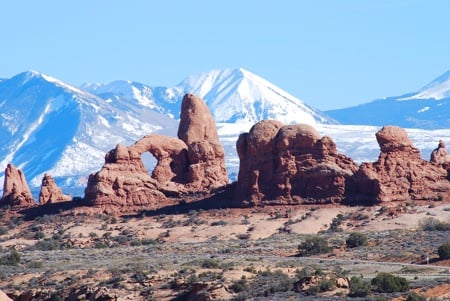
Is the scenery in a national park more important to your visit than the comfort of your lodging? NPT file photo of Arches National Park.
There are so many components that go into a successful national park escape. Travel to the park of your choice, comfortable and reasonably priced lodging, well-marked trails to explore, good interpretive programs, and nutritious, tasty meals are just some of the most obvious aspects. What's most important in your estimation to a successful park trip?
Do you put more emphasis on a clean, comfortable room to return to at day's end than on an interesting ranger-led program? Do you want to be able to lose yourself in a park museum, or down a trail, and everything else is secondary? Do you go home disappointed if the interpretive staff is made up of volunteers who are a little shaky on their presentations?
Let us know what makes the perfect national park trip, and we'll pass on your thoughts to the NPS.
Story Categories:
A copy of National Parks Traveler's financial statements may be obtained by sending a stamped, self-addressed envelope to: National Parks Traveler, P.O. Box 980452, Park City, Utah 84098. National Parks Traveler was formed in the state of Utah for the purpose of informing and educating about national parks and protected areas.
Residents of the following states may obtain a copy of our financial and additional information as stated below:
- Florida: A COPY OF THE OFFICIAL REGISTRATION AND FINANCIAL INFORMATION FOR NATIONAL PARKS TRAVELER, (REGISTRATION NO. CH 51659), MAY BE OBTAINED FROM THE DIVISION OF CONSUMER SERVICES BY CALLING 800-435-7352 OR VISITING THEIR WEBSITE. REGISTRATION DOES NOT IMPLY ENDORSEMENT, APPROVAL, OR RECOMMENDATION BY THE STATE.
- Georgia: A full and fair description of the programs and financial statement summary of National Parks Traveler is available upon request at the office and phone number indicated above.
- Maryland: Documents and information submitted under the Maryland Solicitations Act are also available, for the cost of postage and copies, from the Secretary of State, State House, Annapolis, MD 21401 (410-974-5534).
- North Carolina: Financial information about this organization and a copy of its license are available from the State Solicitation Licensing Branch at 888-830-4989 or 919-807-2214. The license is not an endorsement by the State.
- Pennsylvania: The official registration and financial information of National Parks Traveler may be obtained from the Pennsylvania Department of State by calling 800-732-0999. Registration does not imply endorsement.
- Virginia: Financial statements are available from the Virginia Department of Agriculture and Consumer Services, 102 Governor Street, Richmond, Virginia 23219.
- Washington: National Parks Traveler is registered with Washington State’s Charities Program as required by law and additional information is available by calling 800-332-4483 or visiting www.sos.wa.gov/charities, or on file at Charities Division, Office of the Secretary of State, State of Washington, Olympia, WA 98504.


National parks and their natural resources belong to you. The National Parks Traveler works to ensure you know how these essential places are being cared for.
Sign Up For Our Weekly Newsletter
Unsubscribe at any time.
INN Member

The easiest way to explore RV-friendly National Park campgrounds.

Here’s the definitive guide to National Park System campgrounds where RVers can park their rigs.
Our app is packed with RVing- specific details on more than 250 campgrounds in more than 70 national parks.
You’ll also find stories about RVing in the parks, tips helpful if you’ve just recently become an RVer, and useful planning suggestions.


Comments
For years I have joked that the best trip to Yellowstone NP involves seeing a moose. Although I never come home from Yellowstone NP disappointed, the more wildlife I see on a trip, the more special that trip become. I do appreciate the trails, the campsites, the Ranger programs, the other provided amenities, but what makes a good trip for me is the wildlife.
For us the most important thing is, by far, avoiding crowds. We plan trips for times of year when crowds will be minimized, and during the trip we plan any front country sight-seeing, programs, and visitor center browsing to happen on weekdays - preferably rainy ones.
Don't care about rooms, because we bring our own room. Ditto for meals. Well-marked trails are nice, but with the aid of a guidebook and map, I've never had much trouble on a trail (except that one day in Acadia on the side of Pemetic Mountain....and the time in the Queets Valley in Olympic when a wash-out had obscured the trail....)
Interpretive programs are nice, but I've always done so much research about places before we visit them I usually end up disappointed. I've found one of the most rewarding things involving NPS staff is getting them alone and chatting them up. Three incidents come to mind: On a rainy day in the Hoh Rainforest (Olympic) when the tourists were bitterly complaining that it had the audacity to rain in the rainforest, I got to talking to the ranger sitting at one of the info desks. She told me some of her experiences with exploration along the beach section, and I told her about our adventures kayaking in the San Juan Islands. We spent about 20 minutes just chatting about exploring nature and both ended up learning a lot.
The year before that my wife and I were the lone visitors in the Congaree visitor center. After talking about our canoe plans for Cedar Creek, another ranger came up and somehow I mentioned we were going to Carolina Sandhills NWR next. Turns out this guy used to work there and we spent a long time talking about red-cockaded woodpeckers and management of longleaf pine ecosystems.
Just this past summer we had a great talk about birds with a ranger in Acadia. Her name has been mentioned here in another thread I know. I was in awe of her ability to talk to me about egg-shell density and things like that, then turn around and explain to someone else the difference between a seagull and a bald eagle without a hint of condescension. The parks need a hundred clones of this ranger!
As I think about it, there are other experiences involving the human element: Randomly meeting a couple personal friends of Traveler's Bob Janiskee about 4 miles deep in the wilds of Gros Morne NP in Newfoundland. A lone hiker in the Queets Valley pointing me to some Sitka Spruce research I'd never read. The retired couple in Theodore Roosevelt NP recounting their RV trek from Alberta to Arizona.
Ironic that a borderline misanthrope, such as myself, that tends toward preservationism would pick human interactions as among the most memorable good times in national parks. I think the thing I found uplifting in these events is the reaffirmation that there are good people out there that share my thoughts on nature and science.
It's also no secret that if I listed my ten most disappointing events in national parks, they would all involve interactions with other people. Nature has never let me down.
I would rate a winter visit to Carlsbad Caverns as among my most memorable experiences. Upon arrival at a make-shift trailer/visitor center (the real VC was being renovated) we were greeted personally by a female ranger who made a special effort to come out from behind her information desk to engage us in conversation and give us an introduction to the park and it's array of underground adventures. Because we arrived in the off-season (the week after New Year 2008), we had much of the underground gallery of hydrogeochemical art to ourselves. There were plenty of roving rangers knowledgable about cave formation available to answer our questions. They all spoke in whispering tones to preserve the cathedral-like quiet of the interior of the dimly lit passageways and vaulted rooms.
I agree with Kirby Adams. The chance to interact personally with uniformed members of the NPS is often more rewarding and memorable than a formal presentation or guided walk. On the other hand, having worked many decades ago as a park ranger-naturalist, I would hope that even experienced park visitors would never be disappointed by attending an NPS interpretive program.
In answer to the question posed by the above article, "Is the scenery in a national park more important to your visit than the comfort of your lodging?" I often find lodging to be a distraction to the enjoyment of the scenery. I often postpone breakfast in order to absorb the onset of a beautiful dawn. I plan evening meals to enable me to be out once again to enjoy the changing colors of sunset and dusk. My most memorable nights in the parks have been out under the stars without a tent.
Owen Hoffman
Oak Ridge, TN 37830
We're big fans of 'world's biggest ball of string attractions. And I always love to see wildlife, and feast on the natural beauty of the scenery, but lately I've gotten to be quite the junkie of getting as many different stamps on my NPS Passport. For example, getting both the Hoh Rainforest and the Hurricane Ridge stamps when visiting the Olympics. It's a cute little childlike gimmick, but I guess I'm just a cute little child.
Nature. Wilderness. Natural Beauty. Quiet. Peacefulness.
Our best experience of the Great Smoky Mountains National Park is just being there. After thirty years we are still in awe of the mountains, the trees, the wildlife, (Lots of bears this year, wild turkeys, Moose and deer and a coyote this year) and the folks like us that we exchange stories with. To take a half hour walk in the woods or a two or three hour hike to Grotto Falls or to stand at Newfound Gap and watch the fog lift on the Tenn. mountains and the bright Sun on the North Carolina mountains or to watch a yearling bear in a tree getting the last nuts or berries off of a small branch or to stand quietly as a bear walks through an historic cabin site, any of these would be enough by themselves but to experience them all and more in a week is breath taking and spirit enriching. That's our experience of the National Parks.
Rick, and here I thought just collecting *one* postmark from with a park was sufficient. Sounds like I've got quite a bit of backtracking to do...
What makes or breaks a trip for us is how knowledgeable and passionate the park staff is.
Every staff member, from volunteers to maintenance to interp to fee collectors, need to exhibit some level of personal passion for the place they care for. If they don't it's very noticeable, leaving this tax payer wondering why they are soaking up my hard earned taxes in a job they don't seem to care about.
1) Wildlife, whatever kind, as undisturbed as possible, just doing their thing.
2) Scenery, the wilder the better.
3) Learning stuff, whether from a prepared Ranger talk or just schmoozing with them (when they aren't busy keeping people from getting to close to the moose ;>)
Kirby, the ranger from Acadia that you mentioned, Lora, finally got a permanent position with the Fish and Wildlife Service in Sacramento. If you want more of her knowledge you'll have to travel out there!
Ranger Holly
Holly, that's good to hear about Lora, though USFWS's gain is certainly Acadia's loss. I hope all the rookie rangers out there took notes!
Owen, I didn't mean to imply I was disappointed in interpretive talks because they were lacking in any way. I just happen to be consumed with the collection of knowledge to the point that I've spent years, literally, reading everything I can get my hands on about the ecology and biogeography of a place before going there. My wife always says our trips are like the final exam for the six-credit course I've made out of studying where we're going to go. So while the talks are usually quite well done, I usually end up wishing I'd spent the time actually on the trail learning the real story you just can't find in a book. That's just me. I'd highly recommend that anyone that wanders past a ranger/naturalist/historian giving a talk, have a seat and lend an ear. That's your tax money well-spent.
1) Seeing wildlife and great scenery.
2) Getting lots of great pictures of that wildlife and scenery.
For me, it's fun and unique trails. Sure, the traditional climb to a peak or trail through a canyon is fun, but I like to be a bit more adventurous. What makes a visit great for me is a hike that involves rock scrambling, climbing and maybe even a rappel here or there. I'm talking about the Double O primitive trail in Arches, Old Rag in Shenandoah, Angel's Landing in Zion and any really any technical or non-technical canyon route in the Colorado Plateau.
Being a Ranger in training its great to see this topic and read everyone's post. This is pretty much the only website news related site that I look at everyday and can't ever get enough of it. I took a trip out to Utah back in August and found some things that I love the most about National Parks, Rangers that could not of been friendlier. The interpretive programs I went to were great and all the Rangers who led them took plenty of time afterwards to answer questions and chat a little. I know a lot of visitors don't even stop into visitor centers, but those that do might be getting the only interaction with a Ranger during there entire visit. A Ranger that tries to say Hey if they are just standing behind the desk or one that comes around the counter to explain something on a relief map has always been a like of mine. To those Rangers in Arches, Canyonlands, Bryce, and Zion back in August, thanks for inspiring me more and helping me better experience and love Utah's National Parks!
P.S. Ed, I'm pretty sure what you saw in the Smokies was an Elk, not a Moose.
Any visit to any NPS area is the best experience -- EXCEPT for the time a couple of years ago when I ran headlong into the Bush/Cheney idea of "privatization." That summer I was appalled to find no rangers in the visitor center at Bryce Canyon. Instead, all the "privatized personnel" were wearing FORD MOTOR COMPANY T-shirts!
Man, I hope to goodness that's over now!
And, by the way, I do love the real, honest-to-gosh VIP volunteers. What wonderful people they all are. Back in the early 70's my five-year old daughter was one of the first VIPs when we were at Sunset Crater. She'd sit on a stool behind the desk proudly wearing her little VIP vest and would steer visitors toward the restrooms and then give them the full spiel about the drive through to Wupatki and all the trails they needed to hike. It was a lot of fun to watch how visitors would come in the front door, spot Jennifer and a real ranger standing at the desk and head straight for her. I had hired a blind seasonal that summer and she would lead Charlie through the campground as he walked around inviting campers to his evening program. Overflow crowds at our improvised campfire circle every night as Charlie read a Braille version of Helen Keller's essay, If I Had One Day To See, while color slides of beauty were on the screen. Many of our visitors left that program in tears as they sometimes did when Charlie led them on guided walks with either Jennifer or a visitor holding his arm and guiding him as he guided them on a walk that taught them to use their other senses.
Sorry. I guess I got a little carried away in some great memories.
I remember that non-profit group at Bryce Canyon sponsored by Ford Motor with a prominent logo on their uniforms. I once went on what I thought would be a ranger-led walk, but it was led by one of these non-profit workers with the sponsor logo right on the shirt. This is the best photo I can find. I wasn't deliberately trying to obscure her face, but it just turned out that way.
That sort of felt cheap. I frankly don't mind scheduled walks led by personnel from non-profits like the Yosemite Association that don't wear sponsor logos. Once I walked into the Yosemite Valley visitor center and all the people behind the counter were YA personnel. A lot of NPS sites and visitor centers are staffed at least part of the time by non-profit workers and volunteers.
To Lee Dalton & y_p_w: Based on the picture you posted, that "privatized" personnel at Bryce Canyon were quite the opposite of that. On the right side of that shirt, you'll see the SCA logo. The Student Conservation Association provides internships and seasonal jobs for (mostly) college students at parks and natural areas across the country. They do everything from trail work to invasives managment to interpretation on about $60 a week! Essentially, they are volunteers!
Most of the SCA interns you see at visitors centers and giving programs have done the same training at the paid staff. Just because that particular year, the shirts that all of the SCA interns had to wear were corporately sponsored, doesn't mean it's a bad thing. Shouldn't you be happy that an American company like Ford is supporting conservation efforts in our country?
http://www.thesca.org/
Furthermore, I started my career in interpretation as an intern (not as an SCA, but many of my colleagues did) and I would have been disappointed if people avoided my programs or told me they felt "cheap" because I wasn't a "real" ranger. Sure, the next season I was happy to put on my flat hat with the green and gray. But I was also proud to serve our nation's parks as an underpaid yet well-trained intern and volunteer.
Nope -- I know the difference between SCA folks and Ford Motor Company. SCA interns are real volunteers. Ford Motor Company didn't come free. The real problem with the Ford folks was that it was one of the Cheney administration's attempts to demolish the parks as we know them. It went right along with the idea of corporate sponsorship of facilities in parks -- like the Blackwater Boardwalk or the Haliburton Visitor Center.