
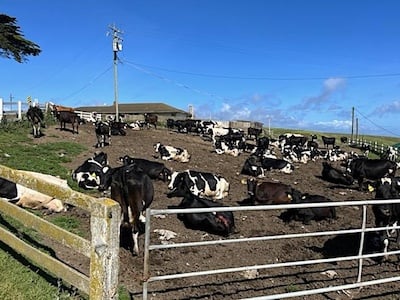
The National Park Service is failing to recover fair market value on the leases for beef and dairy ranches at Point Reyes National Seashore, according to Public Employees for Environmental Responsibility, which claims taxpayers are losing millions of dollars on the operations.
The advocacy group maintains that federal law and NPS policy requires the agency to require fair market value on the leases for the operations, yet it is charging "only a fraction of that amount."
Currently, 14 dairy and beef ranchers hold 21 leases that occupy approximately one-third of the entire seashore. The Park Service also manages ranches on 10,000 acres of the adjacent Golden Gate National Recreation Area. Together, these operations support 5,725 head of cattle, according to the national seashore’s 2021 decision to continue ranching for another 20 years.
These purely commercial operations serve no park purpose, argues PEER. While the national seashore draws more than 2 million visitors each year, barbed wire fences restrict park visitors from entering the leased dairy and ranch lands.
The issue of ranching on the national seashore has been controversial. The ranches operate in a rare arrangement under federal leases created after the Park Service purchased their lands by the early 1970s. They have become a growing flashpoint for environmental concerns over cattle impacts on the land and water and greenhouse gas emissions at the 71,000-acre seashore. Tangled up in the debate is the fate of endemic tule elk, which neared extinction in the mid-1800s but have rebounded and now compete with cattle for water and forage in parts of Point Reyes.
The grazing provisions of Point Reyes leases charge only $7/per animal unit (defined as a cow and a calf) per month, PEER said in a release. By contrast, the U.S. Department of Agriculture calculates the fair market value for an animal unit in California as $27.60/month per cow-calf for the latest year available. In addition, the ranchers' leases with the Park Service cover both land for grazing and, in many cases, multiple houses per ranch, as well as associated barns, sheds, and corrals. However, the operators do not pay anywhere near a fair market value leasing fee for residences and associated lands, the group maintains.
Point Reyes is in Marin County, which has some of the highest real estate values in the country. For example, one ranch has been leasing over 1,000 acres with five houses and grazing its 280 cattle on those lands for less than $2,000 per month, said PEER. Moreover, these private businesses pay no property tax while generating substantial revenue.
“We estimate that these below-market Point Reyes Seashore leases cost taxpayers around $3 million every year,” said Pacific PEER Director Jeff Ruch, noting the annual lease revenue is approximately $800,000 short of covering the seashore’s estimated costs for administering the leases. “Taxpayers should not be obligated to subsidize these private businesses.”
PEER on Monday asked that the Interior Department's inspector general audit the Point Reyes leases, as well as the similar leases in the Golden Gate National Recreation Area, to determine whether they are set at fair market value.
“The case for taxpayer support for the National Park Service is undermined by sweetheart deals such as those that have long been in place at Point Reyes,” Ruch added, pointing out that the leases for all the Point Reyes ranches and dairies expire in September of this year. “These commercial operations should start paying their fair share to use national park lands.”
Stories about:
Story Categories:
A copy of National Parks Traveler's financial statements may be obtained by sending a stamped, self-addressed envelope to: National Parks Traveler, P.O. Box 980452, Park City, Utah 84098. National Parks Traveler was formed in the state of Utah for the purpose of informing and educating about national parks and protected areas.
Residents of the following states may obtain a copy of our financial and additional information as stated below:
- Florida: A COPY OF THE OFFICIAL REGISTRATION AND FINANCIAL INFORMATION FOR NATIONAL PARKS TRAVELER, (REGISTRATION NO. CH 51659), MAY BE OBTAINED FROM THE DIVISION OF CONSUMER SERVICES BY CALLING 800-435-7352 OR VISITING THEIR WEBSITE. REGISTRATION DOES NOT IMPLY ENDORSEMENT, APPROVAL, OR RECOMMENDATION BY THE STATE.
- Georgia: A full and fair description of the programs and financial statement summary of National Parks Traveler is available upon request at the office and phone number indicated above.
- Maryland: Documents and information submitted under the Maryland Solicitations Act are also available, for the cost of postage and copies, from the Secretary of State, State House, Annapolis, MD 21401 (410-974-5534).
- North Carolina: Financial information about this organization and a copy of its license are available from the State Solicitation Licensing Branch at 888-830-4989 or 919-807-2214. The license is not an endorsement by the State.
- Pennsylvania: The official registration and financial information of National Parks Traveler may be obtained from the Pennsylvania Department of State by calling 800-732-0999. Registration does not imply endorsement.
- Virginia: Financial statements are available from the Virginia Department of Agriculture and Consumer Services, 102 Governor Street, Richmond, Virginia 23219.
- Washington: National Parks Traveler is registered with Washington State’s Charities Program as required by law and additional information is available by calling 800-332-4483 or visiting www.sos.wa.gov/charities, or on file at Charities Division, Office of the Secretary of State, State of Washington, Olympia, WA 98504.


National parks and their natural resources belong to you. The National Parks Traveler works to ensure you know how these essential places are being cared for.
Sign Up For Our Weekly Newsletter
Unsubscribe at any time.
INN Member

The easiest way to explore RV-friendly National Park campgrounds.

Here’s the definitive guide to National Park System campgrounds where RVers can park their rigs.
Our app is packed with RVing- specific details on more than 250 campgrounds in more than 70 national parks.
You’ll also find stories about RVing in the parks, tips helpful if you’ve just recently become an RVer, and useful planning suggestions.


Comments
Make them pay like everyone else
I would have liked to see some reporting here beyond the press release. Why is PEER doing this? Why now? Has something changed? Do they have a relationship with the litigants working against the ranchers? Do they have a relationship with the Seashore? More importantly, does it make sense to compare these ranch agreements with private-sector leases? Do the ranchers have the same rights and the same business flexibility as private-sector ranchers? (Of course not -- these ranchers operate under severe constraints that make PEER's comparisons absurd.)
Sarah,
As you well know, these ranchers enjoy huge subsidies not available to the private sector. Furthermore, there is a long, detailed, and documented history of them *not* complying with lease terms. Additionally, your insinuations are inappropriate. A better way to express your question Why Now is, why not sooner. Regardless, the law is the law, and it’s objectionable that so much time and effort has to be applied to enforcement in the face of all the political influence exerted to perpetuate abuse of supposedly protected public lands.
“Taxpayers should not be obligated to subsidize these private businesses.”
YEAH! Taxpayers should be obligated to subsidized public employees like those members of PEER!
The hypocrisy of public employes whining about taxpayer funding of other entities lacks an amazing amount of self-awareness.
Public Employees for Environmental Responsibility (PEER) is a left-of-center organization that provides legal assistance and resources to whistleblowers who speak out about environmental issues in state and federal agencies. PEER is funded both by donations and payouts from lawsuits and settlements.
You report that PEER argues that “These purely commercial operations serve no park purpose,” and that “barbed wire fences restrict park visitors from entering the leased dairy and ranch lands.” Are your readers and PEER aware that the Point Reyes National Seashore is on the Pacific Tectonic Plate? That it is separated from the American Tectonic Plate by the San Andreas Fault? That to access the Seashore the 2 million plus annual visitors travel on California Highway One, which generally runs north and south on the San Andreas Fault? According to the NPS website, the Pacific plate “is estimated to creep northwestward about two inches a year.” The Earthquake Trail at the Seashore Headquarters includes a “fence . . . [that] illustrates the 16 feet . . . of displacement that occurred during the infamous 1906 earthquake” when “the Point Reyes Peninsula leapt forward [roughly] 20 feet . . . .” NPS statistics show 2,336,202 visitors in 2022, an average of 6400 a day or almost 45,000 visitors a week. Is the NPS prepared to provide first aid, shelter, food, and water for a week or more for visitors stranded out in the Seashore when an earthquake along the San Andreas Fault renders the two-lane roads out of the Seashore impassable? If trained and provided with the necessary supplies, people living on the dairies and ranches in the Seashore, one of the only national parks with working agriculture, would be available to assist in an emergency or natural disaster. Residents of the Seashore would be a life-saving resource for the National Park Service to meet its responsibility to provide adequate visitor protection. What about the value to the NPS, taxpayers and residents of adjacent Marin County of having livestock grazing and thus keeping the fire fuel load down and maintaining historical coastal prairie conditions? Without the ranches, chapparal and scrub would take over the landscape as it has in the coastal area of the Wilderness. The ranchers maintain roads, which makes the land accessible for fire prevention and removal of invasive species plants. The ranches maintain artificial stock ponds, which benefit wildlife, including birds and the threatened California red legged frog. And there are endangered species plant that benefit from grazing, too.
Judy,
With all due respect, this is disappointing fear-mongering. What you describe as chapparal and scrub “taking over” is regarding as restoration by any impartial ecologist. Additionally, the red-legged frog is a clear red-herring. All the specific studies as well as the vast majority of general literature on ranching indicate that the ranch operations in Point Reyes are a net-negative for the health of the environment. Finally, the law is the law, isn’t it?
According to PEER's IRS Form 990 for 2021 (latest year available)
Total Revenues: $1,177,000
Salaries & benefits paid: $1,055,000
So, that leaves $122,000 for legal assistance and resources to whistleblowers.
Okay.
Ah, so many willing to shoot the messenger vs contemplate the message. Sad state of the country these days. There are valid arguments on both sides of the PRNS leases, cattle, elk, etc. but certainly how PEER is funded, or the work they do, are not pertinent to the true matter at hand. Neither Ali's fear mongering about how those ranchers are going to save us all when an earthquake strikes. They won't. They will be without water, power, access to medical help just like everyone else.
When the messenger has an obviously biased agenda, and has a vested interest in promoting that agenda, yes it's legitimate and NECESSARY to an informed discussion to point that out.
Look, I don't blame PEER for doing what they're doing or promoting their point of view, or for NPT for covering them. But like the NRA, Sierra Club, ATV advocacy groups, Crockett Club, Isaac Walton League, et al., their involvement in issues of outdoor recreation, conservation, and preservation is of limited value and insight, simply because they're so predictable and predictably lopsided and EVERYONE KNOWS IT! NONE of them add much insight to the debate--they're already lined up where they're lined up, they ain't gonna change, and everyone knows it. They add nothing to the debate.
Well, according to that 990, while salaries and benefits totaled $1.05 million for tax year 2021, expenses totaled $1.77 million and Program Service expenses totaled $1.5 million.
Without discussing the 990 with PEER, isn't it worth assuming that since they have lawyers on staff, some of the salaries went for legal work? And some likely went to outside attorneys?
https://projects.propublica.org/nonprofits/organizations/931102740/20233...
Indeed, if you look at their accountants' report, they spent $471,066 on legal expenses (salaries and wages and contractors) in 2022.
https://peer.org/wp-content/uploads/2023/02/22-PEER.pdf
Another $274,742+ was spent on resource protection.
isn't it worth assuming that since they have lawyers on staff, some of the salaries went for legal work? And some likely went to outside attorneys?
Now you're the one asssuming that PEER is using their "salaries" for legal assistance and resources for whistleblowers.
I assumed salaries were for salaries and that left $177,000 for legal assistance and resources for whistleblowers.
Unless PEER is willing to itemize just how they're funding legal assistance and resources for whistleblowers, I suppose we're all left to assume how PEER is using their funds.
Would PEER like to respond?
The cattle compete with the native Tule elk.
Remove the cattle and their for-priofit operations.