
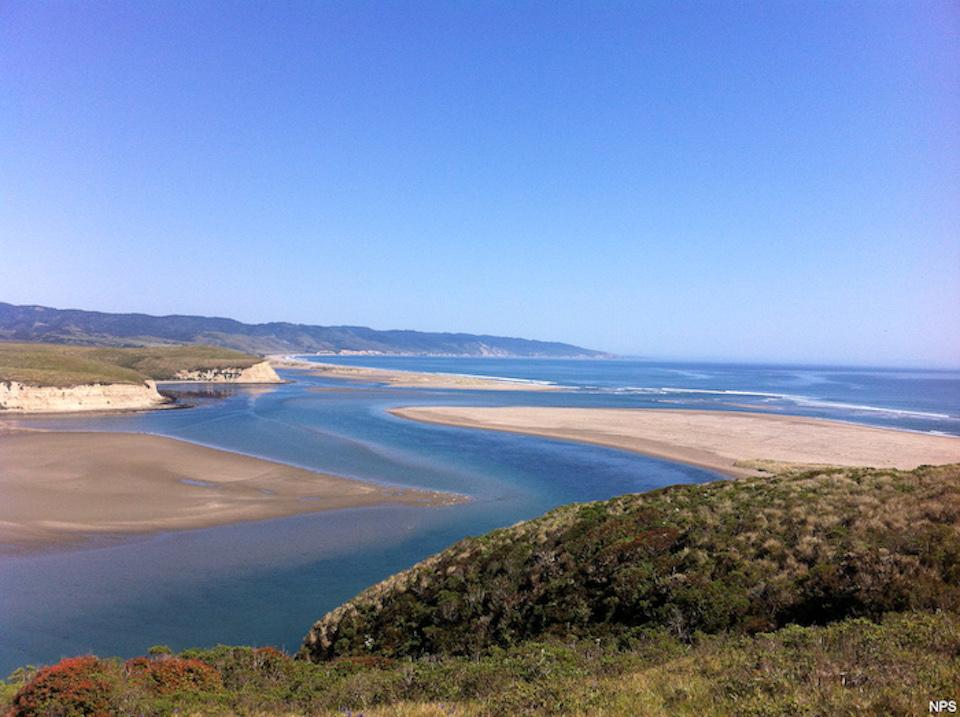
Editor's note: This updates with Point Reyes staff working with the California Coastal Commission staff to provide updates on water quality monitoring in time for the April meeting.
A plan the National Park Service developed at Point Reyes National Seashore to manage cattle operations could be derailed by the California Coastal Commission because of the Park Service's failure to produce promised reports on dealing with the water quality impacts from the livestock operations.
Before the plan was adopted last year, outside groups claimed the 24 cattle and dairy operations operating in the seashore pollute and adversely impact the environment (water quality, methane emissions, erosion, fish habitat), the infrastructure (pavement degradation from milk trucks), and recreational opportunities at the seashore.
In the past, the Coastal Commission staff had voiced concerns that the plan failed to adequately protect marine resources. Back in 2020 the commission staff noted that away from the Tomales Bay area of the national seashore water quality data had not been collected since 2013. At the time, the staff wanted the Park Service to outline a strategy for monitoring water quality beyond the Tomales Bay watershed, "with a particular focus on areas that drain to Abbott’s Lagoon and Drake’s Estero and the creeks that drain to these features, but also including areas that drain directly to the Pacific Ocean."
Additionally, staff asked that the Park Service provide an annual report to the commission that details "monitoring results and water quality analysis" along with strategies. In April 2021 the commission agreed with those conditions, narrowly approved the seashore's ag plan, and told the Park Service to provide the reports this April.
It had appeared that the Park Service might not be able to meet that deadline. Point Reyes Superintendent Craig Kenkel in a letter dated March 4 told the commission that since the agency was sued over its plans for managing agriculture and wildlife he could not comment on the matter. That position did not sit well with all members of the commission, which earlier this month discussed whether it should rescind its approval of the seashore's ag plan. The matter is expected to resurface at the commission's April meeting.
“The National Park Service has to be responsible for what they haven’t done,” Commissioner Roberto Uranga said during the commission's meeting earlier this month. “They had a year and that’s inexcusable.”
"This idea of an unlimited period of delay, to me it's just not acceptable," added Commissioner Caryl Hart. "I'm not willing to support a delay in the report. I would rather this come back to the commission in a month to hear from the National Park Service on whatever progress has been made."
Since the March meeting staff from the national seashore has been working with the commission staff to provide the necessary information and "updated materials" were to be posted on the commission's website Friday morning, said Point Reyes spokesperson Melanie Gunn in an email Thursday.
"There may continue to be specific questions the park will not be able to address due to litigation," she added.
Ranching has existed on the coastal California peninsula for 150 years. The industry's role in the establishment of the seashore has been and remains controversial. While the seashore's administrative history notes ranchers' opposition to the seashore, the Park Service on the seashore's website explains that ranchers came around to supporting the seashore due to development pressures creeping into the area.
While then-Interior Secretary Ken Salazar in November 2012 refused to renew the lease of the Drakes Bay Oyster Co. so the estero could be managed as official wilderness, he also directed the Park Service to work on extending ranching leases “from 10 to 20 years to provide greater certainty and clarity for the ranches operating within the national park’s Pastoral Zone and to support the continued presence of sustainable ranching and dairy operations."
In February 2016, litigation was brought against the Park Service related to the ongoing ranch planning process and the use of lands in the planning area for ranching and dairying. The plaintiffs and the Park Service, together with the ranchers and the County of Marin, entered into settlement negotiations. The court approved a multi-party Settlement Agreement on July 14, 2017.
Per that agreement, the Park Service agreed that in lieu of a Ranch Comprehensive Management Plan, it would prepare a General Management Plan Amendment and Environmental Impact Statement addressing the management of the lands currently leased for ranching in Point Reyes and the north district of Golden Gate.
This past January a number of groups sued the Park Service, claiming that the plan favored cattle ranches to the detriment of native Tule elk in the seashore.
The National Park Service has "prioritized the commercial needs of ranchers instead of providing maximum protection to the natural environment and supporting the public’s use and enjoyment of these majestic lands along the California coast," argued the lawsuit, filed by the Resource Renewal Institute, Center for Biological Diversity, and Western Watersheds Project.
The management plan addresses lands, resources, development, and visitor use in a 28,000-acre section of the national seashore. It also allows for culling of Tule elk if population numbers get out of hand.
Stories about:
Story Categories:
A copy of National Parks Traveler's financial statements may be obtained by sending a stamped, self-addressed envelope to: National Parks Traveler, P.O. Box 980452, Park City, Utah 84098. National Parks Traveler was formed in the state of Utah for the purpose of informing and educating about national parks and protected areas.
Residents of the following states may obtain a copy of our financial and additional information as stated below:
- Florida: A COPY OF THE OFFICIAL REGISTRATION AND FINANCIAL INFORMATION FOR NATIONAL PARKS TRAVELER, (REGISTRATION NO. CH 51659), MAY BE OBTAINED FROM THE DIVISION OF CONSUMER SERVICES BY CALLING 800-435-7352 OR VISITING THEIR WEBSITE. REGISTRATION DOES NOT IMPLY ENDORSEMENT, APPROVAL, OR RECOMMENDATION BY THE STATE.
- Georgia: A full and fair description of the programs and financial statement summary of National Parks Traveler is available upon request at the office and phone number indicated above.
- Maryland: Documents and information submitted under the Maryland Solicitations Act are also available, for the cost of postage and copies, from the Secretary of State, State House, Annapolis, MD 21401 (410-974-5534).
- North Carolina: Financial information about this organization and a copy of its license are available from the State Solicitation Licensing Branch at 888-830-4989 or 919-807-2214. The license is not an endorsement by the State.
- Pennsylvania: The official registration and financial information of National Parks Traveler may be obtained from the Pennsylvania Department of State by calling 800-732-0999. Registration does not imply endorsement.
- Virginia: Financial statements are available from the Virginia Department of Agriculture and Consumer Services, 102 Governor Street, Richmond, Virginia 23219.
- Washington: National Parks Traveler is registered with Washington State’s Charities Program as required by law and additional information is available by calling 800-332-4483 or visiting www.sos.wa.gov/charities, or on file at Charities Division, Office of the Secretary of State, State of Washington, Olympia, WA 98504.


National parks and their natural resources belong to you. The National Parks Traveler works to ensure you know how these essential places are being cared for.
Sign Up For Our Weekly Newsletter
Unsubscribe at any time.
INN Member

The easiest way to explore RV-friendly National Park campgrounds.

Here’s the definitive guide to National Park System campgrounds where RVers can park their rigs.
Our app is packed with RVing- specific details on more than 250 campgrounds in more than 70 national parks.
You’ll also find stories about RVing in the parks, tips helpful if you’ve just recently become an RVer, and useful planning suggestions.


Comments
Kurt,
Thanks for covering this issue.
When you write that “Before the plan was adopted last year, *outside groups claimed* the 24 cattle and dairy operations operating in the seashore pollute and adversely impact the environment…” please note that the Park services own environment study said exactly that. For example, it said if ranching were removed, “…impacts on water quality would be noticeable, long-term, and beneficial.” There are several other documented (not claimed) impacts from these operations on the environment. A second example is that ranching in the park generates the equivalent of 24,000 metric tons of CO2/year, six-and-a-half times the amount generated by all the car traffic of the over two million annual visitors. These emissions are over 60% of overall park emissions, 21% of countywide agricultural emissions, and 6% of total emissions in Marin County.
I’d also like to point out that public comments to the new plan both to the NPS directly and to the CCC has been overwhelmingly in opposition. The public, who owns the land, wants the park restored. https://www.marinij.com/2020/04/23/marin-voice-public-has-spoken-on-pt-r...
Thanks for pointing that out, Kenneth.
It's worth remembering that a decade ago the California Coastal Commission actively worked to protect Point Reyes National Seashore from a damaging commercial oyster farm that had been grandfathered into the national park. The CCC cited the Drakes Bay Oyster Farm multiple times for flaunting permits and disturbing wildlife. When the farm's 40-year permit expired and the NPS declined to renew it, the oysterman sued the NPS with legal and financial support from right-wing groups. Remarkably, the oysterman is permitted to raise cattle in the national seashore--with similar disregard for park regulations--and is the spokesperson for Seashore ranchers. A designated federal wilderness, Drakes Bay is recovering after a multi-million dollar taxpayer-funded clean up. But the bay and other coastal waters and rare wildlife are subjected to fecal pollution from upstream dairy and beef ranches in the park. The CCC reasonably required the NPS to address the impacts from these tenant ranches. The NPS, which struggled to push through an unpopular, pro-rancher management plan for the Park, appears to be shining the Commissioners on.
I also share this concern that for the last 50 years it seems like the NPS puts most of their funding and resources into the 30% of ranch leased lands and completely neglects their EPA and wildlife responsibilities by decidedly ignoring water quality issues of E. Coli (highest in CA so years in Point Reyes) and water contamination by cows in a national park. The millions of visitors are at risk of contaminated waters with no sofnage to worn them about the dangers. NPS tested water in 2013 then stopped - I believe because the results would condemn the pollution of Ranching in the park. We need to care more about elk and less about cows on this coastal seashore. Absolutely NO delays in water quality testing. 10 years is long enough. NPS needs to care about park visitors not ranch leasees.
Kurt, about this: "It also allows for culling of Tule elk if population numbers get out of hand," "out of hand," I’m sorry but this is incorrect. First, “out of hand” is vague and subjective. The plan calls for the culling of every elk above an arbitrary threshold of 140 for the Drakes Beach herd. Last count there were 151 animals, and they grow by 10-15% every year. There are 400-500 elk in the park and about 5,500 cows. There are as many cows in Point Reyes as there are tule elk in existence. Tule elk are now at about 1% of their historical population, and there are about 90 million cattle in the US. All this matters. Also, that is just regarding culling. The plan also calls for “aggressive hazing” and increases fences in the park from 340 miles to 380, much of which is barbed wire and not wildlife friendly. Finally, the park service is also being sued (a separate lawsuit) regarding the 8’ elk fence that keeps the Tomales Point herd confined where they are suffering massive drought-related attrition from malnutrition (they are starving). The park’s own study says if the fence is brought down (which was the recommendation of a scientific advisor panel 25 years ago) the park won’t reach carrying capacity for 20 years. “Out of hand” indeed. Please let me know if you want to cover this is more detail.
Those claims about the oyster farm "disturbing the wildlife" were utterly mendacious, after the faked images EAC used were exposed. Hasn't the Drakes Beach Cafe also been shuttered and barred? What about the mammoth financial shenanigans used to demolish the San Geronimo Golf Course, once open to the public and a site for community meetings and a good restaurant, now shuttered and barred. The woman who led the drive the destroy the oyster farm, EAC's Amy Trainer, resigned just after that accomplishment was fulfilled, and went off to reap more enviro-fascist bucks, pulling a Pocohantas by becoming "Environmental Policy Director, Swinomish Indian Tribal Community." While staying in a teepee on the reservation, she somehow manages to also lead an "oil spill prevention" movement along the entire pacific coast that has no noticeable functions or services.
As the total meltdown of SPAWN/TPL/ Marin Parks scandals and shakedowns in San Geronimo has been exposed, its time to remember what they say about Putin's plan to take back Eastern Europe: First take a little, then when they surrender, plow over them, and take over everything. SPAWN already controls dozens of creek properties, and wants to send inspectors to any homes along "ephemeral streams" (i.e any property with rainwater running downhill in the winter).