
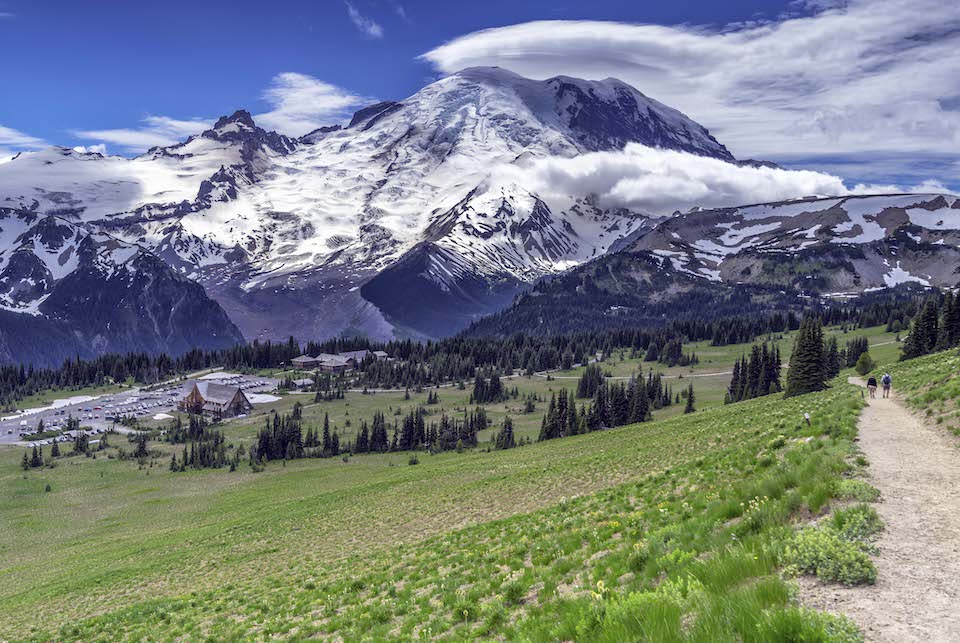
It's a new year in the National Park System. Let's hope it's a great one./Rebecca Latson shot of Mount Rainier from Sunrise
Here's a shortlist of the things we'd like to see sweep across the National Park System this year.
1. Reinstate the National Park Service's budget ASAP.
Remove the National Park Service from the partial government shutdown. Let maintenance crews get back to keeping the parks clean, put staff in entrance stations to collect fees, and bolster the ranks of rangers throughout the parks to deter vandalism, come to aid of those who need it, and interpret these great places.
2. Address the maintenance backlog.
Have Congress, among its first tasks in the new session, approve a solution to the National Park System's nearly $12 billion maintenance backlog. This is a carry-over from last year's wishlist.
3. Cap visitation, at least temporarily
For parks that are overwhelmed with visitors -- the Zions, Yellowstones, Grand Canyons, Glaciers, and Rocky Mountains of the system -- institute temporary daily visitation caps to protect resources and the visitor experience while staff continue to sort through the studies they need to justify permanent caps.
4. Let's create some more large-scale landscape parks!
Where would these be? Consider the Wind River Range of Wyoming (roughly 2,800 square miles, or 1.8 million acres, mostly U.S. Forest Service), the Sawtooth National Recreation Area in Idaho (1,142 square miles, or 730,880 acres, mostly U.S. Forest Service), perhaps part of the Bitterroot Range of Montana (24,223 square miles, much national forest), or the San Rafael Swell area of central Utah (3,000 square miles, mostly Bureau of Land Management). This is a carry-over from last year's wishlist.
5. Have Yellowstone officials cut short the testing of surge pricing for lodging in the park.
Under the unannounced "pilot program" instituted last year, Xanterra Parks & Resorts can charge what the market will bear for slightly more than half the rooms available for visitors. Let's not forget that motto engraved into the Roosevelt Arch at Yellowstone's north entrance: "For The Benefit And Enjoyment Of The People," not to unduly enrich corporations.
6. Have the Interior Department axe its desire to force the National Park Service to reduce protections for predators in national preserves in Alaska.
Park Service law and regulations long have prohibited intensive management and “predator control” to manipulate predator:prey ratios on NPS-managed lands, whether national parks or national preserves.
7. Reauthorize and fully fund the Land and Water Conservation Fund.
The fund long has been a successful conservation tool for protecting America’s national parks and other public lands. The fund allows the Park Service and other federal land agencies to purchase lands within the borders of federally protected areas from landowners when they are offered for sale. Without these funds, the land is more likely to be sold to the highest bidder, risking damaging construction projects ranging from sub-developments to strip malls to resorts. Acquiring these parcels from willing sellers also makes park management more efficient.
8. That there's successful resolution in the National Park Service's favor to the trademark fight over iconic place names in Yosemite National Park.
Back in November a measure of optimism arose in the battle between DNC Parks & Resorts and the federal government, with the parties gaining judicial approval to more time to negotiate a settlement. Does anyone really want to call The Ahwahnee Hotel the Majestic Yosemite Hotel forever?
9. That President Trump's shrinking of the Grand Staircase-Escalante and Bears Ears national monuments in Utah is overturned.
Not only was the president's executive order questionable from a legal basis (something the courts will have to sort out), but the landscapes protected by the original boundaries protected rich cultural, archaeological, and paleontological resources, along with preserving a measure of Southwestern wildness that should be preserved for generations to experience.
10. Quick confirmation of David Vela as director of the National Park Service, which for too long has been rudderless.
And might the new director be free to act in the best interests of the National Park System, not political whims.
Story Categories:
A copy of National Parks Traveler's financial statements may be obtained by sending a stamped, self-addressed envelope to: National Parks Traveler, P.O. Box 980452, Park City, Utah 84098. National Parks Traveler was formed in the state of Utah for the purpose of informing and educating about national parks and protected areas.
Residents of the following states may obtain a copy of our financial and additional information as stated below:
- Florida: A COPY OF THE OFFICIAL REGISTRATION AND FINANCIAL INFORMATION FOR NATIONAL PARKS TRAVELER, (REGISTRATION NO. CH 51659), MAY BE OBTAINED FROM THE DIVISION OF CONSUMER SERVICES BY CALLING 800-435-7352 OR VISITING THEIR WEBSITE. REGISTRATION DOES NOT IMPLY ENDORSEMENT, APPROVAL, OR RECOMMENDATION BY THE STATE.
- Georgia: A full and fair description of the programs and financial statement summary of National Parks Traveler is available upon request at the office and phone number indicated above.
- Maryland: Documents and information submitted under the Maryland Solicitations Act are also available, for the cost of postage and copies, from the Secretary of State, State House, Annapolis, MD 21401 (410-974-5534).
- North Carolina: Financial information about this organization and a copy of its license are available from the State Solicitation Licensing Branch at 888-830-4989 or 919-807-2214. The license is not an endorsement by the State.
- Pennsylvania: The official registration and financial information of National Parks Traveler may be obtained from the Pennsylvania Department of State by calling 800-732-0999. Registration does not imply endorsement.
- Virginia: Financial statements are available from the Virginia Department of Agriculture and Consumer Services, 102 Governor Street, Richmond, Virginia 23219.
- Washington: National Parks Traveler is registered with Washington State’s Charities Program as required by law and additional information is available by calling 800-332-4483 or visiting www.sos.wa.gov/charities, or on file at Charities Division, Office of the Secretary of State, State of Washington, Olympia, WA 98504.


National parks and their natural resources belong to you. The National Parks Traveler works to ensure you know how these essential places are being cared for.
Sign Up For Our Weekly Newsletter
Unsubscribe at any time.
INN Member

The easiest way to explore RV-friendly National Park campgrounds.

Here’s the definitive guide to National Park System campgrounds where RVers can park their rigs.
Our app is packed with RVing- specific details on more than 250 campgrounds in more than 70 national parks.
You’ll also find stories about RVing in the parks, tips helpful if you’ve just recently become an RVer, and useful planning suggestions.


Comments
Implement a carry in / carry out policy. People will act much differently when they take responsibility for their own trash.
Good list. Thank you.
Hire more rangers with the authority to regularly and consistently ticket visitors who park illegally, harm the natural environment, cross barriers, hike with dogs, etc. Rarely are visitors held financially accountable for their transgressions-- which tends to give more people the okay signal to also break the rules.
agree!
Raise admission fees for non US residents. That is how national parks charge in the rest of the world. And charge by person, not by carload.
I just recieved mail from National Park Foundation asking me to donate money. I want to support the national parks, but considering the detrimental environmental policies set by the Trump administration is always trying to and is doing, why would I want to put more money at their disposal? Does anyone have a real answer for me?
Elsie, the NPF is a 501c non-profit that has done good work and continues to do so. Sending them donations doesnt mean it goes directly into Trump's pocket. It's not like sending a direct donation to the NPS.
Kurt, your list is terrific. I'm not sure how many people realize how critical the LWCF is for non-profit matching funds to acquire critical habitat and even battlefields back East. As a longtime member of the Battlefields Trust,once the Civil War Trust, I can say organizations like that rely on those mathing funds to secure lands and easements for those battlefields.
I do have a question though:
Your point about the Wind River protection, does the Wyoming law exempting that state from parklands only apply to the POTUS use of the Antiquities Act or does it apply to Congress as well?
I agree the Wind Rivers around the wilderness areas and outside Pinedale are deserving of protection as a NM but unsure how a designation would come about.
Great list though! We can agree to disagree on the Grand Staircase and Bears Ears but thats more a difference of unit sizes and who manages it than if all of it should be protected. More parks!
tazz. the 1950 law adding Jacksion Hole into grand tetons national poark removed the presidents ability to create monument iin Wyoming by himself. Congress can create monuments and parks inthe state, but has only done so once since , a small 8000 acre monument in the 1970s. i believe that limit should be reversed, as Congress has shown itself unable to act quickly to protect the nations special places for decades, and there are several places in Wyoming- such as the Bighorn mountains and the Black Hills- that deserve monument status at least. Presidents act far more often than Congress does, and thats only been more prounced with the current anti-consevation Republicans we have today.
i would tweak the antiquities Act as follows:
1. the penalties for damaging ruins, natural formations and things like cactuses, become felonies, with 5 years in jail and 25000 in fines, per violation. Enough of bozos spraying " art' on canyon walls.
2 the monument limits in Alska and Wyoming are permsnently repealed, and no state or territory may be exempted from the act or have size limitations on monuments within their borders. The law applies to everyone, period.
3. Congress creates a monument designation fund of 100 bilion dollars a year , that the president can tap when he designates new monuments. This fund will be automatically renewed each calender year, any unspent funds will be rolled over into the new year. There will be several limiatations on this. First, each monument must get 100 million a year in funding. The maximum a president can give to a monument is 2 billion a year. Only Congress can give more than 2 billion in funding, and only Congress can reduce a monuments funding. Existing monuments are eligible for funding as well through expansions, but the expansion must be significant for the monument to qualify. Adding 100 acres to Najavo NM, would qualify, as the monument is only 360 acres. adding 100 acres to Mojave Trails NM, would not qualify, as the monument is 1.6M acres. Once set, the funding is set for 10 years, unless Congress or a future president add to it, in which case the new level of funding will go on for the rest of the initial 10 year period. This provides stability in funding, for staffing and maintenance.
4. The president can expand monuments , but not reduce them. Only Congress may reduce the borders of a monument. When Congress designates a monument, it is acting as the ultimate power in concerning federal holdings. The president may use his discretion to add to a monument estab;ished by Congress, but only Congress may shrink a monument.
This is a good list, and starting with full funding immediately would be a great idea.
Good list. Another priority should be to implement the 2017 NPS System Plan, which provided a vision, goals, and actions to better preserve the system, add new units to the system, embrace new conservation roles, and bring parks to people.