
There's a new sheriff in town, and he's more than willing to have you test his aim.
Back in March, Interior Secretary Ryan Zinke rode into office on Tonto Silvershoes -- reportedly an Irish sport horse, not a Quarter Horse or American Paint -- in downtown Washington, D.C., and the only things missing were a rifle scabbard perched on his saddle and a six shooter dangling from his hip.
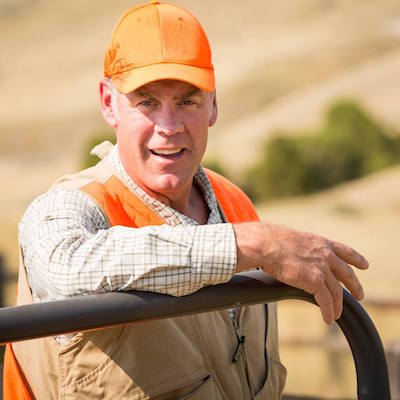
But Secretary Zinke quickly established his Western bona fides, not only with his horsemanship and ever-ready cowboy hat or orange hunting vest and ballcap, but also by reaching out (some might say overreaching) to the shooting community. Not only did he appoint Susan LaPierre, a National Rifle Association luminary and wife of NRA Executive Director Wayne LaPierre, to the National Park Foundation's Board of Directors, but he also has:
* Overturned the Obama administration ban on lead shot and fishing tackle.
* Told the National Park Service in Alaska to review its bans against the use of donuts and grease-soaked loaves of bread to lure bears into range of hunters.
* Proclaimed August as National Sports Shooting Month.
* Directed the land-management agencies under his auspices to, when possible, allow target shooting in national monuments, even though that's a significant cause of wildfires. (And then there was the target-shooting-related death at Tule Springs Fossil Beds National Monument in Nevada.)
* Declared October to be National Hunting and Fishing Month.
* Encouraged Interior employees to share their "hunting and fishing memories."
* Directed the U.S. Fish and Wildlife Service to open up, or expand, hunting and fishing on ten refuges.
* Had his staff issue a release on "Everything you need to know about hunting on public lands."
* And even installed at the Interior Department cafeteria in Washington, D.C., a "Big Buck Hunter Pro" arcade game so Interior employees could challenge their boss with their aim in a "Shotgun Showdown," with the "winner earning bragging rights and a personal visit with the Secretary."

“Some of my best memories are hunting and fishing with my dad and granddad, and then later teaching my own kids to hunt and fish," Secretary Zinke said, rehashing a phrase he's used in quite a few of his previous proclamations. "That's something I want more families to experience. Hunters and anglers are the backbone of wildlife and habitat conservation in America because sportsmen contribute billions of dollars to conservation.
"From my perspective, the more sportsmen we have in the woods and waters, the better our wildlife and land will be. The 'Shotgun Showdown' will help reignite the passion and emphasis of hunting and fishing at the Department, and will be a fun way to advance our mission of wildlife and habitat conservation."
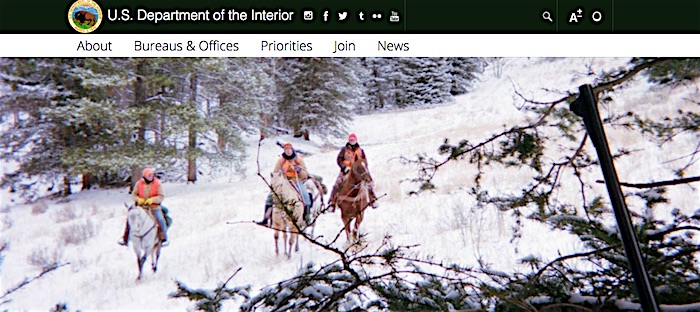
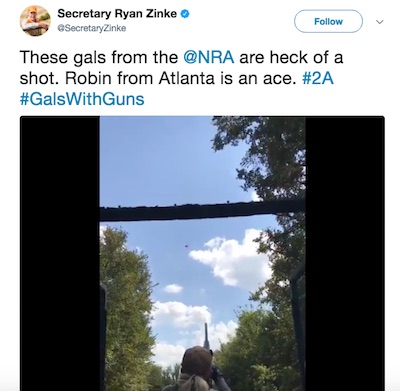
The "new" Interior Department's determined branding with the shooting and hunting industry also is evident on the photo depicting orange-clad hunters riding horses across a snowy landscape that graces the top of Interior's webpage (Did you spot the rifle?) and the secretary's occasional tweets regarding hunting and even the NRA.
On his Facebook page, the secretary also frequently calls out the hunting and fishing community and at times the NRA:
Today I joined the Women's Leadership Forum to shoot clays. Hunters and anglers contribute billions of dollars to conservation through excise taxes paid when sportsmen and women purchase firearms, ammo, and tackle. Millions more are raised through hunting and fishing licenses and Duck Stamps. The more target shooters, hunters, and anglers there are, the more funding for a conservation. Increasing access to public lands is key. -- September 23
Hunting and fishing is a big part of what we do at Interior from hunting on Bureau of Land Management land and U.S. Fish and Wildlife Service Refuges to fishing in National Park Service and Bureau of Reclamation waters. This week the Interior employee cafeteria got a new addition - the classic arcade game Big Buck Hunter. The game will be in the cafeteria, free to play, to get our employees excited about hunting season and to remind everyone about the important role that sportsmen and women play in conservation. -- September 18
September 23 is National Hunting and Fishing Day - held every year since 1972. It’s the perfect day for sportsmen and women to share their passion by mentoring future generations of hunters, anglers, and conservationists. -- September 18
Increasing access to public lands for hunting, fishing, and recreation is a top priority at the Department of the Interior. -- September 17
Hunting and fishing is a cornerstone of the American tradition and hunters and anglers of America are the backbone of land and wildlife conservation. The more people we can get outdoors, the better things will be for our public lands. As someone who grew up hunting and fishing on our public lands - packing bologna sandwiches and heading out at 4AM with my dad - I know how important it is to expand access to public lands for future generations. -- September 15
Great to see more Americans enjoying the great outdoors! This report is good news but also absolutely underscores the need to increase public access to public lands across the United States. Hunting and fishing are a part of the American heritage. As a kid who grew up hunting and fishing on public lands who later took my own kids out on the same land, I know how important it is to expand access for future generations. -- September 7
It's September which means more hunting seasons are opening up across the nation. Don't forget that public lands offer some of the best hunting opportunities -- September 1
On behalf of our nation's millions of hunters, I was proud to designate August as National Shooting Sports Month at the Department. I grew up in the mountains of northwest Montana, where I spent my time hunting and fishing on our shared public lands. I was lucky to take my boys out on the same land that my dad and granddad took me. -- August 31
Today I sent my report on the national monuments to the White House. No President should use the authority under the Antiquities Act to restrict public access, prevent hunting and fishing, burden private land, or eliminate traditional land uses, unless such action is needed to protect the object. -- August 24
This week the Department opened up access for hunting and fishing in 10 wildlife refuges across the country. I grew up in the mountains of northwest Montana, where I spent my time hunting and fishing on our shared public lands. I was lucky to take my boys out on the same land that my dad and granddad took me. -- August 11
I'm happy to announce today the Department intends to finalize the process to consider whether to accept 3,595 acres to make the Sabinoso Wilderness area accessible to hunters and all members of the public for the first time ever. Expanding access to hunting, fishing, and recreation on federal lands is one of my top priorities as Secretary. -- August 9
It goes on, but the trend is clear: Secretary Zinke is a BIG proponent of hunting and fishing.
And that's fine.
Both activities grew up with the country and play important roles, whether it's putting food on the table, helping manage species such as deer and elk in settings where there no longer are predators to control the populations, and instilling conservation ethics and a love for the outdoors.
How long before Secretary Zinke raises discussion of redesigning the logos for the Interior Department and the National Park Service to include rifle scope cross-hairs over the bison, and the NRA insignia on the mountain? And when it comes to controlling big game populations through hunting, perhaps that's a solution to the nonnative mountain goats at Olympic National Park, where a plan is in the works to reduce, and possibly eliminate, the population.
But, hunting and fishing aren't the only activities that benefit from public lands administered by the Interior Department, and the fact remains that hunting participation is on the slide while other outdoor activities are growing significantly and contributing much more economically. Indeed, participation and economic contribution from hunting are dwarfed by some other recreational activities on public lands.
According to the U.S. Fish and Wildlife Service's five-year report on outdoor recreation, released September 7:
Fishing
As one of the most popular outdoor recreational activities in the United States, fishing attracted 35.8 million individuals 16 years old and older in 2016. ... Anglers spent $46.1 billion on trips, equipment, licenses, and other items to support their fishing activities in 2016.
Hunting
In 2016, 11.5 million people, 5% of the U.S. population 16 years old and older, went hunting. ... Hunters spent $25.6 billion on trips, equipment, licenses, and other items to support their hunting activities in 2016.
Wildlife Watching
Wildlife watching is a favorite pastime for millions in the U.S. Over 86 million people 16 years old and older fed, photographed, and observed wildlife in 2016. ... They spent $75.9 billion on their activities
What the report did not touch on are the numbers of hikers and backpackers ($201.5 billion in annual spending), paddlers, skiers and snowshoers ($73 billion/year), campers ($166.8 billion/year), RVers, and rock climbers who enjoy public lands and also have a great economic impact. According to the Outdoor Industry Association, 42 million Americans hike, 45.8 million participate in biking (road, mountain and BMX), and 40.5 million camp (car, backyard, backpacking, RV). And, of course, 331 million folks went into the National Park System last year.
When will the secretary designate a "National Hiking Month" or a "National Birdwatching Day"?
At the end of the day, let's hope these other outdoor pursuits get equal time with the hunter-in-chief leading Interior.
Stories about:
Story Categories:
A copy of National Parks Traveler's financial statements may be obtained by sending a stamped, self-addressed envelope to: National Parks Traveler, P.O. Box 980452, Park City, Utah 84098. National Parks Traveler was formed in the state of Utah for the purpose of informing and educating about national parks and protected areas.
Residents of the following states may obtain a copy of our financial and additional information as stated below:
- Florida: A COPY OF THE OFFICIAL REGISTRATION AND FINANCIAL INFORMATION FOR NATIONAL PARKS TRAVELER, (REGISTRATION NO. CH 51659), MAY BE OBTAINED FROM THE DIVISION OF CONSUMER SERVICES BY CALLING 800-435-7352 OR VISITING THEIR WEBSITE. REGISTRATION DOES NOT IMPLY ENDORSEMENT, APPROVAL, OR RECOMMENDATION BY THE STATE.
- Georgia: A full and fair description of the programs and financial statement summary of National Parks Traveler is available upon request at the office and phone number indicated above.
- Maryland: Documents and information submitted under the Maryland Solicitations Act are also available, for the cost of postage and copies, from the Secretary of State, State House, Annapolis, MD 21401 (410-974-5534).
- North Carolina: Financial information about this organization and a copy of its license are available from the State Solicitation Licensing Branch at 888-830-4989 or 919-807-2214. The license is not an endorsement by the State.
- Pennsylvania: The official registration and financial information of National Parks Traveler may be obtained from the Pennsylvania Department of State by calling 800-732-0999. Registration does not imply endorsement.
- Virginia: Financial statements are available from the Virginia Department of Agriculture and Consumer Services, 102 Governor Street, Richmond, Virginia 23219.
- Washington: National Parks Traveler is registered with Washington State’s Charities Program as required by law and additional information is available by calling 800-332-4483 or visiting www.sos.wa.gov/charities, or on file at Charities Division, Office of the Secretary of State, State of Washington, Olympia, WA 98504.


National parks and their natural resources belong to you. The National Parks Traveler works to ensure you know how these essential places are being cared for.
Sign Up For Our Weekly Newsletter
Unsubscribe at any time.
INN Member

The easiest way to explore RV-friendly National Park campgrounds.

Here’s the definitive guide to National Park System campgrounds where RVers can park their rigs.
Our app is packed with RVing- specific details on more than 250 campgrounds in more than 70 national parks.
You’ll also find stories about RVing in the parks, tips helpful if you’ve just recently become an RVer, and useful planning suggestions.


Comments
Zinke is a bit one-sided in his views, I think. Hunting is all well and good, but, given your dollar figures listed above, even combined, that doesn't match the spending power of the regular hiker / photographer / backcountry backpacker / camper / skier / snowshoer / climber / paddler / red-or-yellow jammer bus rider / average tourist just spending a day or two in a national park. Zinke appears to have conveniently forgotten these particular visitors.
Personally, I'd rather shoot wildlife with a camera. Of course, as another reader suggests, I probably need to start shopping around for a bright orange kevlar vest (they do sell them), so when I'm in the park, the hunters don't mistake me for an elk, or bear, or whatever animal du jour at which they aim their high-powererd rifles. Oh, wait a minute, I won't be sleeping in a den and I don't particularly like grease-soaked donuts (ok, I do like donuts...). Oh, and the thought of involving the NRA in our national parks scares the hell out of me. They come off as being hateful and fearmongering and downright nasty. And I'm a gun owner myself! (no, not a member of the NRA and never will be).
P.S. Based upon what I have read about Theodore Roosevelt, I believe that Zinke is a bit presumptious in likening himself to Roosevelt. Yes, Roosevelt enjoyed hunting, but Roosevelt was so much more and stood for so much more than Zinke will ever hope to. Roosevelt spent time with the naturalist John Muir (can't imagine Zinke spending time with anybody unless they had a gun in their hand ready to shoot down some wildlife). President Roosevelt signed into existence five national parks, 18 national monuments, 55 national bird sanctuaries and wildlife refuges, and 150 national forests (excerpt from the sierraclub.org). Roosevelt believed in preserving our lands, not shooting them full of holes for target practice.
Thanks, Rebecca. Your post this morning is as good as your photography.
And how exactly has he "forgotten" them? I don't see anything he has done as impairing those particular visitors. In fact other than baiting bears, I don't see anything particularly objectionable on Kurt's laundry list.
A slightly skewed picture as only 23.7 million wildlife viewers traveled away from their homes to do so. In addition, wildlife viewing can be done year round while hunting and fishing is generally limited to certain seasons. While I no longer hunt myself I still fish and associate with hunters, fishermen & fisher women as well as nature photographers, hikers, backpackers and campers and all sorts of combinations of them. All of them who are passionate about their hobbies have a great deal of respect and value natural areas and wildlife. Most also respect each other. There are exceptions to be found in any group. Unethical and disrespectful hunters, photographers, hikers and RVers. Fortunately they are the exception rather than the rule.
EC and Wild, this post is not intended to disparage hunters or anglers. Indeed, they belong on the landscape.
The concern is that the secretary seems to be overlooking other groups that don't just have a larger economic contribution than hunting and fishing, but are more prevalent on the public landscape. We're still waiting for those "days" and "months" dedicated to hikers, RVers, campers, birdwatchers, outdoor photographers, and more.
Hopefully they're coming. But I have a feeling that if the secretary were so one-sided in praising hiking or birdwatching or mountain biking he'd draw criticism from Western politicians, and the NRA, at least.
The pendulum shouldn't swing too far to either side of the spectrum. Public lands are for all of us, no matter our passion. When it comes to the secretary of the Interior, he/she shouldn't hold one use so high above another.
What's also interesting, to head in a slightly different direction, is that not all hunters and anglers are in lockstep behind the secretary.
Backcountry Hunters and Anglers has launched a media campaign critical of Zinke's monuments report.
They already exist. https://americanhiking.org/great-outdoors-month/
That would appear to be a collective celebration of all aspects and forms of outdoor recreation, EC, which makes the current secretary's efforts on behalf of hunting and fishing stand out even more...
Could a lot of this be a generational thing or even something on a bigger scale. Plenty of room for multiple use and people's individual ways of experiencing the wild places. The cacaphonous wining going on to get their own way and litigous income has certainly carried the day for some years now. A return to something that we can have some joy without constant combat certqainly, I believe, bring some peace to many of us that see to much BS spouted. I wonder, Kurt, what the Senior Repansek might chime in to many of these issues. I suspect you would know what he'd say but he probably has to much sense to enter the discussion and possibly mess up a beautiful day to experience. Im stepping out on a limb here, Kurt, I know. As you can tell Im not an English major and admit that to possibly head off the typical personal gramatical attacks that a couple of your posters use instead of actual critical thinking.
Blessings to you all wherever you stand on these issues.
Lest we forget, Theodore Roosevelt personally boasted of killing 50,000 animals, many of them on our public lands. My files bulge with his hunting stories from all across the West, including Grand Canyon and Yellowstone. "Mr. President, when will you set aside this infantile need to shoot and kill living things?" asked John Muir. TR never did.
If we want to rewrite the history, we should at least be honest about the times. When TR was president, well more than half of the population still lived on farms and in rural areas. EVERYONE hunted and fished. Now that we get our meat from a feedlot, who are we to judge? A century ago, if you didn't hunt--and grow your own fruits and vegetables--you couldn't just drive to the nearest minimart. If you didn't hunt something, you likely starved.
The hunting and fishing culture runs deep in America because we are barely a century past the midpoint between urban and rural life. A farmer, my grandfather hunted and fished. All of my uncles hunted and fished. Why get upset when a secretary of the interior happens to "promote" that lifestyle? At one time, all Americans promoted it, and indeed, bought everything that moved on four legs or flew on two wings in the farmers' markets of the country. What ended the decimation of wildlife? Hunters and fishermen, who insisted on seasonal, licensed hunting, rather than blasting away as Roosevelt did.
We owe hunters and fishermen a lot. But no, those bad boys carry guns! Let's face it. We are the romantics; we are the ones failing to appeciate that survival depends on killing. Oh, sure, Someone does it for us, and the results come to us in plastic wrap. It's all laid out for us there in the supermarket so we can play John Muir all day long.
I don't particularly like Zinke's emphasis on hunting, but then, our emphases are ahistorical, too. We forget that the public lands are the leftovers of the public domain, until 1935 open to occupancy, sale, and settlement. It should not surprise us that some Americans harbor strong feelings that are historically out of touch with ours. A historian, Theodore Roosevelt knew how to live in both camps, which is why he was able to accomplish so much. A conservationist, he still believed in the homesteader and the right to use the public lands.
If anything, we can blame Mr. Zinke for being overzealous, now to forget that homesteaders are a thing of the past. With feedlots, we don't need the public lands for meat. We just cannot expect millions of Americans to forget the past so soon. They may seem infantile, as they did to Muir, but then, he was a millionaire, too.
Very well said, Alfred Runte! The Hunter Gatherer roots run deep and as much as they may be glossed over by technolgy and the resulting detachment from the food chain taking it for granted many try and maintain the connections that fill a void. Not for sissies:).
Perhaps Zinke is taking aim at his next job: Executive Director of the NRA when Wayne LaPierre retires. Would be a significant increase in salary and perks.
To Kurt and Rebecca. First I must say I am very much surprised by your economic take on this as I was under the impression you were always against letting money influence decisions or policy. That said, I will point out that if you look at "per person" spending, sportsman far outspend the other groups. I'd also ask how his reaching out to these groups in any way harms the others? I would also argue that not only have hunters been neglected in the past but under attack by people with the mindset of Rebecca, so I see this reaching out as a positive step. If I really wanted to play devils advocate a case could be made that we could reduce the number of hikers and photographers and replace them with half the number of hunters and get the same economic benefit while also reducing crowding in the parks at the same time. Which is why as a hiker, camper and rather poor photographer, I will be the last one to criticize hunters or those who welcome them. I don't in any way feel I am being neglected or that my pastimes are in jeopardy by these actions. (Also, thanks for the linked reports Kurt. The geek in me finds these very interesting).
I don't believe anyone posting here has made any attempt, nor had any inclination to somehow disparage hunters in any way. But what we are trying to say is simply that there are some places where hunting is simply not appropriate.
Let's also note that there may be a very big difference between responsible hunters and irresponsible gun owners who use petroglyphs, road signs and outhouses as targets or who cut loose with barrages of bullets without considering where those bullets may be going.
National parks and monuments are not appropriate places for shoot 'em up bang bang.
Wild, since you bring up economics, I'll ask first whether you've donated to the Traveler? The Traveler exists to keep folks such as yourself informed and up-to-date with what goes on in the National Park System, and we can only do that if the readership -- which runs upwards of 1.6 million a year -- supports us. Without support, we'll be forced to turn the lights off. And since you don't use your real name, I don't know if you've contributed yet. So, have you?
Now, to the heart of your question: The point of the article was that the secretary shouldn't focus solely on one public lands constituency; there are many that care for and support the public landscape. The economic data was cited not to "let money influence decisions," but rather to point out that there are others besides the hunting and fishing community who contribution billions to the economy. It's not as one-sided as the secretary would make it appear.
And in an effort to presage your response, I've said it several times already, we're not against hunting or fishing here at the Traveler. We're certainly not criticizing them, as you imply. Those activities have long traditions and need to remain on the landscape. That said, we would hope that the secretary soon will recognize the values, and traditions, of the other outdoor communities.
As to the devil behind you, hunters (when they're hunting) don't contribute to crowding in the national parks, and you can't use them to replace hikers and photographers. More so, your math won't pencil out. Hikers and backpackers alone contribute $201.5 billion annually, whereas hunters spent $25.6 billion, and just a fraction of that in the few places in the National Park System where hunting is allowed.
The fact is that there are plenty of public lands already open to hunting and shooting. The national parks were not set up for those purposes, and need not be used for those purposes. As to TR: He once wrote that Yellowstone greatest use could be to "open it up to men of science." THAT is the value of preservation, so nature without much impact from modern man can be studied, as a reservoir of research and knowledge. Zinke is our current Pinchot, not our current TR.
But Pinchot was an honorable man who sincerely believed he was doing the right thing. Many of his ideas turned out to be correct. Pinchot was seeking to establish careful and responsible management of public forest lands. He was NOT defending the robber barons of the time who had nearly succeeded in complete destruction of many of our natural resources.
Our current administration is working to reverse the work of Gifford and Teddy.
Well actually some of the parks were set up to include those purposes. But I seem to have missed something. What National Parks is Zinke proposing be opened to hunting/shooting that aren't already open to hunting/shooting?
Yes Sportsman are a MUCH smaller population and are dwarfed in total dollars spent. But, they also contribute $2,034 / person vs. $882 / person for the wildlife watchers, so perhaps singling them out isn’t that out of line. I certainly would have no problem if Zinke were to announce a national hikers month or photographers month or pick your activity du jour. Personally & selfishly I’d rather see more wilderness and less people. How to accomplish that is the million (or billion) dollar question isn’t it?
Although I generally enjoy reading “The Traveler” no, I have not yet donated (yes there is still hope). I would be much more inclined to do so if articles contained less hyperbola and fear mongering.
“How long before Secretary Zinke raises discussion of redesigning the logos for the Interior Department and the National Park Service to include rifle scope cross-hairs over the bison, and the NRA insignia on the mountain?”.
When I first started reading the Traveler it seemed to contain far less of this type of rhetoric but perhaps that is my own bias showing (or maybe it’s a little bit of both). Quite frankly I am suffering from political overload these days. I think it is time for me to pack my pack and escape for a while and recharge which is what I intend to do. I wish everyone a great day.
Wild, hyperbole in editorials/opinion pieces is fairly common. While this one didn't carry that specific disclaimer, it's fairly obvious. Any news articles you can point to? We do strive to take a largely center of the road approach.
EC--
That's not how this is working. Zinke hasn't and almost certainly won't name specific NPS units from above. Rather, he has asked his bureaus including NPS to put forward areas that can increase hunting & fishing opportunities. I doubt that WASO will reply with a flat out 'no, hunting, especially hunting with lead shot & bullets, is not compatible with the NPS mission of "unimpaired for the enjoyment of future generations"'. Rather, either they will feel compelled to list at least a few NRAs (Preserves almost all already allow at least subsistence hunting as well as fishing), or they may push it out to regions to nominate units. NPS doesn't have a director nominated yet; top administrators won't want to be seen as not cooperating.
For what it's worth, I'm not against hunting on public lands. As long as it has negligible (or positive) effects on the wildlife populations, I consider hunting as much of a valid use of public lands as hiking, mountain biking, camping, ORVs, and other forms of public recreation. I'm against hunting in most NPS units more for empirical rather than ideological reasons. Hunting generally makes wildlife more wary and thus less observable for other visitors. During the hunting season (a few weeks in much of the west, but most of the year where I've lived in the southeast), it's nice to have a place to hike and do non-hunting wild land activities without having to wear orange & earplugs. But even that last sentence is in conjunction with accepting that during hunting season, it is appropriate to have extensive areas of national forests & BLM lands open to hunting and essentially off limits to other, incompatible forms of public use & recreation.
take away the orange vest--give him a dark brown or black shirt---NO gun--turn him loose in the national park
Promoting hunting is all well and good, but rescinding the lead ban before doing so shows his priorities
Yep, following the facts. Ten years - no impact.
Have a Happy Thanksgiving.
EC, if you have facts, cite them
Where do you get the "...following the facts. Ten years - no impact"? It appears the ban on lead hasn't been completely effective, as reintroduced California Condors are still dying of lead poisoning after eating animal carcasses containing spent lead ammunition, and lead toxicity is the greatest cause of Condor mortality (source: Arizone Department of Game and Fish). Instead of being rescinded, I think the ban needed better enforcement.
Recipe to garner the fox news vote: Pander to gun lobby (e.g. Roy Moore, Zinke), pander to Hezbollah wing of Evangelicals (e.g. "two Corinthians-Trump), pander to anti gay, anti abortion anti immigration and promote the military, while hypocritically stealing from the govt you pretend to be sworn to serve. Zinke has checked all necessary boxes. I'll bet Hannity thinks him a national hero.
Still dying, yes. From eating from spent carcasses? The evidence says otherwise. Deaths haven't been reduced much less eliminated in areas where there is a total ban and there has been no evidence of a reduction in areas where there are partial bans. If there were a direct correlation, even partial bans would have a partial impact. Neither partial or total bans have had an effect.
We're still waiting for you to to provide "The facts" that the former ban on lead ammunition had no effect on Condor mortality. Your "Evidence" that Condor deaths haven't been reduced or eliminated seems to be an opinion rather than based upon research. Very little research has been done on this subject, and that which has been done has been criticized as poorly done. If there is credible research showing that the ban didn't work, I'd like to see it. We also need research to show how effective the ban was in reducing spent lead ammunition left in the environment.
Even with the high level of monitoring and treatment, lead exposure remains the leading cause of death in wild California condor populations. Of the 135 condor deaths from 1992 to 2009,biologists were able to establish a definitive cause in 76 individuals. In juveniles and adults, lead caused 26 and 67 percent of the deaths, respectively (Rideout et al. 2012). Overall, from the first releases in 1992 until the end of 2012, 42 of the 123 condors deaths (34 percent) where a cause of death is known were as a result of lead poisoning, more than twice the next single highest cause of death, which is predation (ECOS, FWS 2013).
arglite, thank you for your post. There is a great deal of information on the effects of lead poisening on wildlife eaily accessable on google.
There are a number of plausible explanations for why these restrictions have not yet had an effect on California condor blood lead levels. The law is limited in that it controls the use of lead ammunition only for big game and nongame hunting activity. Upland game hunting, nuisance animal depredation, dispatching domestic livestock, and poaching also have the potential for creating lead-contaminated carrion available to condors; these are not addressed by this law. Comprehensive bans that address these additional sources of lead poisoning on private lands, such as the ban on lead ammunition implemented by Tejon Ranch in January 2008, can assist in reducing this threat to condors. (ECOS, FWS, 2013)
Argalite, I already did cite them in an earlier discussion we had on this topic. But then you have already conceded: "the resitrictions have not yet had an effect....."
The ban in the primary Condor corridor is 100% (not just big game). The bans elsewhere cover a major portion of the previous use of lead ammunication. Compliance is estimated by game officials at 99% so enforcement isn't an issue. Nevertheless no effect.
I am citing my source, I don't see yours. I am citing the 5-year review by FWS in 2013. I see you have words, but no citation, so they are meaningless
And your citation indicates the ban had no effect, as you already admitted. If you don't see my citation, it is because you are too lazy, or afraid, to look.
Ron, like climate change you are confusing cause and effect. No one disputes that climate changes. No one (and certainly not me) disputes that condors die from lead posioning. The question is what causes those things. The evidence to date shows that man doesn't create climate change, at least not in any measurable way, and lead ammunition isn't the source of the condor lead poisoning as banning the ammunition has had, by argalites own admission, no effect.
You forgot to mention, the guy trying to prove the world is flat by riding in a homemade rocket has postponed his launch.
EC, I have to disagree with you on this one. Condors in the wild take advantage of carrion, If a hunter has shot prey and missed where it landed and/or fell, it becames potential carrion. There are indeed recorded instances of lead poisoning in condors that took advantage of such carrion. Bottom line: Why do we need lead shot?
However, I have to agree with you somewhat between the lines. Even as wind turbines chew up eagles, hawks, bats, and owls, here we are worrying about lead shot in condors. But no, we ignore the wind farms and focus on the hunters. After all, no hunter can claim to be green.
Actually a recent documentary issued by NRA-News showed that most condors have little med bottles on their perches, so they can add tablets of as much additional dietary lead as they wish.
Alfred, if lead ammunition is the prime cause or even a significant one, why has there been no change in poisening when lead has been 100% banned in their prime range? But I will say, I don't know why lead shot prevails. Alternative metals are cheaper though some have claimed less effectiveness.
EC, This is really out of my area of expertise; I am going by what I have heard from others, principally rangers in Zion and Grand Canyon national parks. Apparently, it's one thing to ban the ammunition, another to make it stick. As you say, if hunters can live without lead shot, why not?
Meanwhile, the irony in all of this remains. There are legal "takings" of eagles for ceremonial purposes, only you had better be Native American even to touch a feather. Late in President Obama's second term (I haven't checked what happened to it), the Interior Department was asking for a legal "take" by wind farms. The new rules were posted in the Federal Register.
If hunters ask, environmentalists cry foul, but when Al Gore asks, the fowl fall from the sky. Lead shot? Let's do without it, but let's do without the wind farms, too. As for the ceremonial allowances extended to Native Americans, why not use the feathers they already have? It's time the great birds of America got a break from all of us. Nor do I mean giving up on leftover turkey.
The California Department of Fish and Game last week reported that so far, 99 percent of hunters in California have been in compliance with new state hunting regulations requiring the use of non-lead ammunition in the range of the California condor in central and southern California.
It would appear making it stick isn't a problem. Having an impact is.
Come on, EC. Since when have 99 percent of people complied with anything? Oh, yeah. I forgot. We did achieve 97 compliance with scientists on the issue of global warming.
You believe this statistic? I believe this. The California Department of Fish and Game has taken a page from Jerry Brown. Just make it up as you go along, and hope that no one asks your methodology. In this case, what would you expect hunters to say: They're breaking the law? And forget the hunters. What about the "shooters," you know, those for whom anything is a worthy target, from stop signs to abandoned buildings?
In any commons, the Tragedy of the Commons prevails. People who think they can get away with something try it, and that includes taking target practice on animals out of season. You've seen it; I've seen it. Some on the Left even defend it as a necessity of living in poverty. At the gasoline station, we can't get leaded gas anymore. It's time that were true of ammunition, and only then will the statistics matter.
Wow, what a bunch of yahoos. EC where do they get the lead if not from ammo? Are you saying lead in our environment is good? If you read the report on ECOS by fws (five-year review) you will see that the ban seems to have made an effect on corvids and vultures. Who in their right mind does not think humans cause the climate change that we are experiencing? EC, go home. Alfred, what is the thing with the wind farms? Kill your cats and all will be good. Cats who venture outside are the real killers of birds, much more than windfarms. I really like what New Zealand is proposing - to kill all non-native predators. When the ban in the state becomes total, you will see some results in the condor story, but only after the diehards empty their stored lead ammo boxes (they bought allot during the Obama years).
Ok, travelers, we're going to shut the door on this post, even though it's probably raked up a very high number of comments. Sorry to those who didn't get the last word in.