


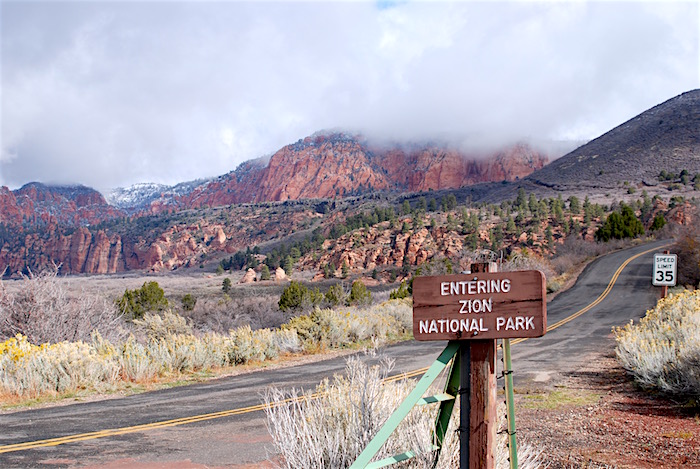
Just two weeks into the Trump administration, one pledged to pursue a vigorous domestic energy development course, Zion National Park officials find themselves in a bind over how to react to a proposal to allow oil and gas exploration within a mile of the park.
With U.S. Rep. Ryan Zinke's confirmation as Interior secretary yet to be finalized by the Senate, park officials are waiting for him to take the helm at Interior and seek his guidance on the matter.
“It’s a real peculiar time to be making hard statements one way or another with the transition of administrations," said Zion spokesman John Marciano. "It's a sensitive topic."
At issue is the possibility that the U.S. Bureau of Land Management will put up for an oil and gas lease auction in June three parcels near the park in southwestern Utah, including one that would straddle the Kolob Terrace Road north of Virgin that is used to reach the "roof" of the park. The agency is taking comments through Friday on an environmental assessment analyzing the consequences of putting the parcels up for auction, though the National Park Service is thinking of asking the BLM to extend the comment period.
"We’re writing a letter to BLM to ask them to extend the comment period so we can further review with senior leadersjhip and further obtain more current geological statistics from various services that will affect how we’ll respond," said Mr. Marciano late last week. "We want to get more information. We want to support our statements with better statistics.
"... Until further analysis of the EA is done, which will include obtaining more up-to-date statistics from various departments and conversations with senior leadership, we really can't respond to having a particular position," he added. "We are, however, concerned with protections under the Clean Air Act as Zion is considered a Class 1 area; the affect of noise, erosion, and with protecting the darkness of the night sky."
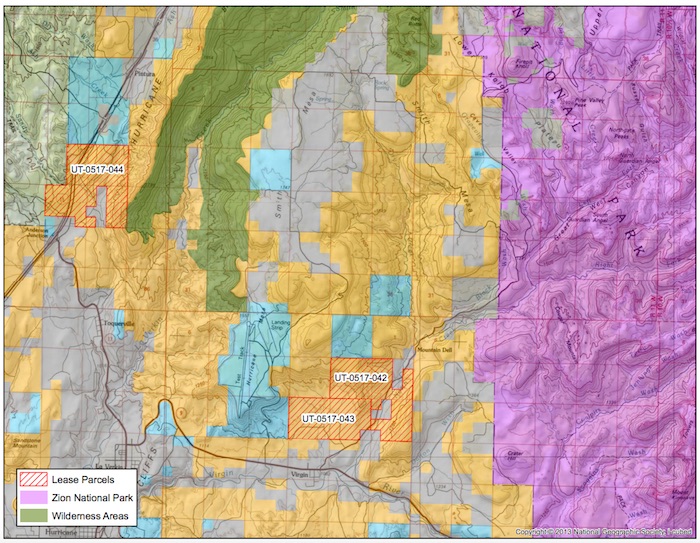
National Parks Conservation Association officials have been more vocal in opposing the potential auction, saying drilling isn't appropriate so close to the national park.
“We’re concerned about air quality, night skies, soundscapes," said Cory MacNulty, NPCA's senior program manager for Utah. “We are also concerned about the impact on visitor experience. We feel not only is this not in an appropriate location, but they’re being offered for lease at a very critical time with increased visitation to Zion.”
Zion has seen a sizeable increase in visitation, with last year's tally of 4,317,028 representing a nearly 18 percent increase over 2015 numbers. The park's heightened popularity has officials working on a visitor use management plan, one that might call for a carrying capacity to be established. With shoulder seasons getting shorter and shorter, NPCA officials are concerned about the impact drilling activity could have on those trying to enjoy the park.
With at least one of the parcels being located in critical winter habitat for mule deer, any successful leasee likely would have to concentrate their drilling operations during the busy tourist season, said Ms. MacNulty.
"The bottom line for us," she said, "is there aren’t producing wells in the county. This is not an appropriate place to start, a mile from Zion National Park. The national park is drawing visitors from around the world, and we’re grappling with that visitation now. Given the importance of the park to the economy and the future of the area, we don’t think this is an appropriate location."
Louise Excell, an area resident, spoke out against the proposal in January.
“As a lifetime resident and a retired owner of several hospitality and tourist-related businesses in Springdale, Utah, I know how crucial the greater Zion National Park area is to our visitors and local residents alike,” she said. "I cannot imagine how visitors will feel as they discover pump jacks and flares from oil and gas drilling are visible from both inside and outside the park. Not only will the sight be jarring for visitors and residents, but other important natural resources and quality of life will be affected, including diminished air quality, loss of natural soundscapes, and night skies.”
Officials with the Southern Utah Wilderness Alliance see no need for the parcels to be put up for auction.
"The oil and gas industry has roughly 2 million acres of BLM-managed lands in Utah already under lease that they have not developed," the advocacy group said. "Despite the extensive leased lands, in 2016 the drilling of new oil and gas wells in Utah reached a 30-year low."
“BLM’s proposal to sell these two leases is déjà vu all over again. Just like its proposal in 2008 to sell leases adjacent to Arches and Canyonlands National Park and Dinosaur National Monument, this is an entirely ill-conceived plan that should be rejected,” said Landon Newell, SUWA's staff attorney. “This lease-first, think-later approach to oil and gas leasing has been rejected time and time again. It’s hard to understand what would compel BLM to propose offering these parcels but whatever their motivation, BLM should rethink its proposal which threatens Utah’s most popular national park.”
Traveler footnote: A petition asking the BLM not to put the parcels up for auction can be found at this page.
Stories about:
Story Categories:
A copy of National Parks Traveler's financial statements may be obtained by sending a stamped, self-addressed envelope to: National Parks Traveler, P.O. Box 980452, Park City, Utah 84098. National Parks Traveler was formed in the state of Utah for the purpose of informing and educating about national parks and protected areas.
Residents of the following states may obtain a copy of our financial and additional information as stated below:
- Florida: A COPY OF THE OFFICIAL REGISTRATION AND FINANCIAL INFORMATION FOR NATIONAL PARKS TRAVELER, (REGISTRATION NO. CH 51659), MAY BE OBTAINED FROM THE DIVISION OF CONSUMER SERVICES BY CALLING 800-435-7352 OR VISITING THEIR WEBSITE. REGISTRATION DOES NOT IMPLY ENDORSEMENT, APPROVAL, OR RECOMMENDATION BY THE STATE.
- Georgia: A full and fair description of the programs and financial statement summary of National Parks Traveler is available upon request at the office and phone number indicated above.
- Maryland: Documents and information submitted under the Maryland Solicitations Act are also available, for the cost of postage and copies, from the Secretary of State, State House, Annapolis, MD 21401 (410-974-5534).
- North Carolina: Financial information about this organization and a copy of its license are available from the State Solicitation Licensing Branch at 888-830-4989 or 919-807-2214. The license is not an endorsement by the State.
- Pennsylvania: The official registration and financial information of National Parks Traveler may be obtained from the Pennsylvania Department of State by calling 800-732-0999. Registration does not imply endorsement.
- Virginia: Financial statements are available from the Virginia Department of Agriculture and Consumer Services, 102 Governor Street, Richmond, Virginia 23219.
- Washington: National Parks Traveler is registered with Washington State’s Charities Program as required by law and additional information is available by calling 800-332-4483 or visiting www.sos.wa.gov/charities, or on file at Charities Division, Office of the Secretary of State, State of Washington, Olympia, WA 98504.

Comments
You can thank SUWA for making a visit to Angel Arch a 20 mile round-trip hike instead of a short hike off the road. These are the same people that did that.
You're opposed to the idea of an arch that you have to out in some effort to see?
I drove in to Angel Arch several years before the area was closed. Most of the route was actually IN the creek. Where it was on land, the landscape had been badly torn up in places where people had driven around, instead of through, wet and muddy spots. I camped out there and took a cooling dip in the creek only to find an oil slick on the water. (Some of it probably came from ME, because it was sweaty hot out there.)
I encountered one poor group whose vehicle had suffered some kind of breakdown several miles in. A service truck had come out from one of the not very nearby towns and they had a makeshift repair shop under some shade trees.
A couple of years after the "road" was closed to vehicles, I hiked it. Yup, a kind of long round trip, although I don't think it was 20 miles. But it was wonderful. I met only about six other hikers in three days. Complete quiet except for an occasional aircraft overhead. All level. Easy hiking except in a few places where I had to slog through some sand for short distances. Much of the hiking was actually in the creek. Soggy shoes, but it was kinda like a bit of air conditioning. Two terrific nights alone in the wild. No problem with water. A filter provided all I needed.
All in all, one of the very BEST hikes I've ever taken. Even at my advanced age, I know I wouldn't have any problem doing it again. In fact, I think I may take advantage of this reminder to see if I can do it again this year.
Thank you SUWA, for making this kind of thing possible for those who are still tough enough to make it. If I find out my 76 years are too many, I'll still be thankful because my granddaughters will have it available when they're ready to try. In a world that is becoming ever more mechanized and electronified, we need tough, wild places even more where people may still test themselves against wild as our ancestors had to do.
As for drilling -- this may be the first of many battles we'll need to fight over the next four years. Get ready.
I wonder if there's oil under Mar-A-Lago?
The National Parks belong to all the people , please leave the them alone so all Americans can continue to enjoy for all time.
Wasn't it possible to hike it before if that is what you wanted to do?
I'm confused as to why park officials need guidance as to how to respond just because there is an administration change. Shouldn't they respond the same regardless of what administration is in place? It's also somewhat ironic that people hate the idea of drilling for oil and gas yet apparently have no problem with their town or the park turning into one huge massive traffic jam of gas guzzling vehicles. It would also be nice if the BLM was quoted in this article. I see lots of hysteria again just like many other articles filled with "could" "possibly" or "might". I also see how many have made the leap to this happening in the Park itself. Yes one mile is awful close for comfort but then shame on us for not having an acceptable buffer zone established for all of the parks. Or is there and that was perhaps also not mentioned? One other note. It sounds to me like this was in the works under the prior administration since the comment period is about to end.
So being a disabled vet how does one hike 20 miles to see a National Park treasure The Parks are for all people and not just a few who are in good shape. They are for the average person or family with small kids who may not be fit to hike 15-20 miles and be equippped camp out. I understand some sites do to limited access willl be prohibited but let's don't restrict sites becasue of some with zealot or selfish objectives.
I'm not sure I understand your last sentence, Concerned Citizen, at least with respect to Angel Arch in Canyonlands.
There are many arches you can see from your vehicle in the adjacent Arches NP. Some of those arches have wide accessible paved paths up to them. See their website https://www.nps.gov/arch/planyourvisit/accessibility.htm
Parks are under some pressure to ensure ABA (Architectural Barriers Act) compliant paths in the developed front-country, specifically to let visitors such as yourself enjoy parks safely. I think that's a good thing in the developed front-country. [Parks are under pressure on broader ADA compliance, too. The only grumbling I've ever heard from NPS staff about ADA compliance is specifically about 508 compliance on our documents. It isn't that folks don't want accessible documents as much as it is that the Microsoft Office tools we're supposed to use simply stink at 508 compliance.]
The issue with Angel Arch in Canyonlands is whether visitors (or anyone) should be allowed to drive vehicles up Salt Creek Wash, which became the legal question of whether a wash per se counts as a road or right of way grandfathered in to a National Park because vehicles have driven up it in the past. Such driving is damaging to the flora & fauna & geomorphology of the wash & riparian area (there's data behind this statement of fact). NPS eventually prevailed in a court of law versus the county's attempt to claim Salt Creek Wash as a legal road right of way that NPS could not close to vehicles.
In my opinion, based on the ecological damage that vehicular access would cause, if any sites will have limited access by foot only, I think that Angel Arch is a top candidate. I don't consider maintaining the flora & fauna of Salt Creek "unimpaired for the enjoyment of future generations" to be selfish, nor do I consider myself to be some zealot. Others may disagree with that self-assessment.
I agree tomp2, thank you for the post.
Is the entire length of the Salt Creek Road in environmentally sensitive areas? Given that the road was in bad condition then why is it not possible to repair the road? Maybe there is a way to place the road where it avoids the sensitive areas. Some visitors do not have the energy or the time to hike the approximately 20 miles to the arch. Maybe there could be an extension of a road from another area to make it more accessible. Canyonlands National Park - Needles District has lots of long hikes but very few moderate day hikes (10 miles and under). Most hikes there require almost a full day or an overnight trip for the average visitor.
Maybe it time to evolve the park. Put roads and hiking trails in places that have not had them before. I see other parks doing road construction. Why could this not be done to Salt Creeek Road or portions of the Salt Creek Road to allow more access to all visitors?
As is the case with many "roads" in Utah, the Salt Creek "road" is actually a live stream for almost all of its length. It never has been a real road.
I think in some cases trails need to be better organized. For example in Arches National Park there is an informal hike to Ring Arch. Really overgrown and I never saw the Arch close up. Saw it from a distance but too much brush to get through to get close. How much damage did I do considering there was no trail? No sign. Wouldn't hikers do less damage with a formal trail instead of guessing at where they think the trail should be?
I would like to see the Park Service do guided ranger hikes to Angel Arch. Just like they offer in the Fiery Furnance. If the 20 miles is as easy as people are saying then the Park Service should have no trouble leading this hike. Have it start in the morning and end in the afternoon if it is as accessible as some here are suggesting.
The simple fact is that there has been roads in the area for many years and several years ago people decided that there should not be a road anymore. I have often wondered what would happen if access to Angel Arch came from the south. Would there be less disturbance to the environment coming into the park from the south.
So if you have unlimited time and energy you can visit Angel Arch. I plan almost all of my family's trips. Right now to visit Angel Arch I would have to allow one full day to visit it. Others would suggest that you have to camp to get there. 2 days then just to visit this arch. Sorry if I believe that maybe the Park Service can do better than this.
Odd that some people are talking about preserving Salt Creek and access to Angel Arch for future generations since its access is currently restricted to the current generation. Right now the majority of the current visitors to Canyonlands National Park cannot see this area because somebody decided that it would be best to eliminate the roads in the area. The people making this decision were extremely narrow-minded people. Upgrading the road could not happen. Some here comment on people getting stuck. Guess putting a ranger station on some part of that road would be out of the question. Somebody who could notify others when people get stuck. Somebody who could maybe have access to equipment to get out of ditches.
Just close off the area. That was the only thing considered. We keep restricting people to certain parts of our national parks but yet we are puzzled about why they are crowded. In this case people could be spread out in the Salt Creek Area. What's next? Close the parking area where all the cars are supposed to park because there are fumes from the cars in the area
Seeing this area became more difficult and inaccessible to the majority of the public when this area was closed to visitors. Of course it is a level 20 round-trip. If you have several days to spare then you should be able to make it. Sad that the Park Service wants to hide this landmark and restrict access to it. How many visitors have missed seeing this landmark because of this decision?
I'd really like to know what the park service is not publishing any information on the proposoed oil drilling in and aroiund our parks. Please do the world population and inform.
http://www.nationalparkstraveler.com/2017/02/change-administrations-puts...