

Shale gas, that trapped within the Marcellus Formation buried beneath the Eastern United States, has grown to become a significant component of the country's energy portfolio. But it also poses a threat to national park lands in the region, with more than a few proposed natural gas pipelines that could cross the Appalachian National Scenic Trail.
“Far and away, the biggest external threat is natural gas pipelines. Right now there are four in Pennsylvania and Virginia where there’s been permit requests from (the Federal Energy Regulatory Commission), and there’s kind of a race to get the gas from the Marcellus shale area to the East Coast and eventually out of the country," Ron Tipton, executive director of the Appalachian Trail Conservancy, replied when asked how the incoming Trump administration might adversely affect the iconic trail. "This is our top priority at ATC right now."
With Donald Trump promoting an "all of the above" philosophy in regards to energy production in the United States, there are growing concerns within the conservation community about how that will impact public lands. While the bulk of the country's public domain is in the West, the rise of fracking on private property in the East has spawned an outpouring of natural gas that needs to get to market, and pipelines are key.
As for the West, the nominee for Interior secretary, Congressman Ryan Zinke of Montana, has during his term supported a weakening of wilderness protections, has in the past voiced approval for transferring U.S. Forest Service lands to states, and indicated disapproval of a president's use of the Antiquities Act to create national monuments. At the same time, he has been supportive of full funding of the Land and Water Conservation Fund, which is used to fund land acquisitions, support recreation projects, and protect water resources.
But there are concerns over the impacts of ramped up energy development on Western national parks.
"Though Mr. Zinke has expressed support for the Land and Water Conservation Fund and opposes the sale of public lands, he has prioritized the development of oil, gas and other resources over the protection of clean water and air, and wildlife," Theresa Pierno, president and CEO of the National Parks Conservation Association, said after his nomination. "Mr. Zinke has advocated for state control of energy development on federal lands, a move that threatens our national parks. Mr. Zinke has repeatedly voted to block efforts to designate new national parks that would diversify the National Park System."
In the East, FERC has two natural gas pipeline proposals outlined in draft environmental impact statements - the Mountain Valley Pipeline proposed to run through parts of Virginia and West Virginia, and the Atlantic Coast Pipeline Project that would thread through West Virginia, Virginia and North Carolina. Combined, those two projects would require nearly 1,000 miles of pipeline along with a number of compressor stations. At least two other pipeline proposals -- the Appalachian Connector Pipeline and the WB Express Project -- are on the horizon.
At NPCA's Mid-Atlantic office, Pam Goddard criticized FERC and other federal permitting agencies for "not requiring the applicants to do the studies that should be required by law to show the impacts."
“The (Appalachian Trail Conservancy) and the trail clubs and the gateway communities have spent millions of dollars promoting and protecting the trail," said Ms. Goddard, NPCA's Chesapeake and Virginia program director, noting that the agencies are "totally ignoring what that will do to tourism.”
The Appalachian Trail was originally envisioned as a "'super trail' along the mountain crests of the eastern wilderness," notes the National Park Service. "(Benton) MacKaye saw the Appalachian Trail as an escape from the evils of modern life and as 'a moral equivalent to war.'"
While sections of the 2,180+-mile trail do traverse wilderness-quality landscapes, the crush of society has created views of cities, industry, and highways along some sections today. The proposed gas pipelines will only add to this viewshed impairment, said Mr. Tipton.
The 301-mile Mountain Valley Pipeline, he said, as proposed would cross the A.T. and then swing north and parallel the foot path.
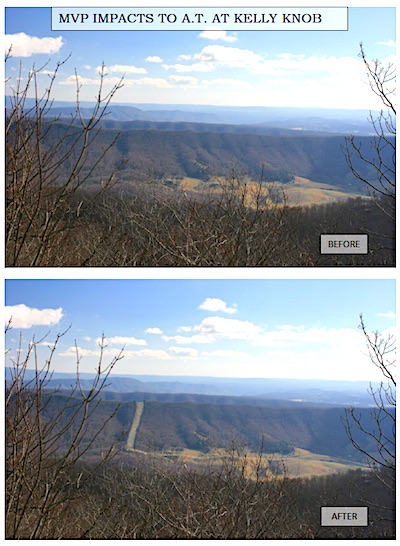
"FERC did a draft EIS which is now out for comment and their comment about the impact on the A.T. scenic landscape is there is none," he said during a phone call. "We’ve done visuals. We had professional companies do visuals of where this pipeline would run and what it would look like, and it would be in the foreground in many places."
The pipeline also is proposed to cross through the Jefferson National Forest, the backdrop for many miles of the A.T., and officials there have told the Appalachian Trail Conservancy that if the plan is approved as proposed the Forest Service would change its "Scenic Integrity" management criteria for the trail from "high" to "moderate," according to Mr. Tipton.
"Because this pipeline is really going to degrade the scenic landscape," he added.
The upper reaches of the Obama administration haven't paid much attention to the pipeline proposals, said Mr. Tipton, though he expressed confidence that if President Obama had another year to serve "we could have gotten both high level Interior and Agriculture support for opposition to this route."
Back at NPCA, Ms. Goddard was fearful that approval of these proposals could set dangerous precedents for wilderness areas and roadless areas.
"They’re going to have these 125-foot-wide corridors adjacent to wilderness and even some roadless areas," she said. "Once we open the door to changing wilderness, and allow these kinds of precedents, what’s stopping it from any other park?”
In his official comments to FERC on the Mountain Valley DEIS, Mr. Tipton was highly critical of the agency's draft.
"It is difficult to provide substantive comment on the DEIS due to the fact that the document is fundamentally deficient and lacks even the most basic analysis of impacts to the Appalachian National Scenic Trail. Further, much of the information that is included is incorrect and in no way meets the needs of the National Environmental Policy Act or the National Forest Management Act," he wrote. "Given our extensive experience analyzing potential impacts to the Appalachian Trail from a variety of proposed developments, this is a fundamentally deficient NEPA in terms of analyzing impacts to the ANST. As a result, we feel there are only two ways in which FERC and its cooperating agency, the United States Forest Service, can meet their legally required responsibility. FERC must withdraw this DEIS until it is ready for public comment, or offer a supplemental DEIS focused on potential impacts to the Appalachian National Scenic Trail."
Key flaws with the DEIS from ATC's point of view included:
- Lack of a visual impact assessement
- Weaking of current Forest Service protections for the A.T.
- An incomplete analysis of the pipeline's cumulative impacts on the trail
NPCA cited many of the same concerns in its official comments, and noted that the DEIS failed to include an analysis of air and water impacts, and lacked an economic analysis.
"We respectfully request that FERC withdraw the DEIS until it is ready for public comment," Ms. Goddard said in the comments submitted to FERC. "Numerous studies, outlined above, must be conducted to truly show the many impacts this proposal would have on our national parks and forests. FERC should revise their plan to conduct the missing but necessary studies, including how to avoid impacts to the resources."
While discussing the two pipelines currently under review, Ms. Goddard, noting two others in the works, said FERC should "do a cumulative EIS for all of them and colocate them."
“Instead of fighting these one by one and having this horrible crisscross across the A.T., why can’t FERC say enough is enough, why can’t we put these all in the same spot?" she wondered.
There was hope from some conservation corners that if Mr. Zinke is confirmed as Interior secretary he will be mindful of impacts to public lands and national parks.
“He shares the industry’s values specific to the importance of access to and funding for America’s public lands and waters. He knows the important role they play as the infrastructure of the $646 billion outdoor recreation economy. We look forward to a collaborative relationship and constructive dialogue with him, but we will also be ready to defend the protection of our shared lands and waters--our American heritage--should they be threatened," said Amy Roberts, executive director of the Outdoor Industry Association.
At the National Wildlife Federation, CEO Collin O'Mara was cautiously optimistic about Mr. Zinke's management style when it comes to public lands.
“By offering Rep. Ryan Zinke—a sportsman and proponent of keeping public lands public and investing in conservation—the position of Secretary of the Interior, President-elect Trump is signaling that he intends to keep his promises to America’s hunters, anglers, and outdoor enthusiasts. Rep. Zinke has opposed efforts to sell off America’s public lands and has supported investing in wildlife conservation and reauthorizing the federal Land and Water Conservation Fund," said Mr. O'Mara.
"... the millions of members of the National Wildlife Federation look forward to hearing his ideas for improving public land management, increasing access for outdoor recreation, recovering at-risk wildlife populations, reclaiming degraded lands, expanding wildlife-friendly renewable energy development, and strengthening relationships with tribes. We also hope he will affirm previous statements that climate change is real and advocate for common-sense solutions that strengthen our economy, enhance energy independence, reduce emissions, and improve the resilience of wildlife habitat.”
Back at the Appalachian Trail Conservancy, Mr. Tipton was hopeful about Mr. Zinke's view of public lands and national parks.
"Ryan Zinke has received enthusiastic reactions from some senior staff at conservation groups like The Conservation Fund because he is on record supporting full funding for the Land and Water Conservation Fund and because they have worked with him directly. What I have heard from a few different sources is that he is enthusiastic about land protection in Montana because of his experience as a hunter and angler," said Mr. Tipton.
"It's hard to predict what his appointment would mean to the A.T. The big question will be whether we can gain the interest and support of Rep. Zinke and his senior team for the protection of the A.T. landscape, a new initiative designed to expand the zone of protection for the trail in key areas. The other key question is will he support the Park Service in its efforts to challenge energy development, such as natural gas pipelines, that are proposed for locations where they would seriously impact the A.T. viewshed?"
Stories about:
Story Categories:
A copy of National Parks Traveler's financial statements may be obtained by sending a stamped, self-addressed envelope to: National Parks Traveler, P.O. Box 980452, Park City, Utah 84098. National Parks Traveler was formed in the state of Utah for the purpose of informing and educating about national parks and protected areas.
Residents of the following states may obtain a copy of our financial and additional information as stated below:
- Florida: A COPY OF THE OFFICIAL REGISTRATION AND FINANCIAL INFORMATION FOR NATIONAL PARKS TRAVELER, (REGISTRATION NO. CH 51659), MAY BE OBTAINED FROM THE DIVISION OF CONSUMER SERVICES BY CALLING 800-435-7352 OR VISITING THEIR WEBSITE. REGISTRATION DOES NOT IMPLY ENDORSEMENT, APPROVAL, OR RECOMMENDATION BY THE STATE.
- Georgia: A full and fair description of the programs and financial statement summary of National Parks Traveler is available upon request at the office and phone number indicated above.
- Maryland: Documents and information submitted under the Maryland Solicitations Act are also available, for the cost of postage and copies, from the Secretary of State, State House, Annapolis, MD 21401 (410-974-5534).
- North Carolina: Financial information about this organization and a copy of its license are available from the State Solicitation Licensing Branch at 888-830-4989 or 919-807-2214. The license is not an endorsement by the State.
- Pennsylvania: The official registration and financial information of National Parks Traveler may be obtained from the Pennsylvania Department of State by calling 800-732-0999. Registration does not imply endorsement.
- Virginia: Financial statements are available from the Virginia Department of Agriculture and Consumer Services, 102 Governor Street, Richmond, Virginia 23219.
- Washington: National Parks Traveler is registered with Washington State’s Charities Program as required by law and additional information is available by calling 800-332-4483 or visiting www.sos.wa.gov/charities, or on file at Charities Division, Office of the Secretary of State, State of Washington, Olympia, WA 98504.


Comments
A very important question that needs to be asked is this: How much of the gas and oil produced by Trump's energy "policy" will remain in the U.S. and how much will be shipped overseas to pump dollars into the pockets of the big oil companies and their stockholders?
I'm not at all optimistic about the incoming president and Congress. I'm also afraid that our parks and public lands may well be among the least worrisome things we will face in the next four years.
It will be very interesting to see how long it takes for people who voted for DJT to realize they made a horrible mistake. (Or -- and I really believe it's highly unlikely -- for people like me to begin to say "Hmmm, he might not be so bad after all.)
Only one thing is certain at this point: We're Gonna Find Out.
Lee Dalton - those people who voted for DJT will never blame him for anything - it will always be Obama's fault. If Trump can make a buck from it, he will, and that includes any sort of development within the national park system. I am usually an optimist, but not in this case. I think our national parks and national forests and monuments will suffer in the long run. The question is, by how much?
No, Rebecca that is the Dem's MO. Blame it on Bush. If Trump does things that are damaging, I will be among the first to blame him. I'll start now. While I in generally like his plan to cut taxes, I think his tax probosals attacking imports is wrong. It smells much like Smoot-Hawly which was an econmic disaster. I also disagree with building a wall. Totally unnecessary, no jobs, no schools, no healthcare, no giveaways, the illegals will have no incentive to come.
You say "if Trump can make a buck he will" in reference to energy development in the park. How exactly would Trump "make a buck" no matter what the policy? And how does that stand against his statements that he wants to forego $400k in annual salary? That hardly sounds like someone greedily actiing only for himself. The fact is, you have nothing from him that suggests he will institute policies that will have any major negative effect on the parks. As noted in Kurt's piece, the apointment of Zenke would appear to point the other way.
Rebecca - so far you have been correct in this: "Lee Dalton - those people who voted for DJT will never blame him for anything - it will always be Obama's fault." Despite the contortions of his apologists.
Here's an interesting, and very alarming article from today's SLC Tribune regarding a GOP attempt to gut the civil service laws.
http://www.sltrib.com/home/4811853-155/new-feds-could-be-fired-for
I share Lee’s sentiment that the parks may be the least of our concerns but keeping my fingers crossed that that is not the case. As for Rebecca's comment on Trump voters not blaming him for anything. That is politics these days and would be true regardless of who was elected. I can’t come up with one thing Obama did in his last 8 years that liberals criticized and 8 yrs later many were still blaming Bush. I am hopeful that given the large number of conservatives who aren't fans of Trump will continue to be critical when they disagree with him. I also find the fact that he has reached out to many of those who strongly disagreed with him a cause for cautious optimism. As for enriching himself that would not surprise me but that remains to be seen as opposed to Clinton where that was pretty much a given.
I think the majority of the American people wish we had two different choices. One thing for sure, it will be a very interesting 4 years.
Here we go . . . . it's starting.
http://www.deseretnews.com/article/865675686/Zinke-Interior-Department-i...
And it looks as if Rob Bishop is joining the Navy or something:
http://www.deseretnews.com/article/865675660/Bishop-turns-up-heat-on-mar...
Doing what he said he was going to do. And got elected saying he was going to do it. Refreshing.