

Yellowstone Lake, on its surface, is an immense body of deep, cold water that could be fatal in a matter of minutes to anyone who fell into it. But deep down, on the lakebed, hundreds of hydrothermal vents are furnace-like, generating water temperatures of more than 300 degrees in some parts of the lake. Beyond the astonishing temperatures, though, researchers from the Woods Hole Oceanographic Institution hope their studies help them answer how "environmental processes and climate affect continental hydrothermal systems."
There is more, of course, expected to be teased out from the three field seasons the researchers are to spend on the lake. What microbial habitats might be clustered around these vents? How do earthquakes impact the hydrothermal vents, of which there are an estimated 250 on the lakebed. What triggers hydrothermal explosions?
"The project is sited in the northern half of Yellowstone Lake, which hosts one of three major thermal basins in Yellowstone National Park," the project's website notes. "While most of the thermal activity in Yellowstone discharges into pools, fumaroles, and geysers that can be observed on the ground surface, the system beneath the lake discharges through a series of vents and fissures onto the lake floor, where it is hidden from sight. This thermal system is particularly sensitive to perturbations, making it an ideal location for studying the cause-and-effect relationships between magmatic, tectonic, and environmental activity with hydrothermal circulation. The extreme sensitivity of the system to perturbations is evidenced by the fact that the northern part of Yellowstone Lake hosts the largest known hydrothermal explosion craters in the world, which are generated when the pore pressure in a system suddenly drops, causing catastrophic vapor explosions that can excavate large volumes of rock and fluid."
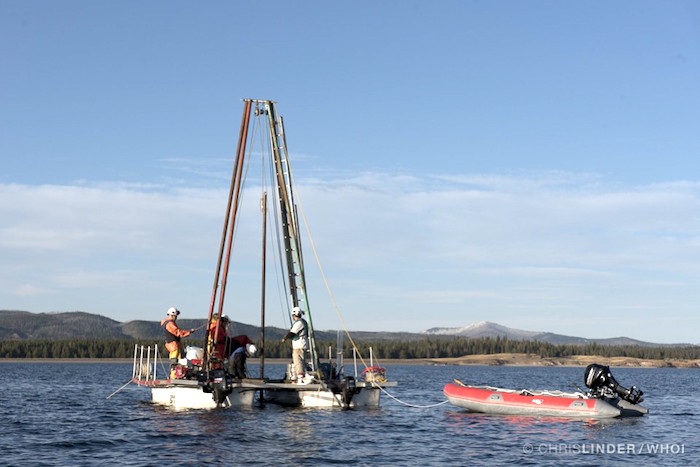
Along with measuring vent temperatures and studying water flows, the research also involves taking core samples from the lakebed to study sediments that might tell stories of the environment before and after hydrothermal explosions.
"Even though all of the sites are within Yellowstone Lake, each one is in a different geologic area, including a deep ‘graben’ (a ditch in between two faults), a large hydrothermal explosion crater, the deep, hydrothermally active hole east of Stevenson Island, and areas of landslide deposits. The cores from these different sites will give the team an unprecedented look at the post-glacial geological history of the lake region, including the processes by which large hydrothermal explosion craters were formed," Chris Linder, one of the researchers, wrote on the project's blog.
"Several cores were 40 feet in length (previous cores from the Lake maxed out at ~28 feet), and one of the cores may have penetrated into glacial flour, meaning it may provide a complete record back to the last glaciation. Many of the cores contained significant amounts of gas, probably carbon dioxide, especially the Stevenson Island core. The team is thrilled with the coring effort and eager to see what stories the cores will reveal."
The core samples are scheduled to be opened in January.
Stories about:
Story Categories:
A copy of National Parks Traveler's financial statements may be obtained by sending a stamped, self-addressed envelope to: National Parks Traveler, P.O. Box 980452, Park City, Utah 84098. National Parks Traveler was formed in the state of Utah for the purpose of informing and educating about national parks and protected areas.
Residents of the following states may obtain a copy of our financial and additional information as stated below:
- Florida: A COPY OF THE OFFICIAL REGISTRATION AND FINANCIAL INFORMATION FOR NATIONAL PARKS TRAVELER, (REGISTRATION NO. CH 51659), MAY BE OBTAINED FROM THE DIVISION OF CONSUMER SERVICES BY CALLING 800-435-7352 OR VISITING THEIR WEBSITE. REGISTRATION DOES NOT IMPLY ENDORSEMENT, APPROVAL, OR RECOMMENDATION BY THE STATE.
- Georgia: A full and fair description of the programs and financial statement summary of National Parks Traveler is available upon request at the office and phone number indicated above.
- Maryland: Documents and information submitted under the Maryland Solicitations Act are also available, for the cost of postage and copies, from the Secretary of State, State House, Annapolis, MD 21401 (410-974-5534).
- North Carolina: Financial information about this organization and a copy of its license are available from the State Solicitation Licensing Branch at 888-830-4989 or 919-807-2214. The license is not an endorsement by the State.
- Pennsylvania: The official registration and financial information of National Parks Traveler may be obtained from the Pennsylvania Department of State by calling 800-732-0999. Registration does not imply endorsement.
- Virginia: Financial statements are available from the Virginia Department of Agriculture and Consumer Services, 102 Governor Street, Richmond, Virginia 23219.
- Washington: National Parks Traveler is registered with Washington State’s Charities Program as required by law and additional information is available by calling 800-332-4483 or visiting www.sos.wa.gov/charities, or on file at Charities Division, Office of the Secretary of State, State of Washington, Olympia, WA 98504.
INN Member

The easiest way to explore RV-friendly National Park campgrounds.

Here’s the definitive guide to National Park System campgrounds where RVers can park their rigs.
Our app is packed with RVing- specific details on more than 250 campgrounds in more than 70 national parks.
You’ll also find stories about RVing in the parks, tips helpful if you’ve just recently become an RVer, and useful planning suggestions.


Comments
What's the potential for an eruption, in the near future???? And the impact on the western "United States"?????
1. Anytime
2. Devastating.
I recommend you move as far away from Yellowstone as possible, please.
Moving as far away from Yellowstone as possible wouldn't help. Were Yellowstone to erupt as it did 638,000 years ago, the ash would encircle the entire globe. A "nuclear winter" of at least five years would result. No crops would grow anywhere on the planet, which itself would be covered with a minimum of three feet of ash.
Memo to Al Gore. And you worry about global warming, Al? In that case, the planet has news for all of us. With or without the human race, it will survive another five billion years. Sure, you people should take good care of me, but don't think for a minute you're in control.
It would help me, as these doomsday-obsessed, probability-challenged people would still inhabit my electronic world but I'd be less likely to run into them in person. There are many ways the empire may fall in the next century or two, but having it due to the eruption of the supervolcano isn't likely to be one of them.
How many of you are aware that Yellowstone National Park was evacuated last summer because of fear the supevolcano was about to erupt?
Yup. It actually happened in July. Here's a website that contains the story -- a story that apparently the government succeeded in keeping hidden.
While you're at it, check out some of the other articles on here if you want to learn the TRUTH about our sneaky government.
http://unitedmediapublishing.com/yellowstone-evacuated-amid-fears-of-sup...
Alfred, are you absolutely sure the entire earth would be covered with three feet of ash. The last time it happened, several feet did blanket what is today Nebraska and killed a bunch of titanotheres. It's also true that about 1/8 inch of Yellowstone ash can be found in some sediments in New York. But three feet worldwide is kind of a stretch.
But then, again, if Yellowstone was evacuated last July and it was kept secret from us, who knows . . . . . ?
You are joking, right Lee?????
My b.s. meter is pegged. Lee cited a story from 2015. I found another, same quotes, from 2016, as well as one from 2014. And there doesn't appear to be a "Richard Dunn" working for the NPS.
And here's the park disputing it:
http://www.snopes.com/yellowstone-evacuation-volcano/
No, Esteemed Comrade, I'm not joking.
United Media Publishing is considered to be Gospel by many conservative fans. A few folks I know simply cannot be convinced that it is complete fantasy.
After all, if it's on the Internet and it supports your beliefs about anything, it HAS to be true, doesn't it?
What a shame that so many people are susceptible to this kind of thing.