
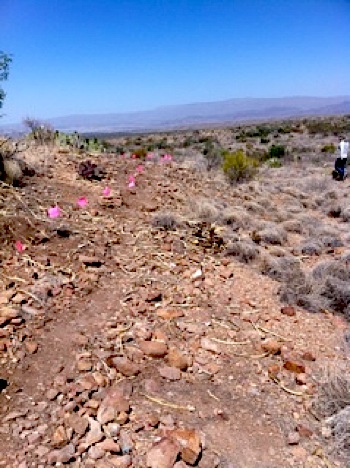
Construction on a multiple-use trail at Big Bend National Park is under way, even though Park Service officials haven't approved mountain biking on the trail. Roger Siglin photo.
Questions are being raised over whether the National Park Service's approach to the multiple-use trail in Big Bend National Park was preordained to satisfy the International Mountain Bicycling Association.
At the sametime, a regulatory flub that had crews working to construct the trail before the requisite paperwork was made public is being criticized by an environmental watchdog.
While the Park Service is calling the path being built near Panther Junction a multiple-use trail suited for both hikers and mountain bikers, Big Bend officials have not even started the regulatory process to allow mountain bikers on the trail.
"This trail has been billed from day one as a mountain bike trail and only secondarily as a multi-use trail. That is the obvious rational for the NPS saying it is building a hiking trail which does not require rule-making, and only after it is done will a decision be made to promulgate a special regulation to open it for mountain bikes," contends Roger Siglin, whose long Park Service career took him from Alaska to the Southwest in positions that ranged from chief ranger in Yellowstone National Park to superintendent of Gates of Arctic National Park and Preserve.
"If a hiking trail were the main purpose, it would be constructed differently to avoid the ups and downs of the current alignment," Mr. Siglin added in an email to the Traveler. "Also, there are many more attractive alternatives that could have been considered on lands classified as potential wilderness and currently managed as such. The area where construction is occurring was not included in that classification because it was once considered a potential source of water for the basin, and also as a potential location if a decision were ever made to relocate the basin development."
Back in mid-February John Wessels, the Park Service's Intermountain Region director, signed off on a Finding Of No Significant Impact for the environmental assessment that was conducted on the proposal to build the multi-use trail at Panther Junction. But someone pushed the wrong button on their keyboard and the FONSI was not made public at the time.
As a result, work on constructing the trail began before everyone heard of the Park Service's decision.
Most of the trail would be single-track – approximately the width of a bike's handlebars – with one-way traffic moving counter clockwise. This would be the first trail constructed from scratch on undeveloped park land to accommodate both hikers and mountain bikes, according to Public Employees for Environmental Responsibility. Horses would be barred from the trail.
PEER and a local group, Our Texas Wild, are challenging both the substance of the plan and the short-circuited process employed to approve it. Concerns raised by the groups include:
* The pay-for-play aspect of the trail where a user group, the International Mountain Bicycling Association and its local affiliate, paid for the Environmental Assessment conducted during the approval process for the trail. The group will help build the trail to its specifications and is even offering to patrol it for the National Park Service;
* A previous Big Bend superintendent is part of the business operations of the local biking group. The outgoing superintendent, says PEER, pushed the project over the unanimous objection of his own staff, including 20 who filed personal comments opposing the trail; and
* Big Bend already has hundreds of miles of trails and roads open to mountain biking and there are another 900 miles of bike-accessible trails and roads on state and private lands surrounding Big Bend.
Mr. Siglin wonders if the trail project was pushed through to prevent Big Bend's next superintendent from reviewing, and possibly rejecting, the project.
"Did Superintendent (Bill) Wellman’s announced retirement effective the end of April create pressure to get the construction well on it’s way to completion prior to his replacement? He has been the major NPS supporter of the project in spite of the documented opposition of his staff," the Park Service retiree said.
"If the special regulation process were followed prior to construction it would have been delayed for several months allowing a new manager to re-evaluate the trail."
Public comments issued on the proposal were finally posted by the Park Service last week, two months after they were finalized and two days after IMBA announced trail construction, PEER said in a release.
“To create a first-of-its-kind biking trail through pristine public land, without allowing the public to review the FONSI before construction, without going through essential rule-making process and while allowing an interested group to have behind-the-scenes access, creates a terrible precedent for the National Park System,” said Judy Calman, staff attorney for Our Texas Wild. “This area is included in the Citizen’s Wilderness Proposal and has long been discussed as suitable for wilderness designation.”
Once the FONSI and response to comments finally appeared they were remarkable both for what they contained and for what they lacked, maintains PEER:
* The Park Service declared that constructing a trail and associated parking lot is the “Environmentally Preferred Alternative;"
* NPS admitted it could not make more of an effort to avoid archeological sites because there are thousands of archeological sites in the park and it would be impossible to build a mountain biking trail without going over them; and
* While conceding the area is suitable for potential wilderness designation, Big Bend has declined to pursue that option because it would preclude use of mechanized transport.
“Nobody is against mountain biking. The issue is whether national parks should be prostituted to a special interest,” said PEER Executive Director Jeff Ruch, pointing out that the agency labeling the building of a parking lot as the “environmentally preferred alternative” denotes how warped the decision-making process has become. “Absent a statutory charter, the National Park Service should not be using tax dollars to promote exclusionary recreation.”
Mr. Siglin noted that the trail is poorly located for hiking in the summer, because it will be hot and most hikers will head to higher elevations, and not very attractive to mountain bikers because it's only about 2 miles in length and there are numerous other biking options elsewhere in the park and nearby Big Bend Ranch State Park.
"Jeff Renfrow, who works for Desert Sports in Terlingua, told me personally it would not attract many mountain bikers coming to the Big Bend area," said Mr. Siglin.
"If all of the above is true," he continued, "then the remaining rationale for the trail is that IMBA considers it a foot in the door for building additional trails nationwide on NPS lands. It will also build the constituency for changing the law to allow mountain bikes on single-track hiking trails in designated wilderness on all federal lands, which is a stated IMBA objective."
Story Categories:
A copy of National Parks Traveler's financial statements may be obtained by sending a stamped, self-addressed envelope to: National Parks Traveler, P.O. Box 980452, Park City, Utah 84098. National Parks Traveler was formed in the state of Utah for the purpose of informing and educating about national parks and protected areas.
Residents of the following states may obtain a copy of our financial and additional information as stated below:
- Florida: A COPY OF THE OFFICIAL REGISTRATION AND FINANCIAL INFORMATION FOR NATIONAL PARKS TRAVELER, (REGISTRATION NO. CH 51659), MAY BE OBTAINED FROM THE DIVISION OF CONSUMER SERVICES BY CALLING 800-435-7352 OR VISITING THEIR WEBSITE. REGISTRATION DOES NOT IMPLY ENDORSEMENT, APPROVAL, OR RECOMMENDATION BY THE STATE.
- Georgia: A full and fair description of the programs and financial statement summary of National Parks Traveler is available upon request at the office and phone number indicated above.
- Maryland: Documents and information submitted under the Maryland Solicitations Act are also available, for the cost of postage and copies, from the Secretary of State, State House, Annapolis, MD 21401 (410-974-5534).
- North Carolina: Financial information about this organization and a copy of its license are available from the State Solicitation Licensing Branch at 888-830-4989 or 919-807-2214. The license is not an endorsement by the State.
- Pennsylvania: The official registration and financial information of National Parks Traveler may be obtained from the Pennsylvania Department of State by calling 800-732-0999. Registration does not imply endorsement.
- Virginia: Financial statements are available from the Virginia Department of Agriculture and Consumer Services, 102 Governor Street, Richmond, Virginia 23219.
- Washington: National Parks Traveler is registered with Washington State’s Charities Program as required by law and additional information is available by calling 800-332-4483 or visiting www.sos.wa.gov/charities, or on file at Charities Division, Office of the Secretary of State, State of Washington, Olympia, WA 98504.


National parks and their natural resources belong to you. The National Parks Traveler works to ensure you know how these essential places are being cared for.
Sign Up For Our Weekly Newsletter
Unsubscribe at any time.
INN Member

The easiest way to explore RV-friendly National Park campgrounds.

Here’s the definitive guide to National Park System campgrounds where RVers can park their rigs.
Our app is packed with RVing- specific details on more than 250 campgrounds in more than 70 national parks.
You’ll also find stories about RVing in the parks, tips helpful if you’ve just recently become an RVer, and useful planning suggestions.


Comments
Here we go again. The bike haters will stop at nothing to prevent bikes from riding single track on NPS land. What they're really afraid of is that this trail would show that bikes are a perfectly sound way of visiting parks, and that all the FUD arguments would be proven wrong once bikes are actually allowed. So, they'll stop at nothing to prevent bikes from riding singletrack.
I love mountain biking and will drive many miles for a great trail. But, I think I agree with most of the concerns raised by PEER on this particular trail. I hike in BBNP, I ride in BBRSP and I am okay with it staying that way. They are both wonderful parks, each offering something completely different.
I would like to see more access to bikes in areas where great alternatives like BBRSP don't exist, though.
Mr. Repanshek plays fast and loose with the facts by citing information from Public Employees for Environmental Responsibility (PEER) without researching alternative views before writing. The proposed trail is not located in backcountry wilderness, but on property adjacent to the visitors' center. The funding for the study was not from IMBA funds, but from public funds, as is the case for all impact studies.
With such unreliable statements coming regularly from PEER, it seems advisable that all their facts be cross-checked before publication without qualification.
Mr. Kohn, the article does not state that the trail is located in backcountry wilderness. It does, however, quote an attorney for "Our Texas Wild" saying that the land in question is seen by that group as potential wilderness.
As for the funding of the EA, there does appear to be a paper trail pointing to funding of $10,000 from a group known as "Bikes Belong," as well as another $2,000 from IMBA and $1,500 from the Big Bend Trails Alliance. Another $8,000 came from the Park Service.
That said, it's not unusual for organizations or businesses proposing a project on public lands to pay for some, or all, of the environmental studies.
Kurt--I thought your readers might be interested in the results of an internal park meeting on the proposed "multi-use trail" in Big Bend during the planning process. Note that these are park employees, the kind of people who promote out door activities and who are not opposed to mountain biking as many of your readers accuse anyone who questions this proposal as being.
Rick
NPS Internal Scoping Sessions
The feelings of the park staff can be broken down into two main categories; practical and philosophical.
Practical Concerns
* The park budget is already stretched to the limit and will probably get worse, not better, as the recent Core Operations exercise and memos from our regional and national offices have indicated.
* There would be lots of additional costs other than simply those associated with building and maintaining any new trails. Parking and access among others.
* Maintenance, interpretation and protection work and caseloads would all be increased, and incur additional costs.
* We have trouble maintaining the hiking trails we have now with a trail crew that isn’t base funded and competes for limited funding on an annual basis.
* In light of the budget and staffing issues we already face, is this additional work something we want to, or can, take on?
* There has already been a noticeable increase in illegal riding in the park and we haven’t been able to control that.
* Many staff members are quite skeptical about the mountain biking community’s offer to both help build and maintain any new mountain biking trails. What about the longterm?
* Despite mountain bike advocates being able to raise the necessary funds for the EA, this project will take valuable time and effort away from previous staff commitments. That costs money.
* Why should this proposal supersede new trail priorities already established under the recently completed General Management Plan and the Backcountry Management Plan?
* What will these proposed trails look like? There seems to be some confusion about how wide and what their impacts will be in terms of erosion, scarring and visibility.
* While any new trail would be multiple use, is this genuine or simply PC talk to get access?
* How did this go from possibly “expanding opportunities” to immediately focusing on building new single-track trails?
* The backcountry areas being considered inside the park are inferior routes compared to existing and potential routes outside the park, which are high quality experiences.
* We could end up with a bike trail that isn’t very desirable. Is this initiative more a symbolic victory for IMBA and other proponents rather than a functional high quality mountain biking outcome?
* There are already good single-track riding options right outside the park. Seems like it would make more sense to expand those.
* If the purpose is to increase visitation and economic potential in the park and area, then increased mountain biking opportunities outside the park will achieve those goals.
* This seems more appropriate for the use of private land outside the park. They are looking for more economic development opportunities, here’s one where the economic benefits would flow directly to them.
* IMBA could better use their money to expand opportunities on private land.
* Park could help inform visitors of the opportunities outside the park.
* Would commercial mountain biking be allowed. If so, how is that managed?
* In addition to the increased maintenance workload that would be associated with this, what about the increase to the protection rangers?
* Search and Rescue (SAR) concerns. Access would be difficult.
* Possibility of much more serious injuries than with hikers.
* Possibility of multiple serious injuries occurring simultaneously.
* While SAR can be optional under certain circumstances, we are required to respond to Emergency Medical Services (EMS) situations, it is never optional.
* How would the trails be patrolled?
* Would patrol, EMS/SAR incidents and maintenance require additional specialized equipment?
* Old Ore Road is already a good ride, building an additional trail that parallels it isn’t needed.
* Would adding trails to existing road corridors expand those corridors incrementally and possibly nibble away at wilderness boundaries?
* While nearly all existing park trails (other than the trailheads) are in areas managed as wilderness and therefore not going to be examined, Hot Springs Trail from RGV is not.
* Would it be examined as a possible mountain biking opportunity?
* How can we propose such an activity given our Backcountry Management Plan zoning prescriptions? These areas are in the “Wild” zones established under that plan. It commits us to preserving the undeveloped and trail-less nature of all backcountry areas not currently containing trails. This is a separate designation from the Wilderness Management Zone.
* Lack of specificity on the Organic Act resulted in a broad mix of values and experiences in the various NPS units across the country.
* The General Authorities Act of 1979 mandated servicewide consistencies resulting in “a single expression of a cumulative national heritage.”
* The Code of Federal Regulations implements this mandate including the rule of no bicycling off-road in NPS units. Let’s not set a precedent of picking apart and compromising this consistency by changing the rules for each activity and park.
Philosophical Concerns
Most of the comments and concerns expressed by park staff were articulated by more than one person. The same concerns emerged repeatedly and crossed divisional lines.
* Many people had serious concerns about the implications of the “pay for play” aspects of having the groups that support the activity fund the EA. Will this set a pattern not only for this park, but others? That we will only consider activities where the proponents raise the funding necessary for the compliance study? Will the NPS lose control over these types of management decisions and be directed to examine certain activities to the exclusion of others?
* Many people also had serious concerns about the implications of this project for other NPS areas, especially if the expansion of mountain biking opportunities in the park is approved and we build a single-track trail for mountain bikers in a natural, wilderness dominated park. While the activity may be appropriate for the urban parks like Rock Creek and Cuyahoga Valley, it is not for parks like Big Bend.
* Very serious concerns about this activity as a fairly benign way of possibly opening up both undeveloped backcountry areas and wilderness in all parks to new inappropriate activities. There is a lot of suspicion about this. Seen as a “slippery slope” for such activities as ORVs, dirt bikes, Segway scooters, jet skies, etc. and other currently nonpermitted activities.
* If a change of the existing Code of Federal Regulations through the rulemaking process can make this currently illegal activity legal, then the same could occur for other activities and technologies.
* New activities and technologies are constantly emerging and there were many questions about whether we should be examining them individually as they emerge, or simply continue to manage for the overall preservation and protection of NPS lands as we always have.
* IMBA has openly advocated opening up wilderness to mountain biking. While that isn’t part of the project here, it is part of their national agenda.
* A lot of discussion and concern about the extremely tenuous nature of the current NPS policy that requires the agency to manage both proposed and suitable wilderness as designated wilderness. What’s to stop the current or subsequent administration(s) from simply overturning the policy with the stroke of a pen?
* Would allowing this activity in areas currently designated as non-wilderness (Grapevine Hills area) preclude designating those areas, or any other similar areas, as wilderness forever?
* Seen as an agency wide concern.
* Discussion about the NPS’s original opposition to the implementation of the Wilderness Act in NPS units. The opposition was based on the NPS belief that it wasn’t necessary because the NPS mission was already to keep the backcountry wild and not intrude on those areas with machines, mechanized transport, etc. If implemented the project would demonstrate NPS inability to preserve primitive and wild conditions in non-wilderness backcountry.
* IMBA, as an advocacy organization, raises both their national profile and money by their participation in this project. Their motives were questioned.
* Many comments about the appropriateness of examining one particular activity for expansion when it is already allowed and there are numerous opportunities for singletrack riding right outside the park.
* Many comments about the appropriateness of examining one particular activity, period.
* Too much accommodation for one proposed activity.
* Suspicion of whether or not any new single-track trail would truly be a multi-use trail, if built, or if that is merely PC talk designed to help move the process along.
* Many questions about whether or not this specific activity is a good enough reason to pursue a rulemaking change, which is a very serious proposal.
* Is expanding this activity something an agency with a very clear preservation mandate should even be considering, especially since it is readily available on other multi-use public USFS and BLM land? NPS roads are enough.
Conclusions
There is very little support among park staff for expanding mountain biking opportunities in Big Bend National Park. There was none expressed at any of the internal scoping meetings.For both practical and philosophical reasons they do not feel this is a good idea. Our budget andstaff are already stretched to the limit, the activity is already allowed in the park and good singletrackriding is available right outside the park. They are not against the activity itself, many park staff members are avid riders. But they do not feel it is appropriate to expand the activity in Big Bend. There is also a great deal of worry, suspicion and outright skepticism about this proposal. While it is recognized that it does not set an outright precedent for other NPS areas if approved, it does make it much easier to propose in other NPS areas and more difficult to simply deny the request. The “slippery slope” reference came up repeatedly in terms of the possibility and appropriateness of changing longstanding NPS policies with regard to wilderness use/management, motorized recreation, definitions of a “mechanized” device, agency control over examined activities, “pay for play” implications, rulemaking and a host of other serious concerns. The current policies are strongly supported by all levels of the park staff and they see no good reason to change them simply to allow for expanding mountain biking opportunities in the park.
In a word, the park staff’s answer to the possibility of expanding mountain biking opportunities in Big Bend National Park is a resounding “No."
Thanks for this outstanding post, Rick! It's especially encouraging to read of NPS managers acknowledging the long-term maintenance implications and overall increased workload of expanded development.
If 2 miles of trail are added to its current 150 miles, the Park's maintenance, interpretation, patrol, law enforcement and search and rescue budgets will break! Rick's memo suggests that Park staff are busy in meetings, and may need to lock Park gates to reduce visitation to a more convenient level.
It was very encouraging to read the park emloyee meeting summary. Having lived in Big Bend at Panther Junction and in the Basin, I applaud the concern for safety and maintenance. I agree with the statement that one single issue of a 2 mile trail is miniscule compared to the overall management and issues facing the large park, The other concern I would have is for the residents at Panther Juntion. This a small, quiet community, so remote that they have their own school. I imagine that many of the meeting comments came from them.
One of the biggest points that struck me was the need for additional EMS support and a transport to Alpine is not a 'short hop'. I heve been married to a Paramedic for almost thirty years and we recently left the Cody, WY area, Stretching EMS support too thin is a significant concern, from a staffing, safety, and public relations perspective. Anytime a visitor is injured or kiled in a park, it is news. I still remember the problems at Indiana Dunes (and that was over 25 years ago).