
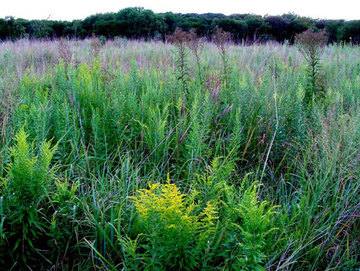
The late summer wildflowers of the tallgrass prairie are a visual treat at Homestead National Monument of America. National Park Service photo.
The Homestead Act that President Lincoln signed into law in 1862 resulted in the privatization of 270 million acres of federal land in 30 states. Today, about 93 million Americans can trace their ancestry to the 1.6 million people who received title to their land through the provisions of the Homestead Act of 1862.
Homestead National Monument of America tells the homesteading story on a tract of land in southeastern Nebraska that includes the country's first homestead claim. Here are some numbers that provide insight into the nature of this fascinating national park.
74,314
Recreational visits in 2010, a new all-time high for the park. Visitation grew by about 50% during 2001-2010, registering a sharp increase after the opening of the Homestead Education Center in 2007.
10,000+
Hours of service to the park that volunteers contribute each year.
211
Acres in the park, all but six federally-owned. For a park map, click to this site.
160
Acres of land that a family could claim under the original terms of the Homestead Act of 1862. In the early 1860s, 160 acres (a quarter-section , or one-fourth of a square mile) was about all the land that a single family could realistically hope to farm. The park contains America's first homestead, the Freeman claim. Daniel Freeman (1826-1908) filed his 160-acre claim at the Land Office in Brownville, Nebraska, at 12:10 a.m. on January 1, 1863, the first day the Homestead Act went into effect.
100 miles
Distance a homesteader walked to plow 10 acres of farm land, the required minimum. Farmers using draft animals had to walk about 10 miles to plow each acre of their land.
100 acres
Restored tallgrass prairie in the park. Homestead's restored tallgrass prairie, which accounts for nearly half of the park's total acreage, is the oldest in the National Park System and the second-oldest in the United States. The National Park service has maintained this rare, diverse ecosystem for more than 60 years.
75 cents
The first electric bill paid by the park's Freeman School, which operated from 1872 to 1967 and was wired for electricity in 1940.
70 x 50 inches
Dimensions of a specially-commissioned commemorative quilt that will be added to Homestead's exhibits during the park's upcoming 150th anniversary celebration of the Homestead Act of 1862.
40 percent
Approximate success rate for claims filed under the Homestead Act. About 60% of the would-be owners did not "prove up" their claims, meaning that they had to relinquish them because they did not break the soil and plant a crop, build a home on the property, and live on the land for five years. Relinquished land was commonly claimed by new settlers.
28 inches
Average annual precipitation in southeastern Nebraska. The park's continental interior location not only inhibits precipitation , but also insures hot summers (July average high 90° F; some days top 100° F ) and cold winters (January average low 12° F).
7
Stops on the park's cell phone audio tour, which includes sites such as the Heritage Center, the Palmer-Epard Cabin (1867), the Freeman School (1872), the osage orange fence, and the tallgrass prairie. Each stop on the tour features a two-minute narration by a park ranger.
3
Hard-packed (crushed rock-surfaced) walking trails in the park. The longest, the 1.7-mile Upland Prairie Loop Trail, has a low hill.
exactly 1 acre
Size of the parking lot at the Homestead Heritage Center and Education Center. Many people know that an acre is almost the size of a football field (without the end zones), but this 43,560 square-foot parking lot provides a more accurate visualization of the land survey's basic unit of measurement.
0
Food, lodging, and medical facilities on the premises. These services are available in the nearby town of Beatrice. The park does have some picnic tables, and visitors can purchase soft drinks and bottled water from vending machines outside the Heritage Center and Education Center.
Also 0
Permitted public uses involving sports or recreation that are not related to the historical theme of Homestead National Monument of America. Among the prohibited activities are organized sporting events or team sports such as baseball, soccer, or flag football.
Story Categories:
A copy of National Parks Traveler's financial statements may be obtained by sending a stamped, self-addressed envelope to: National Parks Traveler, P.O. Box 980452, Park City, Utah 84098. National Parks Traveler was formed in the state of Utah for the purpose of informing and educating about national parks and protected areas.
Residents of the following states may obtain a copy of our financial and additional information as stated below:
- Florida: A COPY OF THE OFFICIAL REGISTRATION AND FINANCIAL INFORMATION FOR NATIONAL PARKS TRAVELER, (REGISTRATION NO. CH 51659), MAY BE OBTAINED FROM THE DIVISION OF CONSUMER SERVICES BY CALLING 800-435-7352 OR VISITING THEIR WEBSITE. REGISTRATION DOES NOT IMPLY ENDORSEMENT, APPROVAL, OR RECOMMENDATION BY THE STATE.
- Georgia: A full and fair description of the programs and financial statement summary of National Parks Traveler is available upon request at the office and phone number indicated above.
- Maryland: Documents and information submitted under the Maryland Solicitations Act are also available, for the cost of postage and copies, from the Secretary of State, State House, Annapolis, MD 21401 (410-974-5534).
- North Carolina: Financial information about this organization and a copy of its license are available from the State Solicitation Licensing Branch at 888-830-4989 or 919-807-2214. The license is not an endorsement by the State.
- Pennsylvania: The official registration and financial information of National Parks Traveler may be obtained from the Pennsylvania Department of State by calling 800-732-0999. Registration does not imply endorsement.
- Virginia: Financial statements are available from the Virginia Department of Agriculture and Consumer Services, 102 Governor Street, Richmond, Virginia 23219.
- Washington: National Parks Traveler is registered with Washington State’s Charities Program as required by law and additional information is available by calling 800-332-4483 or visiting www.sos.wa.gov/charities, or on file at Charities Division, Office of the Secretary of State, State of Washington, Olympia, WA 98504.


Comments
I had the privilege of visiting HOME (what a fitting abbreviation) in 2009. It was a delightful experience. I had planned to spend just a few hours there and then move on, but discovered I needed a full day. Exhibits in the VC are fascinating and filled with more than just facts. They tell a story of people just like us who faced some incredible challenges. Some won and some lost. At times I felt a peculiar choking feeling in my throat and had trouble keeping my eyes dry. It's an emotional experience. The museum design folks at Harpers Ferry created a masterpiece there. The entire staff was as impressive as the rest of the place.
I stayed overnight in the town park in Beatrice (pronounced bee-A-triss). The park is smack in the middle of a pleasant neighborhood and offers showers which were very welcome in Nebraska's heat that day. One of the highlights of the whole thing was the people of Beatrice. Everyone I met was friendly and went out of their way to help me enjoy their town.
A visit to Homestead should be a must on anyone's travel plans if you're passing through Nebraska.
Beatrice is, indeed, a great little town. An old-fashioned main street, with plenty of lodging and restaurants on the outskirts. Homestead National Monument is located approx 40 miles south of Lincoln, NE or 90 miles southwest of Omaha. After spending the night in Beatrice last May, I drove west on the Heritage Highway (U.S. 136) to Red Cloud, the hometown of Willa Cather. I took a walking tour of places made famous in her novels, then headed south to Kansas to visit the National Historic Site of Nicodemus (a town founded by ex-slaves in the 1800's). A very pleasant day's drive.
As fall comes the tallgrass praire at Homestead turns a sepia tone and takes on a different type of beauty. This photo was taken a few weeks ago, in late October of this year while hiking the Upland Prairie Loop Trail through the tall grass praire. The Heritage Center and Education Center can be seen in the distance.
We live on a farm in Phelps County, homesteaded in 1878 by my Great Grandfather
How about a facktoid of "how many Native American Tribes were displaced by the homested act?"