
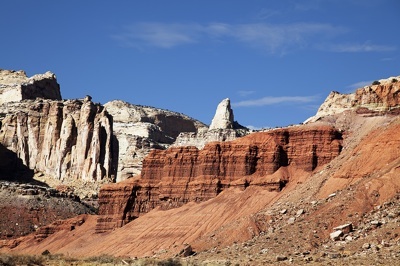
Wastelands, or scenery worth protecting? A campaign is growing to urge the Obama administration to protect more than a million acres of scenic Utah redrock landscape. Stock image of Utah's San Rafael landscape from Big Stock Photo, map outlining the "greater Canyonlands" from Southern Utah Wilderness Alliance.
Southern Utah's redrock landscape is wondrous, a spectacular collection of lands in various stages of deconstruction and reconstruction. While some of that landscape has been protected in the form of national parks, some groups believe more needs that type of protection.
While between them Canyonlands, Capitol Reef, and Arches national parks and nearby Glen Canyon National Recreation Area encompass more than 1.9 million acres, there's at least 1.4 million acres of U.S. Bureau of Land Management property surrounding Canyonlands alone that need stronger protection, according to the Grand Canyon Trust and the Southern Utah Wilderness Alliance.
The groups are promoting petitions that asks the White House and Interior Secretary Ken Salazar to take action to protect these landscapes from rampant off-road vehicle use and heavy industrial use.
The SUWA petition asks the administration to "bar off-road vehicle use on 1,050 miles of ORV routes in sensitive habitat, in streams, wetlands, riparian areas, archaeological sites and other vulnerable areas until it can conduct further studies on the impacts of the activity and determine whether it is, in fact, a sustainable use."
Such a ban would leave open another 1,400 miles of ORV routes within the area addressed by the petition, according to SUWA, and "about 13,000 miles of routes open in the four BLM field offices surrounding Greater Canyonlands."
At the Grand Canyon Trust, the organization is producing a film that shows off the lands in the region surrounding Canyonlands National Park, lands the trust says are "currently threatened by oil and gas drilling, potash and uranium extraction, tar sands strip-mining and unregulated off-road vehicle impacts."
This tableau of red-rock country has never lived up to the expectations of those who set their eyes on the landscape and saw not a wasteland but rather a cataclysm of earth, water, and sky that should be protected and enjoyed as a national park.
As early as 1936, 28 years before the park was actually created, Interior Secretary Harold Ickes envisioned an "Escalante National Monument" of nearly 4.5 million acres, a behemoth that would encompass a good deal of Utah's southeastern corner south of Green River and east of Torrey. Not until the 1960s did the idea of a national park in this corner of Utah return, and it led, after much horse-trading, to a 257,000-acre Canyonlands National Park that was created in 1964.
But the creation of Canyonlands, which grew a bit through the years with the addition of the Horseshoe Canyon annex, didn't settle the debate over exactly how big the park should be. It was revived most recently in the late 1980s by the National Parks Conservation Association, and again in the early 1990s when then-Superintendent Walt Dabney endorsed "completing" the park by stretching its boundaries to the surrounding rims of the basin created by the Colorado and Green rivers.
But in highly conservative Utah, where many resent the federal government's land ownership in large part because they see it as an impediment to economic development, the movement to enlarge Canyonlands has never gathered much steam.
According to the Grand Canyon Trust, "the vast unprotected landscape surrounding the park has been viewed as a dumping ground or sacrifice zone for industrial and extractive uses instead of a national treasure rivaling the Grand Canyon."
"In 1980 the Department of Energy proposed siting a nuclear waste repository at the borderlands of the park and, the following year, exploration for tar sands development began west of the Canyonlands Basin. Six years of lobbying by the National Park Service, the State of Utah, and others opposing the proposed nuclear waste repository eventually eliminated the Davis Canyon site from consideration and inspired then Utah Congressman Wayne Owens to work with the National Parks Conservation Association to propose adding 500,000 to 750,000 acres to the park.
"At that time, as today, there was no support from the Utah congressional delegation to expand protective designations across these federal lands, which belong to all people of the United States. Asa result, they remain open for industrial development."
While President Obama, or any future president, could protect the landscape by designating national monuments under the Antiquities Act, there currently are efforts under way to take that authority away from the White House. Today, U.S. Rep. Rob Bishop, a Utah Republican who chairs the House Subcommittee on National Parks, Forests, and Public Lands, has introduced the Utah Land Sovereignty Act, which would prevent presidents from designating national monuments in Utah.
To gain support for protecting these lands, the Trust and SUWA have been driving efforts to bring public pressure on the White House and Interior Department to take steps to protect them.
The White House has a new petition site called “We the People” and a Greater Canyonlands petition is now posted there. If the petition gains 5,000 signatures by November 2 (it currently has only about 700), the White House will have to respond to the petition on the website, according to the Trust.
At SUWA, officials are promoting their own petition, which asks President Obama "to do everything in your power to protect the Greater Canyonlands region -- the 1.4 million acres of BLM land surrounding Canyonlands National Park..."
Story Categories:
A copy of National Parks Traveler's financial statements may be obtained by sending a stamped, self-addressed envelope to: National Parks Traveler, P.O. Box 980452, Park City, Utah 84098. National Parks Traveler was formed in the state of Utah for the purpose of informing and educating about national parks and protected areas.
Residents of the following states may obtain a copy of our financial and additional information as stated below:
- Florida: A COPY OF THE OFFICIAL REGISTRATION AND FINANCIAL INFORMATION FOR NATIONAL PARKS TRAVELER, (REGISTRATION NO. CH 51659), MAY BE OBTAINED FROM THE DIVISION OF CONSUMER SERVICES BY CALLING 800-435-7352 OR VISITING THEIR WEBSITE. REGISTRATION DOES NOT IMPLY ENDORSEMENT, APPROVAL, OR RECOMMENDATION BY THE STATE.
- Georgia: A full and fair description of the programs and financial statement summary of National Parks Traveler is available upon request at the office and phone number indicated above.
- Maryland: Documents and information submitted under the Maryland Solicitations Act are also available, for the cost of postage and copies, from the Secretary of State, State House, Annapolis, MD 21401 (410-974-5534).
- North Carolina: Financial information about this organization and a copy of its license are available from the State Solicitation Licensing Branch at 888-830-4989 or 919-807-2214. The license is not an endorsement by the State.
- Pennsylvania: The official registration and financial information of National Parks Traveler may be obtained from the Pennsylvania Department of State by calling 800-732-0999. Registration does not imply endorsement.
- Virginia: Financial statements are available from the Virginia Department of Agriculture and Consumer Services, 102 Governor Street, Richmond, Virginia 23219.
- Washington: National Parks Traveler is registered with Washington State’s Charities Program as required by law and additional information is available by calling 800-332-4483 or visiting www.sos.wa.gov/charities, or on file at Charities Division, Office of the Secretary of State, State of Washington, Olympia, WA 98504.


National parks and their natural resources belong to you. The National Parks Traveler works to ensure you know how these essential places are being cared for.
Sign Up For Our Weekly Newsletter
Unsubscribe at any time.
INN Member

The easiest way to explore RV-friendly National Park campgrounds.

Here’s the definitive guide to National Park System campgrounds where RVers can park their rigs.
Our app is packed with RVing- specific details on more than 250 campgrounds in more than 70 national parks.
You’ll also find stories about RVing in the parks, tips helpful if you’ve just recently become an RVer, and useful planning suggestions.


Comments
Throughout this area, there are countless places where ATV overuse and thoughtless driving have caused incredible damage to plants and left the landscape terribly scarred. Despite the fact that throughout Utah literally thousands of miles of designated ATV routes are open to off-highway use, that isn't enough for irresponsible ATV "sportsmen." Those routes seem to be too tame for testosterone driven machos who see any hillside or stream not already marred by tire tracks as a challenge to be conquered.
Add to that irresponsible legislators like Rob Bishop and Mike Noel (a Utah state house representative from Kanab, who led an infamous parade of ATV scofflaws up the streambed of the Paria River -- which they claim to be "an established road right-of-way) and you have the makings of an environmental -- and economic -- disaster. These two, and unfortunately many others like them, represent a large number of Utahns who stand in firm support of those who stand to profit from extractive and potentially destructive use of some of the most incredibly beautiful landscapes on the face of the earth.
They stand in firm support of ripping short term profit from the land and simply cannot see the longer term potential benefits, both economic and intangible, that can provide a continuing future of jobs and prosperity for many of Utah's struggling communities. They choose to ignore strong evidence of the economic benefits of preserving these treasured places. One such study examined the economic impact of Grand Staircase - Escalante National Monument on the town of Escalante. A town that since President Clinton's hated establishment of the monument, as caused an undeniable boom in that tiny town.
Rob Bishop is not one to allow truth to stand in his way. His proposal to erase all Federal land use laws within 100 miles of the Mexican border is a blatant attempt to destroy wilderness areas in such places as Organ Pipe Cactus and the Cabeza Prieta Wildlife Refuge. That comes despite repeated denials from Border Patrol and other agencies when Bishop claims the wilderness areas lead to "wide open" illegal crossing. In fact, when I spoke with a number of Border Patrol officers and NPS rangers and Arizona Department of Public Safety officers last February, they told me that because the wilderness areas are not open to normal public travel, they are actually able to nab a much higher percentage of illegals than is the case on surrounding private land.
Bishop is a leader in a wider Republican attempt to gut the Antiquities Act. Besides Bishop, a number of other Republicans in Congress have introduced similar bills to require state approval before a President can use the act to preserve anything worth preserving.
Like so many other Utah officials, Bishop is firmly in the pocket of powerful individuals and corporations. But, unfortunately, he is just one of many of my Utah neighbors who firmly believe that the end is coming as prophets have told us and so there is no reason to safeguard anything. "The earth was given to us by God for our use," is a frquent refrain around here.
And so that myth of divine gifting leads them to firmly support Utah's environmental motto: "Multiply, multiply and pillage the earth."
I sincerely hope that everyone who reads Traveler will sign any petitions they can as soon as they can.
Here is a direct link to the White House Petitions page:
http://wh.gov/4h9
Well I signed it and so will all my family and friends-- that land belongs to all the citizens of this country -- not just the people of Utah and we want it protected.
In responce to L Dalton your "undeniable boom " in Escalante is a couple of resturants and motels. That all this boom will ever amount to. Look at the huge size of Grand Staircase Escalante National Monument. Lets equate this to sq. mile per job created. Enough said. I am big on the outdoors but keep the facts relavent. You can not justify taking that much land and say its creating jobs. Say its creating wilderness that fine. The Canyonland N. P. is already so large that the vast majority is wilderness. Which is great. How much wilderness do we need? Is BLM is doing a good or bad job? I just spent a month in Monticello Ut with the UFS and in my opinion this area is doing fine as is.
Interesting. But the Escalante Chamber of Commerce might beg to differ with you.
For the record, according to the Escalante-Boulder Chamber of Commerce, there currently are:
* Five B&Bs in Escalante
* Six motels
* An RV park and some cabins
* Five lodges and vacation homes
* Six restaurants
* Nine "artisans"
No quite bustling, but not sleepy, either.
As for whether setting aside park lands or wilderness creates jobs and economic activity, read this post from March 2010 and the economic power of national monuments, parks, and the like. Here's a snippet:
And here's another:
And one more:
Thanks, Kurt.