
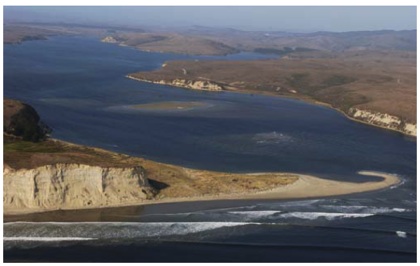
Politicians past and present are putting pressure on Interior Secretary Salazar to authorize the continued operation of an oyster farm in Point Reyes National Seashore beyond the scheduled expiration of its permit in November 2012. NPS photo of Drakes Estero.
During the fall of 1969, U.S. Rep. Pete McCloskey, Jr., button-holed John Ehrlichman, then counsel to President Richard Nixon, and implored him to get the president to support creation of Point Reyes National Seashore.
"The only man who can save the Point Reyes National Seashore is the President," the California Republican wrote to Mr. Ehrlichman on September 16 of that year. "He is running out of time because the House Interior Committee is going to adjourn October 1, and the Bureau of the Budget Director, Robert Mayo, has made it clear that there are no funds available from BOB despite what has been properly characterized thus far as 'weak White House support.'
"The money is available in the Land and Water Conservation Fund. All the President need do is order that it be earmarked for the national seashore projects, specifically Point Reyes," Rep. McCloskey continued.
Forty-two years later, the former congressman again has taken pen in hand for the seashore -- which President Nixon did indeed eventually support more forcefully -- this time to support the continued operation of an oyster farm in Drakes Estero, an area of Point Reyes designated for official wilderness classification.
The letter-writing comes as the National Park Service works to complete a draft Environmental Impact Statement on the impacts of the Drakes Bay Oyster Co. on the estero and its harbor seal populations.
The Park Service's handling of the oyster company's future has been both contentious and embarassing for the agency in recent years. While a Park Service report on the oyster operation concluded that it was impacting harbor seals, the report at times has withered under scrutiny.
In 2009 the National Research Council said the NPS report was skewed, "selectively" manipulated in several areas, and inconclusive overall.
A year later, the Interior's Solicitor's Office conducted an investigation into whether the staff at Point Reyes had intentionally mishandled research data it collected to determine the oyster farm's impacts, if any, on harbor seals during pupping season. That probe cleared the staff of any criminal behavior or criminal misconduct in the matter, a finding that itself has drawn criticism.
Part of the investigation centered around charges that Park Service staff "suppressed" more than 250,000 photographs the Point Reyes staff captured with a secret camera from 2007 to 2010 to determine whether farm operations were disturbing harbor seals during the pupping season. Those photos, proponents of the oyster farm say, failed to show any disturbance of harbor seals by farm employees. Interviews conducted by the Solicitor's Office, however, indicated that on at least five occasions the farm's workers caused disturbances of seals during pupping season.
Pressure by U.S. Sen. Dianne Feinstein prompted Interior Secretary Ken Salazar to direct the Park Service to again study the oyster company's impacts on the estero and prepare an Environmental Impact Statement. With a draft of that document expected soon, Sen. Feinstein, former Rep. McCloskey, and others are lobbying the Interior secretary to have an independent analysis of the DEIS conducted and to allow the oyster company to continue operations beyond the expiration of the company's permit in November 2012.
Not only do letters sent to the Interior secretary question the ability of the Park Service to be unbiased in assessing the oyster company's impacts, but they maintain that when legislation for the national seashore was drawn up it was done so with the intent that ranches in the area, as well as the oyster farm, be allowed to operate even within official wilderness.
"The seashore is somewhat unique in the National Park System in that from the beginning, it was intended to have a considerable part of its area, consisting of the historic scenic ranches being leased back to their owners, and to retain an oyster farm and California's only oyster cannery in the Drakes Estero. The estero sits in the middle of those 20,000 acres of ranches designated as a pastoral zone; the oyster plant and cannery on the shores of Drakes Estero are in that pastoral zone," states a letter sent to Secretary Salazar by Mr. McCloskey, former U.S. Rep. John Burton, and former California Assemblyman William T. Bagley.
The letter also cites then-Park Service Director Conrad Wirth's position in 1961 that "... existing commerical oyster beds and the oyster cannery at Drakes Estero...should continue under national seashore status because of their public values. The culture of oysters is an interesting and unique industry which presents exceptional educational opportunities for introducing the public, especially students, to the field of marine biology."
Yet those positions clash with a Solicitor's Office opinion, rendered in February 2004, that stated not only was the Park Service within its rights to order the oyster farm out of the seashore, but that Congress did intend for the estero to be designated as official wilderness after the existing lease expired in November 2012.
The opinion specifically noted that "Tom Johnson, as a condition of his sale (of his land) to the Park Service, reserved the right to operate an oyster farm for 40 years until 2012."
Removal of JOC from the Point Reyes National Seashore property and its oyster farming from the Estero, would allow the Service to begin the conversion of the area to wilderness status, which directive Congress charged the Park Service to accomplish.
Furthermore, in an appendix to its report on the Point Reyes studies, the National Research Council noted that, "The National Park Service and the Department of the Interior Solicitor’s Office read the 1976 legislation designating Drakes Estero as Potential Wilderness and strengthening the enabling act for Point Reyes National Seashore [P.L. 94-544 (Oct. 18, 1976) and P.L. 94-567 (Oct. 20, 1976), 16 U.S.C. § 1132 note] as eliminating the discretion of the NPS to authorize continued operations through a new authorizing instrument beyond the expiration of the RUO in 2012."
The Solicitor's Office opinion also runs contrary to some of the the positions outlined in the latest letter by former Reps. McCloskey and Burton and former California Assemblyman Bagley.
According to their letter, when the seashore was created the state of California retained fishing rights to the submerged lands in the estero. They also noted that John Kyl, then assistant Interior Secretary, had pointed to the state reservation of rights as making the estero "inconsistent" with pure wilderness. Furthermore, they cited 1974 testimony by the sponsors of legislation to create wilderness areas within the seashore that made clear their intention for the oyster farm to continue operating "as a prior, non-conforming use within the potential wilderness area."
The Solicitor's Office, however, held that Mr. Kyl's position was "not only inaccurate but overridden by the Congressional action..." The resulting legislation that designated wilderness in the seashore also made no mention of allowing the oyster company to continue operating after its lease expired or the wilderness designation for the estero was approved by Congress.
Sen. Feinstein, meanwhile, wrote Secretary Salazar this past Sept. 2 with a request that the Park Service's DEIS be independently reviewed before being released for public review.
"Several reports have shown that Point Reyes scientists have not been objective in their analysis of harbor seal impacts in Drakes Estero," wrote the Democrat from California. She also noted the investigations by the National Research Council and Interior's Solicitor's Office that questioned the Park Service's scientific integrity on the matter.
"Taken together, these reports send a clear message to the Park Service and Department of Interior that steps must be taken to address this lack of scientific integrity," added the senator. "The Draft Environmental Impact Statement must incorporate the findings of a review of the Park Service's scientific work when it is in question especially given their history of misrepresenting science.
"I fear that unless the Department of Interior stands behind the independent analysis of this scientific paper, then it will be another example of a lack of credibility at Point Reyes National Seashore."
Story Categories:
A copy of National Parks Traveler's financial statements may be obtained by sending a stamped, self-addressed envelope to: National Parks Traveler, P.O. Box 980452, Park City, Utah 84098. National Parks Traveler was formed in the state of Utah for the purpose of informing and educating about national parks and protected areas.
Residents of the following states may obtain a copy of our financial and additional information as stated below:
- Florida: A COPY OF THE OFFICIAL REGISTRATION AND FINANCIAL INFORMATION FOR NATIONAL PARKS TRAVELER, (REGISTRATION NO. CH 51659), MAY BE OBTAINED FROM THE DIVISION OF CONSUMER SERVICES BY CALLING 800-435-7352 OR VISITING THEIR WEBSITE. REGISTRATION DOES NOT IMPLY ENDORSEMENT, APPROVAL, OR RECOMMENDATION BY THE STATE.
- Georgia: A full and fair description of the programs and financial statement summary of National Parks Traveler is available upon request at the office and phone number indicated above.
- Maryland: Documents and information submitted under the Maryland Solicitations Act are also available, for the cost of postage and copies, from the Secretary of State, State House, Annapolis, MD 21401 (410-974-5534).
- North Carolina: Financial information about this organization and a copy of its license are available from the State Solicitation Licensing Branch at 888-830-4989 or 919-807-2214. The license is not an endorsement by the State.
- Pennsylvania: The official registration and financial information of National Parks Traveler may be obtained from the Pennsylvania Department of State by calling 800-732-0999. Registration does not imply endorsement.
- Virginia: Financial statements are available from the Virginia Department of Agriculture and Consumer Services, 102 Governor Street, Richmond, Virginia 23219.
- Washington: National Parks Traveler is registered with Washington State’s Charities Program as required by law and additional information is available by calling 800-332-4483 or visiting www.sos.wa.gov/charities, or on file at Charities Division, Office of the Secretary of State, State of Washington, Olympia, WA 98504.


National parks and their natural resources belong to you. The National Parks Traveler works to ensure you know how these essential places are being cared for.
Sign Up For Our Weekly Newsletter
Unsubscribe at any time.
INN Member

The easiest way to explore RV-friendly National Park campgrounds.

Here’s the definitive guide to National Park System campgrounds where RVers can park their rigs.
Our app is packed with RVing- specific details on more than 250 campgrounds in more than 70 national parks.
You’ll also find stories about RVing in the parks, tips helpful if you’ve just recently become an RVer, and useful planning suggestions.


Comments
Two questions:
1. What is your evidence for this statement?
"Interviews conducted by the Solicitor's Office, however, indicated that on at least five occasions the farm's workers caused disturbances of seals during pupping season."
2. Why are you placing so much emphasis on the Solicitor's statement from 2004? That's one lawyer, and the statements are from before the Lunnys owned the oyster farm. Given all of the events over the past seven years, how is this a relevant and useful source?
Sarah, the answer to No. 1 is the OIG report itself.
As for No. 2, the 2004 Solicitor's report seems to be the most recent legal interpretation of the ground rules in play. If you're going to question that, why should we rely on statements made over four decades ago that are not reflected in the resulting legislation?
Drakes Estero is in wildnerness now with the inclusion being incomplete because of the grandfathered commercial activity. Full inclusion awaits the ending of the activity and no further legislative action is required. The fundamental issue is political, not scientific and the Secretary Salazar has the choice of granting a 10 year special use permit to the current business owner only. That was the point of Sen. Feinstein's rider on the appropriations bill.
In addition to the Federal govt rejecting Bagley/McCloskey/Burton's claims about public fishing rights extending to commercial aquaculture, three State agencies (Coastal Commission, Dept Fish and Game - twice, and the State Lands Commission) have all rejected those claims as well. Those letters can be found here: http://savedrakesbay.org/Legal_Analysis.html
And it is absurd for these three people to think that the Pt Reyes Wilderness Act offered an exemption for the oyster company. The plain language of the legislation and its legislative reports show no such special exemption, and instead, all point towards giving Drakes Estero wilderness protections once the private rights terminate.
Their letter stinks of revisionist history in order to undermine public wilderness protection.
So, you think their letter stinks of revisionist history but I'm sure you're perfectly fine with the hatchet job the Park Service did with their so called report. So skewing, selectively manipulating, concealing, and misrepresenting scientific data is OK as long as it supports your position? You don’t have to respond, I already know your answer…
Hey Anonymous, you HAVE to admit that's what's going on at the very highest levels of government so an ASS kicking humbling is what's needed. Like children acting badly that need a correction they should have gotten somewhere along the line. They will feel better in the end:).
The director of California Fish and Game says something different. It's not that public fishing rights extend to aquaculture, but that the state hasn't relinquished its aquaculture rights to the NPS yet.
http://abclocal.go.com/kgo/story?section=news/assignment_7&id=8325489
From my perspective, there isn't enough scientific data to understand the full impacts (positive and negative) of the oyster farm. What data exist are mostly from more general natural resource monitoring (e.g., marine mammals). Depending on the intensity of data desired, adequate monitoring to obtain sufficient scientific data would cost between $50k and $200K per year.
If a commercial enterprise is to continue operations within a NPS unit, should adequate monitoring of the ecosystem and impacts be paid for out of the income of that commercial enterprise, should NPS pay for the cost of the monitoring at the cost of not funding other priorities, or should we not conduct any monitoring because if we don't know what the impact is, we can do what we want politically and decry the lack of hard data? The first option might be unfeasible: the cost of monitoring might exceed the total profit from the oyster farm. But then wouldn't the second option be a pretty direct subsidy from NPS to the commercial enterprise? The impacts will happen whether we quantify them or not. I hope that they are negligible, but what data we have suggests that might not be the case.
If they're going to be monitoring Drakes Estero, it's got to be about far more than the oyster farm's impacts. Many of the impacts come from kayakers and hikers. Much of the monitoring would probably be done by volunteers.
Lots of acronyms here, so it’s easy to get confused. You apparently mean the Frost Report—it wasn't issued by the OIG (Office of the Inspector General) but rather by the Solicitor's Office.
Your reference to the Frost Report is incorrect. You say: “Interviews conducted by the Solicitor's Office, however, indicated that on at least five occasions the farm's workers caused disturbances of seals during pupping season.” This makes it sound as if those disturbances of seals really happened. A close reading of the Frost Report makes it clear that they did not.
Disturbances of seals by oyster farm workers were reported by volunteer seal-watchers, but those reports turned out to be incorrect. The photographic evidence makes that clear, as do other verified documents -- electronic time clock and payroll records. The NPS scientists told Field Solicitor Gavin Frost that the three and a half years of photographs showed not a single disturbance by oyster farm workers (yet the photos did show disturbances by kayakers).
It appears that you have been misinformed and are misquoting the Frost Report. Gavin Frost found no evidence for environmental harm. Frost wrote that the scientific "mistakes stem from the refusal, by some NPS employees, to modify their intuitive, but statistically and scientifically unproven, belief that DBOC mariculture activities either disturb harbor seals in upper Drakes Estero or deter pinnipeds from hauling-out at historically preferred subsites there." Gavin Frost was very clear -- he described the NPS scientists as having "bias," "advocacy," a "troubling mind-set," of having "mishandled" data, acted "improperly," and showed a "willingness to allow subjective beliefs and values to guide scientific conclusions."
Sarah, thanks for the correction regarding OIG and the Solicitor's Office.
That said, the Frost Report reference pertaining to DBOC-related disturbances cited by Park Service employees or volunteers in their conversations with investigators or in their written field notes is not incorrect, as that's how the report reads.
Granted, the report also states that there is no photographic evidence of any disturbances.
But it also notes that, "Importantly, though, the camera's limited field of view prevented confirmation of the visual observation made by the volunteer witness. Instead, the digital photos indirectly contradicted the human observation by showing seemingly undisturbed harbor seals near the location of the alleged harassment."
Not the best wording to say, essentially, there's no reliable photographic evidence to support or dismiss the volunteer's observation.
Near the bottom of the report, though, Mr. Frost is more straightforward:
"In short, the limited information found in the inconclusive photographic research neither trumps nor disproves all 2007 and 2008 DBOC-caused disturbances observed by volunteers and included in the research record."
The bottom-line painted by this investigation, though, is that the Park Service didn't do a good job.
Interior Secretary Salazar to step down in March.
http://www.huffingtonpost.com/2013/01/16/ken-salazar-interior-secretary-...