
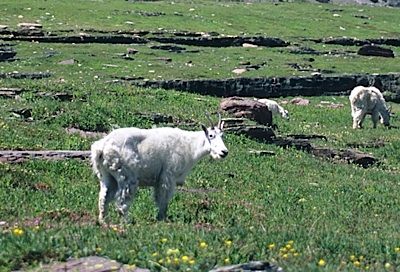
In the wake of a fatal goring of a hiker last fall, Olympic National Park officials have revised their Mountain Goat Management Plan with hopes of preventing another encounter. Kurt Repanshek photo of mountain goats in Glacier National Park.
With hopes of preventing another fatal encounter between a hiker and a mountain goat, Olympic National Park officials will urge hikers not to urinate on trails, as the salty deposits in effect become "long linear salt licks."
Bob Boardman, of Port Angeles, Washington, was gored to death by a mountain goat last Oct. 16 on a park trail near Klahhane Ridge some 17 miles south of Port Angeles. The 63-year-old was protecting other hikers from a goat, estimated at 300 pounds, when it
gored him in the thigh and then reportedly stood over him as he bled to death.
In the wake of the incident, the mountain goat was killed and a necropsy was performed on it to determine if there was an underlying medical condition that might have precipitated its behavior. At the same time, park officials, knowing that mountain goats are attracted to salt, immediately began to spread the word to park visitors about not urinating on or near trails or walking away from your backpack or daypack, as sweaty shoulder straps could also lure mountain goats.
In the months since that incident, park managers reached out to wildlife experts for possible insights into the behavior of the mountain goat that killed Mr. Boardman. In the end, the consensus was some mountain goats can become overly brazen in their search for salt. And in Mr. Boardman's incident, the necropsy on the mountain goat showed it was healthy and "in rut," a highly charged condition during the mating season, a possible contributing factor to its aggressiveness.
Last week Olympic Superintendent Karen Gustin signed off on the park's revised Mountain Goat Action Plan. The 27-page document provides a biological overview of goats, discusses their aggressive behavioral postures, and mentions their affinity for salt and mineral licks.
The document also notes that, "Reports of hazardous interactions between goats and humans are extremely rare. In all reported instances, the encounters were between large, mature males in areas where there was a history of both habituation and salt conditioning."
Regarding Mr. Boardman's fatal encounter, the report notes that the area where the goring occurred was highly traveled by both hikers and goats. "There was a history of habituated goats in the area for over 5 years, with reports of a large male goat (or goats) not yielding way to, following, and occasionally being aggressive to hikers for over 3 years," the paper states.
Because of the many goats in the park (the population is estimated at 300, the paper notes), and the fact that they like many of the same areas hikers do, there is a "high potential for goat-human" encounters, the document said.
Because many of the areas that goats inhabit are also popular destinations for park visitors, both in the front country (e.g. Hurricane Ridge) and backcountry (eg. Glacier Meadows), there is a high potential for goat - human interactions in OLYM. Most notable are the many areas where mountain goats are habituated to human presence have also become conditioned to seeking salts from humans. They can be a nuisance along trails and around wilderness campsites where they will persistently seek salt and minerals from human urine, packs and sweat on clothing. They will often paw and dig areas on the ground where hikers have urinated or disposed of cooking wastewater and chew unattended clothing. The nature of goat – human interactions in OLYM can vary widely, ranging from benign (observing goats from several hundred meters away across a ridge) to, from now what we know from the October 2010 fatality, extremely hazardous.
Management alternatives cited in the report range from simply keeping track of mountain goat locations in the park to closing trails to hikers for up to two weeks and, in extreme cases, killing mountain goats that pose threats.
Park staff and visitors also will be asked to get no closer than 150 feet to a mountain goat.
"If goats approach closer, encourage them to leave the area with loud noises, arm waving, snapping plastic bags, and rock throwing," the report says.
Story Categories:
A copy of National Parks Traveler's financial statements may be obtained by sending a stamped, self-addressed envelope to: National Parks Traveler, P.O. Box 980452, Park City, Utah 84098. National Parks Traveler was formed in the state of Utah for the purpose of informing and educating about national parks and protected areas.
Residents of the following states may obtain a copy of our financial and additional information as stated below:
- Florida: A COPY OF THE OFFICIAL REGISTRATION AND FINANCIAL INFORMATION FOR NATIONAL PARKS TRAVELER, (REGISTRATION NO. CH 51659), MAY BE OBTAINED FROM THE DIVISION OF CONSUMER SERVICES BY CALLING 800-435-7352 OR VISITING THEIR WEBSITE. REGISTRATION DOES NOT IMPLY ENDORSEMENT, APPROVAL, OR RECOMMENDATION BY THE STATE.
- Georgia: A full and fair description of the programs and financial statement summary of National Parks Traveler is available upon request at the office and phone number indicated above.
- Maryland: Documents and information submitted under the Maryland Solicitations Act are also available, for the cost of postage and copies, from the Secretary of State, State House, Annapolis, MD 21401 (410-974-5534).
- North Carolina: Financial information about this organization and a copy of its license are available from the State Solicitation Licensing Branch at 888-830-4989 or 919-807-2214. The license is not an endorsement by the State.
- Pennsylvania: The official registration and financial information of National Parks Traveler may be obtained from the Pennsylvania Department of State by calling 800-732-0999. Registration does not imply endorsement.
- Virginia: Financial statements are available from the Virginia Department of Agriculture and Consumer Services, 102 Governor Street, Richmond, Virginia 23219.
- Washington: National Parks Traveler is registered with Washington State’s Charities Program as required by law and additional information is available by calling 800-332-4483 or visiting www.sos.wa.gov/charities, or on file at Charities Division, Office of the Secretary of State, State of Washington, Olympia, WA 98504.
INN Member

The easiest way to explore RV-friendly National Park campgrounds.

Here’s the definitive guide to National Park System campgrounds where RVers can park their rigs.
Our app is packed with RVing- specific details on more than 250 campgrounds in more than 70 national parks.
You’ll also find stories about RVing in the parks, tips helpful if you’ve just recently become an RVer, and useful planning suggestions.


Comments
So much for peeing in the woods! Scary!
We had been in Glacier NP for several weeks and were not aware of the aggressive posture of an angry goat.We were returning to the Sperry Chalet from a hike to Lincoln Peak when we encountered a large billy nibbling the gravel on the trail. when we tried to pass he turned broadside to us and when we didn't back off he made a bluff charge. He would not leave the trail so we had to rock climb around him to get back to the Chalet.Had I persisted in trying to get past him I may well have suffered the same fate as the poor man in Washington. A good book on the mountain goat is Doug Chadwick's " The Beast the Color of Winter". He had a similar experience and was gored in the knee.
Like Chadwick, I studied mountain goats, in my case in Glacier NP and the Sapphire Mts. of Montana. It should be mentioned that I believe Chadwick was injured by a goat he was trapping - I saw very little aggression from goats, but must admit I was not near one, male or female, during the mating season. I saw one male in Glacier (summer) that seemed overly aggressive, and avoided him; usually they were no more aggressive than deer, but with any large animal (especially one equipped with excellent weapons) caution and maintaining your distance is advised.
Most pet owners know that they'd be in big trouble if they would allow "their pets" to become dominant. So what's the difference here between the goat and your shepherd staying between you and that steak on the barbecue? If we'd all just eat Tofu maybe that would solve it:).
now that is a huge goat 300pds?
aggressive goats. wow. looks like bear spray could get a little use here too.
How about going to the farm supply store and buying a few salt and mineral blocks for the goats? They are essential for cattle and horses, and here in Indiana the deer like them, too. I place them nearby, where i can photograph the deer, but a reverse placement strategy might keep the goats from craving "trail salt" so badly that they mug/kill hikers.
It's silly to think that any animal who lives and thrives in wilderness would not become aggressive when feeling threatened. I mean, HELLO!!?? I don't think we need to do anything different, other than educate the public and accept the fact that the wilderness is still wilderness and we should threat is at such.
I live in Montana and I am at all times acutely aware of the wildlife around me. More than anything I carry my pepper sray for Moose, Elk, Buffalo, Goats, Big Horn Sheep and Mountain Lions. These are animals that are significantly large in size and in number where I live. Encounters are frequent, vastly more frequent than encoutering an actual bear. All these animals can easily charge a person once agitated or threatened, which is a very common occurance in these regions. I have also cancelled my hiking plans due to a goat on the trail who appeared to be behaving aggressively.
Enjoy the wild, pay attention, respect the wildlife and return to hike yet another day!