
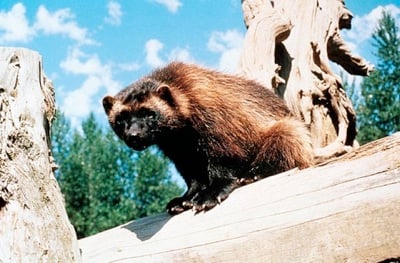
Is the wolverine destined to join the Dodo and the carrier pigeon?
Let’s talk about scarcity. Picture a town of 500 people. We’ve all passed through one. The feeling may be down-home quaintness, but by population size, it is tiny, inconsequential as numbers go. Barely a whir.
Blink and it is gone.
Now disperse those 500 denizens across a landscape that covers half of say, western Wyoming including Yellowstone and Grand Teton national parks.
The number gets lost in diffuseness. Scatter them across a much larger area still, say over the northern Rockies AND westward toward the northern Sierra-Nevada and Cascade ranges.
Were an assessment made now about population size, most would describe the landscape as vacant, devoid of suitable numbers. Not enough. You could even conclude that it would be difficult for humans to bump into each other very often.
This is exactly the narrative for wolverines.
The U.S. Fish and Wildlife Service in December 2010 released a biological assessment. The service found that wolverines warrant being added to the federal threatened species list, but other animals merit greater priority. So action has to wait.
Here’s a fact, the service’s widely-quoted estimate that it has used over the last decade for wolverines across all of the Lower 48—500—was actually dialed dramatically downward in the latest report.
The new guesstimate is that there are only between 250 and 300 wolverines across all of the geography mentioned above, which includes a crazy quilt pattern of national parks that serve as protected islands of habitat.
And over that vast area, the Fish and Wildlife Service admits, there are a scant number of adults reproducing.
Biologists don’t actually know how many wolverines persist because these elusive members of the weasel family—regarded as the “holy grail” critter among trappers in Montana, the last state in the West to have a wolverine trapping season—are difficult to count.
Wolverines exist in such fragmented, low densities that if one or two are killed by trappers, poachers, cyanide-laced coyote baits still being deployed, or accidentally struck crossing a road, the species could be extirpated from entire mountain ranges.
And it’s questionable, in many areas, if other wolverines could ever get there to recolonize.
Studies show that these charismatic, solitude-craving animals are ultra-sensitive to habitat intrusion. In Canada, industrial-strength heli-skiing has caused wolverine to flee their high-altitude haunts. Snowmobile 'high markers' also have impacts, reaching places where machines couldn’t go only a few years’ past.
All of this corroborates what scientist William Newmark concluded back in the 1980s: that despite public perceptions, animals were still winking out in large landscapes, even presumed protected areas such as national parks, that were inadequate by themselves to safeguard wide-ranging species.
There is another threat bearing down: climate change. If computer models play out, notes ecologist David Gaillard with Defenders of Wildlife, one-third of the habitat wolverines need—deep snowfields in high-elevation terrain—could disappear in the next 30 to 40 years.
Stories abound in the historical record of how excited settlers were to have the opportunity to shoot the last buffalo, wolves, grizzlies, and prairie elk. That’s hardly something worth bragging about—snuffing out the last of its kind.
It won’t be long before Montana finally yields and ends its senseless wolverine trapping season that still allows animals to be harvested for pelts that deliver only a few hundred dollars apiece.
The question is: Then what? Every year, the Fish and Wildlife Service is required by law to do a status review of animals on the warranted but precluded list. Another 12 months doesn’t need to pass before the service acknowledges the wolverine is in serious trouble.
Truth is, the service admitted as much in December but claims there isn’t enough resources available to try and reverse the wolverine’s decline, this as the species in our backyard slips away.
One service official said there might be as few as 212 wolverines left in the continental US; 212, only a relative handful of which are giving birth to young, spread across perhaps 100,000 square miles of current range.
In hindsight, society expresses bewilderment at how our ancestors allowed the passenger pigeon, the Carolina parakeet and other species to vanish. No one can claim the wolverine will be lost due to ignorance or because the animal posed any safety risk to humans, livestock, or pets. They don't.
Although it was the G.W. Bush Administration that sat on its hands during the wolverine spiral of the last decade, conservationists say it’s the Obama Administration now that shoulders responsibility for flaunting the lame excuse that intervention is necessary but action is incapacitated by a shortage of “resources.”
The U.S. is spending about $1 million annually per soldier in Afghanistan. Think of it. If just a couple of those troops were sent home to be with their families and brought out of harm’s way, we could make a valiant attempt to save the wolverine with that relative pittance not spent on the war.
Todd Wilkinson has been a journalist for almost 25 years. He started as a violent crime reporter with the legendary City News Bureau of Chicago. During college, he spent two summers working in Yellowstone National Park. For the past two decades, he has been an environmental journalist based in Bozeman, Montana.
Story Categories:
A copy of National Parks Traveler's financial statements may be obtained by sending a stamped, self-addressed envelope to: National Parks Traveler, P.O. Box 980452, Park City, Utah 84098. National Parks Traveler was formed in the state of Utah for the purpose of informing and educating about national parks and protected areas.
Residents of the following states may obtain a copy of our financial and additional information as stated below:
- Florida: A COPY OF THE OFFICIAL REGISTRATION AND FINANCIAL INFORMATION FOR NATIONAL PARKS TRAVELER, (REGISTRATION NO. CH 51659), MAY BE OBTAINED FROM THE DIVISION OF CONSUMER SERVICES BY CALLING 800-435-7352 OR VISITING THEIR WEBSITE. REGISTRATION DOES NOT IMPLY ENDORSEMENT, APPROVAL, OR RECOMMENDATION BY THE STATE.
- Georgia: A full and fair description of the programs and financial statement summary of National Parks Traveler is available upon request at the office and phone number indicated above.
- Maryland: Documents and information submitted under the Maryland Solicitations Act are also available, for the cost of postage and copies, from the Secretary of State, State House, Annapolis, MD 21401 (410-974-5534).
- North Carolina: Financial information about this organization and a copy of its license are available from the State Solicitation Licensing Branch at 888-830-4989 or 919-807-2214. The license is not an endorsement by the State.
- Pennsylvania: The official registration and financial information of National Parks Traveler may be obtained from the Pennsylvania Department of State by calling 800-732-0999. Registration does not imply endorsement.
- Virginia: Financial statements are available from the Virginia Department of Agriculture and Consumer Services, 102 Governor Street, Richmond, Virginia 23219.
- Washington: National Parks Traveler is registered with Washington State’s Charities Program as required by law and additional information is available by calling 800-332-4483 or visiting www.sos.wa.gov/charities, or on file at Charities Division, Office of the Secretary of State, State of Washington, Olympia, WA 98504.

Comments
This article was informative, taking the author for his word and facts, wolverines seem in dire straights but the last two paragraphs place this article in the junk pile. Another political POC author...Bush's fault and we spend too much money on defense.
My health insurance went up $150/mo due to Obamacare. Let's take the money we are spending for Obamacare and not give it to drug addicts, criminals, and illegal aliens.
Oh, I'm sorry, this article is supposed to be about Wolverine's and their plight.
"Oh, I'm sorry, this article is supposed to be about Wolverine's and their plight."
yep, so stick to it
You know, Ryan, if there was a connection made to the article/comment and the economic and security crisis the country is undeniably going through it just might be helpful for the Wolverine. Take a look at what people care/don't care about when the cupboard's bare. This road we're on will slam the affluence that supports so many environmental and wildlife efforts. You put the choice of your families existence and the Wolverine's and there is not a choice. I've heard the phrase "environmental pimps" used that is concerning but is a factor in the parallel universe that some like to portray as their righteous mission. Economic recovery is a far better way to help with all these natural resource issues because when people are hungry that meat on the hoof takes on a different image.
Respectfully
One can always use any article as a pretext to gripe about what the government is spending its money on. The point is, the wolverine is in trouble, and is it worth mobilizing support to prevent its disappearance. I would say, "Of course, it is."
I agree in part, justinh, but throwing money at something has proven not always the most helpful. Mere griping about government usually comes from government employees, from what I've seen. Most efficient and productive elements in wildlife work are the "boots" on the ground who are overruled by politicos on up the "chain. I have ALWAYS worn the boots on the ground so I'm quite aware of how it works.
I am aware of the interest that University of Washington has shown in the Northern Cascades Wolverine population. Why do they still exist there and not in the Sierra Nevadas? People would be my answer. Pretty simple, really, LOL!
Rock On, Wolverines, somewhere :).
Anon,
I can appreciate people's plight, but that is not the subject of the article, that's it. It really is that simple.
Anonymous,
I think I'm suggesting something different. The alternative to imaginary either/or budget debates isn't "just throwing money at something."
Look it is very simple...people are causing the demise of the wolverine.....not Pres Bush or the war in Afghanistan. The author wants readers to believe he is concerned about wolverines when in fact his sole purpose was to make a political statement. This guy is nothing more than a political activist hack posing as an environmentalist. His only quest is to get the readers on this forum to lean towards his politics using the plight of the wolverines as his ruse. Like I said previously, a POC political hack posing as an environmental author.
There is an excellent wolverine article in this month's issue of the NPCA magazine.
This is a great article. The author is absolutely correct to question our national priorities on a fundamental level. Why are we concentrating so much of our resources on killing people when we should be focused on preserving and re-establishing the ecosystems that all life depends on (including our own).
Some people were obviously uncomfortable with these questions, so they've brought up the strawman argument that wolverines were being prioritize over people, or that environmental health requires wealth. Some day we'll all realize that the wolverine, the buffalo, the salmon, and the human are all literally interdependent. Its not a matter of prioritizing species. Its a matter of recognizing that our fates are linked.
Wealth and affluence isn't an issue either. Pre-contact America was "poor." People didn't have money. They only had food, shelter, clothing, medicine, and family. Somehow their ecosystem track record was pretty good.
Great article. Kep em' coming.
These articles always mention the "continental US", or the "lower 48", yet in the Anchorage Daily News they post photos of folks who have hunted wolverines: www.adn.com/2008/07/11/462262/hunting-gallery.html#id=1600174&view=large...
I'd really like to know how the situation is on a more global view, or at least over the entire 50 states. Talking about how in the lower 48 things are dire while elsewhere in the country the wolverine is a target animal for subsistence hunters seems to be less than the full story.
There is no end to the number of places the federal government could find a couple million dollars per yer in waste. Why does this author single out the war in Afghanistan? Imagine if we turned all the money we are now spending on solar shingles and climate change research and used it for wildlife. Or some of the money we spend the study things like cow farts.
Quite so. The wolverine is if fine shape in Canada, Alaska and Russia. There are also huge stretches of federal wilderness in the lower 48 that are very difficult to study. Most of "population studies" don't venture very far from the comfort of park headquarters or a decent size city. Things that are important are difficult to measure, so we assign importance to things that are easier to measure.
If you read the last two paragraphs Concerned Taxpayer, the author is critical of Obama as well. See "flaunting the lame excuse."
MikeA and others, I agree that the federal government can use taxpayer dollars lots more wisely. However, I'm appalled to see critics of profligate federal spending choose perfectly legitimate expenditures as examples of "wasteful" spending. When we do this, it doesn't make our point, it just makes us look uninformed or agenda-driven.
Take "cow farts" research, for example. To ridicule that is to show that you lack vital understanding of the chemistry that impacts every living creature on this planet.
Because of our meat-based diet, we maintain vast numbers of cows. Cow flatulence happens to be a rich source of methane (CH4). Methane is a critically important greenhouse gas because a methane molecule has roughly 25 times the atmospheric heating impact of a carbon dioxide molecule (CO2). Atmospheric methane really matters. Given our concerns about the causes and consequences of global climatic change, it would be very foolish to NOT conduct research on methane's sources, residence time, etc.
Please consider these facts the next time you are tempted to ridicule research on cow farts.
The 53-minute film Wolverine: Chasing the Phantom was aired last fall on the PBS "Nature" series. Click to this site to see an extended preview. If you are a Netflix subscriber, it's available for streaming. (I just watched it again this afternoon.) Viewers have rated it at 4.5 stars, but I would give it five stars with an oak leaf cluster. The scenery alone (much of it shot in Glacier National Park) makes this a "must-see" for wilderness fans.