
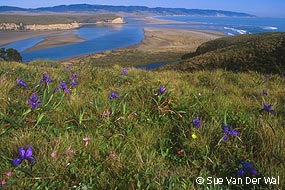
Should an oyster farm be moved out of Drakes Estero at Point Reyes National Seashore so the estero can become part of officially designated wilderness? Photo of Drakes Estero by Susan Van Der Wal via NPS.
Editor's note: A longstanding dispute concerning proposed wilderness at Point Reyes National Seashore continues to simmer with no clear end in sight. At the center of the dispute is an oyster farm operating in Drakes Estero within the national seashore. While Congress has called for the estero to be included in officially designated wilderness, the operation of the oyster company stands in the way. There are differing viewpoints on whether the company should move out of the estero. What follows is the perspective from Neal Desai, the National Parks Conservation Association's Pacific Region associate director.
A big decision at Point Reyes could strike at the core values of our national parks.
To protect the West Coast’s only marine wilderness or to commercialize it – that is the choice that Department of Interior Secretary Ken Salazar must make as he considers the fate of Drakes Estero, an estuary within Point Reyes National Seashore in Northern California. At stake is the destiny of a wildlife sanctuary and the longstanding interpretation of national park laws and policies, which state that wilderness is set aside to restore natural conditions, not to support private commercial use of natural resources.
In 1976, after years of public debate, Congress passed the Point Reyes Wilderness Act, which preserved ecologically significant lands as wilderness and preserved farming lands in a pastoral zone. Called one of “the most significant ecological units within the national seashore” by the National Park Service, Congress designated Drakes Estero as a wilderness area with the mandate that natural conditions would be restored once the operating rights for an existing oyster company expired. The original owner of the oyster company knew this, and when he sold it to Drakes Bay Oyster Company (DBOC) only 5 years ago, it was clear that the operating rights were scheduled to cease in 2012, so that the harbor seals, fish, and other elements of the natural setting would become a priority.
But in 2009, following intense lobbying, the new company was able to persuade Congress to include--in a bill moving towards passage--language requiring Secretary Salazar to consider extending the company’s commercial lease.
Drakes Estero is the ecological heart of Point Reyes National Seashore and its watershed is home to several protected and endangered plants and animals, including eelgrass, harbor seals and birds including Black Brant and Great Egrets. Yet industry wants the waters for its motorized oyster boats, wants the sandbars reserved for its oyster bags (at the expense of harbor seals), and wants to make a fundamental change in wilderness policy so that private commercial use is acceptable.
In October 2009, after being notified of placing more than 700 bags of clams in unauthorized areas and therefore violating his permit, the owner of the oyster company told the National Park Service that he had removed his illegally placed bags and placed them within the authorized area. But photographic and site-visit evidence from December 2009 showed that he instead moved the clam bags on a sandbar well within a harbor seal protection area. A representative of the Coastal Commission said that "this was essentially the worst possible place to put these clams" and assessed a fine of $61,250.
NPS is mandated by law to provide “maximum protection” for the natural resources in the wilderness zone, which Drakes Estero is within. Their unique policies protect these special places from private exploitation and instead preserve them in the public trust – a core value of our National Park System. It is time to restore wilderness and wildlife protection to Drakes Estero.
Here is how you can help: Visit www.savedrakesbay.org to learn more and submit public comments to the National Park Service.
Story Categories:
A copy of National Parks Traveler's financial statements may be obtained by sending a stamped, self-addressed envelope to: National Parks Traveler, P.O. Box 980452, Park City, Utah 84098. National Parks Traveler was formed in the state of Utah for the purpose of informing and educating about national parks and protected areas.
Residents of the following states may obtain a copy of our financial and additional information as stated below:
- Florida: A COPY OF THE OFFICIAL REGISTRATION AND FINANCIAL INFORMATION FOR NATIONAL PARKS TRAVELER, (REGISTRATION NO. CH 51659), MAY BE OBTAINED FROM THE DIVISION OF CONSUMER SERVICES BY CALLING 800-435-7352 OR VISITING THEIR WEBSITE. REGISTRATION DOES NOT IMPLY ENDORSEMENT, APPROVAL, OR RECOMMENDATION BY THE STATE.
- Georgia: A full and fair description of the programs and financial statement summary of National Parks Traveler is available upon request at the office and phone number indicated above.
- Maryland: Documents and information submitted under the Maryland Solicitations Act are also available, for the cost of postage and copies, from the Secretary of State, State House, Annapolis, MD 21401 (410-974-5534).
- North Carolina: Financial information about this organization and a copy of its license are available from the State Solicitation Licensing Branch at 888-830-4989 or 919-807-2214. The license is not an endorsement by the State.
- Pennsylvania: The official registration and financial information of National Parks Traveler may be obtained from the Pennsylvania Department of State by calling 800-732-0999. Registration does not imply endorsement.
- Virginia: Financial statements are available from the Virginia Department of Agriculture and Consumer Services, 102 Governor Street, Richmond, Virginia 23219.
- Washington: National Parks Traveler is registered with Washington State’s Charities Program as required by law and additional information is available by calling 800-332-4483 or visiting www.sos.wa.gov/charities, or on file at Charities Division, Office of the Secretary of State, State of Washington, Olympia, WA 98504.


National parks and their natural resources belong to you. The National Parks Traveler works to ensure you know how these essential places are being cared for.
Sign Up For Our Weekly Newsletter
Unsubscribe at any time.
INN Member

The easiest way to explore RV-friendly National Park campgrounds.

Here’s the definitive guide to National Park System campgrounds where RVers can park their rigs.
Our app is packed with RVing- specific details on more than 250 campgrounds in more than 70 national parks.
You’ll also find stories about RVing in the parks, tips helpful if you’ve just recently become an RVer, and useful planning suggestions.


Comments
Point Reyes National Seashore offers great relief from the traffic and confusion of an over-crowded San Francisco Bay Area. The urgency to remove the Drakes Bay Oyster Farm will be dependent on the extent to which its operations constitute an ecological and aesthetic impact of significance. Given that most of the Point Reyes ecosystem is not in a natural state, but is semi-agricultural/ranch land, I suspect that it will be some time before the NPS is able to close down or relocate the Oyster Farm, unless direct evidence can be produced that demonstrates that this establishment is causing detrimental impacts to the landscape and ecosystem.
If I may correct one issue: Point Reyes is not the only marine wilderness on the West Coast, at least the Rocks and Islands Wilderness, south of Cape Mendocino exists since 2006.
You conveniently ignore all the obfuscation, distortion of fact, cover-ups of exculpatory data (e.g., the spy cameras) and outright lying on the part of PRNS's previous supervisor, its chief scientist and Jon Jarvis, now the chief of the National Parks, in regard to the Drakes Bay Oyster Company, as well as the fact that the oyster farm has been on that site since before WWII, long before PRNS was a twinkle in anyone's eye. If the numerous ranches within the park, some of which border Drakes Estero, aren't a threat, why is the oyster farm, whose effects on the local ecosystem are demonstrably beneficial? The Point Reyes Wilderness Act of 1976 made specific provision for continuing the oyster farm's lease, another fact conveniently omitted from your unbalanced, biased article. How about a little fairness?
"The Point Reyes Wilderness Act of 1976 made specific provision for continuing the oyster farm's lease, another fact conveniently omitted from your unbalanced, biased article."
---
Actually, the Point Reyes Wilderness Act makes no mention of extending the oyster farm's lease. You may read the complete text of the bill at: http://www.nps.gov/pore/parkmgmt/upload/lawsandpolicies_publiclaw94_544.pdf
The law renaming the Wilderness after Phillip Burton likewise makes no mention of the oyster farm: http://www.nps.gov/pore/parkmgmt/upload/lawsandpolicies_publiclaw99_68.pdf
The only mention of any connection to the oyster farm is indirect, in the language of the original bill referring to "potential wilderness additions comprising eight thousand and three acres ..." Those acres are the land and water of the oyster farm's operations. Labeling them as "potential wilderness" means that Congress intended the area to become wilderness automatically when the non-conforming use (the oyster farm) could be removed. Johnson's Oyster Company, at it was called back then, had a valid existing right, good for 40 years after its special use permit was issued in 1972. Thus the land could not become wilderness until 2012. But that was Congress's intention when it passed the original Point Reyes Wilderness Act.
That is the crux of the matter, regardless of the way the Park Service might have handled any of the other issues.
Fact: the 1976 Point Reyes Wilderness Act makes absolutely no provision for continued oyster operation.
Fact: Best available science shows a clear negative impact from oyster operations on harbor seals
Fact: Drakes Bay Oyster Company was fined $61,500 in December 2009 for illegally operating within long-known harbor seal protection areas after being warned of this violation.
Fact: The oyster operation has a considerable negative impact on this one-of-a-kind estuary, including eelgrass destruction, multiple types of disturbances to harbor seals, and violating any sense of solitude with their motorized boats and jack hammers.
Fact: A majority of Americans don't want their national parks or national park wilderness areas commercialized.
Actually - the evidence I've heard is that eelgrass proliferation is aided by the reduction of turbidity via the oysters' filter feeding. The areas near the oyster racks have excellent eelgrass growth. Occasionally a boat propellor might clip some eelgrass, but I doubt it's too severe.
Best available science seems to show that the greatest impact on harbor seal populations come from hikers and kayakers, as well as aircraft flying overhead. I realize that it can never be zero for impacts from the oyster farm, but what I've heard is that they truly make their best effort to mitigate their effects. That doesn't mean mistakes haven't been made from time to time.
I'd also note that I don't believe that any of the land of the oyster farm operations is in the potential wilderness. I've seen a copy of the wilderness plan map, and any land area that is marked as "potential wilderness" is away from the oyster farm. I think there was a certain area that had already transitioned from potential to fully designated wilderness, which is referenced in the Act.
I've also read the Point Reyes Wilderness Act several times. It sets no timetable for the removal of the oyster farm. It's really short, and doesn't set a timetable for any of the "potential wilderness additions" to be converted to full wilderness. My understanding from interviews with John Burton (whose brother sponsored the Act) is that the intent wasn't necessarily that the oyster farm had to go, but that if it did go the area might be converted to full wilderness.
The unsaid thing here is that in order for Drakes Estero to become fully designated wilderness, the State of California would have to give up their water bottom rights, and I doubt they will. They have the authority to issue shellfish permits (and in fact did extend the farm's permit to 2029). They also reserve mineral rights, although I doubt there's going to be any oil exploration in Drakes Estero.
Hayseed:
Thanks for reading and commenting. Drakes Estero is within a federally designated wilderness area. The ranches at Pt. Reyes, including Mr. Lunny's (owner of the oyster company), is not within the designated wilderness area. Wilderness management calls for the preservation of natural resources (which includes natural systems, ecosystems, habitat, behavior, native species, etc) -- millions of non-native oysters simply do not support natural resources management and instead alter it -- this is not a benefit for wilderness management. I am putting forth my viewpoint on what is the best purpose for Drakes Estero. Many, including me, believe it is for maximum protection of natural resources and wildlife, not for private commercial profit. Others disagree and such is the debate that usually accompanies land-use decisions. Oysters can be and are grown elsewhere (they are grown at Tomales Bay only a few miles away), but this is our only chance on the West Coast to create a marine wilderness, allowing restoration of the natural processes and resources.
Y_P_W:
Thanks for reading and commenting. Yes, the land part of the oyster company's operations is not in a designated wilderness area - the marine (waters) section where the oyster harvesting takes place is within the designated wilderness area. Regarding reserved rights by the state and their shellfish permits, see this document from the State Counsel to the NPS: http://savedrakesbay.org/uploads/cdfg_letter.pdf -- the NPS doesn't have to wait for the State to take action before it can designate the estuary as full wilderness and the shellfish permits are contingent on oyster operations being approved by NPS (at this point, they are approved until Nov 2012 and if the NPS decides to restore wilderness in 2012 through removing the oyster operation, then the shellfish permits cease).
I did a little looking around the Net and found that the National Research Council of the National Academies released a study in 2009 titled "Shellfish Mariculture in Drakes Estero, Point Reyes National Seashore, California" It's available online at: http://www.nap.edu/openbook.php?record_id=12667&page=R1
Appendix A, beginning on p. 105, deals with the wilderness issue. The Interior Department Solicitor's Office confirms what Neal says in his response: that California already gave up its rights in 1965. Here's a quote from the Solicitor's letter included in the appendix:
"In conjunction with the Seashore authorization Act of 1962, the State of California, by 1965 legislation ..., conveyed to the United States all of the right, title and interest of the State in lands one-quarter mile seaward of the mean high tide. More precisely the State granted “all the tide and submerged lands or other lands beneath navigable waters situated within the boundaries of the Point Reyes National Seashore …” to the United States. Excepted from this grant and reserved to the State were the “right to fish upon, and all oil, gas and other hydrocarbons in the lands … together with the right to explore or prospect …” within the tidal and submerged lands." (http://www.nap.edu/openbook.php?record_id=12667&page=108)
(Also: The fishing rights mentioned seem to be public fishing rights, not commercial.)
FOOTNOTE 1: It is noted that the State continues to issue to Johnson Oyster Company commercial allotments in Drakes Estero which seem to be in conflict with the 1965 State legislative grant and 1976 Congressional mandate to convert the bays of the Estero into wilderness status. On the other hand, the continued public fishing in the Estero is consistent with the State legislative grant and the conversion to wilderness status.
Further, since the United States owns the tide and submerged lands in Drakes Estero, it clearly follows that permission of NPS is appropriate for commercial activities taking place on those granted lands. (Emphasis in original.)
(http://www.nap.edu/openbook.php?record_id=12667&page=109)
On the same page, the Solicitor's letter states: "Addressing the potential wilderness lands and water, the House Report 94-1680, accompanying the eventually enacted Bill (HR 8002) states that it was its intent that there be 'efforts to steadily continue to remove all obstacles to the eventual conversion of these lands and waters to wilderness status.'" The major obstacle is the oyster farm.
Finally, the Park Service's Wilderness Management Policies state: “The National Park Service will apply the principles of civic engagement and cooperative conservation as it determines the most appropriate means of removing the temporary, nonconforming conditions that preclude wilderness designation from potential wilderness.” (Sec. 6.3.1) This implies strongly that the Park Service has a duty to remove nonconforming uses from potential wilderness when it has the opportunity.
I still haven't seen anything that shows that the State of California doesn't maintain mineral rights to the waters of Drakes Estero. I still contend that it could be an obstacle to any attempt to convert it to full wilderness status because it might make it a "nonconforming use".
The other thing is that Senator Feinstein's legislation does create an express permission for the Secretary of the Interior to extend the reservation of use. The NPS may have their own policies in place (which do not necessarily carry the full force of the law), but it would seem that they also have to contend with the law.
I'm frankly a bit sorry that I couldn't make it to the open hall they had in the East Bay. Unfortunately I couldn't make it even though it was close to home. I heard these meetings included various opinions pro and con.
I have been enjoying the Point Reyes area since Easter Week of 1972. Those trips always include bbqed oysters, that I make sure come from the estuary... I love the idea of fresh seafood coming not only from the local area, but being raised in pristine non polluted area near a wilderness area. This makes wonderful and tasty feeling, that has kept me going there year after year.
What makes me mad is the voracious National Park service and misplaced eco warriors trying to take over more and more land, creating huge bureaucracy and layer after layer of Federal employees all at the tax payers expense..while at the same time they try to limit peoples enjoyment of the land and seashore. We have a clause in the laws of a free people in this United States, called "Grandfathered in" - use now for it was never more
appropriate. In fact since the long running free enterprise entrepreneurs at the oyster farm have been there since WW2 it should be Great-Grandfathered In!
Come on people the farm is causing disturbance to the Seals? What joke, nothing disturbs these creatures- they are prolific and have massed enormous populations - they need no protections at all -especially from an oyster farm , my goodness, talk about a compatible commercial business. I am sure the reason a lot of those seals are there - is they are robbing and poaching lots of the oyster farms stock..and an in any other circumstances, if the farmer sustains loses from wildlife - he could apply for a depredation permit and eliminate a few of the pack..to restore a more balanced ecosystem.
Its only when well intentioned people propelled by a unbalanced sense of good - trying to overcompensate for what they think is right for the animals, and leave humans out of the equalization - then those misguided souls, partner up with the federal employees to form a wall of fascism that is way out of control..We need to cut the funds back on the National Park Service and the monstrous bureaucracy that is devouring our public lands locking it up for only a narrow segment of our societies thinking...
A new vision need to take place to rid of us of the myopic one sided view that 'man is bad all animals are good'. Restore a sane balance of both. Let man interact and commingle with specialty groups, see the two as part of the whole, not one at the expense of the other, this attitude is very draconian - and will only cause greater and greater clashes of the far eco left and what is truly right for man and beast
"let my oysters go" This is a microcosm of how the Fed/Eco extremist want to push private entrepreneurs around destroy his business and gobble up more land just for the sake of feeding the the many layers of federal bureaucracy .
I say fire them all and put there jobs up for bid! Place the NPS in a performance/achievement basis get promoted for placing more land in the fair and multiple use for ALL Americans, not just the eco-freaking kayakers in their purple wetsuits.
Bring back some sanity, give this guy a 99 year lease and get back to enjoying pollution free seafood from an awesome area of the planet.
rangler
ps could not help showing you the bias and distortion on the matter
quote:
A big decision at Point Reyes National Seashore could strike at the core values of our national parks. To protect the West Coast’s only marine wilderness or to commercialize it –
Framing the subject like it's 'either or' and insinuating that "commercializing" would mean that nasty free enterprise would take over the marine wilderness, that car washes, sand and gravel pits, recycling batteries from hybrid cars would cause run off in to the estuary..fear tactic, fear mongering, blatant bias, propaganda, they have pulled out all the stops on this battle...disgustingly transparent, be ashamed Mr. Desai very ashamed !
Y_P_W:
Just a quick FYI on the legal tools for land transactions. Senator Feinstein's legislation allows the Secretary to consider offering a special use permit, not a reservation of use. A reservation of use is a one-time land transaction tool and this one for oyster operations is from 1972 (when the original oyster company sold their small parcel of land to NPS) to 2012 -- a period of 40 years.
Rangler:
Thanks for reading and your comments. While it is clear we disagree on the highest and best purpose for Drakes Estero, we both have an opportunity to provide our input to the NPS and such is the purpose of a public process to decide the land use. As I responded before to another commenter: Oysters can be and are grown elsewhere (they are grown at Tomales Bay only a few miles away), but this is our only chance on the West Coast to create a marine wilderness, allowing restoration of the natural processes and resources.
Certainly they can be raised elsewhere, but the waters of Drakes Estero are considerably more nutrient rich. Oysters grow considerably faster and have a quality that I haven't found from any oyster I've tried from Tomales Bay. Tomales Bay also suffers from bacterial spikes every time there are heavy rains. When there are heavy rains, local oyster purveyors that use oysters from Tomales Bay either get them from DBOC or have them shipped (with the additional fuel consumption) from places like Washington or British Columbia. DBOC has more production than all of the Tomales Bay oyster farms combined. To eliminate DBOC would mean that oyster lovers in the area would have to increasingly turn to far flung suppliers, which presents a substantial increase in carbon use.
I've participated in discussions on the Drakes Bay Oyster Farm on this and many other forums. It's been my opinion that a wilderness designation might be nice, but that the ultimate health of the Drakes Estero ecosystem isn't going to come from a full wilderness designation, but from sound management practices. I don't think it helps to demonize the oyster farm for mistakes that they made; they've generally been model stewards of the land and waters (with a few mistakes along the way) - especially compared to the previous owner. The previous owner probably took the best deal he could, since the NPS typically uses the threat of eminent domain to pretty much force a sale.
I love Point Reyes. It holds a special place in my heart, and the oyster farm is part of it. One of these days, I want to be able to take my kid on a visit to the lighthouse to watch the whale migration, maybe a short hike on the Chimney Rock Trail, followed by a trip to the oyster farm for his first raw oyster. I really wished that I could have made it to the open house in Berkeley to make my feelings known.
as a former harbor seal moitor at prns, one of the sites i monitored on a regular basis was the drakes bay site. One of the site questions dealt with preceived disturbances, ranging from a heads up display to flushing, during a period of ~10 yaers i only observed two incidences that could be attributed to drakes bay oyster farm, by comparison tidal sand drifts opened up a large portion of one of the primary pull out sites to the south allowing several coyotes and at least one bobcat to find and completely disrupt the site, inaddition one of the more common disturbaces was plane overflights, several on lease to the nps. at another site, dp, an immature elephant seal caused the site to be abandoned for several years. where did the harbor seals go, they migrated to adjacent sites and retuned when the preceived threat was gone. pt reyes is not a wilderness area the land has been cultived and manipulated for thousands of years, there is evidenceof man made fires going back thousands of years, long before the current dairy and oyster farms were established. the lush green hills would have revered back to coyote brush if the dairy cattle didn't control it. the tule elk were reintroduded into park and are now becoming more widely dispursed and are responsible for the ruturn of the cougar. a ggod part of the problem can be laid at the feet of the park administration and the gov't, they are trying to create a wilderness in the middle of a thriving urban area without consideration for the previous business's and envirronment. leave the oyster farm along, control the agricultural waste flowing into the bay, harbor seals are being used for polital reacalloungsons---let's sit back and just enjoy their behavior
to find the site and completely disrupte the colony
Just thought I might add something to an old debate.....
Former legislators back Point Reyes oyster company's claims
http://www.marinij.com/ci_18672190
Of course I mention this article here because of who the Marin I-J interviewed:
Here's some video from the Bay Area's ABC affilate:
http://abclocal.go.com/kgo/story?section=news/assignment_7&id=8325489
The core mission statement of NPS is flawed, agenda based and anti-nature (humans) besides eliminating one more perfectly positive activity engaging the interaction of people and a natural process providing a native renewable resource that actually does very good things in the environment. Quit being sissies and get real (refreshing:).