
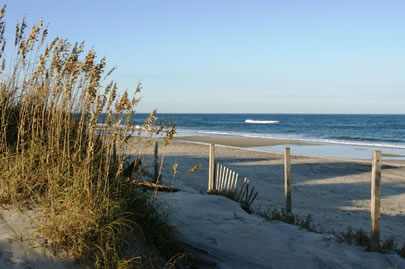
The National Park Service's preferred plan for dealing with off-road vehicles at Cape Hatteras could potentially adversely impact sea turtles, piping plovers, and seabeach amaranth, but U.S. Fish and Wildlife Service officials don't think that will happen. NPS photo.
While the potential exists for the National Park Service's preferred off-road vehicle plan for Cape Hatteras National Seashore to be detrimental to piping plovers, sea turtles, and seabeach amaranth, U.S. Fish and Wildlife Service officials believe the plan will be at least minimally helpful to all three in the long-run.
In a lengthy "biological opinion" assessing preferred Alternative F in the seashore's Final Environmental Impact Statement on an ORV management plan, FWS officials conclude that management tools should provide sufficient protection of those three species to endure continued ORV driving on the 67-mile-long seashore.
But that conclusion comes near the end of the 157-page document, one that notes high up that "potential" exists for piping plovers, a threatened species under the Endangered Species Act, to be adversely affected during nesting, wintering, and migration seasons; for three species of sea turtles that come ashore to nest at Cape Hatteras, and their resulting offspring, to be adversely affected, and; for seabeach amaranth, a threatened beach plant with distinctive fleshy, reddish stems, to also be adversely affected by allowances for ORVs and pedestrians under the preferred alternative.
The bulk of the document is spent on biological backgrounds on the species, information that addresses their range, population numbers, habitats, population dynamics, existing threats such as predation and coastal development, even how climate change might impact them. It also examines how beach driving and pedestrians could affect the species, and examines baseline conditions for the species.
When it comes to human presence on the seashore, the FWS researchers noted that all of the concerned species are at a disadvantage. Vehicles can, and do, run over piping plovers and their fledglings as well as sea turtle hatchlings and buried nests in these settings, pets can scatter plover fledglings, and beach goers can harass sea turtles and their hatchlings, and crush plover nests as well as amaranth plants and scatter their seeds.
At the same time, the document notes, management actions seashore officials can take under Alternative F can be beneficial to all three species.
"These beneficial effects can be categorized as measures to limit the interaction of vehicles, pedestrians, and their pets with nesting, migrating, and wintering piping plovers and their nests, hatchling and juvenile piping plovers, germinating seabeach amaranth and nesting sea turtles and their nests, eggs, and hatchlings," reads one section of the report.
After analyzing all the potential impacts and the off-setting beneficial effects of Alternative F, the biological opinion concludes that:
* (i)t is reasonable to conclude that implementation of the proposed ORV management plan will allow the breeding population of piping plovers to continue to grow at CAHA, barring events such as major changes in habitat conditions due to storms. Under the proposed management plan breeding piping plovers will continue to be exposed to potential human disturbance that may cause the population to grow at a slower rate than would occur in the complete absence of disturbance, and may cause the breeding population size to stabilize at a level below that which the available habitat could support in the absence of disturbance. Because we do not have a means of estimating the population growth rate at a particular locale (without or without disturbance), or the actual carrying capacity of the habitat within CAHA, the magnitude of these effects is unknown.
* Despite the continued potential for some adverse effects, the USFWS expects implementation of Alternative F should afford a reasonable opportunity for successful nesting of sea turtles annually. The proposed management activities would contribute to achieving the desired future conditions for nesting sea turtles...
* The USFWS expects implementation of Alternative F to afford a reasonable opportunity for at least a minimal amount of successful germination annually at CAHA’s most significant sites (Bodie Island, Cape Point, Cape Hatteras spit and Ocracoke spit). This is expected to potentially produce a slight population increase of seabeach amaranth over the near term.
Story Categories:
A copy of National Parks Traveler's financial statements may be obtained by sending a stamped, self-addressed envelope to: National Parks Traveler, P.O. Box 980452, Park City, Utah 84098. National Parks Traveler was formed in the state of Utah for the purpose of informing and educating about national parks and protected areas.
Residents of the following states may obtain a copy of our financial and additional information as stated below:
- Florida: A COPY OF THE OFFICIAL REGISTRATION AND FINANCIAL INFORMATION FOR NATIONAL PARKS TRAVELER, (REGISTRATION NO. CH 51659), MAY BE OBTAINED FROM THE DIVISION OF CONSUMER SERVICES BY CALLING 800-435-7352 OR VISITING THEIR WEBSITE. REGISTRATION DOES NOT IMPLY ENDORSEMENT, APPROVAL, OR RECOMMENDATION BY THE STATE.
- Georgia: A full and fair description of the programs and financial statement summary of National Parks Traveler is available upon request at the office and phone number indicated above.
- Maryland: Documents and information submitted under the Maryland Solicitations Act are also available, for the cost of postage and copies, from the Secretary of State, State House, Annapolis, MD 21401 (410-974-5534).
- North Carolina: Financial information about this organization and a copy of its license are available from the State Solicitation Licensing Branch at 888-830-4989 or 919-807-2214. The license is not an endorsement by the State.
- Pennsylvania: The official registration and financial information of National Parks Traveler may be obtained from the Pennsylvania Department of State by calling 800-732-0999. Registration does not imply endorsement.
- Virginia: Financial statements are available from the Virginia Department of Agriculture and Consumer Services, 102 Governor Street, Richmond, Virginia 23219.
- Washington: National Parks Traveler is registered with Washington State’s Charities Program as required by law and additional information is available by calling 800-332-4483 or visiting www.sos.wa.gov/charities, or on file at Charities Division, Office of the Secretary of State, State of Washington, Olympia, WA 98504.


National parks and their natural resources belong to you. The National Parks Traveler works to ensure you know how these essential places are being cared for.
Sign Up For Our Weekly Newsletter
Unsubscribe at any time.
INN Member

The easiest way to explore RV-friendly National Park campgrounds.

Here’s the definitive guide to National Park System campgrounds where RVers can park their rigs.
Our app is packed with RVing- specific details on more than 250 campgrounds in more than 70 national parks.
You’ll also find stories about RVing in the parks, tips helpful if you’ve just recently become an RVer, and useful planning suggestions.


Comments
Please provide documentation of any case of "Vehicles can, and do, run over piping plovers and their fledglings". To my knowledge, there is no documented case of this happening at CAHA.
Anonymous, read a bit more of this sentence:
You're right that there has been no documented case of this occurring at Cape Hatteras, but it has happened in a similar beach setting, at Fire Island National Seashore. (Source: The Fire Island National Seashore: A History, by Lee Koppelman and Seth Foreman, page 94.
So we can both agree that there are no documented cases of piping plovers having been run over by vehicles at Cape Hatteras?
Your inclusion of this statement in an article about the CAHA ORV Management Plan suggests that piping plovers have been run over at CAHA. To suggest that this has happened, even with your 'in these settings' qualifier, is a disservice to readers.
Cape Hatteras is not Fire Island. What happens outside of the Seashore boundaries at Cape Hatteras has no bearing on what goes on inside. If it did, the great numbers of least terns nesting on the Cora June dredge island mere hundreds of yards outside of the Seashore could surely be counted in the bird counts. Sadly, they are not.
(Source: Junk Science vs. Cora June Island - http://obx-access.wikidot.com/junk-science)
Anonymous,
We can agree that the USFWS review found no documented cases. But that's not to say there haven't been any instances. As the biological opinion clearly notes, plovers -- adults or chicks -- could easily be run over without the motorist noticing.
The following, also from the biological opinion, speaks to the potential for plovers being run over:
And a bit further it says this:
To say that "what happens outside of the seashore boundaries at Cape Hatteras has no bearing on what goes on inside" is debatable in the case, at least, of plovers and vehicles and pedestrians. Obviously the USFWS reviewers thought plover incidents outside Cape Hatteras were germane to their review of the preferred alternative.
As far as the FWS comparing the outside world to the Cape Hatteras World of plovers...
Why does Cape Hatteras have 1000 meter buffers and all other locations much less?
Answer: The FWS reviewers were evidentally asked only to review Biased Anti orv facts!
As far as ORV tracks in enclosures... The numbers are far exceeded by pedestrians and no one is crying about regulating them?!
As far as you stating "But that's not to say there haven't been any instances." That is like me stating that these birds never existed on the island before the late 1980's because no one was counting them!
In turn I am in full agreement with Anon above because the NPS FWS and DOI all word these inflammatory statements to make the ORV groups look bad to 80% who read and cannot comprehend what they are reading.
It is like stating that the plovers had a record year but not mentioning that over 50% of the chicks were killed by Ghost crabs and the like and not ORV's.
Matt,
Both Alternative F and the biological opinion address pedestrians, as well as predation. Neither single out ORVs. The rub, no doubt, stems from the fact that this is an "ORV" plan, not an "ORV and Pedestrian" plan or a "Wildlife Protection" plan.
As for ghost crabs and plovers, here's what the biological opinion had to say about them:
Without documentation you have no real science, just the 'maybe', 'probably', and 'possibly' junk science that is passed off as 'best-available science'.
Again, without documentation you have NO science.
I've been driving at CHNRS since early 70's. I've never even come close to hitting a bird, why? Because God gave them wings to escape danger. If the birds were that dumb and vulnerable they would have been extinct thousands of years ago from predators who are much better adapted to catch them. Vehicles are not the problem, if anything they keep the predator numbers down and help the birds. But this is not really about the birds is it Audubon? No, it is about you and your lawyer's cash flow isn't it? Another freedom lost, another community gravely injured, another government promise broken and stomped into the ground. Sure It's criminal but the government thrives on that, give em a chance to make some MORE laws..yeah, thats what we need alright....never ends..total bs.
I am sure that USFW and NPS employees are interested in passing "junk science" off to the public to put forth their anti-orv agenda...give me a break. ORV's are destructive, in general, and have the potential to be destructive, in general. If you can show me or convince me that ORV's tred lightly on the land, then ORV plans would not be needed at CAHA or anywhere else they are used across the country. ORV use is one form of recreation amongst many and has a place at the table...but the folks who put these documents together are presenting the information as objectively as they can (in the context of an ORV plan), with the information and science they have available. Keep in mind, 9 times out of ten, extensive scientific studies are not feasible because the parks to do not have the money, and of course we all know how woefully underfunded our public lands are. Because of this, it is absolutely acceptable to look at other studies with similar circumstances, it's done all the time and is not outside the realm of good science.
These issues are not black and white and not easily resolvable...lets keep our minds open to the realities of the situation.
Jack says I've never even come close to hitting a bird, why? Because God gave them wings to escape danger.
The issue is not with adult birds. It is with young birds that cannot yet fly.
Same situation, besides they don't nest near the water where the ORV's travel.
Ryan - are you aware that ORVs are simply 4WD vehicles? ORV is a misnomer - the Tahoes, 4Runners, and CRVs you see patrolling the urban playgrounds each day are all ORVs, according to the NPS. Each plan should be catered or built around evidence found in a particular area. That's like saying California's state budget should be the same as Delaware's. So far at CAHA, peer reviewed science does not exist, hence the general disdain for any prohibitive measures. Both sides agree that some level of conservation is needed. However, the level proposed by Audubon and generally adopted by the NPS is extreme - there has been no compromise. Pro access interest groups have been willing to compromise from the beginning, but their wishes have fallen on deaf ears.
The side that won’t compromise is the ORV side. They believe they are the deciders on what science is junk and what is not. The deciding factor usually being that if it restricts ORV access it is “junk Science”. Yet they decide a dredge spoil site (Cora June) outside of the Park boundary is the cause for the lack of nesting shorebirds in the Park. They fail to mention that there have been spoil site (dredge islands) adjacent to the Park Boundaries for years. Some of those spoil islands had nesting birds on them have completely eroded away like the one that was next to Cora June. In the last 30 years there has probably been a net loss of square footage of spoil sites adjacent to the park. The dredge spoil hypothesis isn’t even “Junk Science”, just made up nonsense to justify ORV use on the beach.
As far as nesting plovers (along with terns, skimmers, and Oyster Catchers chicks) never having been run over on the beach they don’t know that they haven’t. All the scientific evidence suggests it was a very high probability that it has occurred. Adult birds do get run over by vehicles on the beach I have witness gulls being hit by vehicles.
Hey Matt I got a science experiment for you. Lets make a dozen plover chick decoys (ping pong ball size and sand colored) and hide them on the beach at Cape Point. Do you want to bet me that some of them won’t get crushed? I’ll give you pretty good odds but I get to hide them.
That is not really the point for me. The point being that a lame disingenuous argument that plovers have not been documented being crushed in CHNS by ORVs is “Junk Science” makes your side look just foolish, belligerent and uncompromising to many of us that believe there is a time and place for ORV use in CHNS.
Anonymous ,
yes I am aware that ORV's are a general term and that 4-runners, Jeeps, etc. fall under that umbrella. But that does not detract from my point that ORV's tend to be destructive. I would actually make the case that someone driving a 4-runner on the beach would have the potential to do more damage because of their lack of experience driving off road...just a hypothesis.
On a personal note...my family has strong ties to CAHA and my wife's family has been going there for 40 years. I was there a month ago (part of my bi-annual trip to CAHA) and I had never seen so many cars on the beach. My father in-law (who has 40 years of experience to draw upon) said he has never seen the beach so crowded and tore up. Now this is just what he said, I am not old enough to verify that, but I believe him. My point is the balance between uses seems out of whack and now the physical resource as well as the visitor experience is suffering. Just how I see things.
Close the beaches to all or let the park system sell it off for a profit like the audubon does. I have little patience for (people) who claim one thing and state another.
"As far as nesting plovers (along with terns, skimmers, and Oyster Catchers chicks) never having been run over on the beach they don’t know that they haven’t."
I can state that they have not and you cannot prove me wrong....Now that is your science at work
"All the scientific evidence suggests it was a very high probability that it has occurred."
Please educate us all, because I have yet to see it and if it existed the Enviro's would have made a shirt with pictures printed on it.
"Adult birds do get run over by vehicles on the beach I have witness gulls being hit by vehicles."
They also die in dumps also lets outlaw these as well or better yet if you want to save gulls please attend a landfill and clean up all of the items you deem dangerous to gulls.
"I am aware that ORV's are a general term and that 4-runners, Jeeps, etc. fall under that umbrella. But that does not detract from my point that ORV's tend to be destructive."
Show me the damages left behind in the sand? A whole summers worth of ORV's have driven on the beaches and after the storms last week not one track remains!
"If you can show me or convince me that ORV's tred lightly on the land, then ORV plans would not be needed at CAHA or anywhere else they are used across the country."
there we go Ryan lumping it all together...This is not the same all around and if it was plovers would only require up to 1000 meters (as stated by the FWS) and not a minimum of the same with 200 meters being the norm everywhere else but CAHA.
"but the folks who put these documents together are presenting the information as objectively as they can (in the context of an ORV plan), with the information and science they have available. Keep in mind, 9 times out of ten, extensive scientific studies are not feasible because the parks to do not have the money, and of course we all know how woefully underfunded our public lands are. Because of this, it is absolutely acceptable to look at other studies with similar circumstances, it's done all the time and is not outside the realm of good science."
Well lets now change it from junk science to extremely frugal science, cheap science, dollar general science, or even governmental science. Either way this statement alone proves that if it is spoken by the master you will listen...
"Both Alternative F and the biological opinion address pedestrians, as well as predation. Neither single out ORVs. The rub, no doubt, stems from the fact that this is an "ORV" plan, not an "ORV and Pedestrian" plan or a "Wildlife Protection" plan."
Correct Kurt if it were about the birds then why dont we build them a habitat on pea island where they would be in a vehicle free zone? Lets not start up with that would not be natural or that is changing an environment by humans and not nature. If we can justify killing predators, caging eggs, putting up miles of signage and string (which according to the science used by others can and does kill birds when they run into these signs and strings even though we cannot prove it)
This comment has been edited to delete gratuitous language -- Ed.
Matt,
If frugal science is a problem with you, please, please get some people together and lobby congress to better fund the parks. The parks have to follow the law just like everyone else, and by law, the parks are mandated to protect the resource while providing opportunities for recreation. And the NPS can only do within the resources they have available.
Selling the land off or giving it back to the state, sure...I am willing to bet that much of the beaches now used by the public would be private and no-one would be allow to do anything if it was not afforded the current level of protection. There are plenty of examples of prime shoreline, or prime mountain real estate, whatever, that were not protected and are now lined with million dollar mansions with private ownership of the beach or land in front of it. (see Cape Cod for one example)
As for showing you damage caused by ORV use, it impacted my visitor experience, and I am visitor just like anyone else, and this is a recreation area, right? So why should my experience be of less value than those of an ORV user?
BTW, I partake in the ORV experience on the beach and have spent plenty of time on barrier island type environments. I enjoy driving on the beach, but I am also willing to concede to the NPS when they say a closure is necessary, we can't have it all.
Ryan first you state this...
"As for showing you damage caused by ORV use, it impacted my visitor experience, and I am visitor just like anyone else, and this is a recreation area, right? So why should my experience be of less value than those of an ORV user?"
And then this....
"BTW, I partake in the ORV experience on the beach and have spent plenty of time on barrier island type environments. I enjoy driving on the beach, but I am also willing to concede to the NPS when they say a closure is necessary, we can't have it all. "
I am guessing your experience was impacted by you?
I too will concede to the NPS when needed, but the NPS did not make the 1000 meter buffer (instead of the normal 200 meter) that closes down large amounts of this pristine area it was the Enviro law suit that did so. It was not the visitors fault or even the ORV users fault it was simply another example of someone using legal action to get their agenda into law.
BTW I use my ORV to access the beach and not to recreate on it. It is simply a tool to get to the spots where I can relax on a beach without a thousand towels around me. It is simply a way for my kids to actually get to experience this wonderful place without having to cross hundered of yards on extremely hot sand and havine the means to transport what a beachgoer would call needed items like an umbrella or easy up, chairs, and a cooler with cold drinks and sandwiches so we can stay more than a few minutes. I wish people would realize that 99% of people who do drive on the beach do so to get to the place they call their paradise and not to just drive on the beach to tear it up. If indeed you do drive on these beaches then you know these statements are true.
I guess I was not clear...having too many vehicles on the beach impacts the visitor experience...and no, I do not know how many that is, which is why it is difficult to manage.
"That is not really the point for me. The point being that a lame disingenuous argument that plovers have not been documented being crushed in CHNS by ORVs is “Junk Science” makes your side look just foolish, belligerent and uncompromising to many of us that believe there is a time and place for ORV use in CHNS."
If my argument that plovers have not been documented being crushed at CHNS by ORVs is lame and disingenuous, then conversely the argument that they have (without offering proof) is also.
Just like applying Fire Island studies to CAHA while ignoring the Cora June birds just outside the boundary, Audbon/DOW/SELC only want to allow information when it benefits them. Any thing that does not benefit the ultimate goal to deny ORV access is dismissed.
As far as FWS and NPS employees using junk science, they have and will continue to do so as Alternative F, 1st Draft was written by DOW/SELC/Audubon and presented as the Consent Decree. 1000-meter PIPL buffers, buffers for State 'species of concern' AMOY and other restrictions not seen at any other NPS 'park' came directly from the Consent Decree. The ORV Plan is based heavily on the Consent Decree.
It is apparent that nesting areas in the Seashore have grown up with vegetation, forcing the birds to the water's edge and to the spoil islands to avoid predators. If a scientist is truly interested in why birds numbers have dropped, why would this factor not be explored or even recognized?
How does asking for proof of a statement provided as 'best-available science' make us look 'foolish, belligerent and uncompromising'? I think that continuing to assert that claim, refusing to provide that proof while resorting to name-calling is none too glamorous.
We agree on that Too Many Vehicles does impact the experience, but I have rarely experienced this, in my 20 years coming down, as we do not tend to stop at those locations. We did go to the point this year in late august and it was not bad at first but then became increasingly crowded, so we moved...
"I guess I was not clear...having too many vehicles on the beach impacts the visitor experience...and no, I do not know how many that is, which is why it is difficult to manage." - Ryan
Not being able to use my vehicle to access parts of the Seashore impacts my visitor experience.
What is being presented as an ORV plan is a disregard for the people that use their vehicles to access their recreation site. As a regular user to CAHA, 'ORV-ing' is not my recreation. We are not driving up and down the beach for recreation. We use our vehicles to transport supplies and equipment for sun-bathing, swimming, fishing, kayaking, etc. to the water's edge and then we park for the rest of the time.
All vehicles are street-legal and on average more modern than what you see on paved streets. I would argue that most are better maintained that the average street vehicle. The beach is no place to have a breakdown. Wreckers are very expensive at about $300.
Unfortunately, many people that wish to weigh in on this argument have never actually been to CAHA. Instead they believe what is written in a press release or an article in a travel magazine written by an employee of one of the groups with an interest in denying ORV access. They picture a bunch of rednecks in jacked-up, oil-leaking pickup trucks speeding down the beach while drinking beer and throwing cans out the window.
I have two college degrees, all my teeth, and my vehicle is a 3-year-old pickup truck with all stock equipment with the exception of add-ons like a cooler/rod rack and a rack for kayaks. I follow the rules of the beach and I expect others to do so also. I always have a trash bag and walk around and collect any trash that may have washed up.
In my circle of friends, I'm pretty average. We all care deeply for the beach and its inhabitants. We think we are part of the ecosystem and want to help protect it from harm. We disagree with the anti-vehicle crowd about the best way to do that.
We think the interior areas should be cleared to their former state so that the birds can once again nest and breed in those areas with less predation. We think that turtle nests that are in danger of being washed away by the ocean should be relocated to insure their survival. We think that people being on the beach at night is an preferred way to reduce predator activity instead of having NPS kill hundreds of predators each year.
Unfortunately, DOW/SELC/Audobon disagree with all of these thoughts. They declare that we are the real cause of the damage.
Imagine how incensed you would be if someone showed up out of the blue one day and accused you of injuring something you love. Then they started a process that attempted to take that thing from you, declaring that you were unfit to have it.
That is the feeling that we have and may explain the hostility and resentment that we show to the people that have done this to us and continue to do this to us. As NPS announces the ORV plan, these same groups are still not content with how much access we have left and are already pressing to take more.
It appears they will not be content until there is none. That is our reality.
Get this straight. 8 Villages with a total population exist WITHIN the park's boundaries. The DOI promised us a road, support of our tourist based economy, and continued traditional access to our beaches for fishing and recreation. In return we gave them almost all our land.
Now we are left with a road that washes out at the drop of a hat as opposed to a road that was to be moved as necessary and no outlet for recreation.
There are at least 100 miles of unihabitated barrier islands and many opportunities for spoil islands for the birds. Let us be and let us live our lives in peace.
Anonymous said:
Submitted by Anonymous (not verified) on November 18, 2010 - 2:45pm.
"Without documentation you have no real science, just the 'maybe', 'probably', and 'possibly' junk science that is passed off as 'best-available science'.
Again, without documentation you have NO science."
This has been the ORV special interest group's problem from the very beginning. Little if anything they say about science has any documentation, i.e., it is not anywhere close to real science. The ORV special interest group's constant refrain is based on "maybe," "probably," and "possibly" -- that is: opinion and I-want-it-to-be-so passed off as authoritative science. And a basis to denegrate, reject, and dismiss what actually is the best available science.
But. . . trade it back and forth, and say it enough times, and it becomes fact. That the ORV special interest group has repeated the "environmental junk science" mantra enough times for them to believe it and try to spread it.
Prove that the environmental science behind what is going on is, in fact, junk science. Or at least provide some basis to "refudiate" it.
Ginny says:
". . .continued traditional access to our beaches for fishing and recreation. In return we gave them almost all our land.
Now we are left with a road that washes out at the drop of a hat as opposed to a road that was to be moved as necessary and no outlet for recreation.
There are at least 100 miles of unihabitated barrier islands and many opportunities for spoil islands for the birds. Let us be and let us live our lives in peace."
Question: Move the road to where?
Question: Traditional access to beaches?
Tearing up the beach with ORVs laden with giant coolers and barbecue outfits is traditional? Parking four deep on the beach is traditional? Traditional access exceeds one vehicle per 20 linear feet?
"Let us be and let us live our lives in peace" might have worked in 1953. But this is the real world, and even Ginny must realize that those days are gone. With tourism providing the overwhelming portion of the Hatteras economy, and construction of vacation homes being another major employer, it simply is silly to continue to claim that Hatteras should be protected as a traditional cultural property area. McMansion vacation real estate rentals and t-shirt shops are not particularly traditional. Neither are the tricked-out ORVs that now dominate many areas of the beach.
Get real.
Oh. And the birds were there first. They are traditional.
.
Submitted by Redford (not verified) on November 19, 2010 - 6:05pm.
Anonymous says:
Submitted by Anonymous (not verified) on November 18, 2010 - 2:45pm.
"Without documentation you have no real science, just the 'maybe', 'probably', and 'possibly' junk science that is passed off as 'best-available science'.
Again, without documentation you have NO science."
This has been the ORV special interest group's problem from the very beginning. Little if anything they say about science has any documentation, i.e., it is not anywhere close to real science. The ORV special interest group's constant refrain is based on "maybe," "probably," and "possibly" -- that is: opinion and I-want-it-to-be-so passed off as authoritative science. And a basis to denegrate, reject, and dismiss what actually is the best available science.
But. . . trade it back and forth, and say it enough times, and it becomes fact. That the ORV special interest group has repeated the "environmental junk science" mantra enough times for them to believe it and try to spread it.
Prove that the environmental science behind what is going on is, in fact, junk science. Or at least provide some basis to "refudiate" it.
Annymous writes:
Submitted by Anonymous (not verified) on November 19, 2010 - 1:09pm.
"Unfortunately, many people that wish to weigh in on this argument have never actually been to CAHA. Instead they believe what is written in a press release or an article in a travel magazine written by an employee of one of the groups with an interest in denying ORV access. They picture a bunch of rednecks in jacked-up, oil-leaking pickup trucks speeding down the beach while drinking beer and throwing cans out the window."
The ORV special interest group continues to chant this mantra, as well. Another say-it-enough-times-and-it-will-be-true excuse to denegrate, reject, and dismiss the interests and concerns of others. And to denegrate, reject, and dismiss the facts that others have just as many rights to express opinions about beach access, and to work to preserve Outer Banks resources as they belive appropriate.
Unfortunately, the ORV special interest group refuses to acknowledge that others also have legitimate interests and rights, based in law, as relate to Outer Banks beaches. And love those beaches just as much as the ORV special interest group.
Ginny says:
". . .continued traditional access to our beaches for fishing and recreation. In return we gave them almost all our land.
Now we are left with a road that washes out at the drop of a hat as opposed to a road that was to be moved as necessary and no outlet for recreation.
There are at least 100 miles of unihabitated barrier islands and many opportunities for spoil islands for the birds. Let us be and let us live our lives in peace."
Question: Move the road to where?
Question: Traditional access to beaches?
Tearing up the beach with ORVs laden with giant coolers and barbecue outfits is traditional? Parking four deep on the beach is traditional? Traditional access exceeds one vehicle per 20 linear feet?
"Let us be and let us live our lives in peace" might have worked in 1953. But this is the real world, and even Ginny must realize that those days are gone. With tourism providing the overwhelming portion of the Hatteras economy, and construction of vacation homes being another major employer, it simply is silly to continue to make claims such as Hatteras deserving special status, and being protected as a traditional cultural property area. McMansion vacation real estate rentals and t-shirt shops are not particularly traditional. Neither are the tricked-out ORVs that now dominate many areas of the beach.
Oh. And the birds were there first. They are traditional.
.
Matt
"Without documentation you have no real science, just the 'maybe', 'probably', and 'possibly' junk science that is passed off as 'best-available science'.
Do you believe that vehicles in CAHA have never crushed shorebird chicks because there is no “physical documentation”? Is there any reason to protect chicks from vehicles?
(With that logic one could assume that Martians planting crops were just likely to have caused craters on the planet as an asteroid impacting the Martian surface, because no one documented the event.)
“I wish people would realize that 99% of people who do drive on the beach do so to get to the place they call their paradise and not to just drive on the beach to tear it up. If indeed you do drive on these beaches then you know these statements are true.”
It is not the “intention of the 99% of the people” I am worried about. It is the documented evidence of what the ocean beach becomes when 100’s of cars go cruising in a few miles of beach to claim their piece of paradise for the day.
Many of us who enjoy driving on the beach have come to the conclusion that any beach driving today is an activity that is unacceptable with current management. Yet all (environmental groups) have been willing to compromise and agreed to continue to support beach driving in CHNS. The continued mudsling by ORV groups that the “environmentalist” won’t compromise is incorrect.
There actually has been physical documentation of recreational vehicles running over other species of bird chicks at Cape Hatteras, there's just not documentation of plover chicks being ran over. Unless the laws of physics are magically suspended at Cape Hatteras for plover chicks, I have no doubts based on evidence from other beaches where they were actually looking, that at some point in the past, both chicks and nests have been ran over.
MAN. You did it again Kurt. Did you have to put in that " Vehicles can, and do, run over ..........." Look at what that started. Reminds me of Neg Reg all over again. Can you tell why it wasn't successful. There is only one distinct difference between the two sides. One just wants to be a part of nature and enjoy the experience of CAHA as it was intended and the other wants to take that privilege away from them. Plain and simple. Just Read Between The Lines.
As always,
Ron (obxguys)
One just wants to be a part of nature and enjoy the experience of CAHA oblivious to the consequences of their actions and the other side wants to preserve the historical flora and fauna of the Park for present and future visitors to experience.
Yes, I can tell why the reg/neg was not successful.
I can see this plan doing more harm than good. The island does not contain enough habitat for a sustanable population that will reduce the threat. It will create congested areas of vehicles. This will be another problem to be solved which will create another. The natural state of the island needs to be defined when attempting to save. How far back in time does natural become. Anyway as I see it this plan does not solve a problem it only creates a demand in funding. And sorry to say funding is going to be dern hard to get 1.3 trillion deficit. Good luck to all.
From South Nags Head.
Kurt in SNH
You bring up an excellent point about the funding. With a 1.3 trillion deficit everything in this country needs to take a funding hit. All the money in the world would not solve CHNS problems.
The Park already had a serious problem with congestion of vehicles at key resource areas.
Mike Murray is literally "cutting the baby in two". It is an awful plan for all concerned. The proposed plan just exacerbates all the problems this Park already has. Just because both sides are unhappy doesn't make it a compromise or good for the Park. I hope someone above him can do something better before this is done but it is probably to late.
I don't believe the park will get the funds needed to implement the plan. Congress will maintain and thats all. The park may find itself dependent on those evil ORVs for the needed revenue stream. I love irony.
Anonymous
How many of you guys are there ? And who the heck are they. You make it personal when you respond specifically to my post but, you are not at all personal, you are anonymous.
I don't recall disturbing any flora or fauna. So get off my case !
Ron (obxguys)
"those evil ORVs for the needed revenue stream" This is so typical.
Other than taxes paid by all (or at least those without good accountants) Orv users and beach goers are the only people providing funding to this National Park.
I Know the NPS will not be given any money to impliment this plan, but this is no concern to the Enviros closing the beaches is cheap costs only some signage and string to decorate our national park with. I assure you they will find the money to make permanently closed signs and distribute about 5 miles of string and stakes to close the rest come April. Unlike my Kurt I know this again only affects the ORV groups and those who want access to the beaches. The prefered plan leaves open roughly half the shore to ORV's, until April when they will close more than half of that for prenesting closures. The Enviros will have you believe otherwise with science based on theory and odds are statements.
Everyone blurts out save this park for future generations as a lump it all together statement... Well people have been driving on these beaches for 50+ years and yet the beaches are still there and except for natural changes due to tides and storms still looks more the same than not. go back to the turn of the previous century and this island was covered in trees and even less inviting to the Plovers before man cut them all down (just another example of pick and chose when it comes to Enviro's facts). I do not see anyone saying bring back those good old days? Which future generation are we saving this for? Is not this generation the future one from 20 years ago? What are we saving? A bird that requires you to have a spotting scope with a range of 1,000 yards to see, a turtle that rarely frequents these beaches as compared to those south of here, and what is any Environmentalist doing to assist in saving these creatures besides suing the Government and fencing them inside string and signage. 15 plovers fledged and 16 plover chicks died but nobody knows why because we could not see them so we have to take the word of the very people who want beach lovers gone.
And Crot... unless you have proof then this did not happen. No chicks have been run over in CAHA. Prove it otherwise and I will concede, but until then leave the laws of physics to the professionals.
Ron (obxguys) sez:
I don't recall disturbing any flora or fauna.
And there lies the problem.
Matt,
"unless you have proof then this did not happen. No chicks have been run over in CAHA. Prove it otherwise and I will concede, but until then leave the laws of physics to the professionals."
You are guilty of speaking in broad generalizations as much as those you are criticizing. There are no absolutes, and your statement is absurd. Do we have proof, I have no idea, but your statement about the difficulty in seeing these chicks kinda disproves your statement above.
Saving a bird you have to "have a spotting scope with a range of 1,000 yards to see" or protecting a " turtle that rarely frequents these beaches as compared to those south of here" is not a rational argument. What qualifies you to make this determination of what is important and what is not. Are there other sites these birds and turtles live and breed, sure, but why do we as humans have the right to extinguish their existence on CAHA so we can drive on a beach to recreate? And thats the argument right? Driving on the beach trumps all other users and all other forms of life?
I understand your desire to drive on the beaches of CAHA to get to areas you see as important, really, I do get that, and have done it myself. However, what I feel you are failing to grasp is that the NPS, like it or not, has to protect the wildlife of the park, it is plain and simple the law. If they were to ignore the birds and turtles and let people do whatever they want, then they would not be upholding their mission as a park and as an agency. They need to take reasonable actions to protect the wildlife and the "natural" ecosystem, and doing nothing is not reasonable. Is this plan the best way to deal with issues, maybe not, is/was it an exercise in futility, maybe. But they had to do it and trying to please two disparate groups such as the Audubon Society and the Pro-ORV folks is damn near impossible.
I wish I had the answer, I would be a famous and rich man, but I cannot stress the importances of trying to look at everything critical and not through a pro-bird lens or a pro-use lens. It is just not that simple.
Ryan evidentally IRONY escapes you. I indeed was speaking in broad generalizations, but did so to prove a point (that they are stupid) and I see at least one gets it.
As far as the birds being hard to see it is because of 1,000 meter buffers, not the camoflage!! Reading comprehension is next on my agenda.
My desires is simply to have access to my National Park. How I chose to do it or how someone else chooses to do it is irrelevant as the NPS alternative closes several beaches permanently and the remainder will close on 4/2011.
"but why do we as humans have the right to extinguish their existence on CAHA so we can drive on a beach to recreate?"
Anytime I have mentioned driving on the beach, I have always stated it is to get to the recreation and not to recreate, but how could I possibly expect anyone such as you to remember a factual statement as that.
"And thats the argument right? Driving on the beach trumps all other users and all other forms of life?"
Just as the NPS killing off hundreds of what they deem predators to protect what 15 birds? Or putting up cages to prevent other creatures from eating is overriding nature to protect nature? Who or what deems what creatures shall survive? According to the LAW as you call it the NPS does on Cape Hatteras. It seems funny how that works. What is left of the National Park when the beaches are closed to humans if these birds do succeed in flourishing? I guess future generations will get to enjoy it, but who knows how far into the future that is?
Show me a picture of a little bird and tell me it is in danger and that it habitat is shared by big oil dripping ORV's who are driven by drunk rednecks and the donations of the blind sheep will roll in. We then gather these funds and hire a lawfirm who specializes in these sort of things, find a sympathetic Judge and SUE the government because the government failed to do its job in the first place.
I can appreciate your argument Matt, but attacking me personally just makes your argument that much less palatable.
I guess in this instance I will be the fool and you the professor.
Ryan
Attacking people with different opinions by mind reading the inner working of enviros minds is the part and parcel of the radical ORV recreationalists, go to one of the 4 local ORV active web sites and read their comments.
It is interesting; to Matt driving to his fishing spot on the National Park beach is not of any recreational interest to him. I disagree, when you are driving a vehicle on the NPS beach that is a recreational activity.
Matt
"Well people have been driving on these beaches for 50+ years and yet the beaches are still there and except for natural changes due to tides and storms still looks more the same than not. Go back to the turn of the previous century and this island was covered in trees and even less inviting to the Plovers before man cut them all down."
If you look at the historical photos there has been a considerable loss of ocean beach. The beach has changed since the 1930's probably due to the building and stabilizing of dunes (according to Dr. Orrin Pilkey and Dr. Stanley Riggs coastal geologist)
The amount of ORV use on the beach has increased to the point where to some that activity has impacted the fundamental reason why this Park was established. It has nothing to do (for me or any of the enviromentalist I know) of removing people from the Park. It is about regulating recreational activities that are impairing the Park. Plovers are merely the canary in the coalmine.
matt Stubbs said:
“My desires is simply to have access to my National Park. . . .
Anytime I have mentioned driving on the beach, I have always stated it is to get to the recreation and not to recreate, but how could I possibly expect anyone such as you to remember a factual statement as that.”
It seems that the ORV special interest lobby wants all of the beach – “my National Park.” Drive anywhere, anytime to get where they want to go -- never mind what it does to the beach or flora and fauna, and never mind how it affects other people who also wish to enjoy the natural environment and its resources, without some tricked-out ORV making noise, making pollution, and creating transient hazards.
And once that tricked-out ORV gets to its recreation, it completely dominates and expropriates the location. One need only look at photos from the Point and Oregon Inlet to see ORVs parked door-to-door and two- and three-deep.
Here is what one member of the ORV special interest lobby members posted on another CAHA-related board as the necessities for recreation on the beach, once at the selected recreation spot:
"typical needs of my family for beach day....
2 surfboards
coupla' boogie boards
minimum 2 rods pp
tackle box
pyramid weights
rod spikes
beach towels
beach chairs (not everybody gets one)
cooler to hold (hopefully) fish caught
cooler for food & drink
bait cooler
2-5 gallon buckets
shelling bags
garbage bags
i've probably forgotten something"
Redford,
A little reality for you is that is "MY NATIONAL PARK" As I pay taxes and I will recreate in it as I please within the law. I do not own a "tricked out ORV" but I do own a 2007 stock Silverado pickup that does not leak oil. I can attest that I personally have never destroyed any flora and fauna as the areas I have driven on are SAND. To drive elsewhere would be illegal like the dunes.
In the years I have spent coming to Cape Hatteras I have never seen someone walk out onto the beach near the point. So who's vacation are we messing up if we drive out there to fish? I have also only seen the point as crowded as you speak of a few times in those 15+ years of coming down, but that is what your kind does. Find the extreme and say it is the norm to stir the enviro pot.
I guess when you take your trips to the point in Cape Hatteras you walk out their with your children and wife and sit in the sand with your Birkenstocks and humm tree hugging tunes all day without needing water, food, sunscreen, or even a beach towel, just like the National Park (in your mind) was intending.
Matt, You are wasting your time. Some of these guys have us beat. They know more about us than we know about ourselves.
Ref; My statement that "I don't recall disturbing any flora or fauna"
Crot's reply "therein lies the problem"
I had no idea my memory had gotten that bad. Maybe I am desroying the beach and killing the birds and turtles and just can't remember.
I am sorry Crot, wish I could meet you and apologise in person. Til then, please keep letting us know where we are messing up. We need you and your clairvoyant powers.
Ron (obxguys)
Matt Stubbs said:
At least you didn't pull out the line about how all us Birkenstock people think of you ORV special interest lobby people as yahoo, redneck, beer-swilling, Dukes-of-Hazzard, doughnut-cutting, bird assassins.
Ron Saunders did pull out the self-righteous line to the effect that "we don't affect anything," when any kind of simple logic says that when "you" -- individually and collectively -- drive 4,000 pounds of internal-combustion machine up and down the beach on a daily basis, something will happen to the environment.
Justifying it because "it is my national park" doesn't change the environmental impact. "Out of sight, out of mind" does not cut it.
I pay the same taxes that you do. And I am bound by the same enabling legislation for CAHA as you.
You do not have a right to a bigger environmental impact, and a right to a bigger bite of the resources, just because you need an ORV to do your recreating.
Redford
You realize the island is so narrow that the exhaust and noise from these vehicles will indeed reach the beaches.
I guess if you have to use a boat to reach a national park versus swimming you are the problem also. Please note that you have to use a diesel swilling ferry boat to reach Ocracoke island, but you could swim Yet there is not mention of that as being unacceptable access. Even the Enviros want the bridge to collapse and a Ferry being the only access to Hatteras Island, but this would bring miles of traffic jams for days at a time. Have you ever been to the island? Why has there not been any pedestrians accessing the areas closed off to ORV's? Because those areas are very harsh to access if you are bringing a family with young kids! Would you take your 6 and 3 yr olds to the back woods of Yosemite? If so what would you need....
Matt and Ron are not going to answer any hard questions like: Do they personally believe an ORV in CAHA has ever crushed plovers and beach-nesting shorebirds (despite not having it documented)? Or Redford’s question, do they think 4000 lbs of vehicle doesn't take up considerable more space (and resources) than a person?
I try hard not to not be insulting in my remarks but find it difficult in having any discussion with guys like Matt and Ron. They know environmentalists are not trying to keep towels and sunscreen from beachgoers. They often end up being insulting or worse. The funny thing is I always start out feeling compassionate for Matt and Ron and the changes that are coming but often end up thinking they are getting what they deserve. I have no beef with a tricked out ORV. I enjoy seeing people of all ages enjoying the NP doing a myriad of recreational activities and I believe this NP was set-aside for people to enjoy doing these kinds of things in a National Park Setting (remember primitive wilderness). When the recreation impairs the resource (not just birds and turtles) it is time for management changes. CHNS is long overdue for changes.
Allowing one car per 20 feet of beach is an exceptionally liberal compromise that ORVers should be happy with. Having areas temporally closed for resource protection and alternatives to ORV access is something they need to get use to.
This will be my last post. I apologise for anything I have said to anyone underserving of my criticism. Emotions due run deep on both sides. I am all for a practical policy of regulations, protections, education and funding for the shore.. I am for a permit system for all users as long as it is convenient to obtain, especially for the occassional visitor, that it is reasonable, intended to control and educate for the betterment and not used to punish and fee proceeds go to support and improvement of the shore, to the bennifit of ALL users. The policies concerning closures should also be practical and not used to punish which has not been the case to date.
The thing that troubles me the most is that I believe there are extremists that really do want to totally exclude those like myself from accessing the beach utilizing Motorized vehicles. No matter if it is done in a safe and conservative manner. Their extreme position and demands have caused others to develop an extreme attitude. If anyone cannot understand that then I don't know what to tell you.
I will finish with this. I do not believe the plaintiff groups will ever be satisified with any agreement short of eleminating the "orv" groups from the beach. Like so many laws and regulations in the past, its get your foot in the door and then pursue, pursue, pursue. I may be wrong, I sincerely hope I am. But I'll be ready to say I told you so if I am right.
I hope God will bless me and my family by allowing us to continue the great experiences we have come to enjoy on the shore and hope to see all of you there. Lets do good things together. It can be done. You just have to want to do it.
Wishing EVERYONE a Merry Christmas or other celebration of your choosing and a Happy New Year
( and especially you, Kurt Repanshek )
RON & Cecile (obxguys)
"Allowing one car per 20 feet of beach is an exceptionally liberal compromise that ORVers should be happy with"
If it were only this easy we would all agree. I personally look for a spot with no one and this is the main reason I utilize my street legal non tricked out vehicle to legally search for that spot.
"They know environmentalists are not trying to keep towels and sunscreen from beachgoers."
you are correct they are attempting to keep the beaches from the people with the excessive closures and now with the preferred permanent closure of areas. These closures will close the remaining beaches on 4/1/2011. Mark my words as it has done this for the past 2 years.
I am a reasonable person who expects to be treated the same, but when people believe that we are complaining about having 16 miles roughly to drive on they are WRONG. We are simply stating that with the size of these closures and the proposed permanent closures the 16 miles will be MUCH smaller and more restrictive if the 20 feet per vehicle is enforced. In fact the experiences of all will be affected. It really does not matter if you are there to drive on, walk on, or even levitate on the beaches because closed is closed. Now the NPS and Eviro groups are forcing more interaction between people and ORV's by shrinking the areas available. I do not see the areas referred as Vehicle free and usable to a family unless the are in front of the villages. These vehicle free areas also will close if a plover decides to land there. Simply put give me 20 feet per vehicle and I am happy, but do not pee on my shoes and tell me its raining.