
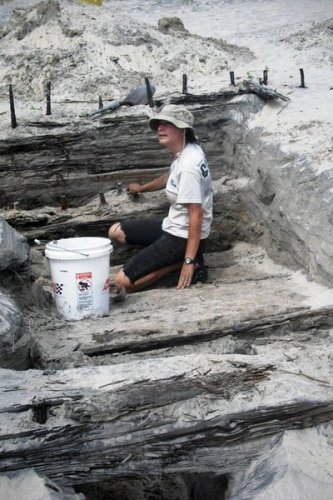
East Carolina University student Kathryn Lee Cooper helps to excavate the remains of the Laura A. Barnes. NPS photo.
The remains of the shipwrecked schooner Laura Barnes will eventually end up in the Graveyard of the Atlantic Museum. Meanwhile, the excavation and preservation processes provide important learning opportunities for a group of budding archeologists.
North Carolina's Outer Banks region has been dubbed "the Graveyard of the Atlantic" because thousands of ships have wrecked there, falling victim to the treacherous shoals, tricky currents, and powerful storms that make this one of the most dangerous coasts in the world. Not surprisingly, shipwrecks are among the visitor attractions at Cape Hatteras National Seashore.
To see some of these wrecks, you don't have to don scuba gear or even get in a boat. In the surf off Pea Island National Wildlife Refuge, for example, you can see the exposed boiler and smokestack of the steamship Oriental, a Federal transport that ran aground in 1862. On the north side of Oregon Inlet, low tide exposes the remains of the Lois Joyce, a 100-foot trawler that foundered during a December 1981 storm. On the beach 14 miles south of the Oregon Inlet Campground and about 25 miles north of Buxton is a keel-up wooden shipwreck, all that remains of the Margaret A. Spencer (wreck date unknown). There are plenty of other wrecks along the beach and in the surf, some of them exposed only briefly during unusually low tides or after storms have heavily eroded the beaches.
One of the best known of the Cape Hatteras shipwrecks is the Laura A. Barnes, a four-masted schooner that foundered when it came ashore on Bodie Island during a heavy fog on the night of June 1, 1921. After being pushed around by wind and waves, the wreck settled into the sand of Coquina Beach (about a mile south of its original location) during the 1970s.
There the wreck was readily accessible for public viewing. If you wanted to see it, you just drove to Coquina Beach (directly across NC Hwy 12 from the Bodie Island Lighthouse), made your way to the bathhouse/restroom area, and crossed over the dunes on the boardwalk. The remains of the Laura A. Barnes lay right there on the beach at the bottom of the steps. Over the decades, the wreck was seen by hundreds of thousands of Cape Hatteras visitors.
In May and June 2010, a project formally titled Shipwrecks of the Graveyard of the Atlantic undertook a variety of underwater archeology tasks and related documentation of shoreline shipwrecks. One goal of the project was to excavate the Laura A. Barnes remains and preserve them for display at the Graveyard of the Atlantic Museum in Hatteras. Putting the ship remains on display at the popular museum (three million visitors a year) was deemed to make more sense than leaving the wreck on the beach where a storm could rip it apart and scatter the pieces.
Ranger Doug Stover, Cultural Resource Manager at Cape Hatteras National Seashore, explained that students played a key role in the Laura A. Barnes project. Working under the supervision of several faculty mentors, 12 students from East Carolina University's Field School of Maritime History and Underwater Research were assigned to assist with excavation. For the students, two of whom were doctoral candidates, the project was a learning laboratory that gave them experiences, insights, and skills that couldn't readily be acquired from lectures and books. If you want to become a competent archeologist you need to heft, haul, and screen a lot of dirt and sand while someone in the know helps you to put the puzzle together and draw meaning from it all.
Someday in the not too distant future, Cape Hatteras visitors touring the Graveyard of the Atlantic Museum will be able to view the preserved remains of the ill-fated schooner Laura A. Barnes, a ship that came ashore on a foggy night in 1921, spent nearly 90 years on the beach, and helped to train a new generation of archeologists.
Story Categories:
A copy of National Parks Traveler's financial statements may be obtained by sending a stamped, self-addressed envelope to: National Parks Traveler, P.O. Box 980452, Park City, Utah 84098. National Parks Traveler was formed in the state of Utah for the purpose of informing and educating about national parks and protected areas.
Residents of the following states may obtain a copy of our financial and additional information as stated below:
- Florida: A COPY OF THE OFFICIAL REGISTRATION AND FINANCIAL INFORMATION FOR NATIONAL PARKS TRAVELER, (REGISTRATION NO. CH 51659), MAY BE OBTAINED FROM THE DIVISION OF CONSUMER SERVICES BY CALLING 800-435-7352 OR VISITING THEIR WEBSITE. REGISTRATION DOES NOT IMPLY ENDORSEMENT, APPROVAL, OR RECOMMENDATION BY THE STATE.
- Georgia: A full and fair description of the programs and financial statement summary of National Parks Traveler is available upon request at the office and phone number indicated above.
- Maryland: Documents and information submitted under the Maryland Solicitations Act are also available, for the cost of postage and copies, from the Secretary of State, State House, Annapolis, MD 21401 (410-974-5534).
- North Carolina: Financial information about this organization and a copy of its license are available from the State Solicitation Licensing Branch at 888-830-4989 or 919-807-2214. The license is not an endorsement by the State.
- Pennsylvania: The official registration and financial information of National Parks Traveler may be obtained from the Pennsylvania Department of State by calling 800-732-0999. Registration does not imply endorsement.
- Virginia: Financial statements are available from the Virginia Department of Agriculture and Consumer Services, 102 Governor Street, Richmond, Virginia 23219.
- Washington: National Parks Traveler is registered with Washington State’s Charities Program as required by law and additional information is available by calling 800-332-4483 or visiting www.sos.wa.gov/charities, or on file at Charities Division, Office of the Secretary of State, State of Washington, Olympia, WA 98504.


National parks and their natural resources belong to you. The National Parks Traveler works to ensure you know how these essential places are being cared for.
Sign Up For Our Weekly Newsletter
Unsubscribe at any time.
INN Member

The easiest way to explore RV-friendly National Park campgrounds.

Here’s the definitive guide to National Park System campgrounds where RVers can park their rigs.
Our app is packed with RVing- specific details on more than 250 campgrounds in more than 70 national parks.
You’ll also find stories about RVing in the parks, tips helpful if you’ve just recently become an RVer, and useful planning suggestions.


Comments
I have a photo of the Laura A Barnes taken at the mouth of the LaHave River in Nova Scotia. I would be happy to share it with you if you like.
The Laura A Barnes was originally located on the beach behind the Bodie Island Maintenance shop in the early 1970's. It was moved to its current location at the Second Coquina beach structure south parking lot by House mover Willie Rogers with the assistance of the Bodie Island Maintenance crew. Fred Kelly and Linda Pierce should also have knowledge of this move. July, 29, 2021