
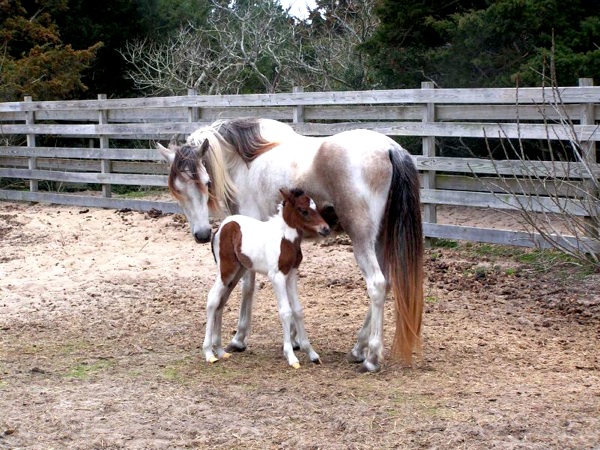
This little filly recently was added to the Ocracoke pony herd at Cape Hatteras National Seashore. NPS photo.
The pony herd at Cape Hatteras National Seashore has grown by one thanks to the addition of a filly born late in March.
The filly, named Paloma, was born on a warm spring morning, March 22, to Spirit, a full-blooded Ocracoke pony. The Ocracoke School children chose the name, which means "dove" in Spanish, of the newest member of the herd.
In case you're wondering about the seashore's ponies, here's some background from the park's website:
Legend has it that the “Banker” horses of Ocracoke were left here by shipwrecked explorers in the 16th or 17th century. European ships commonly carried livestock to the New World. If a ship ran aground near the coast, animals were thrown overboard to lighten the load so that the ship could be re-floated. The livestock were often left behind when the ship again set sail. Sir Richard Grenville’s ship Tiger ran aground at Ocracoke in 1565. There is speculation that he may have unloaded Spanish mustangs on the island.
Horses have been documented on Ocracoke since the first European settlers came to stay in the 1730s. There have been as many as 300 horses on Ocracoke. While small and powerful, they are full-grown horses that are often called or referred to as Banker ponies as their range included most of the Outer Banks. Physically, the Ocracoke ponies are different from other horses - they have a different number of vertebrae and ribs as well as a distinct shape, posture, color, size, and weight that sets them apart from other horses.
The ponies have played a major role in the island’s history, serving residents as beasts of burden at work and play, in beach rides and races. When the early colonists settled Ocracoke, they used the ponies to help make life easier on the island by pulling carts to haul freight and fish. The U.S. Lifesaving Service used them for beach patrols and to haul equipment to shipwreck sites. The US Coast Guard kept a small band of Banker ponies to patrol the beaches in World War II. As time progressed, the families that lived on the island claimed the ponies, holding pony penning in the summer. Riders would start early in the morning at the north end of the island and drive the ponies into the village where holding pens had been constructed. Once in the pens they would sort out the ponies and brand the new ones. Some ponies would be broken for riding or sold, and the rest were turned loose to roam free again.
Story Categories:
A copy of National Parks Traveler's financial statements may be obtained by sending a stamped, self-addressed envelope to: National Parks Traveler, P.O. Box 980452, Park City, Utah 84098. National Parks Traveler was formed in the state of Utah for the purpose of informing and educating about national parks and protected areas.
Residents of the following states may obtain a copy of our financial and additional information as stated below:
- Florida: A COPY OF THE OFFICIAL REGISTRATION AND FINANCIAL INFORMATION FOR NATIONAL PARKS TRAVELER, (REGISTRATION NO. CH 51659), MAY BE OBTAINED FROM THE DIVISION OF CONSUMER SERVICES BY CALLING 800-435-7352 OR VISITING THEIR WEBSITE. REGISTRATION DOES NOT IMPLY ENDORSEMENT, APPROVAL, OR RECOMMENDATION BY THE STATE.
- Georgia: A full and fair description of the programs and financial statement summary of National Parks Traveler is available upon request at the office and phone number indicated above.
- Maryland: Documents and information submitted under the Maryland Solicitations Act are also available, for the cost of postage and copies, from the Secretary of State, State House, Annapolis, MD 21401 (410-974-5534).
- North Carolina: Financial information about this organization and a copy of its license are available from the State Solicitation Licensing Branch at 888-830-4989 or 919-807-2214. The license is not an endorsement by the State.
- Pennsylvania: The official registration and financial information of National Parks Traveler may be obtained from the Pennsylvania Department of State by calling 800-732-0999. Registration does not imply endorsement.
- Virginia: Financial statements are available from the Virginia Department of Agriculture and Consumer Services, 102 Governor Street, Richmond, Virginia 23219.
- Washington: National Parks Traveler is registered with Washington State’s Charities Program as required by law and additional information is available by calling 800-332-4483 or visiting www.sos.wa.gov/charities, or on file at Charities Division, Office of the Secretary of State, State of Washington, Olympia, WA 98504.


National parks and their natural resources belong to you. The National Parks Traveler works to ensure you know how these essential places are being cared for.
Sign Up For Our Weekly Newsletter
Unsubscribe at any time.
INN Member

The easiest way to explore RV-friendly National Park campgrounds.

Here’s the definitive guide to National Park System campgrounds where RVers can park their rigs.
Our app is packed with RVing- specific details on more than 250 campgrounds in more than 70 national parks.
You’ll also find stories about RVing in the parks, tips helpful if you’ve just recently become an RVer, and useful planning suggestions.


Comments
All together now,
"Awww..."! I remember devouring the Margarete Henry books as a child! I think most little girls my age must have read "Misty" and "Stormy".
I should clarify that I DO realize this article is about the Cape Hattaras herd of wild ponies and not the ones from Assateague National Seashore.
Connie, Even though they're different islands that also is the first thing that pops in my mind. I never got over my love of horses and I am determined to own a Chincoteague "pony" one day. My parents took me when I was 14 to see the pony swim and 14 years later I was a ranger there. The highlight was when I got teh chance to meet the real Maureen Beebe!
Colorado Jim and I were on the final leg of our Coastal Carolinas Dumb & Dumber trip two days ago when we stopped by the Ocracoke pony enclosure at feeding time. The little foal was nowhere to be seen, darn it. Win a few, lose a few.