
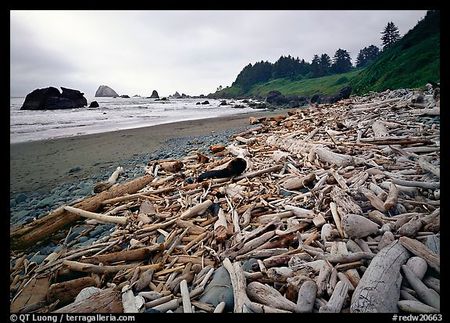
Driftwood at Hidden Beach about a mile south of False Klamath Cove in Redwood National and State Parks. Photo by QT Luong, used with permission. www.terragalleria.com/parks.
The powerful earthquake that struck the northern California coast Saturday didn’t yield a tsunami or kill anybody, thank goodness. At Redwood National and State Parks, as elsewhere in the region, nobody was injured and property damage was slight. But as they say, it isn’t over until it’s over.
Residents of the seismically-active northern California coast are aware that earthquakes can cause massive property damage, injuries, and deaths in their area at any time, and without as much as a moment’s warning. Near the shoreline, concerns are compounded by the possibility of fearsomely destructive tsunamis that can be triggered even by faraway quakes. On March 27, 1964, a 9.2 quake (8.4 Richter scale) centered in the Gulf of Alaska made Crescent City ground zero for the most damaging earthquake ever to strike the U.S. mainland, a maelstrom that took out 30 city blocks, destroyed or damaged nearly 300 homes, and left 11 people dead. No, people on the northern California coast most emphatically do not take earthquake hazards lightly.
Earthquake and tsunami readiness is serious business at Redwood National and State Parks, too. The park headquarters in Crescent City is situated in the central business district at an intersection whose previously existing structures were demolished by the 1964 tsunami. The southern headquarters of this fragmented, elongated, coast-hugging park are located in the coastal town of Orick (about 35 miles north of Eureka), and the park also shares some office space in Arcata. Small wonder that Redwood National and State Parks recently became the first unit in the entire National Park System to be certified tsunami ready.
On Saturday, January 9, a 6.5 temblor centered within 30 miles of Arcata gave a large area of the northern California and southern Oregon coast a good shaking. Given the earthquake and tsunami history of the region, it’s easy to appreciate that residents described the effects as “scary,” even if property damage was minimal and there were no deaths or serious injuries.
According to a report submitted by Leonel Arguello, Supervisory Botanist at Redwood:
Many [park] employees who work in Orick and Arcata live in communities around Humboldt Bay, which were most impacted by the quake. The office buildings in both Orick and Arcata suffered no structural damage from the quake. Two computer servers, one each in Arcata and Orick, were damaged, though, with one needing to be replaced. The other was repaired. Two computers that were operating during the quake were also damaged. One, a laptop, was damaged beyond repair, as the ground motion damaged the internal components (i.e. motherboard). The other was repaired and is back in service.
People living and working in the area nearest the quake’s epicenter were shocked by the severity of the shaking. This, the most powerful quake to hit the area since 1992, was a real attention-grabber.
The quake had varying impacts on employees living in the area near the epicenter. Those in Eureka almost unanimously reported this quake to be very severe and extremely frightening – and many of them have lived most of their lives in California and are no strangers to earthquakes. Most if not all the employees living in Eureka suffered material damage within their homes, with items flying off shelves or toppling over onto the floor. One reported finding all of her kitchen knives spread out on the floor throughout her kitchen, having been ejected from the knife block in which they were stored. Fortunately, none of these employees or their family members were injured, nor did any report structural damage to their property.
Farther away in Arcata and McKinleyville, park employees reported the shaking as being scary, but not as severe as what has been described in Eureka. For folks in these communities, hardly any items toppled over and damage was minimal to non-existent.
The absence of a destructive tsunami added an extra measure of “dodged the bullet” relief. Tsunamis are triggered by sea floor displacement, and that did not happen in this instance because the movement along the fault was horizontal (strike-slip variety) rather than vertical.
It would be nice to close the book on this one, but that would be premature. Big quakes tend to be followed by one or more strong aftershocks, and seismologists say that there are about four chances in five of that happening. For residents of the northern California and southern Oregon coast, it’s like waiting for the other shoe to drop.
Story Categories:
A copy of National Parks Traveler's financial statements may be obtained by sending a stamped, self-addressed envelope to: National Parks Traveler, P.O. Box 980452, Park City, Utah 84098. National Parks Traveler was formed in the state of Utah for the purpose of informing and educating about national parks and protected areas.
Residents of the following states may obtain a copy of our financial and additional information as stated below:
- Florida: A COPY OF THE OFFICIAL REGISTRATION AND FINANCIAL INFORMATION FOR NATIONAL PARKS TRAVELER, (REGISTRATION NO. CH 51659), MAY BE OBTAINED FROM THE DIVISION OF CONSUMER SERVICES BY CALLING 800-435-7352 OR VISITING THEIR WEBSITE. REGISTRATION DOES NOT IMPLY ENDORSEMENT, APPROVAL, OR RECOMMENDATION BY THE STATE.
- Georgia: A full and fair description of the programs and financial statement summary of National Parks Traveler is available upon request at the office and phone number indicated above.
- Maryland: Documents and information submitted under the Maryland Solicitations Act are also available, for the cost of postage and copies, from the Secretary of State, State House, Annapolis, MD 21401 (410-974-5534).
- North Carolina: Financial information about this organization and a copy of its license are available from the State Solicitation Licensing Branch at 888-830-4989 or 919-807-2214. The license is not an endorsement by the State.
- Pennsylvania: The official registration and financial information of National Parks Traveler may be obtained from the Pennsylvania Department of State by calling 800-732-0999. Registration does not imply endorsement.
- Virginia: Financial statements are available from the Virginia Department of Agriculture and Consumer Services, 102 Governor Street, Richmond, Virginia 23219.
- Washington: National Parks Traveler is registered with Washington State’s Charities Program as required by law and additional information is available by calling 800-332-4483 or visiting www.sos.wa.gov/charities, or on file at Charities Division, Office of the Secretary of State, State of Washington, Olympia, WA 98504.


National parks and their natural resources belong to you. The National Parks Traveler works to ensure you know how these essential places are being cared for.
Sign Up For Our Weekly Newsletter
Unsubscribe at any time.
INN Member

The easiest way to explore RV-friendly National Park campgrounds.

Here’s the definitive guide to National Park System campgrounds where RVers can park their rigs.
Our app is packed with RVing- specific details on more than 250 campgrounds in more than 70 national parks.
You’ll also find stories about RVing in the parks, tips helpful if you’ve just recently become an RVer, and useful planning suggestions.


Comments
Interesting article but the facts about the '64 earthquake were not correct. It was ~9.2 in magnitude.
Hawaii has had many more tsunamis which have caused more lose of life. So I'm not sure what is meant by "Crescent City [being] ground zero for the worst tsunami in U.S. history" if the '46 tsunami in Hawaii caused the death of 165 people.
Nice catch, Anon. You are quite correct that the tsunami that struck Hilo, Hawaii, on April 1, 1946, took many more lives than the 1964 Crescent City tsunami. (I believe the correct number is 159, although I do recall seeing at one time or another a source that quoted a figure similar to the one you provided.) I should have described the 1964 Crescent City, CA, tsunami as the most destructive to hit the mainland U.S. BTW, on the desk in front of me is a copy of Dennis Powers' book The Raging Sea, which is an interesting and lengthy (288 pp.) account of the 1964 Crescent City tsunami disaster that was published in 2005. I bought this book at the museum in Crescent City last September. Do you know what the full title of this book is? It's The Raging Sea: The Powerful Account of the Worst Tsunami in U.S. History." The fact that the 1964 Crescent City tsunami caused much more property damage than the 1946 Hilo tsunami (which yielded casualty losses of "only" about $26 million) seems to be at the root of the claim. As for the magnitude of the 1964 Good Friday earthquake that produced the Crescent City tsunami, you and I are both right, Anon, but you are more right than I am. The 9.2 magnitude you've quoted is a measurement on the Moment Magnitude scale, whereas the 8.4 I cited is the same magnitude as expressed on the Local Moment scale (aka Richter scale). The Moment Magnitude scale now in common use didn't even exist until 1979, fully 15 years after the Crescent City tsunami we're talking about, so you'll see a lot of older references to the 8.4 number. It's 2010, darn it, and I do realize that I should be citing the Moment Magnitude number, not the Local Magnitude number. Old habits are hard to break (sigh...). Anyway, I've edited the article to fix the problem. Again, nice catch. You guys are a tough audience! Maybe I should find another line of work.
Thank you for keeping us up to date about things in Redwood National Park. Up here in Orick, the southern gateway to Redwood National and State Parks, I was working at the Elk Meadow Cabins when the earthquake hit. I was standing out side watching the Elk graze at Elk Meadows. I felt the ground shake, and by the time I realized it was an earthquake, it ended. The Elk did not flinch, raise their heads or even react. Our 'house cat' however, came running by at about 100mph and went hiding for about one hour. We had no damage and the only inconvenience to our guests was the power outage that lasted for about 6 hrs. No Redwood Trees came down and no damage to the roads.
I'm delighted that the quake impact was so slight in your vicinity, teamredwood. The response (or nonresponse) of the animals is interesting. There are lots of historical reports of animals behaving strangely before a quake hits. In fact, some scientific studies have looked into this reported phenomenon. (I don't know the results.) BTW, I've seen elk at the Elk Meadow Cabins myself, and they looked pretty darn relaxed to me. I'm not surprised that a mere earthquake failed to upset them. :o)