
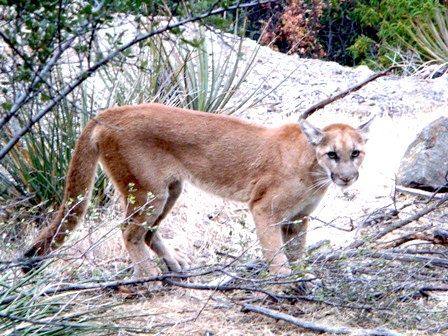
"P-13" is a young mountain lioness that recently was captured and fitted with a radio collar in Santa Monica Mountains National Recreation Area. NPS photo.
Despite its highly urbanized setting, Santa Monica Mountains National Recreation Area has a decidedly wild edginess, one that springs from its resident mountain lions. You're not likely to see one of these big cats, but there's a small handful of them there in the NRA, roaming its rumpled chaparral, preying on its deer and any smaller prey they can find.
Since 2002 biologists at the NRA, which is adjacent to Los Angeles, the country's second-most urbanized area, have been working with the support of the California State Parks and Santa Monica Mountains Conservancy to better understand the mountain lions that roam within, or pass through, the NRA's borders. Recently their task got a bit of a boost when a young female mountain lion was captured and fitted with a radio collar. Found in the Hidden Valley region of the Santa Monica Mountains, the lion named "P-13" could be the kitten of mountain lion P-6, a female that was previously radio-collared and known to be in the area recently based on remote camera photos. Blood and tissue collected during the capture will be used for DNA testing through UCLA that will help determine the potential relationship between P-13 and P-6.
Hopefully her movements will add to the NRA's knowledge of mountain lion ranges, health, and how they react to the surrounding urbanization. Mountain lion P-1, the first one collared in this study, is now thought to be 12 or 13 years old and is most likely alive following a fight with another mountain lion. P-10 and P-12 are both 2-year-old males with functioning collars; they currently inhabit the Topanga and Malibu Creek areas, respectively, although male lions often roam across the entire Santa Monica Mountains. P-13 joins them as the third mountain lion with a functioning collar. She is thought to be at least 1 year old.
Mountain lions face significant challenges in the Santa Monica Mountains, primarily due to limited habitat and threats from urbanization including freeways, such as Highway 101, that obstruct travel. In February of 2009, P-12 successfully crossed Highway 101 at Liberty Canyon, an unprecedented event in the mountain lion study. Designated wildlife corridors within the mountains offer the lions opportunities for long distance movement and the ability to discover new mates. Mountain lions have a range up to 250 square miles, and require ample acreage to find sufficient food.
Genetically, lions in the Santa Monicas are at the southern end of a larger population that extends northward to Big Sur. The long-term survival of mountain lion populations here depends on their ability to move between regions to maintain genetic diversity.
Fortunately, to date there haven’t been any reported negative direct interactions between humans and mountain lions in the Santa Monica Mountains. Sightings are incredibly rare, even for people who spend large amounts of time in the area. Preservation of open space and wildlife corridors in the Santa Monica Mountains through local, state, and federal partnerships is integral to regional mountain lion survival.
Story Categories:
A copy of National Parks Traveler's financial statements may be obtained by sending a stamped, self-addressed envelope to: National Parks Traveler, P.O. Box 980452, Park City, Utah 84098. National Parks Traveler was formed in the state of Utah for the purpose of informing and educating about national parks and protected areas.
Residents of the following states may obtain a copy of our financial and additional information as stated below:
- Florida: A COPY OF THE OFFICIAL REGISTRATION AND FINANCIAL INFORMATION FOR NATIONAL PARKS TRAVELER, (REGISTRATION NO. CH 51659), MAY BE OBTAINED FROM THE DIVISION OF CONSUMER SERVICES BY CALLING 800-435-7352 OR VISITING THEIR WEBSITE. REGISTRATION DOES NOT IMPLY ENDORSEMENT, APPROVAL, OR RECOMMENDATION BY THE STATE.
- Georgia: A full and fair description of the programs and financial statement summary of National Parks Traveler is available upon request at the office and phone number indicated above.
- Maryland: Documents and information submitted under the Maryland Solicitations Act are also available, for the cost of postage and copies, from the Secretary of State, State House, Annapolis, MD 21401 (410-974-5534).
- North Carolina: Financial information about this organization and a copy of its license are available from the State Solicitation Licensing Branch at 888-830-4989 or 919-807-2214. The license is not an endorsement by the State.
- Pennsylvania: The official registration and financial information of National Parks Traveler may be obtained from the Pennsylvania Department of State by calling 800-732-0999. Registration does not imply endorsement.
- Virginia: Financial statements are available from the Virginia Department of Agriculture and Consumer Services, 102 Governor Street, Richmond, Virginia 23219.
- Washington: National Parks Traveler is registered with Washington State’s Charities Program as required by law and additional information is available by calling 800-332-4483 or visiting www.sos.wa.gov/charities, or on file at Charities Division, Office of the Secretary of State, State of Washington, Olympia, WA 98504.
INN Member

The easiest way to explore RV-friendly National Park campgrounds.

Here’s the definitive guide to National Park System campgrounds where RVers can park their rigs.
Our app is packed with RVing- specific details on more than 250 campgrounds in more than 70 national parks.
You’ll also find stories about RVing in the parks, tips helpful if you’ve just recently become an RVer, and useful planning suggestions.


Comments
I hike in the Santa Monica Mountains a lot and particularly in the area adjacent to Hidden Hills. I've never seen a mountain lion and I don't want to. This is a highly urbanized area with housing developments bordering the parks. I worry that someday some runner or mountain biker is going to be mauled or killed as happened in Orange County a few years ago.
I have been hiking in the Santa Monicas for over 30 years and have never seen a mountain lion but have seen their tracks. Although my hiking partners disagree with me, it would absolutely make my day to see one of these beautiful, illusive creatures. Unfortunately, I suspect I never will. They are much more aware of my presence than I am of theirs.
I hike at this trail almost every other Sunday & this Sunday me & my dad went deep into the forest & saw a dead deer carcus. I was kinda scared but kept going & then saw mountain lion scat on a rock. So i hiked back to the car alone because my dad wanted to keep going. Shortly after he followed. I wonder if we kept going we would have encountered a mountain lion?
Albert –
You raise some important questions. Although attacks by mountain lions on humans are rare, they do occur, and it's important to be prudent in areas where these large animals occur.
You were correct to be concerned when you saw the dead deer carcass, and doubly so when you saw lion scat in the area. It's impossible to know if you'd have seen a lion if you had continued your hike, but it sounds like there was a high probability there was a lion in the vicinity, and that's a sign it's time to leave the area.
The best course of action at that point would have been for both you and your dad to leave the area together, return to your car, and report your observations to the park.
Hiking in groups of two, three or more hikers is certainly safer than solo travel in lion country.
The California Dept. of Fish and Game and the Mountain Lion Foundation have the following suggestions about mountain lion safety:
1. Do not hike alone. Go with a partner, or better yet, in a group; keep children close to adults.
2. Do not approach a lion. Most mountain lions will try to avoid a confrontation. Give them a way to escape.
3. Do not run from or past a mountain lion. Running may stimulate a mountain lion's instinct to chase. Instead, stand and face the animal. Make eye contact. If you have small children with you, pick them up if possible so they don't panic and run. Although it may be awkward, pick them up without bending over or turning away from the mountain lion.
4. If you're in mountain lion country, try to avoid squatting, crouching or bending over. Researchers believe humans standing up do not represent the right shape for a cat's prey, but a person squatting or bending over looks a lot like a four-legged prey animal.
5. If you encounter a cougar, make yourself appear larger, more aggressive. Open your jacket, raise your arms, throw stones, branches, etc., without turning away. Wave raised arms slowly, and speak slowly, firmly, loudly to disrupt and discourage predatory behavior.
6. If you are attacked, fight back with whatever is at hand without turning your back. People have utilized rocks, jackets, garden tools, tree branches, and even bare hands to turn away cougars.
Enjoy your hikes, and stay safe!
I took a rather late hike in Reck Park in Topanga this evenng with my dog. We had we were just entering back into the residential area about 7:30 p.m., and I heard a dog that lives in the nearest house off the trail going crazy, my dog got suddenly very alert, and a mountain lion dashed up the hill next to us so fast it took my breath away. I didn't see the head but I saw the long sleek body and long tail...and it was so fast! I have lived in Topanga over twenty years, and about fourteen years ago we had two sightings in my yard one winter. I feel very lucky.
Hi all, I live near the Westlake Village/Thousand Oaks area. About 2 weeks ago I happened to be getting dressed in my room and looked uut my back window to see what I can only describe as a Mountian Lions tail swinging into the brush. I walk through my area often and am familiar with animals around here, muledeer, raccoons, foxes, opposums, ect. We live by a small stream so there's easy water acess and I assume-food. In the years I've been here I'd never seen this color, biege tail, darker brown almost black tip, just shaped in an upward U swinging back and forth going into the oak bushes. It didnt concern me, but really I guess it should.
Saw a large mountian lion on the Limantour Laguna trail 11/13/2015 noon. Took one look at us and ran for the hills in direction of Mt Wittenberg. Thrilled. It was beautiful.