
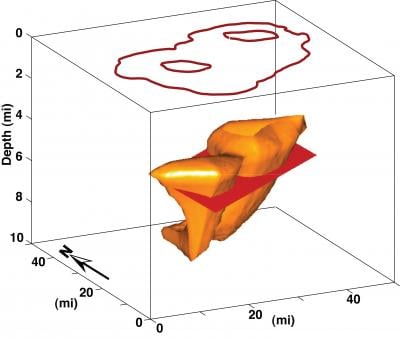
What the heck is going on with the magma pocket that fuels Yellowstone National Park's geothermal plumbing? Image by Wu-Lung Chang, University of Utah
Call it an earth scientist's dream: Swarms of earthquakes are continuing to rattle Yellowstone National Park. What they're indicating is the question we're all waiting to hear an answer to.
Could it be Armageddon is on the way? True, early explorers referred to Yellowstone as the place where hell boiled up. And back in 2004 there was a made-for-TV docudrama that showed the imagined impact to the Rocky Mountain region if the park's underlying supervolcano blew its top. But no one is ready to predict that the supervolcano that created the park's unique geothermal plumbing is ready to erupt.
Still, since the temblors were first detected December 26 more than 500 earthquakes have been counted. And some have approached a magnitude 4.0 tumbler.
The University of Utah Seismograph Stations reports that as of 1800 MST on 2 January 2009, seismicity of the ongoing Yellowstone earthquake swarm continues. Over 500 earthquakes, as large as M 3.9, have been recorded by an automated earthquake system since the inception of this unusual earthquake sequence that began Dec. 26, 2008. More than 300 of these events have been reviewed and evaluated by seismic analysts. Depths of the earthquakes range from ~ 1km to around 10 km. We note that the earthquakes extend northward from central Yellowstone Lake for ~10 km toward the Fishing Bridge area, with a migration of recent earthquakes toward the north. Some of the dozen M3+ earthquakes were felt in the Lake, Grant Village and Old Faithful areas. Personnel of the Yellowstone Volcano Observatory continue to evaluate this earthquake sequence and will provide information to the NPS, USGS and the public as it evolves.
This earthquake sequence is the most intense in this area for some years. No damage has been reported within Yellowstone National Park, nor would any be expected from earthquakes of this size. The swarm is in a region of historical earthquake activity and is close to areas of Yellowstone famous hydrothermal activity. Similar earthquake swarms have occurred in the past in Yellowstone without triggering steam explosions or volcanic activity. Nevertheless, there is some potential for hydrothermal explosions and earthquakes may continue or increase in magnitude. There is a much lower potential for related volcanic activity.
Geologic burps in Yellowstone are the norm. Upwards of 2,000 earthquakes a year are monitored in the park, the Norris Geyser Basin grew a bit hotter than normal in 2003, as did the Artist Paint Pots area last May, and the caldera is pushing up at a somewhat faster-than-normal rate. And yet, the park is still there.
You can find an interesting, 4-meg article into the work of monitoring Yellowstone's slumbering volcano here. The article, by Jacob B. Lowenstern, the Yellowstone Volcano Observatory's scientist-in-charge, and Shaul Hurwitz, a USGS colleague, notes that the supervolcano that created the park's landscape had its last substantive eruption some 70,000 years ago.
Over the past 2.1 million years, the Yellowstone Plateau volcanic field has produced two of the largest and most devastating eruptions documented on Earth. When will it erupt again, or might it have reached the end of its volcanic lifetime? With extended breaks between eruptive episodes, the most recent now reaching 70,000 years, large calderas like Yellowstone present special challenges to hazard assessment. In 2006 alone, Yellowstone experienced over 1200 earthquakes, and parts of its caldera rose more than 7 cm. Yet how can we determine the relevance of this dynamism to eruptive potential? How can we know whether the volcano is recharging for future activity or simply cooling and stagnating?
Though understandably technical in nature, the article provides some interesting insights into Yellowstone's caldera and how scientists are monitoring its behavior.
Story Categories:
A copy of National Parks Traveler's financial statements may be obtained by sending a stamped, self-addressed envelope to: National Parks Traveler, P.O. Box 980452, Park City, Utah 84098. National Parks Traveler was formed in the state of Utah for the purpose of informing and educating about national parks and protected areas.
Residents of the following states may obtain a copy of our financial and additional information as stated below:
- Florida: A COPY OF THE OFFICIAL REGISTRATION AND FINANCIAL INFORMATION FOR NATIONAL PARKS TRAVELER, (REGISTRATION NO. CH 51659), MAY BE OBTAINED FROM THE DIVISION OF CONSUMER SERVICES BY CALLING 800-435-7352 OR VISITING THEIR WEBSITE. REGISTRATION DOES NOT IMPLY ENDORSEMENT, APPROVAL, OR RECOMMENDATION BY THE STATE.
- Georgia: A full and fair description of the programs and financial statement summary of National Parks Traveler is available upon request at the office and phone number indicated above.
- Maryland: Documents and information submitted under the Maryland Solicitations Act are also available, for the cost of postage and copies, from the Secretary of State, State House, Annapolis, MD 21401 (410-974-5534).
- North Carolina: Financial information about this organization and a copy of its license are available from the State Solicitation Licensing Branch at 888-830-4989 or 919-807-2214. The license is not an endorsement by the State.
- Pennsylvania: The official registration and financial information of National Parks Traveler may be obtained from the Pennsylvania Department of State by calling 800-732-0999. Registration does not imply endorsement.
- Virginia: Financial statements are available from the Virginia Department of Agriculture and Consumer Services, 102 Governor Street, Richmond, Virginia 23219.
- Washington: National Parks Traveler is registered with Washington State’s Charities Program as required by law and additional information is available by calling 800-332-4483 or visiting www.sos.wa.gov/charities, or on file at Charities Division, Office of the Secretary of State, State of Washington, Olympia, WA 98504.
INN Member

The easiest way to explore RV-friendly National Park campgrounds.

Here’s the definitive guide to National Park System campgrounds where RVers can park their rigs.
Our app is packed with RVing- specific details on more than 250 campgrounds in more than 70 national parks.
You’ll also find stories about RVing in the parks, tips helpful if you’ve just recently become an RVer, and useful planning suggestions.


Comments
Besides the 3 supereruptions that have occurred at Yellowstone in the last couple million years, there have also been far-larger numbers of 'lesser' but still important and sometimes major eruptions. For example, in the last 14,000 years of the current Holocene Era, there have been 20 large explosive events.
It for sure would not take a supereruption, to put Yellowstone at the center of national attention. A 'normal' eruption could really shake things up, over a goodly chunk of the middle of the United States. No TV-drama necessary.
Early on the morning of May 18, 1980, I was headed up the Little River Trail. This is on the north side of the Olympic National Park, in about the middle. A branch of the Little River divides Klahane Ridge from lesser-known Elwah Range (yes, where the dams are being removed). Both are northern spurs off Hurricane Ridge, site of the most famous & heavily-used destination-facility in Olympic.
Along the lower part of the trail, Little River is just a creek, and is only there because of the precipitous chasm between the 2 ridges. Further up, there is no real stream.
Warmed up & striding along, I was suddenly locked in position by a BOOM beyond my experience. The first sound was followed others, and while standing still I felt a puff of overpressure as a shock-front moved over me. "What the Hell?!", I thought to myself.
The immediate possible cause that I had to deal with, is that a massive land-fall may have occurred, further up the Little River chasm. Total annihilation could be coming down the canyon toward me at a 100 miles an hour. I sprinted up the trail until it climbed several hundred feet above the bottom.
As I recovered from the run, there was more stupendous noise. Could it be the Soviets, nuking the west coast to a cinder? I fixed my gaze in the direction of our local military targets and urban centers, and watched the sky ... knowing I should already have noted the flashes, had it been nuclear explosions.
The hair-raising racket went on & on. Could it be the Mountain - St. Helens? From here!?? That's awful close to preposterous...
But it was the mountain, of course. And my cousin and his brother had gone down there to 'have a look'. They had gone out the ridge-trail that is now the favored view-site (Dave is a DNR forester, and knew this short hike had the best view).
Much of the blast deflected off the ridge they were on, and passed overhead (this site is well-within the zone of total destruction, but avoided the worst). Like me, at first they were confused by what was happening. It was not what they expected. But then it started to get dark. They started running. Then stuff started to fall on them, and it was getting really dark. They stopped, got under some trees and huddled beneath their gear.
Dave does some fairly gnarly things as a forester, and is an advanced fire-fighter as well. With a glint in his eye he confides, "You know how we wonder sometimes, 'What if this tree jumps off the stump and squishes my guts out?' - can I handle it?" If I'm gonna die - can I deal with it ok? Well, now I know the answer." Big smile.
By now, they realized it was the mountain, ash (and rock) was starting to get deep, and they were going to be buried. They found their flashlights, improvised their gear as overhead shields, hustled to the trailhead and abused their vehicle severely escaping the mountain.
Remember, St. Helens was a fair small, if nicely-spectacular eruption ... and unbeknownst to me, my mother had headed from Olympia toward Spokane, and was overtaken by the main ashfall path, like me & Dave, at first having no idea what was happening.
The earthquakes have subsided - at least that's the latest news. The commentary on it in the blogosphere has not.
The whole reaction to this thing has been very funny to me, though I'm starting to get bored with it (record visits to my Web site newspaper aside).
Even so, I didn't notice any less winter traffic in the park yesterday (except less buffalo traffic).
We had a delightful time cross country skiing in the park, and the only earthquake I felt was the one caused by me falling!
Jim Macdonald
The Magic of Yellowstone
Yellowstone Newspaper
Jim's Eclectic World
I would like to know if there is a plan in place to notify those affected if Yellowstone go's. Which is going to be everyone from Missouri/Kansas north and east. Or is everyone going to kept in the dark and our government and FEMA just hoping for the best? I think the people of this country have the right to know what their government plans on doing if there is any warning of a large quake ( 6.0 or greater) or a large eruption. This kind of event can and will affect many lives.
K Gies,
For every "supereruption" there are a thousand "big eruptions", and for every one of those there is a thousand "little eruptions". Neither science nor the government can really tell reliably which of those 'events' a sustained pattern of 'warning activity' will lead to - if anything at all. Most warning-activity comes to nothing.
Most eruptions are little ... but Mount St. Helens was a 'little eruption', and it was fairly impressive. However, the main effects of St. Helens were confined to Washington State (had the wind been different, the ash would have dumped heavily on the urban Portland, Oregon area ... but still, the human cost would have been light).
K, nobody - nobody - knows how to tell if the Big One is coming.