
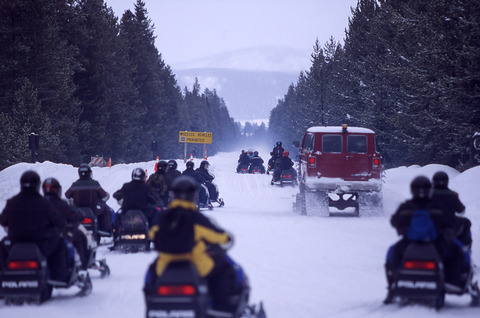
Officials at Yellowstone and Grand Teton national parks, concerned about a a judge's ruling that blocks recreational snowmobiling and snow coach use in the parks, are searching for a way to get around that ruling.
Early Friday evening the parks issued a joint release in which officials said they and their staff, in consultation with attorneys at the U.S. Department of Justice and the U.S. Department of the Interior, were looking at a range of options that might provide for motorized over-snow access this winter.
The release pointed out that the parks' winter-use plan "would have allowed up to 540 commercially guided; cleaner and quieter snowmobiles and 83 snowcoaches a day to enter Yellowstone this winter" and another "40 unguided, (Best Available Technology) snowmobiles a day on Jackson Lake (in Grand Teton) to facilitate ice fishing, as well as 25 snowmobiles a day to travel on the Grassy Lake Road."
What it didn't mention was U.S. District Judge Emmet Sullivan's finding that, "According to NPS's own data, the (winter-use plan) will increase air pollution, exceed the use levels recommended by NPS biologists to protect wildlife, and cause major adverse impacts to the natural soundscape in Yellowstone. Despite this, NPS found that the plan's impacts are wholly 'acceptable,' and utterly fails to explain this incongruous conclusion."
Friday's release from the parks pointed out that, "The discretionary authority of the superintendents of the parks is limited to actions in accordance with regulations. Therefore, they cannot simply issue an order to open the parks to snowmobile or snowcoach travel this winter."
And yet, if you turn the calendar back to December 2007 you'll notice that officials for the parks pretty much did just that. They resorted to using the Administrative Procedures Act to get Yellowstone's and Grand Teton's gates open to snowmobiles ASAP rather than wait the requisite 30 days that normally must pass between acceptance of new rules (in this instance the newly approved winter-use plan for the parks) and their implementation.
Here's the solution the National Park Service turned to last year to open the parks on schedule:
This rule is effective on December 19, 2007. The National Park Service recognizes that new rules ordinarily go into effect thirty days after publication in the Federal Register. For this regulation, however, we have determined under 5 U.S.C. 553(d) and 318 DM 6.25 that this rule should be effective on December 19, 2007. This rule implements the winter use plans for the Parks and relieves the restrictions on the use of snowmobiles and snowcoaches that would exist in its absence. In addition, good cause exists for the effective date of December 19, 2007, for the following reasons:
(1) The NPS has in good faith since at least March 2006 publicly stated that the 2007-2008 winter season for the Parks would commence on December 19, 2007, and the public and businesses have made decisions based on the widespread public knowledge of this opening date.
(2) Since March 2006, the NPS has consistently and repeatedly stated that the 2007-2008 winter season would be a transition winter. As an action common to all alternatives in the Draft and Final EIS, the NPS stated the Parks would be open during the 2007-2008 winter season and operate under rules substantially the same as those that have been in effect last three winters under the temporary plan. Through this rule, the NPS intends to fulfill that commitment.
(3) Many persons planning to visit the Parks have already made travel plans in anticipation of the Parks being open for snowmobile and snowcoach use, such as reserving time off from work, booking airfares and hotel accommodations, making reservations for snowmobile or snowcoach tours, and the like. For example, in late August, Xanterra Parks and Resorts (which operates lodging and other services in Yellowstone) reported that 2007-2008 winter bookings were up 18% over last year. The Christmas-New Year period is the most heavily visited time of the 82-day winter season. If the Parks do not open as scheduled on December 19, it would create unnecessary hardship for visitors who have already planned trips, and would likely result in economic losses for some visitors if reservations had to be cancelled. Significant revenue loss for businesses in and around the Parks would also occur. Many businesses in the gateway communities surrounding the Parks, and the people who rely upon them for their livelihoods, are highly dependent upon the Parks being open for the entire duration of the 82-day season.
(4) Snowmobile and snowcoach operators have made business decisions and investments for the winter season premised on an opening date of December 19, 2007. Such actions include purchasing new snowmobiles and snowcoaches for their fleets, making offers of employment, preparing advertising and other materials, and purchasing snowmobile accessories such as suits, helmets, boots, mittens, etc. A delay in the effective date of this regulation would shorten an already brief winter season, thereby depriving these businesses and others that depend on the winter season (such as hotels, restaurants, service stations, and other hospitality-oriented businesses) of revenue that is important to their livelihoods. As recently as November 2, NPS met with snowcoach and snowmobile guides and outfitters to plan for the 2007-2008 winter season based on an opening date of December 19, 2007.
(5) There would be no benefit to the public in delaying the effective date of this rule, given that there has already been substantial notice of the opening date and that the Parks will be open under conditions substantially similar to those in effect for the past three years. The above-described harms to the public resulting from a procedural delay of this rule should therefore be avoided, and an effective date of December 19, 2007, is warranted.
Park officials were unavailable Friday evening to say whether they could resort to this same process for the coming winter. However, if it is an option they might have to come up with a winter-use plan more in keeping with Judge Sullivan's ruling.
Story Categories:
A copy of National Parks Traveler's financial statements may be obtained by sending a stamped, self-addressed envelope to: National Parks Traveler, P.O. Box 980452, Park City, Utah 84098. National Parks Traveler was formed in the state of Utah for the purpose of informing and educating about national parks and protected areas.
Residents of the following states may obtain a copy of our financial and additional information as stated below:
- Florida: A COPY OF THE OFFICIAL REGISTRATION AND FINANCIAL INFORMATION FOR NATIONAL PARKS TRAVELER, (REGISTRATION NO. CH 51659), MAY BE OBTAINED FROM THE DIVISION OF CONSUMER SERVICES BY CALLING 800-435-7352 OR VISITING THEIR WEBSITE. REGISTRATION DOES NOT IMPLY ENDORSEMENT, APPROVAL, OR RECOMMENDATION BY THE STATE.
- Georgia: A full and fair description of the programs and financial statement summary of National Parks Traveler is available upon request at the office and phone number indicated above.
- Maryland: Documents and information submitted under the Maryland Solicitations Act are also available, for the cost of postage and copies, from the Secretary of State, State House, Annapolis, MD 21401 (410-974-5534).
- North Carolina: Financial information about this organization and a copy of its license are available from the State Solicitation Licensing Branch at 888-830-4989 or 919-807-2214. The license is not an endorsement by the State.
- Pennsylvania: The official registration and financial information of National Parks Traveler may be obtained from the Pennsylvania Department of State by calling 800-732-0999. Registration does not imply endorsement.
- Virginia: Financial statements are available from the Virginia Department of Agriculture and Consumer Services, 102 Governor Street, Richmond, Virginia 23219.
- Washington: National Parks Traveler is registered with Washington State’s Charities Program as required by law and additional information is available by calling 800-332-4483 or visiting www.sos.wa.gov/charities, or on file at Charities Division, Office of the Secretary of State, State of Washington, Olympia, WA 98504.


National parks and their natural resources belong to you. The National Parks Traveler works to ensure you know how these essential places are being cared for.
Sign Up For Our Weekly Newsletter
Unsubscribe at any time.
INN Member

The easiest way to explore RV-friendly National Park campgrounds.

Here’s the definitive guide to National Park System campgrounds where RVers can park their rigs.
Our app is packed with RVing- specific details on more than 250 campgrounds in more than 70 national parks.
You’ll also find stories about RVing in the parks, tips helpful if you’ve just recently become an RVer, and useful planning suggestions.


Comments
I own a snowmobile but I do not live in that area. With all the national forest land to ride in why do people want to ride in there; if its to see the sights I have a an idea. Use a fleet of snowcoaches like a bus route and take your snowshoes or x-country skis get off at one of stops on the route and see the sights and the animals instead of distrubing them. I go into the national forest where I live by and get out and walk in my snowshoes so I can enjoy nature without scaring the H**l out of it. Bottom line is there's plenty of land out there to go on with snowmobiles have senseable rules I have proposed the sightseers can still see the park that way, if they are just there to snowmobile it's wrong.
I do live in this area and a big part of being able to ride in the parks is accesibility to the lakes for ice fishing. My family has been fishing on Jackson Lake for over 60 years....it is a big part of our family bonding and traditions. My grandfather fished there, my parents, my kids and hopefully my grandkids. You cannot access these areas in a reasonable fashion without snowmobiles. Now someone is trying to take that away from us. Think of something that is very important to you and your family and imagine some judge from hundreds of miles away telling you that you can't do it anymore.
As for the national forest lands, why is it OK to ride there and "scare the wildlife" and "damage the soundscape" (give me a break!) but not in the parks? Its the SAME land with the SAME wildlife! The areas affected by snowmobile traffic in Yellowstone is minute compared to the available land where the wildlife resides. Do you realize that the machines are travelling at 35mph and they never leave the groomed trail? Why is it OK for millions of cars to pass over the exact same routes every year but not a few thousand snowmobiles? (at a much lower speed, I might add).
And what about the jobs that will be lost with the banning snowmobiles from Yellowstone? The Old Faithful Inn and axillary businesses would be shut down and in today's economy the families that try to make a living in West Yellowstone and Gardiner, MT don't stand a chance without their winter tourism trade. You might as well take the towns off the map if this ridiculous ruling is not reversed.
How did your parents and grandparents get to the lake, if "you cannot access these areas in a reasonable fashion" without a gas burning engine? Forget your snowmobile, take out the cross country skis and follow the family tradition.
Let me say this about jobs because a lot of people don't have the opportunity to visit Yellowstone in the winter and so are lost in the fog of the rhetoric. If you go to the gateway towns, like West Yellowstone, you will be astounded by the high percentage of businesses that are closed for the entire winter, even during the height of snowmobile season. West Yellowstone's air sure stinks and has a kind of bluish haze, snowmobiles are in ample numbers in the town, the gas station isn't filled with cars but with snowmobiles filling up. But, the vast majority of businesses are closed. Most restaurants are closed, most shops are closed, and you can park on the main strips without the least bit of difficulty because they are so empty. Some West Yellowstone businesses, perhaps, rely on snowmobiles, but the town itself makes its money - yes, the snowmobile capital of the world - in the summer. In fact, it's striking how awful and crowded West is in the summer and how relatively empty it is in the winter - though the air somehow manages to smell worse in the latter.
All the gateway towns have a ghost town like feeling in the winter compared with the summer. It's not even close; West Yellowstone is remarkably empty. Or, look at Gardiner where the North Entrance is open to cars; empty! It's very hard to find much that's open, even in an area that still has tourists coming through by automobile. All the hotels have plenty of vacancies and really cheap rates.
My sense is that these towns would go on and would hardly feel it. West Yellowstone still would serve the recreation industry in the national forests. Jackson and Cody aren't going anywhere. It's a bigger stink than the air from snowmobiles and snowcoaches. There are all kinds of equity issues; it would be nice to talk about those in a better way - than all this woe is me self victimization that goes on from people. Let's figure out how to best care for the place while not making it a special fiefdom for the rich, how to care for the wildlife and the air and snow. Those should be our questions; not first what you and I might be losing by losing our preferred means to Jackson Lake.
Jim Macdonald
The Magic of Yellowstone
Yellowstone Newspaper
Jim's Eclectic World
I took an unguided tour about 10 years ago, on the groomed trails (ROADS), and was the 2nd most memoriable events of my life. (Sorry WW, but our readers really don't need to know about your most memorable event. -- the editors.)
I do not understand here in the "Land of the Free" why visitors can not drive the roads without being in a tour. In the future will everyone in America be required to go on a Cruise Ship when they go on a vacation, or required to be in a tour group.
I had never visited Yellowstone, but truely by accident went 3 times in one year. To me the winter snowmobile was the most beautiful. I absolutely could not stand the summer crowds and traffic jams. I actually fled the park due to the traffic thinking that sitting in Washington DC beltway traffic was better than Yellowstone in the summer. If the NPS wants to cut down on polution in the park then cut down on the summer traffic, prohibit the 4 cylinder pickup trucks that are towing 14' travel trailers, with 14' boat behind them them. If you are towing something then you have to stay out of the park. 500 snowmobiles a day cause more polution than 10,000 cars a day? Reduce the summer traffic and keep Yellowstone open to free travelers, but only on the roads.
When will they limit the number of cars that go in there during the summer? Or how about only allowing hybrid or clean burning cars in there during the summer?
Come on, the problem is not just what happens 3 months of the year.
I totally agree with Jim Macdonald on this issue !
"As for the national forest lands, why is it OK to ride there and "scare the wildlife" and "damage the soundscape" (give me a break!) but not in the parks? "
In the first place, scaring wildlife with snowmobiles is never OK, no matter where it is. Parks are special places, the best of the best, set aside to be "Unimpaired" for future generations. Forests, by definition, are "multiple use" areas. There is a BIG difference.
I agree, Jim says it all in his post. Air quality is worse in the winter, plain and simple. You can talk all you want about the cars and RVs in the summer. Go to West in July and take a deep breath, and go in January and do the same. You will be convinced.
Studies done by the NPS at West Yellowstone and Old Faithful have found that, "Even though summer traffic volumes are nearly 60 times higher than winter traffic volumes, the highest hourly CO concentrations at both locations occur during the winter."