
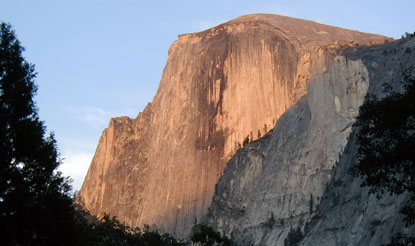
Half Dome is an alluring destination, but is the hike to the top a wilderness experience? NPS Photo.
Thousands of folks trek to the top of Half Dome in Yosemite National Park each summer. Their footprints have created a well-worn path up past Vernal and Nevada falls and onto the granite behemoth. Which begs the question: Does Half Dome offer visitors a wilderness experience?
How can it? The fact that so many folks make the hike arguably makes it impossible to enjoy a wilderness experience. Then, too, there's the use of cables provided by the National Park Service to make it possible to reach the summit with some measure of safety. In a true wilderness setting, you wouldn't find cables to help you along your way.
There's no question that the view from Half Dome is spectacular, but even it detracts from the wilderness experience when you gaze down upon the Yosemite Valley with its roads, lodgings, parking lots, and thousands of visitors.
To get others' opinions on this question, Steve Sergeant at the Wildebeat interviewed a handful of experts and hikers. You can find his audiocast on the matter here. Check it out.
Story Categories:
A copy of National Parks Traveler's financial statements may be obtained by sending a stamped, self-addressed envelope to: National Parks Traveler, P.O. Box 980452, Park City, Utah 84098. National Parks Traveler was formed in the state of Utah for the purpose of informing and educating about national parks and protected areas.
Residents of the following states may obtain a copy of our financial and additional information as stated below:
- Florida: A COPY OF THE OFFICIAL REGISTRATION AND FINANCIAL INFORMATION FOR NATIONAL PARKS TRAVELER, (REGISTRATION NO. CH 51659), MAY BE OBTAINED FROM THE DIVISION OF CONSUMER SERVICES BY CALLING 800-435-7352 OR VISITING THEIR WEBSITE. REGISTRATION DOES NOT IMPLY ENDORSEMENT, APPROVAL, OR RECOMMENDATION BY THE STATE.
- Georgia: A full and fair description of the programs and financial statement summary of National Parks Traveler is available upon request at the office and phone number indicated above.
- Maryland: Documents and information submitted under the Maryland Solicitations Act are also available, for the cost of postage and copies, from the Secretary of State, State House, Annapolis, MD 21401 (410-974-5534).
- North Carolina: Financial information about this organization and a copy of its license are available from the State Solicitation Licensing Branch at 888-830-4989 or 919-807-2214. The license is not an endorsement by the State.
- Pennsylvania: The official registration and financial information of National Parks Traveler may be obtained from the Pennsylvania Department of State by calling 800-732-0999. Registration does not imply endorsement.
- Virginia: Financial statements are available from the Virginia Department of Agriculture and Consumer Services, 102 Governor Street, Richmond, Virginia 23219.
- Washington: National Parks Traveler is registered with Washington State’s Charities Program as required by law and additional information is available by calling 800-332-4483 or visiting www.sos.wa.gov/charities, or on file at Charities Division, Office of the Secretary of State, State of Washington, Olympia, WA 98504.
INN Member

The easiest way to explore RV-friendly National Park campgrounds.

Here’s the definitive guide to National Park System campgrounds where RVers can park their rigs.
Our app is packed with RVing- specific details on more than 250 campgrounds in more than 70 national parks.
You’ll also find stories about RVing in the parks, tips helpful if you’ve just recently become an RVer, and useful planning suggestions.


Comments
Simply put, NO.
A wilderness experience? You really have to ask?
Most of the National Parks I have been to have raped the wilderness with roads, lodgings, gas stations, parking lots, buses, trails, bridges, signs, scenic flights, large groups guided by corporate outfitters, etc..
There are a few of Our National Parks that I enjoy as a wilderness type of experience.
Unless these areas (or other areas in the NPS system for that matter) are within the boundaries of the Congressional designated Wilderness, they are not bound by the laws, prohibitions, and spirit of the 1964 Wilderness Act, nor do many of these areas have a wilderness management plan. Of course, the Wilderness Act didn't set forth use levels. One only has to visit several other wilderness areas across the NPS to realize during the summer, often we are really not alone in the wilderness.
As we saw with the 2006 NPS management policy fiasco, it is becoming increasingly easy for the NPS directorate to be handmaiden to the White House policy desires and not the Organic Act. Of course, one must only look at the rim of the Grand Canyon to see that development, tourism, and the NPS have always gone hand in hand.
I agree Anonymous (not verified), the fact is that the National Park Service manages most of our wilderness acreage.
I feel Our National Park Service, in almost the entire Wilderness areas that I visit has ignored or stepped around the Wilderness Act which defines an area of wilderness to mean an area of undeveloped Federal land retaining its primeval character and influence, without permanent improvements.
I see an over abundance of permanently developed improvements in over built trails, bridges, signs, scenic flights and in the commercialization of Wilderness as in large groups guided by corporate outfitters.
I would argue that the NPS has done much to promote wilderness. I know that even though the Great Smokies does not qualify as a wilderness area the NPS treats it as though it does have that designation. I feel certain that many other parks are doing similar acts. I live in Yosemite and have enjoyed the experience of hiking Half Dome, it is spectacular. That is probably why you don't get that widerness experience you feel entitled to. Venture only a little further to Clouds Rest and you will be rewarded. Or you may want to experience Half Dome by entering from somewhere other than Yosemite Valley. Spending the night at Little Yosemite Valley and hiking up in the wee hours of the morning will certainly allow for a less crowded experience. As long as National Parks are in spectacular places there will be crowds. Yosemite offers hundreds of miles of trails that are in designated wilderness areas where you will not be affected by crowds or over development. Its a difficult task to make available for the public enjoyment without having any impact. I think that the NPS does a pretty good job of finding a balance. Of course you can't please everyone.
I don't care what the legal definition of 'wilderness' is. For me, it's a place where I don't see any other human beings for long periods of time. With the crowds at Yosemite, even on so-called backcountry trails in the high country, that's impossible. (Doesn't matter if they're hiking alone, with a club or a 'corporate' outfitter).
I agree with much of what has been said here. And truthfully, on a personal level, I do question many management decisions of the NPS. However, a big problem we face, more than NPS management, is the expectations of visitors . Too many people just want to see animals from their cars, tour buses, etc. rather than expending any energy and actually experiencing anything.
Our park visitors, in many cases, aren't doing anything active, and expect to be catered to. Of course, this is not what the wilderness experience is about, but how can we shift these core attitudes?
I spent this past summer conducting recreation research in Alaska, you'd be surprised at my data. It's sad how people want to see these places on TV, but rarely want to expend any energy at all on the experience.
In my opinion, this is the root of the problem.
I believe this is a problem of our National Park Service; it has turned into government paid caterers.
"Oh Ranger, there is a bear in my woods.."
It is time the National Park Service stopped this nonsense and got back to preservation and education by not offering the couch, TV or tourist bus and urging folks to walk the Wilderness where expectations do not survive.
This is a very funny thread! It really shows the distinct dilemma that anyone (NPS or whoever else you want to put in there) faces with it's mission.
The thread begins with the initial question: "Is hiking Half Dome a wilderness experience?" No, seems the consensus. And why? Because the NPS "manages" the wilderness, thus reducing its "wild" qualities. No, it's because humans are there at all that's the problem. No, it's because the NPS caters to tourists that don't want to get out of their cars and want to be "catered" to.
But isn't the problem with climbing Half Dome exactly about those tourists who ARE getting out of their cars and doing a pretty strenous day climb in order to experience the very wilderness that's being bemoaned?
Here's how I see it (right or wrong). If we define the wilderness experience as time spent in a place without human influence, there has not been a wilderness experience in the Americas for 20,000 to 40,000 years (depending on your science). If you are talking about land that isn't somehow managed by humans but left to the influence of nature alone, we lost wilderness by first few decades of the twentieth century. Hell, the air we produce in our cities has influenced designated wilderness areas for decades, let alone the physical structures of roads and buildings.
Wilderness can only truly be defined by the way we manage the land. And it's important to realize that wilderness in, say, Alaska, is far more easily managed as wilderness (because of its remoteness, though that protection is beginning to fail as well) as, say, the California mid-Sierra where thousands and thousands of San Franciscans and Los Angelinos and Sacramentoads flock for a bit of relief in whatever is left of nature in the mountains.
I'm not sure what you expect the NPS to do? (And the question applies to anyone expected to manage it, government-affiliated or not). There's lots of complaints, but I see few suggestions.
Here's how to make Half Dome a more "wilderness" kind of experience: limit access. That is how we've traditionally maintained a wilderness experience for people and it should apply to Half Dome as well. Make them register. Limit the number of bodies per day.
What Half Dome needs, like any designated wilderness area, is a human firewall that allows only the smallest footprint possible and less of a human highway.
Glenn's notion of limited access has been practiced successfully with The Narrows and The Subway at Zion for many years. It makes perfect sense for high congestion regions, and I would personally like to see it extended to the Bright Angel and South Kaibab Trails, along with too many others to name in one posting.
The idea of wilderness carries with it too many variables for accurate definition. "Managing" wilderness is folly; that, in my world, removes it from consideration as true pristine wilderness. Try as we like, mankind just isn't intelligent enough to manage Nature. The more we attempt to, the bigger debacle we leave as our legacy. Until we as a species as alleged "stewards" of our lands accept and admit that we cannot do as we damn well please, where and whenever we please, our remaining resources, both flora and fauna, are to be forever subjected to the whims of the arrogant, the profiteering and those whose evolutionary development specific to their intelligence stagnated in the era of the last Ice Age.
My initial comment was in reference to the ridiculous notion of waiting in line to take a walk. How can that be a wilderness experience? The only things missing from that circus were the pop machines and the hot dot vendors. Wilderness indeed........
As far as I can tell, the (big-W) Wilderness areas in the contiguous 48 states are all such small islands of wildness surrounded by lands that are in many cases heavily impacted by human presence. Even if we completely eliminated all amenities for human visitors, such as trails, signage, established campsites, and ranger stations, a tremendous amount of management would still be needed just to keep the influences from the adjacent civilization from impacting these places. And most of the wildlife (plant or animal) in the preserves aren't necessarily aware of the boundaries of these preserves anyway, and trying to keep the unimpacted wildlife in, and the impacted wildlife out, is probably impossible.
It was interesting, when I interviewed the Yosemite spokesman, what he had to say about the possibility of limiting day-use access to Half Dome:
So they don't have the resources to manage the traffic, and feel they have higher-priority problems elsewhere in the park to spend their resources on.
- - - - - - - - - - - - - - - - - - - - - - - - - - - - - - - - - - - - - - - -
The WildeBeat "The audio journal about getting into the wilderness"
Download the MP3 programs or subscribe to the podcast at...
www.wildebeat.net
Bingo Steve....good interview. Glad that to hear the Park's position on permits. After careful thought, I feel 60% of the people going up the Half Dome trail need education. When you get a wilderness permit, you have to listen to a bear-proof container lecture. If and I say IF, permits for Half Dome were started, I'd recommend that if you get a permit you could not do the hike for 3 days after. That way, you'd have to hear a mini-lecture on safety, water, cables etc -or- read a sheet -or- watch a 15 minute video. Like "drive up/drive back" one-day banshee skiers, one-day Domers could benefit from reasonable guidance. But as Scott said there are no resources to manage and monitor all this.
Rick D.
http://www.HikeHalfDome.com
There are higher priority problems elsewhere to spend resources?
How about removing the cable system entirely then.
That ought to stifle, limit the flow of wilderness seekers a bit.
On November 21st, 2007, Random Walker wrote:
There are certainly wilderness advocates who are in favor of this proposal. Unfortunately, the cables are considered a historical monument, and thus are also to be protected by the park. This is a case where the laws that enforce preservation of various park features are in conflict.
- - - - - - - - - - - - - - - - - - - - - - - - - - - - - - - - - - -
The WildeBeat "The audio journal about getting into the wilderness"
Download the MP3 programs or subscribe to the podcast at...
www.wildebeat.net
At Rocky Mountain National Park early (c. 1915) guides put up cables on the North Face of Longs Peak. In about 1979 several of us past seasonal Longs Peak Rangers with the concurrance of the current Longs Peak crew, at that time, got together in a meeting and petitioned the park to remove the cables, which was subsequently accomplished in 1981(?), returing that route to a low 5th class (protecction from the eye bolts left in place). There is an alternative route through the Keyhole around the West Face and up the Homestretch route which requires some scrambling up a well trodden path. Several thousand climbers do so each year, making the 5,000 vertical foot treck from the trailhead. The rationale chopping the cables was in response to Wilderness Area designation in the 1980 Colorado Wilderness Bill.
The Chasm Lake Shelter which, built in the 30s was deemed a cultural resource at the time and retained even though it was within the Wilderness boundary. None of us wanted this utilitarian and historic structure removed. In winter of '04-'05 the shelter was demolished and rearranged by an avalanche.