
Billy Malone And the National Park Service Investigaton At Hubbell Trading Post
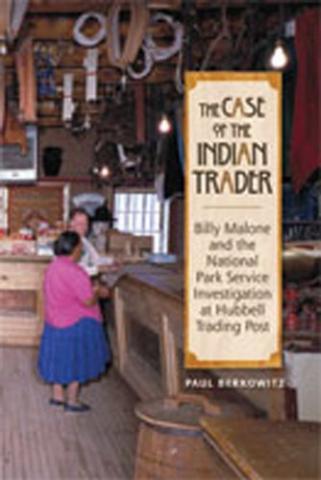
Author : Paul Berkowitz
Published : 2011-05-15
Support National Parks Traveler, and purchase this product at Amazon.com

Editor's note: Earlier this year the Traveler reviewed this book. The following review, which offers a somewhat different perspective, comes from Rick Smith, a long-time Park Service employee who rose up through the ranks to become one of its top managers.
This is a very difficult book for me to review for a couple reasons. The first is the case itself. It involves Billy Malone, the last real Indian Trader employed at Hubbell Trading Post for 24 years.
Malone was among a small group of traders who ran their posts according to the old ways of doing things, probably in much the same manner as did John Lorenzo Hubbell and his family when they were still active. He bought and sold jewelry and rugs without the kind of accounting accuracy that one would expect at a souvenir shop at Grand Canyon or Yellowstone.
He accepted things on consignment and because many of his customers were unable to read or write, especially English, he often forged their signatures on the checks he cashed so that he could give them real money; most did not have bank accounts. Although he worked closely with the NPS at Hubbell, he was an employee of the old Southwest Parks and Monuments Association, later to become the Western National Parks Association. He was also, as were most of the old traders, a serious collector of Indian baskets, rugs, and jewelry.
It is not difficult to imagine what happens when the new management team of WNPA is selected. They begin a series of audits to try to determine what belongs to Billy and what belongs to the Trading Post. Despite his sterling reputation among other traders and the inhabitants of the Navajo Reservation, they become convinced that Billy is guilty of defrauding the Trading Post. They convince the NPS to open a criminal investigation into Billy’s activities. He was also terminated from his job. Everything goes downhill from there.
The criminal investigator assigned to the case makes a series of errors that would make a rookie protection ranger blanch. During the raid on Billy’s house, he seizes far more (rugs, blankets, jewelry) than the search warrant authorizes.
He does not maintain an adequate chain of custody of the seized property, even allowing the Executive Director of WNPA to drive one of the vans that contains a portion of the seized property. When the criminal investigator in Tucson who has control of the property at WACC (Western Archaeological and Conservation Center) is on leave, he authorizes a locksmith to cut the lock on the storage room so that people can see what has been seized. He withholds information that could be exculpatory from the Assistant US Attorney. These and many other errors of omission or commission make this case a nightmare.
What is even harder to accept is that the investigator seems to be operating with the full consent and support of the senior managers of the Intermountain region, so much so, in fact, that when the second investigator assigned to the case, Paul Berkowitz, the author of this book, submits his final report he submits it not to the NPS, but directly to the Office of the Inspector General.
Paul’s exhaustive investigation finally leads to the return of the seized property to Malone and a decision by the US Attorney to drop all criminal charges that had been filed against Malone. In turn, Malone has filed a civil complaint in Federal District Court against many of the NPS personnel involved in the case.
What also makes this book hard to review is Berkowitz’ unflattering analysis of NPS culture, its law enforcement program and its senior management. While he admits that there are lots of good NPS employees, he is relentless in his criticism of what he sees as corruption, cronyism, and lack of respect for law and policy within the ranks of NPS leadership.
To give you an idea of what I mean, here is his take on the Yosemite Mafia, “…"the humorous title proudly invoked by the group belies a darker side exhibited by many of its more powerful and influential members, lending altogether different meaning to the much- touted image of the NPS as a 'family.' Over time several of these powerful figures have variously been implicated in illegal activities ranging from trespassing and molestation, electronic eavesdropping and attempted blackmail, the use of government funds to pay off extortion attempts, the theft of government firearms, to even kidnapping and rape." (To be absolutely fair, I am sure that I would be considered a member of the Yosemite Mafia. Maybe that’s why that statement provoked such a strong reaction in me.)
Paul’s description of NPS culture and leadership does not square up with mine. I went to dozens of superintendent’s meetings, worked in 7 parks, WASO and two Regional Offices. The vast majority of the people with whom I came in contact were honest, hard-working, dedicated employees who wouldn’t think of using their positions to unfairly advance their careers or condone sloppy, incomplete law enforcement work.
Oh sure, we can all think of exceptions to that rule, but Paul seems to make the exceptions the rule. He is right about one thing, though. The NPS is super resistant to change. One only has to think of all the task force reports and committee deliberations that are gathering dust on shelves to confirm his assertion that the NPS culture is highly resistant to change and tends to ignore or punish different points of view. Perhaps that’s one of the reasons that the agency ranks so low in the “best places to work in the Federal Government” surveys, especially in leadership.
I never worked with Paul so I cannot comment on his attitudes toward the NPS and his fellow employees except to say that I have always heard the rumor that he was sour on the NPS, especially its law enforcement profile, and his colleagues.
But, this book is provocative and will make you think about the NPS and how it conducts itself, not only in this investigation, but also in its other activities. I read it in two days; that’s how interesting I found it. There are lessons to be learned here. It will take me a couple days to figure out exactly what they are.
INN Member

The easiest way to explore RV-friendly National Park campgrounds.

Here’s the definitive guide to National Park System campgrounds where RVers can park their rigs.
Our app is packed with RVing- specific details on more than 250 campgrounds in more than 70 national parks.
You’ll also find stories about RVing in the parks, tips helpful if you’ve just recently become an RVer, and useful planning suggestions.

