
Common Southwestern Native Plants, An Identification Guide
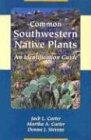
Author : Jack L. Carter
Published : 2003-10
Support National Parks Traveler, and purchase this product at Amazon.com

There are, on those rare occasions, times when I can actually identify a tree or plant rooted along a trail in a national park. But those occasions are exceedingly rare.
Often my identification skills are no better than describing a growth as "spindly stalks with blazing orange flowers on their tips." That, of course to those well-familiar with Southwest vegetation, would be the Ocotillo, one of the more dramatic plants to be found in Saguaro National Park. And let's not even get into the scientific names.
So, often when I'm in the book section of a park's visitor center, I drift over to the plant and bird identification books, with hopes I'll find one that not only will make the identification task easy, but one that I'll pick up more than once. (OK, more often it's my wife who drifts over and calls me over when she finds an interesting book).
One of those books is Common Southwestern Native Plants, An Identification Guide (MSRP $24) by Jack L. Carter, Martha A. Carter and Donna J. Stevens. First published in 2003, this paperback returned in a 2nd edition in 2009, an edition that offers a number of improvements over the first edition. Foremost, for us identification novices, is that each species is described on a single page with an accompanying color photograph. Some species also are accompanied by an illustration. Some photos from the first edition also have been replaced with more descriptive ones, and 20 additional species have been included in the 2nd edition. And information has been provided regarding medicinal or edible aspects of the plants you might see in the Southwest.
So in the case of Ocotillo (Fouquieria splendens/Ocotiilo family (Fouquieriaceae)), not only is there a full color photograph on page 132, but there's also a reasonable amount of description informing readers that this plant "is one of the Southwest's most distinctive and conspicuous shrubs. Although its stems are spiny and it grows in the desert, it is not a cactus. During dry spells, the leafless stems look dead. But shortly after rains, the small, bright green leaves appear along the length of the stem, making it look thick and healthy."
Not only that, but its flowers are popular with migrating hummingbirds, and these plants can live for two centuries, write the authors. There's also a few accompanying illustrations that depict the stalky plant, the flower head, and the spiny leaves. And, of course, attention is paid to Ocotillo's distribution (trans-Pecos, Texas, across southern NM, into southern to northwestern AZ, NV and CA).
If you're accustomed to plant identification books from, say, the National Audubon Society, which organizes wildflowers by color, Common Southwestern Native Plants will take some getting used to. It organizes by type -- cone-bearing plants and flowering plants, which in turn are dissected down into trees, small trees or shrubs, shrubs, vines, cacti, "agave and their allies," and, finally, herbacaeous plants. (For those true novices, "herbacaeous plants" include many of our wildflowers.) And, of course, what might seem to be a wildflower might actually be a blooming shrub, or, in the case of Ocotillo, a shrub, not a tree despite the fact it can grow to 23 feet!
In other words, until you gain a passing knowledge of plant subdivisions, using this book could prove frustrating, as you can't simply flip through the pages looking for the color of the flower.
My wife and I encountered that dilemma first-hand while hiking in Saguaro earlier this year. Among the many beautiful and fascinating blooming plants we encountered was one particularly delicate looking specimen with wispy pink flowers. While thumbing through this book soon after buying it we came upon our plant on page 122 -- the Fairy Duster, Mesquitilla, (calliandra eriophylla/Legume Family (Fabaceae)). "A showy, small shrub of the desert, Fairy Duster bears flower clusters that look like powder puffs. They are pink, the showy stamens white at the base and reddish purple at the tips."
Would it be easier if the book were categorized by color? Perhaps. But the listing that the authors settled on almost forces you to spend more time with the book, flipping through the pages when you're not hiking to become more familiar with it.
If there's a downside to this book, it'd be its size, at 9 inches x 6 inches, which can be a bit awkward for some daypacks. With its glossy pages and gorgeous photographs, will you really want to bend and possibly tear at the pages from frequently pulling it out of your pack and shoving it back down inside?
(Editor's note: For some reason, Amazon.com does not list the 2nd edition among its inventory. You can, though, find it at Jack and Martha Carter's website, www.mimbrespublishing.com)
INN Member

The easiest way to explore RV-friendly National Park campgrounds.

Here’s the definitive guide to National Park System campgrounds where RVers can park their rigs.
Our app is packed with RVing- specific details on more than 250 campgrounds in more than 70 national parks.
You’ll also find stories about RVing in the parks, tips helpful if you’ve just recently become an RVer, and useful planning suggestions.

