
Editor's note: Adam Markham, director of climate impacts for the Union of Concerned Scientists' Climate and Energy Program and a co-author of the report “National Landmarks at Risk," has written the following rebuttal to Dr. Daniel B. Botkin's column on climate change and his thoughts on what is, and isn't, driving it.
My colleagues and I wanted to respond to a recent column by Dr. Daniel Botkin that criticized a report we wrote regarding the threats climate change poses to historic places and landmarks in the United States.
Dr. Botkin challenged the basic science on which we based our report, yet in February 2014, the U.S. National Academy of Sciences and the UK Royal Society released a joint publication in which they stated: “Scientists know that recent climate change is largely caused by human activities from an understanding of basic physics, comparing observations with models, and fingerprinting the basic patterns of climate change caused by different human and natural influences.”
While Dr. Botkin rightly notes that sea level rise has been a problem for a long time, he doesn’t acknowledge that the rate of sea level rise is increasing as the ocean expands and glaciers and ice sheets melt due to global warming. Sea level is projected to continue increasing, threatening nearly all coastal areas. The future rate of change depends on how much heat-trapping emissions we release into the atmosphere.
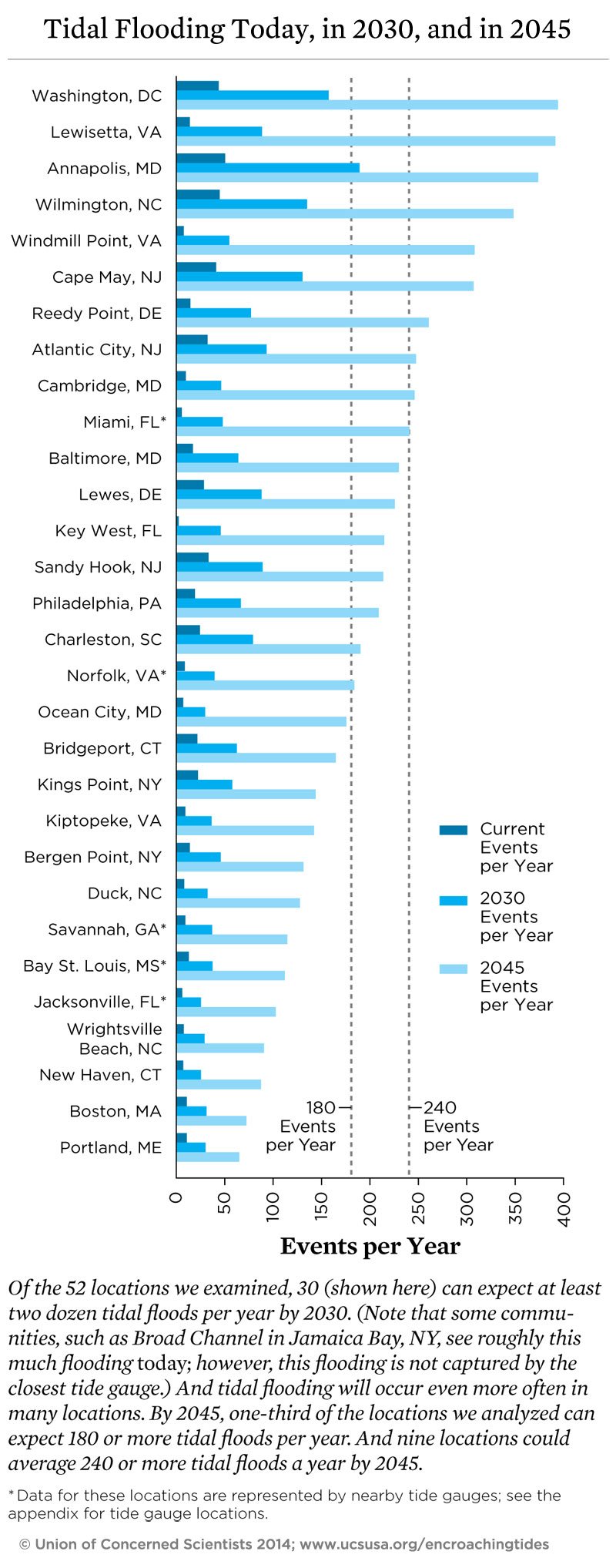
Dr. Botkin also points to hurricane landfall statistics to dismiss our conclusions about flooding at historic sites. But all storms, not just hurricanes, are made more destructive by higher seas. Some of the sites we examined, in fact, are at risk of flooding, or already experiencing it, during regular high tides because sea levels are rising. Downtown Annapolis, for instance, is expected to see 200 tidal floods a year by 2030.
In the report, we also point to the problem of coastal erosion, which can be exacerbated by higher water levels even if storm frequencies remain the same. For instance, in Alaska warming has caused the loss of the seasonal sea ice that used to protect the coast from erosion in winter storms. As a consequence, native villages such as Kivalina and Shishmaref will have to relocate to protect their residents, and archaeological sites that are more than 4,000 years old are being washed away.
Dr. Botkin also cited national fire statistics in his critique. While wildfires occur all over the United States, they are most prevalent in the U.S. West, where they have been increasing as the climate has warmed. While the Western wildfire season lasted about 5 months in the 1970s, it has now expanded to 7 months. Hotter and drier conditions in the U.S. West, along with shorter winters and lowered snowpack, are helping create the conditions that lead to larger fires. The scientific evidence is clear that climatic conditions are the primary factor driving changes in fire activity in the region. In our report, we focused on Western sites that face substantial risks from large and intense wildfires.
Archaeologists at globally important sites including Bandelier National Monument and Mesa Verde National Park have expressed deep concern about the impacts of larger fires and extreme rainfall events on thousands of ancient Pueblo sites.
Let’s also clear up how we wrote our report. The report was drafted by UCS staff, including a scientist who has been studying climate change for years. We carried out extensive literature reviews for each of the sites highlighted, drawing on the latest peer-reviewed publications and technical reports. In the process, we also interviewed many site managers and field scientists familiar with the sites about which we wrote. The final text and case studies were then reviewed by more climate scientists, archaeologists, historians and, indeed, many of the men and women who manage and preserve the historic sites we highlighted as vulnerable to the effects of climate change. (As an aside, Dr. Botkin erroneously described my colleague Kate Cell, a senior outreach coordinator at UCS as a fundraiser. In addition to other excellent work she did on the report, Ms. Cell also helped organize this exhaustive review process.)
The people in charge of these sites are, in many cases, already dealing with climate change. To cite one example, NASA is contemplating a ‘planned retreat’ from sea-level rise and land subsidence at Wallops Island in Virginia, where some of the nation’s early experiments in rocketry took place. Major efforts are also underway to protect the shoreline at the original colonial settlement site at Jamestown, Virginia due to erosion and flooding exacerbated by rising water levels.
Further, the National Park Service runs a climate change response program and has adopted an ambitious climate change action plan. Interior Secretary Sally Jewell who has traveled widely in the national parks since she was appointed has said “everywhere I’ve gone the impact of climate change has been very evident” With regard to historic sites, a recent policy memo from National Park Service Director Jon Jarvis stated “Climate change poses an especially acute problem for managing cultural resources because they are unique and irreplaceable -- once lost they are lost forever”.
The parks themselves are also a rich source of information about our changing climate. As one study by National Park Service climate scientist, Patrick Gonzalez noted, “Field measurements in national parks have detected glacial melt, decreased snowfall and snowpack, earlier spring warmth and streamflow, sea-level rise, increased conifer mortality, and shifts of vegetation biomes, small-mammal ranges, and winter bird ranges. Analyses attribute these impacts to climate change.”
Ultimately, Dr. Botkin’s column was less about our report and more of a criticism of the science used by the Intergovernmental Panel on Climate Change (IPCC), one of the authoritative climate science assessments upon which we relied.
The IPCC is the largest scientific assessment body in the world. Its reports are commissioned by the United Nations and the World Meteorological Organisation, written by scientists, scrutinized through an exhaustive public comment process, and approved by member countries.
We used many other sources in addition to the IPCC, including the National Climate Assessment. Published in May 2014, it is the most comprehensive review of climate science ever carried out for the United States. It concluded that “global climate is changing and this change is apparent across a wide range of observations. The global warming of the past 50 years is primarily due to human activities.”
The National Climate Assessment is produced by an independent advisory committee and finalized by more than a dozen federal science agencies, including the Department of the Interior, which houses the National Park Service. Its reports are authorized by Congress, open to public comment, and are considered the definitive guide to climate change in the United States.
Dr. Botkin is right to assert that climate change is not the only concern at the parks or sites we wrote about in our report. But it is happening and it makes many of the problems parks are already dealing with – including wildfires and flooding – worse than they would be otherwise.
Thankfully, the people in charge of these sites are paying close attention to the science. They are seeking to reduce climate risk and planning for long-term resilience because these sites are part of our heritage. These men and women are stewards, and they want to enable our children and grandchildren to enjoy these sites, even as the climate changes rapidly around us.
Story Categories:
A copy of National Parks Traveler's financial statements may be obtained by sending a stamped, self-addressed envelope to: National Parks Traveler, P.O. Box 980452, Park City, Utah 84098. National Parks Traveler was formed in the state of Utah for the purpose of informing and educating about national parks and protected areas.
Residents of the following states may obtain a copy of our financial and additional information as stated below:
- Florida: A COPY OF THE OFFICIAL REGISTRATION AND FINANCIAL INFORMATION FOR NATIONAL PARKS TRAVELER, (REGISTRATION NO. CH 51659), MAY BE OBTAINED FROM THE DIVISION OF CONSUMER SERVICES BY CALLING 800-435-7352 OR VISITING THEIR WEBSITE. REGISTRATION DOES NOT IMPLY ENDORSEMENT, APPROVAL, OR RECOMMENDATION BY THE STATE.
- Georgia: A full and fair description of the programs and financial statement summary of National Parks Traveler is available upon request at the office and phone number indicated above.
- Maryland: Documents and information submitted under the Maryland Solicitations Act are also available, for the cost of postage and copies, from the Secretary of State, State House, Annapolis, MD 21401 (410-974-5534).
- North Carolina: Financial information about this organization and a copy of its license are available from the State Solicitation Licensing Branch at 888-830-4989 or 919-807-2214. The license is not an endorsement by the State.
- Pennsylvania: The official registration and financial information of National Parks Traveler may be obtained from the Pennsylvania Department of State by calling 800-732-0999. Registration does not imply endorsement.
- Virginia: Financial statements are available from the Virginia Department of Agriculture and Consumer Services, 102 Governor Street, Richmond, Virginia 23219.
- Washington: National Parks Traveler is registered with Washington State’s Charities Program as required by law and additional information is available by calling 800-332-4483 or visiting www.sos.wa.gov/charities, or on file at Charities Division, Office of the Secretary of State, State of Washington, Olympia, WA 98504.

Comments
While believers on both sides seem to agree that things are changing, they don't seem able to agree on the cause. But as long as there is a strong possibility that human activities are a major driving force, shouldn't we be looking for ways to reduce those impacts before it's too late.
The attitudes of some people regarding this issue is the same as saying, "Yes, we can smell smoke but it might be expensive or difficult to do anything about it. Let's wait until we can see some flames so we'll know for sure."
It's not necessary to destroy the building. Instead you get out your infra-red detector and look for hidden hot spots behind walls or ceilings, just as infra-red detectors in satellites are doing with our earth. Or you pull out your gas detector and sniff for carbon monoxide, just as we are doing to sniff out increasing greenhouse gasses within our planet's thin veil of atmosphere.
Wait for the flames to break out on their own and you'll almost certainly destroy the building. There comes a point at which a hidden fire stops smoldering and obtains enough oxygen to suddenly flash over into a full blown four alarm blaze.
By then it's much too late.
If there are some people foolish enough to want to wait for undeniable proof of danger that's okay -- in their house. Trouble is, ALL of us live in the same house. The one we call Earth. I'm not in favor of allowing foolishness to prevail.
Not if it means tearing down the house.
I am inclined to agree Lee, I do not think the debate is not about the climate changing, both Dr. Botkin and Alfred Runte make the point very well. The issue is human caused pollution and how much of that is a factor. In my own less than expert opinion, I think we should try to reduce impacts, it is something we can control. Air quality is not just about affecting climate change, it is about human health, as is all forms of industrial pollution, pesticides use, etc. There are economic issues, as EC points out, but there are also opportunities. This is a very interesting conversation.
Interesting tact Lee. Altering your post without docuementing such after people have responded to your initial comment.
If my fire alarm keeps going off and there is no fire, I fix the alarm, I don't tear down my house.
EC, geez! Not only have the alarms gone off on many fronts, we can smell the smoke. Climate change is accelerating, and the IPCC gives it a 90% certainty that it is indeed human caused.
Owen - if climate change is accelerating why has the temperature been flat for the last 18 years? Why have the models - including those endorsed by the IPCC - been so wrong?
EC, I don't know where you get your information. I suggest taking the IPCC reports seriously.
Owen pointless to have the argument. No matter what you say they will find a single point and harp on it even though they can't explain why ocean temperatures are still rising, Acidification and CO2 content of the oceans is still rising, glaciers globally are melting using their theories, coral reefs globally are dying. This article was disappointing again because it relied on too much anecdotal arguments and not general statements of fact. The arguments are this year type arguments and in North America arguments instead of looking at the longer trends and global numbers. This allows some people to counter any argument with anomalies like what about X year or in y location this is not happening. Then there is always the classic argument of I don't believe their numbers. So never are they required to actually validate their disbelief or prove anything. We might as well resort to it was cold in the trolls yard yesterday so of course there is no global warming. The most pragmatic and boring people in the world think global warming is a risk. No its not scientists or politicians. Actuaries have assessed the risk and dispute several of the non-believers claims. There is a very nice executive summary from the Society of Actuaries on the topic and if you have insomnia, get the detailed report. They at least are putting rates(money) where there mouth is and so will those who live on the coast in time.
If you want to portray the issue of climate change "fairly", you should probably follow this article with about 20 more rebuttals so that your readers get the impression of how far on the fringe Botkin's stance really is. Currently, you're letting them think that there are equal numbers of scientists on both sides of the debate.
This whole affair has really brought NPT down in my view. Very disappointing.
IF mankind is a contributing factor, THEN one has to look at factories, internal combustion engines, and other petrochemical-based activities as prime movers.
This would lead me, a layman, to make a logical leap that most of the impetus to deny mankind being a contributing factor would come from those with financial or philosophical or other vested rights in the petroleum industries.
The science is capably in the hands of the scientists. Laymen like myself can simply follow the money.
rdm24, we would like to think that media for the most part strives to stay neutral while offering differing views for public consumption, debate, and education.
In the end, we believe our coverage of climate change has been quite extensive and encompassing, and would be remiss not to include Dr. Botkin's perspective. You can find more than 100 stories tied to climate change that we've generated under the following link, and we encourage you to peruse them.
/browse/Climate%20Change
Are you denying that temperatures have been flat the last 18 years?
That leaves me out.
Rick as much as I am probably favoring your stance on the issue, there is money on both sides and I would expect people to defend their businesses. There is money behind every study as well so we should assume some possible bias. It puts the onus on us to understand as much as possible and use our own intelligence to determine if the conclusions made are backed up by the measurable facts and then see if those results can be duplicated. You are right in that we need to leave the science in the hands of those capable of doing it.
http://notrickszone.com/2014/10/26/the-unending-pause-ipcc-scientist-prof-mojib-latif-now-sees-global-warming-pause-extending-to-30-years
Leading IPCC scientist Prof Mojib Latif extends the climate warming pause to 2025. Will it ever end? Admits thier models have been 100% wrong.
The Union Of Concerned Scientists is just a Democratic political action committe, I have far more confidence in Botkin's analysis.
He does not acknowledge that the rate of sea level rise is increasing because it's not.
Paul - I also expect businesses to defend themselves. I also expected the grizzly bear that has been terrorizing our town the past few weeks to flip over dumpsters. That doesn't mean that I welcomed it or wanted it to continue. Last night that particular bear was permanently encouraged to cease flipping dumpsters. The petro industry will be a much more difficult change.
My congratulations to Dr. Markham for such a fair and reasoned response. Here remains the problem I have as a historian. In the first place, I remember my history, too. Growing up in Binghamton, New York, in the 1950s, I remember the terrible hurricanes and thunderstorms before anyone talked of global warming and, in 1972, Hurricane Agnes, which ripped apart the Northeast long before “Super Storm Sandy.” Agnes was in fact the most damaging hurricane to date in American history, arriving as she did in the month of June, before the pundits could catch their breath and warn us that June hurricanes are generally rare. The flooding up and down the Susquehanna River Valley was worse than the greatest previous flood in 1936.
I also remember teaching at UC Santa Barbara from a wonderful film, "Where Did the Colorado River Go?," that in 1973. In the early 1990s, Marc Reisner's book, Cadillac Desert, picked up where the film left off, repeating the theme of western water policy run amok. Apparently, all of the government’s stream flow estimates for the Colorado—and other major western rivers—were based on abnormal decades of excess flow. Scientists in the 1920s measured the excess flow and not the historical flow, which was on average 4 million acre feet per year less than what was observable in 1920.
Is it global warming emptying the Colorado River now—and causing all of those western wildfires—or in fact a return to “normal” average stream flows and precipitation going back hundreds of years? As Marc Reisner repeatedly reminded us, it’s a desert, after all. “Water flows uphill toward money” was how he interpreted science’s reliance on erroneous data.
When we say that scientists “know” this or that, the question is what do they really know? What do any of us “know,” for that matter, except the experience we are living now. In the end, that is all Dan Botkin is saying. We need to be cautious in our assumptions, even when we think we “know.” Again, sea levels have been generally “rising” for the past 10,000 years. They had to “rise” or there would be no New York City, Philadelphia, Boston, and all the rest. I live but two blocks from a major erratic dumped by the retreating glaciers in Seattle, which 10,000 years ago was covered with several thousand feet of ice. No global warming, no Seattle, or for that matter, Binghamton, New York.
Running for mayor of Seattle in 2005, I warned the city not to build the waterfront tunnel based on glacial science and seismology. But no, “their” scientists knew better than “my” scientists, and now the $100 million drill—Big Bertha—is hopelessly stuck in the muck. “Their” engineers “promise” to have her up and running by next March, at which time the 7.5 earthquake will probably hit (the tunnel runs directly across the fault) and we won’t have to worry about Big Bertha’s progress anymore.
Scientists are not infallible just because they call themselves scientists. But don’t get comfortable just yet. It is the public’s wish list of make-money projects driving so much of this mess, as I found in running for mayor. What a scold I was! So the Seattle fault ruptures every 1,000 years, and it’s been 1,100 since the last rupture. Get over it, Al. We want the tunnel. After all, it will create jobs, and jobs, and jobs! “Free the Waterfront!” screamed the developers, as if the Waterfront were a slave in chains. “It’s a thing,” I reminded them, “and yes, it has a highway, but should we replace that just on a whim?” The highway is ugly but it won’t cost $6 billion, and now what will the tunnel cost?
I love this debate; it’s timely and necessary. Hats off to Kurt for making it possible for every reader of the Traveler to think. Then think. If the issue is global warming, then why does every alleged solution come with an enormous price tag instead of simply learning to live within our means?
Indeed, God is not dead. His storms will continue to blow and his earth will continue to shake. That’s our lot on Mother Earth—and always has been. Just ask the last group of immigrants struggling to reach North America from Asia, who instead drowned on the Bering Land Bridge. At least, God made it up to Moses. I only hope he will save Seattle.
Al, being neither a historian nor a scientist, and being a few years now from having been a professional wordsmith, I look for simple answers. I'm also a fairly pagan man, and will leave it to others to take it upon themselves to declare what their various deities do or don't do.
I see one thing agreed upon - stuff is happening. Worldwide climate is changing. Seems that most all folks on all sides agree upon that.
Given that, I then ask - are we making it worse, and if so, what can we do to mitigate it.
"Simplistic" is a term of derision I'm used to hearing from the Usual Suspects; I'm quite content, however, in living simply and looking to simple answers to the challenges of life.
Alfred - Thanks for your continued contribution of thoughtful, and thought-provoking, comments.
1998 was an exceptional year. All scientists admit that and know that. However, if you compare 1997 to today, the earth is warmer. If you compare 1999 to today, the earth is warmer. In fact, nine of the top ten warmest years on record have occurred since 2000 (the exception was 1998). If 2014 continues as it has, 2014 will become the hottest year ever.
Climate deniers like to use 1998 as a 'starting' point for their 'science.' It was one exceptional year. However, 2005 and 2010 were warmer than 1998. So no, the temperature has not been "flat the last 18 years." It has been steadily getting hotter.
If you do a least squares regression analysis ( the proper way to measure trends) you will see the trend is flat. Least squares regression equalizes the impact of any given year whether it is the first year, middle year or last year. Looks like you are the denier not those that know how to measure trends.
The IPCC models have been horribly wrong. Time to fix the alarm, not tear down the house.
Ecbuck, wow, you must be the smartest scientist in the world!
Good question. Are "we" making it worse? The simple answer is yes, and for that matter, we have been making things worse for the past 3 million years. Humans are conquerors, first learning to use fire and spears, until their weapons and tools mowed everything down. I remember lecturing about the theory of Pleistocene overkill, this to remind my students that natives were the first conquerors in North America. Columbus didn't upset the balance of nature. It had started 10,000 years before. What he upset was THAT balance of nature--the one he found and everyone dubbed as stable, when indeed it was nothing of the kind. Oh, Dr. Runte, my students would scream in horrified disbelief. But Indians were ecologists. I read it in a book!
What book, I would ask? What is the author's motive? Do you think that Native Americans did not change their world to suit themselves? Well, you think that because you have it easy. Your next meal will be served in the dorm. They had to go out and find it--kill it--clean it--carry it--cook it over an open fire. Indians ecologists? Yes, for themselves, using the best tools available at the time.
American univesities don't teach like that anymore. Nor do presidents. And that's why global warming "exists." It exists in the minds of those people who see advantage in peddling the fear. "Rain will follow the plow! God speed the plow!" Remember that boosterism from the 19th century, arguing why settlers should plow the plains? And they did, only to find that God wasn't about to make it rain only because the boosters said it would rain. Then came the Dust Bowl and it all blew away. Global warming? No, the history of the planet, which no one bothered to read because they were so busy speculating in LAND!
What are they speculating in now? Renewal energy. Big combines, big corporations, have much at stake on the public lands. They need our fear to convince us that we should give up our inheritance for their bottom line. For the record, Dr. Botkin believes in renewal energy--as I do--but not these sprawling, land-gobbling projects that will destroy more than they will possibly save.
There is money in peddling fear, just as there is money in peddling hope. "God speed the plow! Rain will follow the plow!" Many people got rich over that, just as many are getting rich now. The historian remembers that--remembers the great hurricances of a century ago and asks what is REALLY different. What is different? The American coastlines had not been developed. There were fewer people, homes, mini-malls, and all the rest of it that those great hurricances could blow away. There were fewer people around to scream: "Storms will follow the plow!" Now that millions of people have built their homes on sandspits, you bet, Super Storm Sandy knew how to blow them away. Fade in. Governor Cristie and Barack Obama are walking arm in arm down the beach. Elect us and we will save you! We will hold back the seas! It is nonsense, and they know it. They can only hope you won't know.
All that Dr. Botkin is saying is that the science has been abused--made to say more than it really says by people who have an agenda. No historian is surprised at that. Human beings have always had agendas. Saving American rivers from perpetual flooding (and rivers always "flood") the United States built more than 3,000 large dams, and the dam-builders got very rich. Nature didn't lie, did she? Here is my flood plain. This is where I go when the spring rains come. If you build there, I will "flood." Now every spring along America's rivers, developers are screaming flood! Global warming? No, stupidty, and some Americans got very rich.
As I have said, I will believe fervently in global warming when the price tag lowers just a bit--and when Seattle, which wrings its hands about rising seas, abandons the Waterfront Tunnel. Which is it? Will the tunnel flood or won't it? The answer lies not in global warming. Rather, the answer lies in who is getting rich.
Not all humans have the conquest the Earth mentality, Dr Runte. Some of us actually wish to see some aspects of the planet not gobbled up by temporary economic play things only to deplete the landscape for hundreds, if not thousands of years. If we can reverse the acidification of the oceans to stop the bleaching of coral reefs, then maybe we SHOULD think about doing that. Maybe creating areas where commercial fishing is barred should be considered so that we don't entirely deplete the oceans fish stock. If we can halt how much sulfur dioxide is tossed into the atmosphere by installing scrubbers on coal plants, then that should be done to stop the acidification of forests and ecosystems. Science has already proven that this works and can lesson the impact on burning fossil fuels. But, the problem always is the battle between conservation and extractionists. Scientific thought and processes should EVOLVE over time. Perhaps, this country should be putting those solar plants on old industrial sites instead of in BLM and NF lands. That's kicked around a lot by preservationists, but of course, it's just EASIER to gobble up land that just has "disposable" rabbits and turtles.
I personally don't want to be a part of a human race that looks like a mere parasite or virus when we don't have to if we use that brain in our head to better facilitate not only our survival but other species. I also don't have a self-defeating "ohh screw it" mentality, either. And seriously, at least this side of the hemisphere had bison, elk, deer, beavers, and other creatures. The european side of the planet wiped out and completely depleted those species to where it will take many centuries to restore populations of these creatures.. I realize that yes, the ground sloth and other creatures were eliminated on this side of the planet from human expansion, but to use a few examples as a "norm" is not exactly fair. And some of those same forces that depleted the resources (like a nice little virus) look to do the same to this side now that they are here. I'd love to have barred witness to more than just a few acres of the giant old growth forests found in the eastern us during the 1700s before the onslaught of industrialization, but one just has to use their imagination to guess how it must have been, because that is all we have left other than a few fractured acres. Soon, the next generation or maybe a generation after that will just have some videos or pictures of what a coral reef looked like. Something that we could have prevented, if human ingeniuity didn't spend too much time just catering to the underachievers of our plane.t Self-awareness is a beautiful thing, unfortunately many on this planet don't have it, or fail to achieve a heightened level of awareness, thats why I feel it's necessary for those with some level of self-awareness to always shock those that choose to not utilize it..
Dr. Runte's last two sentences say it all -- on both sides of the issue.
"The answer lies not in global warming. Rather, the answer lies in who is getting rich."
Too bad we very rarely seem able to replace money with common sense and honesty.
Well Lee, I must agree, I to find Alfred Runte's post extremely educational and I think both he and Dr. Botiken have a valid position. I think it is true that we have bought into the "neo-liberal" economic theory that the only thing between a nations prosperity and failure is unrestrained capitalism including the privatization of all that is in the public sector. As President Reagan said, the "government is the problem". Not only is this economic policy of the last 40 years proven a disaster for at least 50% of the nations population, but it has consequences world wide. Even more telling is its effects on the environment in which we live. Thank you Mr. Runte for your comments on this issue. I remember well the sayings of the old timers when contentious development proposals or social issues arose, "just follow the money".
Good points, Gary, and yes, I agree with all of them. The original environmental movement, then called preservation, concerned itself with wildlife and open space. And talked openly about population growth--and the resulting pollution--which were doing the planet in.
Then came the political correctness of the 1980s, and suddenly, we couldn't talk about population anymore. Why? Because it was alleged to be growing fastest in poorer countries, and who were we to tell them not to reproduce? After all, we were consuming 25 percent of the earth's resources--just 250 million of us--which became the excuse for letting population slide. We should clean up our act before telling anyone else to clean up their act. There it was: How to turn environmentalists against themselves by recasting the problem as not enough of the "right" technology.
As with global warming, we are not going to reverse ocean acidification--or any of it--just with a technological fix. Here in Seattle, the absurdity is to eliminate a six-lane highway for a four-lane tunnel and, just this morning in The Seattle Times, Sound Transit wants $15 billion more for light rail. I love rail, but come on, folks. Who has that kinda dough? And now the politicians are talking about a sea wall for New York City, as if the middle class can pay and pay and pay.
As for the Mojave Desert, billions more--2 million acres given over to solar collectors, again, as if technology can do it all.
As for environmentalists, The Wall Street Journal reported this morning they are giving $30 million to political candidates, undoubtedly those supporting reductions in green house gases by ripping the Mojave Desert apart. What happened to rooftop solar? Ah, but that doesn't cost a billion dollars, nor leave power distribution in the hands of big corporations who have learned how to scream "global warming!" the loudest of all.
Take corporations out of it and I am on your side. I will retrofit my roof with solar and buy an electric car. But I won't give up my public lands without a fight, and to every environmentalist who thinks that is the solution, I say go back and read your history. You are giving up your inheritance and getting nothing back in return. The land will be gone, and your earth will continue to heat, until all of us learn to live within our means.
Hogwash. Noone is calling for "unrestrained capitalizm" or "privatization of all that is in the public sector". But claiming so does create an easy strawman to attack.
Hi EC, A few days back, you generously apologized for some previous comment. Believe me, no apology is necessary for standing up for your convictions. We all get feisty from time to time. We just need to keep these comments formal, and I applaud how that usually is the case. . .
In any event, this will be my last comment in this thread. I am writing an article on Olympic National Park I hope all of you will enjoy.
The point about government is that it should work for us--and offer real solutions. Some will require government and some will require privatization. In the end, those are merely tools. But yes, I have to agree that the push is on to make government into a candy store. Running for office, every question I got was what will you do for me. It was quite the opposite of JFK's inaugural: "Rather ask what you can do for your country."
What we all can do is be informed. It costs nothing to read and learn. The more we learn, the less we will be intimidated by those who claim to have done the learning for us. And with that, I will get back to Olympic National Park, where thank goodness, a group of citizens did not heed the "experts" that it "needed" to be logged.
Alfred, off subject, and you or traveler can certainly "gong me here", but I was interested in your experience running for office and discovering that questions asked of you revolved around "what can you do for me". Having participated in some citizen groups and lower level political campaigns, I found that was not always the case. It was disconcerting to hear write that. Anyway, way off subject, will be interested in your article on Olympic.
I disagree. That is not the role of (federal) government as invisioned by our founders.
I guess you need to inform the IPCC and UK Met Office
Yet last February (2013) even IPCC’s chairman Rajenda Pachuri has admitted that world temperature data has been flat for the past 17 years. And that was after the British media reported that the UK Met Office was projecting a 20-year standstill in global warming by 2017.
http://www.forbes.com/sites/larrybell/2013/09/10/terrifying-flat-global-...
Ecbuck,
This is a silly article and not something that can be relied upon. The writier is not professional, and noting is referenced adequately.
Actually, I believe we can stop the acidification of our oceans by some changes to coal fired power plants. It is going to require some efforts not just by our government, but all governments around the planet to curb the burning of coal, or require flue-gas desulfurization scrubbers. Unfortunately, some countries in Asia and Africa will need to step up the plate big time and that is easier said than done. But sort of like the ozone layer, which has healed immensely since humans took control of their actions, we can reduce the tide of acidifcation. We also need to stop dumping plastic all over the place, and quit supporting products that have so much single use throw-away plastic. That's not only unsustainable but down right moronic if you look at it from a holistic level.
Just in east tennessee alone, there is a lot of fast food plastic all over the highways because littering is accepted…. and where does it end up? A good portion of it gets flushed away in the water ways, which is completely asinine. No wonder there is such a gigantic layer of floating plastic debris in our oceans. Was it there 100 years ago? No. It's all happened relatively recently, and this is another action that can be curbed, if we had ahem.. AWARENESS.
http://www.realclimate.org/index.php/archives/2011/01/forbes-rich-list-o...
The above article is worth reading by all and particularly EC,Beachdumb, and other climate change deniers. Not that it will change any minds already made up.
Roger,
Both sides can can pick and choose their data points and point to "lucky breaks" to defend themselves The reality is our "recorded time" is so brief that it can't hardly define the norm - if there is one.
Lets get back to basics. If human generated CO2 is the cause of global warming and CO2 emmission have continue to rise substantially, why have temperatures flattened for nearly two decades? Or are you one of those that deny that fact?
If the science is settled, why have the models using that science been so horribly wrong?
Those questions have been asked repeatedly here and no one has had the answer other than to contradict their idol, the IPCC, and claim the flatenning hasn't happened.
Science is based on theory, followed by experimentation/observation to confirm the theory. The observations don't confirm the theory. The science is far from settled
Alfred is right. We need to deal with the changes not pretend (my words) that we can stop them. After all, who is to say that the gains of massive productive farmland to feed the starving isn't worth the loss of a few glaciers? Who is to say that a warmer climate - if is happening - isn't beneficial? At one time this land was covered in ice. At another covered by ocean. Which was norm? Which was natural? Which should be preferred?
The reality is that nature - like water - always wins. What we do as humans will be meaningless in the spectrum of time.
Another point that can be made re global warming. If it is caused by events outside human control it can't be stopped. If it caused by man's activities the chances ot the worlds governments cooperating to control it is beyond their ability given the incompetence of governments in general and the inability of people to concern themselves with things that will happen after they are dead. So we are left with adopting to whatever happens and EC is right. On a geological time scale what we do today is meaningless. Time for all of us to move on to another subject.
Much truth here Roger, but I am not quite ready to give up the ship. What we do on a daily basis can make a difference, Gary mentioned a few. There has to be some counter force to the just "whats in for me" attitude. Its not easy, but we do have National Parks, wildlife areas, National Forests ,etc, it was no easy task to accomplish. We have citizen groups suing polluters, investigating fraud and corruption both in the public and private sectors, the scientific community trying to deal with climate change, etc. no easy tasks. Traveler and its subscribers are at least talking about it. Lets keep giving it the effort, sometimes positive changes do occur. Thank you Traveler for providing this forum.
1950s
2014
The City walls (of peniscola) were built on the rocks above, but near, sea level, and that’s where they are now.http://en.wikipedia.org/wiki/Peniscola
Best available real science says the global sea level rise average is 1.7mm per year and slowing.
Just a question that I've had on my mind. Since all land masses are eroding with their particles displacing their mass in the ocean, how is that displacement figured into sea level rise data? Just asking...
Two things -- first, even if climate change is largely due to natural causes that cannot be controlled by man, human activities undoubtedly exacerbate those things. More careful management of human activities will at least help reduce negative effects.
Second, from a geologic standpoint, the amount of deposition in oceans resulting from erosion of continental landmasses, while significant, is miniscule when compared to the volume of water melting from glacial ice worldwide.
http://www.skepticalscience.com/sea-level-rise.htm
Here is an excellent article that explores a numer of reasons for rising oceans.
www.usc.edu/org/.../Issealevelrising.pdf
Hmmmm. I can't get that link to work, but found that if you go to the USC website and then search for sea level, you will find the article listed along with a number of others. Here is the link to USC:
www.usc.edu/org/
Thanks, Lee.
Myself, I'm not so sure how minuscule deposition is as a factor considering the view of just one drainage, the Colorado River through the Grand Canyon. All that has disappeared finding its resting place in the Sea of Cortez. All other events that either displace their volume or in floating objects , weight. As much as we all want to believe something as absolute and that we have the ability to change outcomes with our intelligence alone, lots of evidence would suggest otherwise.
I hope you were able to find the article referenced above. It points out that there are a very large number of variables involved in rising sea levels. Sedimentation is one, but probably plays a smaller role than we might expect.
Regarding sea level rise I have traveled 1000's of miles in arctic Canada, some of it on coastlines where the land has been rising since the ice sheets melted. In one location I have photos of 900 feet of isostatic rebound as it is called. Every few decades or so a big storm would leave a new beach line and seperate terraces in loose rock. That mass of rebound on a continental scale must have had wide spread effects on sea levels aside from that caused by the melting glaciers.
EC, I have been thinking about your post, and in the geologic time scale I think you are correct, but in our lifetimes, peoples actions make a huge difference in my own view. The debate does rage on about the human contribution to climate change and from what I generally read and see, there is much to support the claims of those asking all of us to think about it. That issue aside, the effects of air pollution, pesticide pollution, industrial pollution including gases generated by drilling, fracking, the manufacturing and disposal of the waste, and the list goes on, are serious issues that affect the lives of millions people. The actions we take may or may not decide the climate warming debate, but they certainly will enhance the quality of life of a vast number of human beings including the offspring of many of us.
Rmackie,
I don't (and never have) denied that we humans can have an impact. Though Lee insists there are people that believe that, he can't seem to produce a name. There certainly are forms of "pollution" which should be minimized. But for many (not all) of the ones you mentioned, we have already reduced dramatically and the incremental reductions that can be made are insignificant relative to the costs. In some cases we can make improvements with our actions - but talking the Chinese into it may be more difficult.
I don't believe that the actions we take relative to climate warming will "enhance the quality of life". In fact I believe that not only will they be ineffective but will in fact hurt our quality of life.
EC, I guess it all depends on how you define "quality of life".
I for one would like to see collective positive efforts made to reduce our society's overall ecological footprint. Climate Change has indeed been accelerated by human activities, mostly related to the consumption of fossile fuels.
As a non-scientist, you seem to doubt this, but a reasonable review of the perponderance of evidence, including the conclusions presented by a solid majority of scientific articles on this important topic, will demonstrate that you are on the wrong side of a debate that is actually moribund and no longer active within the scientific community.
Unfortunately repetitive mis-interpretation and mis-representation of vast amounts of climate change data and outright rejection of credible climate model projections somehow gets published and repeated over and over again in the non-scientific news media, which as Climate Change denier propaganda, gives the misleading impression to an otherwise uninformed reader that the link between human activities and accelerated climate change is still very much in question.
More on this to come in the near future......
Thank you Owen, I think your comment is right on. I understand ECs point, yes addressing issues of fossil fuel dependence is going to require looking at alternative energy technologies and will result in some economic dislocations in the fossil fuel industry. There will also infrastructure costs to all of us. Of course the fossil fuel industry could jump on the bandwagon. One of the greatest rewards of this emergency hire only appointment I have working fires in Yosemite National Park and the surrounding forests, is the people I meet from all over the US and the world for that matter. Meeting these people and trying to answer the fire related questions, I often times, if not most of the time, learn more from the visitors than any information I may give out. Met a great young couple from Germany one day, she a school teacher, he an industrial engineer. He was telling me that Germany has achieved production of solar energy accounting now for 30% of its energy use, mostly rooftop. I believe Germany now leads leads the world in this regard, others may have better information. It was interesting to see a young couple from another nation embrace the concept of working towards alternative energy sources and related climate change issues. They represented many of comments I heard on a daily basis.
We live in very interesting times. From the Alaska Dispatch website. "Dan White, director of the Institute of Northern Engineering at UAF, warned there is enough gas bubbling up under the ice of some Arctic lakes in winter that one must be careful not to hurt oneself when lighting the gas.The Arctic methane, Wadhams said, "could cause a large amount of warming in a short time."Igor Semiletov, a professor at the International Arctic Research Center at UAF, estimates there might be 500 times as much methane trapped beneath the Arctic as there is currently in the atmosphere.If a lot of it got loose fast, the planet could really heat up."
Pages