
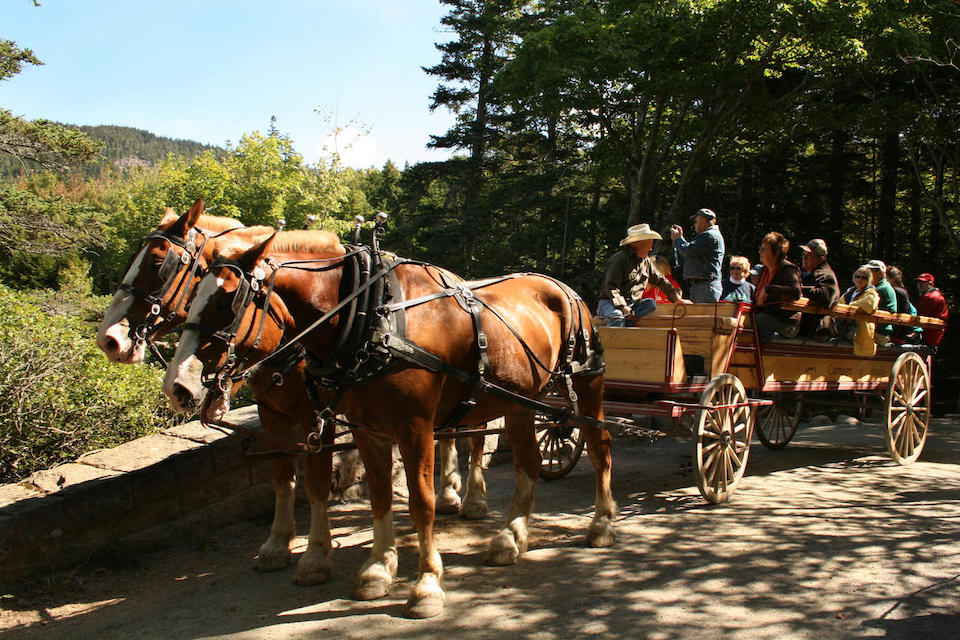
A crush of bikes -- both muscle-powered and eBikes -- has created conflicts with horse-drawn carriages in Acadia National Park/NPS file
When John D. Rockefeller Jr. went to work a century ago constructing a network of carriage roads at Acadia National Park, he envisioned bucolic paths where riders and horse-drawn carriages could travel blissfully, away from motorized vehicles. The National Park Service embraced these roads, and for years banned "motor vehicles" from "any road specially designated or constructed for horse-drawn vehicular traffic, except duly authorized work cars."
Today, however, riders on questionably legal, and definitely illegal, motorized bikes on those roads are spooking and even harassing horses that pull visitors serenely through the park.
Horse-drawn carriages in years past have had some conflicts with muscle-powered bikes that legally use the carriage roads, but the arrival of eBikes late last summer has led to more contentious issues this year. Some eBike riders at times rapidly come up and pass horse-drawn carriages, and then veer sharply in front of the horses. Others slap the horses on their flanks or run their hands along the steeds, said Emily Carpenter, manager of Carriages of Acadia, which offers carriage rides from May to October and also offers boarding for equestrians who want to explore the 45 miles of carriage paths on their own mounts.
"There’s just so much more congestion on the carriage roads with horses, bikes, and now eBikes," she said last week. "The issues we are having aren’t with the ones that are legal, but we’re seeing a lot of illegal eBikes, and there’s no place that they’re checking them. So you’ve got the ones that are out there that have actual throttles on them, and they’re flying by us going uphill.”
Though motorized vehicles, including eBikes, long have been prohibited from navigating the carriage paths, in August 2019 Interior Secretary David Bernhardt ordered the National Park Service to open access for the motorized bikes to any routes that traditional bikes could take. In issuing the order, which is being challenged on the grounds that it was improperly issued, Bernhardt said the decision "simplifies and unifies regulation of electric bicycles (eBikes) on Federal lands managed by the Department and also decreases regulatory burden."
In reality, though, at least at Acadia, the rule change has led to a rush of eBike users to the carriage roads and created a burden for a park that doesn't have enough rangers to be everywhere. And while the rules specify that only Class 1 eBikes, those that are pedal-assist only, with no throttle, and have a maximum assisted speed of 20 mph, can take to the carriage roads, Carpenter and others say they've seen Class 2 throttle-assisted eBikes.
“We’ve had issues with some bicycles for years, whether they were eBikes or (traditional)," she said last week. "It isn’t necessary everybody on bikes or eBikes, just the people who are not following the rules. But, we’ve just seen a marked difference since we’ve now added a motor to some of the people that already were being jerks on regular bikes."
Shortly after Bernhardt issued his order a year ago, Lauren Cosgrove, Northeast program manager for the National Parks Conservation Association, voiced a prophetic warning of potential problems that could result from eBikes on the carriage roads.
“Without properly evaluating impacts, and without adequate time for the public process to help inform this decision, the park is opening itself to unnecessary visitor conflicts," she said at the time. "Consistently named as one of the most visited national parks in the country, people travel from all over the world to experience Acadia National Park and especially at this time of year. Now a place where visitors go to walk, hike and ride to find solitude and to escape the sights and sounds of the modern world will be mixed with bikes that could buzz by, traveling up to 20 miles per hour.
“Monitoring and enforcing eBike use will be extremely challenging given Acadia’s already high visitation and limited resources. This administration continues to put pressure on park managers to submit to policies that are at odds with proven management that protect park resources and the visitor experience. More research is needed to determine where and how eBikes can be used safely and what costs these vehicles could have on the park and the more than 3.5 million people that visit Acadia each year.”
The eBikes and other motorized vehicles -- Carpenter has seen Segways (which are allowed if they're for ADA use) and electric Razor scooters -- can make it difficult for the carriage drivers, in part because they're so silent the drivers don't always hear them until they're alongside the carriages. Getting horses used to the different bikes and scooters is a challenge, too, said Carpenter.
"It’s all different movements, it all can tend to be a little alarming," she explained. "There’s no way for us to get them used to everything because we don’t know what we’re going to meet out there."
An even greater problem is with some of the riders, on both traditional bikes and eBikes.
"My horses have been smacked by bicyclists, they’ve been run into by bicyclists on purpose," said Carpenter. “Our horses are amazing. They should kick them. Most horses would kick out or bolt and cause a runaway with passengers in (the carriage). That’s my fear. Riding horses, they're going to spook, kick, trip, bolt. I’ve had kids fall off on their bikes right next to the horses. Obviously, there’s only so much we can do. We’ve had a couple horses kick out but not land a kick on somebody when they’ve actually smacked them."
At Acadia, public affairs specialist Christie Anastasia said there even was a motorcyclist on the carriage roads recently.
"They (Carriages of Acadia) have been having a disproportionate increase in negative interactions with eBikes specifically," said Anastasia. "The interactions have ranged from (cyclists) coming up too quickly from behind and startling the horses, passing too quickly, and then cutting in front of the horses without giving them enough room up to smacking the horse on the butt as they go by.”
Carpenter fears the situation is only going to get worse as the coronavirus pandemic eases and more people travel to Acadia.
"I don’t know what the right answer is. My fear next year is when there’s no pandemic going on and we’re even busier that there’s just going to be so much congestion on the carriage roads with everything, plus now motors. It’s not going to be enjoyable for many people. I don’t want to drive my horses in it. It’s just going to be a matter of time before there’s a bad accident,” she said. "A couple of my guides came back the other day, there’s a short stretch between (the stables) and Jordan Pond, it’s like a 1.3-mile stretch, and one of the girls said that she easily saw 100 bikes on it."
Exactly how much bike traffic has increased this year due to the addition of eBikes is unknown, said Anastasia. For the park to try to police all the traffic on the carriage roads is an impossible challenge at this point. Not only are there 45 miles of the roads, but there are three-dozen different points of entry and exit, she explained. While the park has in the past been aided by a program that sends volunteers out onto the carriages roads to monitor the traffic, it was suspended this year in large part due to Covid-19.
The park's law enforcement rangers, meanwhile, usually are out working in congested areas along the park road, said Anastasia, adding that, "I’m sure they could write lots of tickets, but they would have to be there to do that."
In the wake of Bernhardt's directive to the Park Service, the question of where it would be appropriate for eBikes to travel was raised, something Carpenter pointed out last week.
"The whole point of building the carriage roads was that there would be a safe place to ride and drive your horses and walk," she said. "So it’s a little frustrating that now we’re seeing so much congestion, and potential accidents and stuff that we can’t necessarily control.”
National Parks Traveler is a 501(c)(3) nonprofit media organization that depends greatly on the support of its readers and listeners. Please donate today to help us expand our coverage of national parks and protected areas.
Stories about:
Story Categories:
A copy of National Parks Traveler's financial statements may be obtained by sending a stamped, self-addressed envelope to: National Parks Traveler, P.O. Box 980452, Park City, Utah 84098. National Parks Traveler was formed in the state of Utah for the purpose of informing and educating about national parks and protected areas.
Residents of the following states may obtain a copy of our financial and additional information as stated below:
- Florida: A COPY OF THE OFFICIAL REGISTRATION AND FINANCIAL INFORMATION FOR NATIONAL PARKS TRAVELER, (REGISTRATION NO. CH 51659), MAY BE OBTAINED FROM THE DIVISION OF CONSUMER SERVICES BY CALLING 800-435-7352 OR VISITING THEIR WEBSITE. REGISTRATION DOES NOT IMPLY ENDORSEMENT, APPROVAL, OR RECOMMENDATION BY THE STATE.
- Georgia: A full and fair description of the programs and financial statement summary of National Parks Traveler is available upon request at the office and phone number indicated above.
- Maryland: Documents and information submitted under the Maryland Solicitations Act are also available, for the cost of postage and copies, from the Secretary of State, State House, Annapolis, MD 21401 (410-974-5534).
- North Carolina: Financial information about this organization and a copy of its license are available from the State Solicitation Licensing Branch at 888-830-4989 or 919-807-2214. The license is not an endorsement by the State.
- Pennsylvania: The official registration and financial information of National Parks Traveler may be obtained from the Pennsylvania Department of State by calling 800-732-0999. Registration does not imply endorsement.
- Virginia: Financial statements are available from the Virginia Department of Agriculture and Consumer Services, 102 Governor Street, Richmond, Virginia 23219.
- Washington: National Parks Traveler is registered with Washington State’s Charities Program as required by law and additional information is available by calling 800-332-4483 or visiting www.sos.wa.gov/charities, or on file at Charities Division, Office of the Secretary of State, State of Washington, Olympia, WA 98504.


Comments
A classic of this administratin. Jam it in - screw what the NPS says as they don't have a Director and they are all "Deep State" - and the bully that is the Secretary gets his way.
Elections have consequences.
Besides, this is all Fake News, right?
I don't understand all the hatred towards ebikes. Is it the ebike itself, bikes in general or the additional crowding that they bring? I also find it hard to believe that ebike riders, which I assume tend to be older, engage in more boorish behavior than that of regular bicyclists (not that older people are immune from that).
Simple solution ban motorized vehicles, motorcycles and e bikes.
Great solution, lets just ban horses while we are at it, they are dangerous to park goers... I am not positive but there could be other solutions. I would love to have the trail to myself but thats a little selfish.
Ok.... I will be real honest I could totally understand that certain people are jerks, and at times there could absolutely be a need to have certain trails that are designated for horse only or hikers only etc... the problem is that most of the people on these sites see no reason that an ebike should ever be allowed on a trail. They have never ridden a class one ebike and have no idea what they are talking about. Ebikes on roads with heavy, fast moving traffic are more dangerous than on trails. I dont know why I waste my time, you cant change these peoples minds but alas, here I am.... :(
Did you read the article? E-bikes give jerks an even easier way to be jerks, only solution from here is to ban all bikes. Horses and foot traffic only.
I think we need to be addressing the bad behavior of people around horses, rather than pointing the finger at ebikes. There should be clear rules and signs to tell people how to act around the horses. Class 1 ebikes give a lot of people the opportunity to enjoy the carriage roads, who otherwise could not. Congestion on the carriage roads sounds like it has become a problem too, so maybe we need to do something there to limit the number of people on the road at a time.
Exactly but that would be common sense... ;) I hate jet skis on the lake and quads on the trail or fire roads, most of the time they are just stirring things up or tearing things up, but I dont own the lake or the fire road so its up to us to establish rules that make everyone be able to enjoy the outdoors in their own way. There is a reason the lakes shut down when the reach maximum capacity.... we dont just outlaw every thing so the swimmers can have the lake to themselves.....
"riders on questionably legal, and definitely illegal, motorized bikes on those roads are spooking and even harassing horses that pull visitors serenely through the park" I love how this site always pretends to be completley open to ebikes.....
Even regular bikes, heck even foot traffic can spook horses when people have no wareness of their surrondings, and lets be honest if you driven anyware in the last ten years you will realize people have no awareness of their surroundings. This is a people problem....
Whoa, that topic suddenly got very creepy.
Shocker, an anit bike article on NPT. Whodathought?
I wouldn't call it anti-bike, Zeb (great to see you're still reading!). Rather, it's questioning visitor behavior, whether they're on a bike, an ebike, on foot, or horseback. Are you suggesting that the reported behavior of those on eBikes should be applauded?
Kurt, no one is suggesting that anyone be appluaded for bad behavior. The article clearly says that many people even non ebikers are bahaving poorly around the horses. These people should be banned from the park regardless of their transportation. I realize you try to be unbiased about ebikes and even bikes but there are lots of contradictions that make it difficult to not see at least a little bias. You constantly talk about people want to escape the noise of the city "only to have ebikes buzz by" then follow it up with a quote about how ebikes are too "silent" for horses. The article clearly has quotes that this is not just about ebikes but regular bikes and even hikers yet its aimed only at ebikers.
I respect your opinion but I disagree with the approach and end result of your direction. Its pretty obvious that most anti-ebike people want them banned because of the "motor". There are a lot more prudent and acceptable ways to monitor things then banning. Bicyclists can be elitist and annoying as much as anyone but they arent lazy. Just look at the mountain bike community. They manage and maintain, through volunteers, thousands of trails throughout the US. Why not suggest things like volunteer ebike groups to monitor the trails? Who do you think could spot illegal ebikes and monitor its usage better?
Its not that I dont respect your opinion on whether Bernhardt's directive was legal, you have some valid points, its just that I know the motive behind most peoples opinion is to ban ebikes. There are many options that could be explored, but thats not what hikers or horse riders want. If there was more reasonableness in the conversation, I think these things could be explored. Unfortunately and consistently, we have seen arguments that if it has a "motor" its needs to be banned. You are free to disagree with me but, I thnk even you can see that many, many people share similar thoughts to me, and you see that in the comments. Also, these people are much more educated about ebikes than those against them. IMHO
At various times I've enjoyed riding horses and trail bikes (not usually at the same time...!). Now, eBikes are for a younger, more agile generation but I suspect they make about as much noise as a regular bike, depending what kind of surface, whether the rider sings, etc. Most horses can, with training, learn not to fear bikes, especially the calmer, more sensible ones with some draft horse blood, like those in the photo appear to be. Unfortunately, a lot of people don't know to be careful around horses. If they ride too close, or reach out and smack one on the butt, or make a sudden loud, startling noise, well, they are animals, and big, powerful ones. No horseman would claim to be able to overpower one by sheer strength! And that doesn't even address the problem of plain ol' stupid!
All of which is to say that not all roads and trails are suitable for all uses, any more than all national parks are suited for all activities. Hikers may not like reckless riders or horse poop, horses may not like bikes or hikers with tall backpacks, and bikers gripe about pokey hikers clogging up the trail. So it would seem the most logical thing is to apportion the carriage roads and trails, one for this, another for that, a third maybe for all three. And in smaller locales where that isn't do-able, stick with the simple: open only to hikers and with at least part of the route handicap-accessible.