
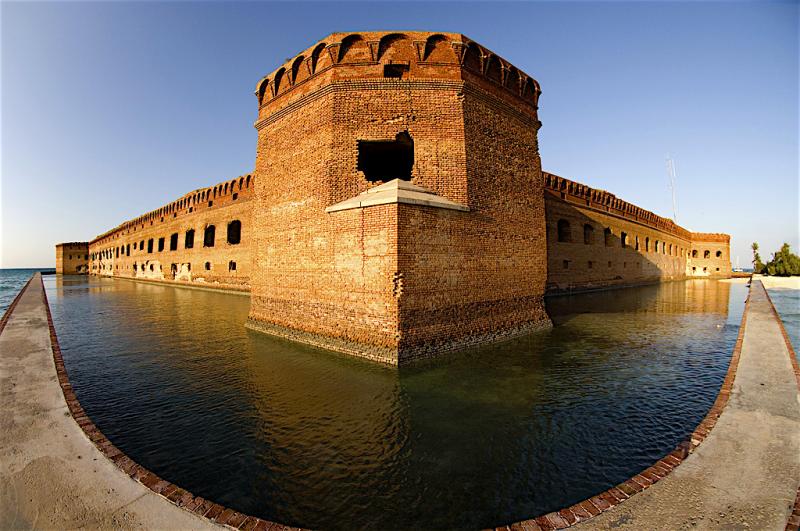
Dry Tortugas National Park is just one of 419 units of the National Park System that have deferred maintenance in some amount/NPS file
Editor's note: This story has been corrected to reflect that the annual dispersal of the $6.5 billion over five years is expected to be $1.3 billion, not $1.5 billion.
Passage by the House of Representatives of the Great American Outdoors Act this week would queue up $6.5 billion for the National Park Service to use in tackling backlogged maintenance work, but it won't solve the problem, according to an outside economist.
"This is a Band-Aid. It's fine, it's good to get some money, an infusion of cash, to solve some of these problems, that's great," Margaret Walls, a senior fellow at Resources For the Future, said Monday during a phone call. "But it doesn't really address the long-term problem, which, as you said, the deficit grows every year and they continue to add to this list of projects that need to be done.
"Unless you have a better ongoing funding situation for the parks, you're still going to run into this problem over time."
While the Park Service stands to get an additional $6.5 billion to spend over five years from the GAOA to address the maintenance issue, the backlog has been growing at hundreds of millions of dollars per year in recent years ($313 million during Fiscal 2018), annual sums that will whittle away at the $1.3 billion expected to be made available annually through this funding.
Indeed, nearly $700 million was spent during Fiscal 2018 on maintenance projects, yet the backlog is still about $12 billion.
"I think it would make a dent probably in some of the more serious problems that have been on the to-do list," Walls said of the $6.5 billion.
"Some parks have a really high number, and some do not," she said. "And some of the ones that have a high number are things like the George Washington Parkway and the Blue Ridge Parkway and the National Mall in D.C. Things like that. I don't know how they're (the NPS) going to allocate the money they get."
A Money Pit
There are many unanswered questions, at least publicly, tied to how the National Park Service might spend $6.5 billion for backlogged maintenance if the Great American Outdoors Act is passed by Congress and signed into law by the president.
How will the money be distributed across the 419 units of the National Park System? Yosemite National Park alone had roughly $645 million in backlogged maintenance at the end of FY18, Yellowstone's tally was $585.5 million, and the National Mall and Memorial Parks had nearly $655 million. Those three units alone could use the first $1.3 billion installment.
Then, too, the Andrew Johnson National Historic Site in Tennessee had $1.7 million in FY18 deferred maintenance, of which more than $461,000 was tied to facilities at the park. Horseshoe Bend National Military Park in Alabama was looking at more than $4.5 million in deferred maintenance, the bulk -- $3.4 million -- tied to road needs. Pinnacles National Park in California reported $10.6 million, of which nearly $6 million was linked to road needs and roughly $1.6 million associated with water systems.
Then there are 413 other units in the National Park System that have needs of greatly varying dollar amounts.
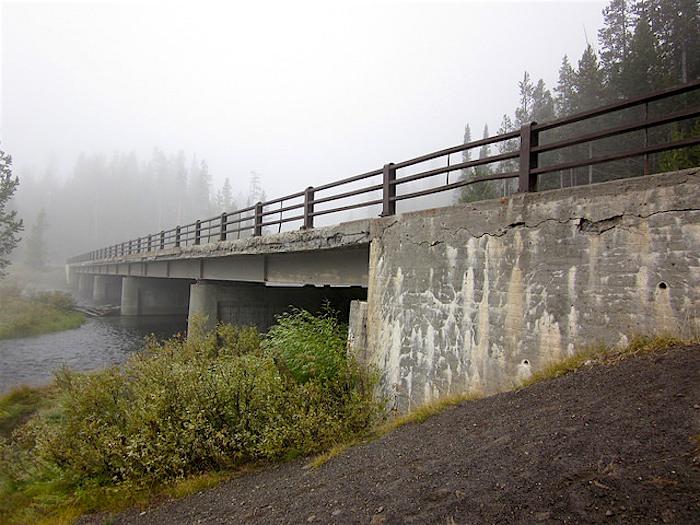
Road and bridge needs account for roughly half of the deferred maintenance across the National Park System/NPS file
Realizing that, it must be accepted that while the $6.5 billion will be a step forward for the Park Service, it shouldn't be viewed as a panacea for the financially strapped agency that oversees parks from the Pacific Ocean at National Park of American Samoa to Virgin Islands National Park in the Caribbean, and from Noatak National Preserve in northern Alaska to Big Bend National Park on the U.S.-Mexico border.
“The Great Americans Outdoors Act will be a huge success for repairing our national parks and other public lands. But it is not a be-all, end-all solution to the challenge of parks keeping up with needed repairs," said John Garder, senior director of budget and appropriations for the National Parks Conservation Association.
"They have the largest share of assets in the federal government, outside the Department of Defense, and repairing that infrastructure takes funding, and more will need to be done outside of this bill in the long run," Garder added during a phone call.
As roughly half of the $12 billion backlog the Park Service faces is tied to roads and bridges, Congress has been trying to provide additional dollars for the parks through transportation bills. However, with significant differences currently between the House and the Senate when it comes to infrastructure legislation, how soon that influx arrives is unknown.
"The Senate passed through committee their transportation bill (America’s Transportation Infrastructure Act) with unanimous support last July," said Emily Douce, director of budget and approriations for NPCA. "The hope is that they’ll pair it with some of the wastewater and drinking water infrastructure legislation as a start of an infrastructure package. However, the holdup is how to pay for it.
"The Senate bill, if enacted, would provide $1.73 billion (under the current FAST, the parks receive $1.42 billion) for national parks over five years through the National Parks Transportation Program," she added. "The parks are eligible for other competitive programs as well, such as the Nationally Significant Federal Lands and Tribal Projects Program.
"The House just passed the Moving Forward Act (infrastructure package) which includes the Invest in America Act providing additional funding for parks," said Douce. "The House bill, if enacted, would provide $1.999 billion over five years for national parks in the Federal Lands Transportation Program with the eligibility to receive more in other programs like the Senate bill."
At the Pew Charitable Trusts' Restore America's Parks program, Marcia Argust was optimistic the Park Service would be able to make, and sustain, progress in keeping its sprawling park system repaired.
"Enactment of the GAO Act will be a tremendous step in tackling critical repairs within our national parks. The $12 billion backlog won’t disappear overnight, but with continued annual funding for preventive maintenance, policy improvements in the pending surface transportation reauthorization act, and new technologies, the National Park Service will be well-situated to keep pace with repairs," she said Monday via email.
No Overnight Fix
When it comes to making repairs to historic structures, costs and delays can escalate. At Death Valley National Park, repairs and restoration work at Scotty's Castle related to an October 2015 thunderstorm underscores the problems associated with large projects involving historic structures.
In that instance, there hasn't been one single general contractor for all repairs at the historic facility. Designs are done by architecture and engineering firms. Other companies handle construction. Each project has been progressing on its own schedule, depending on design complexity, potential impacts to natural or cultural resources, and unplanned issues.
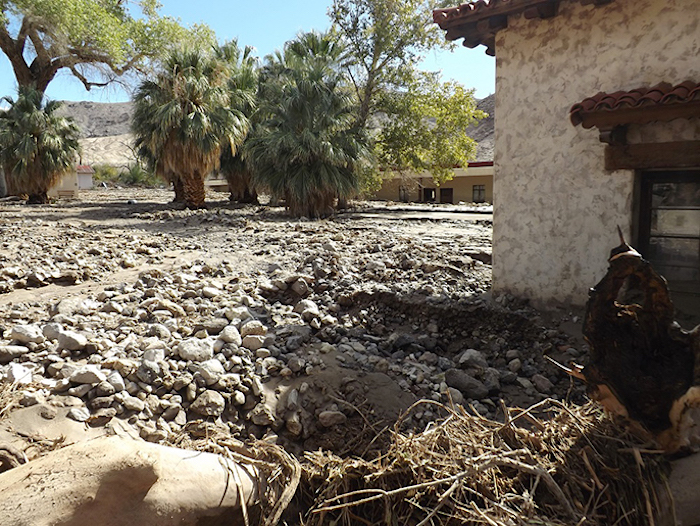
Cleaning up and repairing storm damage inflicted on Scotty's Castle in Death Valley National Park in October 2015 has not been quick or easy/NPS file
Each project’s "next step" is for specialists to review the design documents for impacts to the historic district in Grapevine Canyon.
“People ask why it’s taking so long,” Abby Wines, the park's management assistant, told the Traveler last fall. “I don’t think they understand how much damage happened in the flood. We had many decisions to make about how to do the repairs. Scotty’s Castle is such a special historic place. It’s better to do this right than to do this fast.”
Slowing the work can be the need to prepare environmental assessments, which are open to public review, and consulting with state historic preservation offices, ensuring the work complies with the National Environmental Policy Act, and complying with Section 106 of the Historic Preservation Act.
Currently, Scotty's Castle is expected to reopen to the public in fall 2021.
Then, too, is the question of which projects are "shovel ready," projects that can be started tomorrow?
"When I've talked with state park systems, which also have their own backlogs, deferred maintenance backlogs, I have been told that it's hard to spend money quickly and do big construction projects, or not just even big construction projects but just to get work done in a timely manner," said Walls. "So, it might be great to get this infusion of money, but I don't know if they're going to be able to tackle all these problems lickety-split."
NPCA's Garder agreed that the timeline to put the full $6.5 billion to work on the ground in the park system could be longer than five years.
“The bill allows for funds to be kept in an interest-bearing account while the Park Service is engaged in the complex planning that’s needed for some of these larger projects," he said. "So, according to the Congressional Budget Office, the larger projects would take longer to plan, the funds that would be seeded into the account would bear interest so that the amount of backlog that would be addressed would be over $7 billion.
"Additionally, there’s a provision in there that allows for matching funds, so if there were philanthropic interest in helping with some of those projects, between the two we could see a more significant amount than this $6.5 billion.”
Is GAOA A Jobs Bill?
There also is hope in some circles that the legislation will prove to be a jobs creator at a time when Covid-19 has been a sea anchor of sorts on the economy. That remains to be seen.
"Maybe the time we're in it won't be too hard as normal to get workers and get them going on these projects," Walls said. "I don't know if that's going to be the case or not. Covid could actually make it worse. I think there's a hope that this is going to be a boost to employment."
U.S. Bureau of Labor statistics numbers obtained by Resources For the Future show that "an estimated 7.7 million jobs were lost in 'leisure and hospitality' industries due to Covid, many of those jobs in the tourism sector.
RFF looked at five Western national park gateway communities -- West Yellowstone, Montana, outside the west entrance to Yellowstone National Park; Springdale, Utah, near Zion National Park; Estes Park, Colorado, near Rocky Mountain National Park; Moab, Utah, just outside Arches National Park; and Cortez, Colorado, close to Mesa Verde National Park -- and found most were heavily dependent on park tourism business.
"The numbers confirm our assumptions about the intrinsic vulnerability of gateway communities to the current recession. All of the towns have a greater share of jobs in tourism than the region as a whole," said an RFF blog from earlier this year. "The percent varies across the communities, however. The smaller towns—Springdale (the smallest) and West Yellowstone—are more dependent on tourism than the others. In West Yellowstone, 37 percent of all jobs are in tourism-related businesses. Cortez is the largest and most diversified of the five towns, though it still has roughly twice as many jobs in tourism-related industries (as a share of total jobs) than the Mountain West region as a whole."
Accepting that, the possibility of an infusion of money to tackle park maintenance could help local economics, RFF's researchers believe.
"The Great American Outdoors Act could help communities recover from the economic fallout generated by the pandemic. To be clear, the main purpose of the bill is to provide much-needed financial support for our chronically underfunded parks and public lands," they wrote earlier this year. "In our view, the bill stands on its merits for this alone. But at this time of great need, it might also provide an economic boost in the rural communities that need it most."
Story Categories:
A copy of National Parks Traveler's financial statements may be obtained by sending a stamped, self-addressed envelope to: National Parks Traveler, P.O. Box 980452, Park City, Utah 84098. National Parks Traveler was formed in the state of Utah for the purpose of informing and educating about national parks and protected areas.
Residents of the following states may obtain a copy of our financial and additional information as stated below:
- Florida: A COPY OF THE OFFICIAL REGISTRATION AND FINANCIAL INFORMATION FOR NATIONAL PARKS TRAVELER, (REGISTRATION NO. CH 51659), MAY BE OBTAINED FROM THE DIVISION OF CONSUMER SERVICES BY CALLING 800-435-7352 OR VISITING THEIR WEBSITE. REGISTRATION DOES NOT IMPLY ENDORSEMENT, APPROVAL, OR RECOMMENDATION BY THE STATE.
- Georgia: A full and fair description of the programs and financial statement summary of National Parks Traveler is available upon request at the office and phone number indicated above.
- Maryland: Documents and information submitted under the Maryland Solicitations Act are also available, for the cost of postage and copies, from the Secretary of State, State House, Annapolis, MD 21401 (410-974-5534).
- North Carolina: Financial information about this organization and a copy of its license are available from the State Solicitation Licensing Branch at 888-830-4989 or 919-807-2214. The license is not an endorsement by the State.
- Pennsylvania: The official registration and financial information of National Parks Traveler may be obtained from the Pennsylvania Department of State by calling 800-732-0999. Registration does not imply endorsement.
- Virginia: Financial statements are available from the Virginia Department of Agriculture and Consumer Services, 102 Governor Street, Richmond, Virginia 23219.
- Washington: National Parks Traveler is registered with Washington State’s Charities Program as required by law and additional information is available by calling 800-332-4483 or visiting www.sos.wa.gov/charities, or on file at Charities Division, Office of the Secretary of State, State of Washington, Olympia, WA 98504.


Comments
GAOA just passed "House" 301-107. President Trump will sign as well. A great win here for all Americans. Not a cure for NPS Maintenance backlogs but a great way forward. Well get there, well get there. Thanks Kurt for report.
Well, $6.5B towards a $12B backlog sure sounds like a good first step to me.
I don't visit this site regularly anymore but it was the first community I thought of when I just read the news. I'm a bit surprised and definitely disappointed to see that the only article about it is so negative and written from the perspective of "not enough".
Of course I agree that they need to increase the budget so the deferrals can stop...but can't we all celebrate together for a second?
Hope to see a follow up article in the coming days!
Matt, maybe you missed this story:
https://www.nationalparkstraveler.org/2020/07/passage-great-american-out...
The point of the "panacea" story is that $6.5 billion is nice, but it's clearly not enough. Settle for less and, well, you settle for less. Let's not make this a one-and-done package. There is a lot of work to do across the park system, and the bills keep rolling in (did you see our mention of the overpass problem discovered at Yellowstone yesterday or the latest pump failure with the Transcanyon Pipeline at Grand Canyon, also from yesterday?).
Without continued pressure on Congress, what are the odds that it'll increase funding for maintenance in the OPNS budget? Will the appropriators figure this $6.5 billion is enough for the next decade?
Let's check back in 6-12 months and see where things stand.
Kurt, your exactly right. 6.5 Billion is not the 20 billion we need for deferred NPS Maintenance. I serve in the United States Army and we have our budget issues here as well. It all falls into the category of appropriations from Congress. NPS, Forest Service, BLM, USFWS, and BIA have always been mis-understood and underfunded. I'm just happy GAOA is going to become law. Too long has the LWCF been under-funded as well. I look at my 15 month old son and 3.5 year old daughter and hope our congressional leaders look after them and other American children for their future in the outdoors. I call my Senator and Congressmam from Oregon all the time on these conservation issues. We are all in it together. Keep up the great reporting, we need you. Be well.
Kurt...
First, thanks for your service!
As you well know, the point of any budget is to determine what you have versus what you need, and prioritize based on what can be reasonably afforded given any differences or shortfalls.
How do you state that the backlog and/or accumulated deferred maintenance is $20billion? I've read that it's $12billion, and the bill's $6.5billion allocation goes a long way, let's call it half-way, to meeting that.
I'd look to our NPS leadership and representatives to guide the prioritization and allocation process, hopefully with significant input from other interested parties such as Friends, outside organizations like Sierra, etc and the public.
With all the money needed for roads and bridges, isn't it perhaps time to consider going without them? Perhaps a new emphasis on foot traffic or bicycle access or roadless wilderness would be a nice break for nature. Nothing wrong with a gravel path and they are a lot cheaper. Part of the outdoor experience is crossing a log footbridge every now and again.
Richard, I don't believe I stated the backlog was $20 billion. Indeed, I cite $12 billion throughout.
Best,
Kurt
The biggest problem with the Act is that it depends on an unsustainable funding source — revenues from offshore and public land oil and gas drilling royalties. So, in order to fund park maintenance and land acquisition, we must continue public resource explotation. This is not only harming lands, waters, wildlife, and public health, but it is also worsening climate change.
It is also fueling the fragmentation and degradation of lands that should be protected as new and expanded parks and wilderness. Moreover, it is a direct threat to existing national parks, by promoting drilling nearby. Egregious examples include BLM lands adjacent to Arches and Canyonlands national parks and Little Missouri National Grassland next to Theodore Roosevelt National Park.
As soon as we get rid of Trump and end Republican dominance of the Senate, we need to amend this Act to use another source of revenue to fund these vital programs. We do it through appropriations for the Pentagon, so we can do it for protecting our natural heritage.
I emphatically agree. Now, try telling the rightwingers. I can't keep swimming through their Kool-Aid. It's like a firehose of medieval ignorance, superstition, and primitive dogma.
Once again Trump gets done what noone before him did.
https://appalachiantrail.org/news/great-american-outdoors-act-signed-int...
Trump didn't "get it done." He doesn't even know what is in this bill. He just has enough working digits to handle a Sharpie.
Can't wait to visit yos em mite!
But he knows and is responsible for what is in every bill, administrative decision, budget and bureauocratic action you don't like? You are only kidding yourself if you don't think he knew exactly what was in that bill.
How does that Orange Kool-Aid taste, Bucky? At least Donald has enough smarts to pass the 'person, woman, man, camera, TV' test, although he probably had help. If you need help, Bucky, just let us know.
I'm doing fine Brian. Given all you can come up with is personal insults, I'd say your coming up a little short. Trump has generated the best thing for the National Parks since the time of Roosevelt and your TDS has so overcome you, you can't give him credit for it.
Oh, poor Bucky: "Nobody likes me."
Your hero has initiated 99 anti-environment actions for every 1 action that supports the environment! Let's not get too excited about the 1/100.
Brian, list those 99 "anit-environment" actions and show their cost is $6+ billion.
Here you go, Bucky. https://www.nytimes.com/interactive/2020/climate/trump-environment-rollb... You can add up the costs to society and the environment all by yourself.
Sorry, hard to add up fantasys
https://www.nytimes.com/interactive/2020/climate/trump-
environment-rollbacks.html
Here you go, Bucky. Happy reading. The NPT editor won't let me post the link in one continuous line. I'm sure you can figure it our...or google both lines.
I don't see anything there that has a net cost to society. In fact, just the opposite. I see the elimination of a plethora of unnecssary, overbearing and ineffective regulations which has or will lead to a substantial increase in sociatal prosperity and freedom with negligible impact on the environment.