
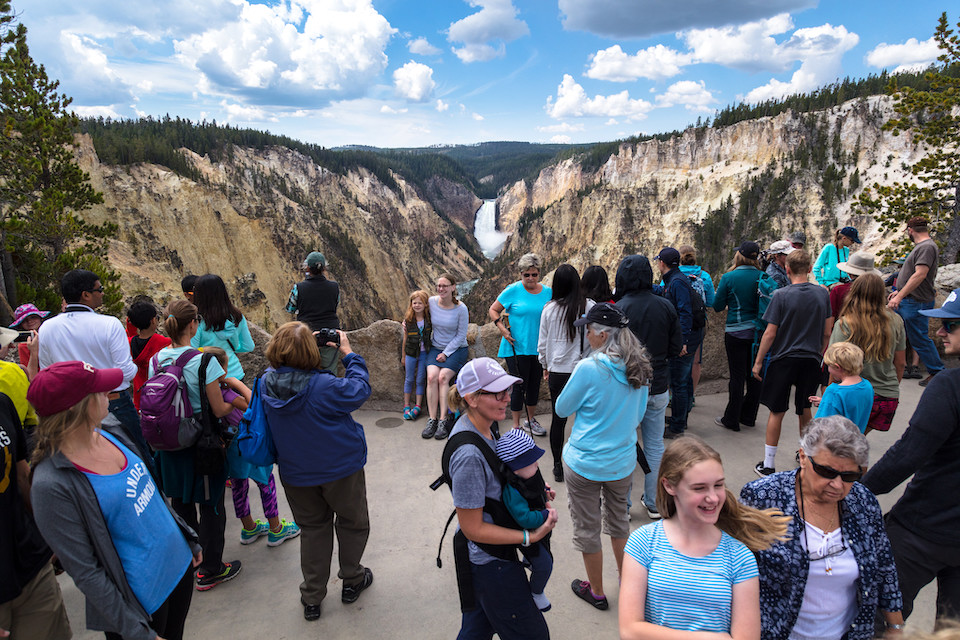
Crowds can impact the visitor experience in parks, such as crowds at Artist Point in Yellowstone/NPS, Jacob W. Frank
Editor's note: This article was edited to remove an offensive word from a direct quote. It was from a reader comment on our Facebook page. Our intention wasn't to fan racial insensitivities. We apologize for this misstep and will work to improve our communication. We value all of our readers and will continue to advocate for diversity in the parks.
Hours spent in a line waiting to enter a national park. Crews working to maintain trails that climb through piny forests and are blighted by piles of human waste. Visitors taking out their rage against fellow visitors and park staff when they can't find a parking spot at their favorite trailhead or overlook. These are some of the issues National Park Service staff are trying to solve as they cope with record visitation.
Nine years after then-Park Service Director Jon Jarvis worried that the National Park System was becoming irrelevant to Americans, the parks have never seen more visitors. Last year a record 331 million passed through an entrance station, and that number could be challenged when all the 2018 data are in. Whether those millions are coming to experience the wonders -- natural, historic, cultural -- that abound within the parks or simply to say they visited a Yellowstone or a Shenandoah or an Everglades is a question for social scientists. For now, the question most park staff is trying to answer is how to handle these tremendous crowds while protecting not only natural resources, but the visitor experience.
"We are hearing more and more from visitors who have indicated that they are not coming back to Rocky as a result of the congestion," Rocky Mountain National Park spokeswoman Kyle Patterson said.
Rocky Mountain isn't the only park grappling with that complaint. Congestion in parks was voiced by many who grew frustrated during their vacations this past summer. Some of that frustration actually occurred before people passed into the parks, as long waits outside an entrance station left more than a few fuming. Then, too, there was the experience of crowding once one got into a park.
"The behavior by busloads of people is beginning to ruin every tourist location in North America," Francine Deason said on Traveler's Facebook page. "Buses should be required to wait their turn in line like everybody else! I, for one, am tired of being shoved aside by rude, self-centered people whose only goal is to take endless selfies and who don't even have a desire to look at and enjoy the fantastic scenery and who prevent others from seeing it. A lot of times it is a once in a lifetime chance to see a place and it is ruined by these out of control busloads of rubes."

Roads in Acadia National Park regularly get jammed during summer months/NPS
Kim Shaffer, a Southern California resident, agreed that the crowding and poor behavior is getting unreasonable. "It's depressing when I want to stay close to home and visit some of the parks nearby. Now it seems I have to deal with crowds, loud music, a lot more trash, and graffiti than ever before," she noted.
Problems cited by Traveler's Facebook audience crisscrossed the National Park System:
* The parking area at Logan Pass in Glacier National Park can fill by 8 a.m., there are many cyclists in the area, and many hikers go off-trail and get too close to wildlife;
* In Acadia National Park, during the prime fall foilage season the only way to reach popular sites such as Jordan Pond and Cadillac Mountain was by the park's Island Explorer shuttles;
* Arches National Park in October was "out-of-control crowded," wrote Sally Brunner. "When you left Arches to go back to Moab it took an hour just to go two miles."
* Rocky Mountain National Park doesn't have enough rangers or volunteers to maintain the trails, said Thad Wright, adding that it’s the fault of "the entitled slobs that have never learned to 'pack out what you pack in' and not obeying rules or using common sense and respecting the environment!"
There were kudos, as well.
* "We visited Dinosaur (National Monument) for the first time -- what a treat!" wrote Gail Docter. "And Organ Pipe Cactus National Monument is in excellent shape right now!"
* "We went to Yellowstone in early June and loved it," said Diane Morello. "Slow driving was fine with us, better to bask in the country. Food sources were distant, but general stores were helpful. We faced crowds at Old Faithful, but not enough to dissuade us from going a second time."
* "The lesser known parts of Acadia, Schoodic Peninsula and Isle au Haut, were blissfully quiet by comparison (in fall) and just as beautiful," wrote Kim O'Connell, a Traveler contributor. "This summer, Theodore Roosevelt National Park was uncrowded even in August. Definitely one of the best kept secrets of the park system."
Impacts from these crowds are many: road shoulders turning into parking areas with motorists running over vegetation, trail erosion becoming extensive, social trails zigzagging away from official trails, restrooms dirty more than they are clean, wastewater systems overtaxed, litter, stress impacting what was to have been a restful vacation, pressure to build a larger human footprint in the parks, campgrounds turning into dusty acres from overuse.
Against the complaints, the record crowds, and the impact to resources, the National Park Service continues to seek solutions. But the agency for the most part has ignored a 40-year-old directive to identify visitor carrying capacities for the parks and implement them. Congress gave that order to the Park Service in 1978 via the National Parks and Recreation Act. The agency failed to do so then, and again in 2006 when the agency's own Management Policies repeated that directive.
General management plans for each unit shall include, but not be limited to:
(1) measures for the preservation of the area's resources;
(2) indications of types and general intensities of development (including visitor circulation and transportation patterns, systems and modes) associated with public enjoyment and use of the area, including general locations, timing of implementation, and anticipated costs;
(3) identification of and implementation commitments for visitor carrying capacities for all areas of the unit; and
(4) indications of potential modifications to the external boundaries of the unit, and the reasons therefor." -- National Parks and Recreation Act of 1978
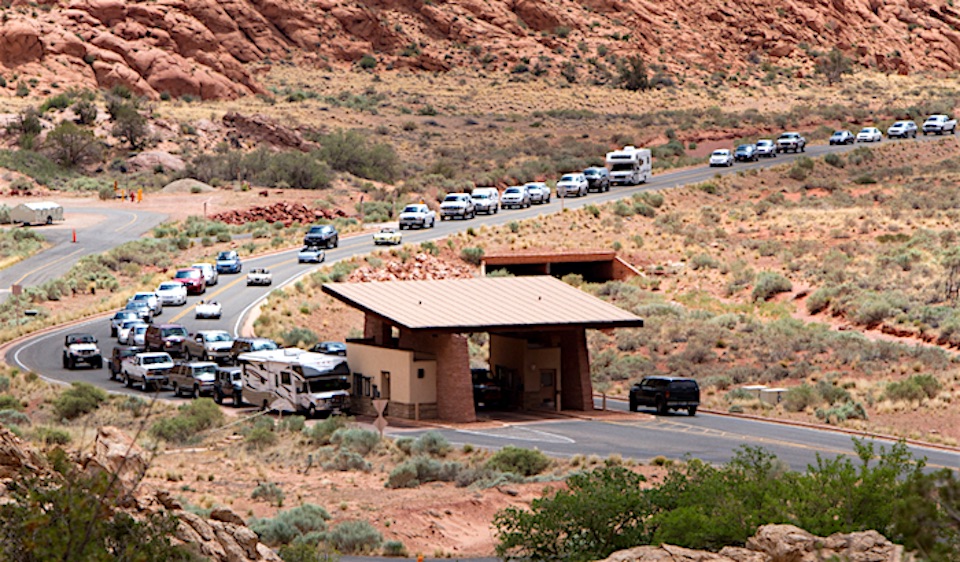
There are times when the entrance road off U.S. 191 to Arches National Park is closed because of backups/NPS
A small handful of parks have implemented caps of various sizes, some in response to lawsuits. Some have been moving in that direction by limiting access to certain areas when crowds become too great. For instance, at Glacier National Park the superintendent hasn't been hesitant to bring down the gate on the road to the Many Glacier area; at Mount Rainier, sometimes it can be "one car out, one car in" to reach Sunrise; at Rocky Mountain, when the Bear Lake parking lot fills up, only the shuttle buses can get there; at Arches, the entrance station will halt traffic, and sometimes the Utah Highway Patrol will close access to the park off U.S. 191, if things back up too much.
But sometimes trying to cope with numbers doesn't lead to limits.
When overcrowding near Grand Prismatic Spring in Yellowstone was creating problems with illegal parking along the Grand Loop Road near the thermal area, park officials responded in 2017 not by limiting visitors but by building a new parking area that covered nearly an acre near the Fairy Falls Trailhead. While it was promoted as a temporary solution, it came with a new trail and a hardened overlook of the colorful hot spring. At the time, then-Superintendent Dan Wenk said the trail and overlook “provide a different view of Grand Prismatic Spring and minimize the growth of unsightly, unofficial social trails in the process.”
Now retired, Wenk commented recently that, "Our own species is having the greatest impact on the park and the quality of the experience is becoming a casualty.”
Yellowstone's new superintendent, Cam Sholly, recognizes crowding is a problem, that there are adverse impacts to park resrouces, and is aware of the visitor complaints. And yet, he's not ready to put a hard number on how many people can flood the park on a daily or annual basis.
"We're taking these increases in visitation very seriously," he told the Traveler during a wide-ranging exchange. "As you know, any effort this large must include the right data/analysis, public/staff involvement, and accountability in our decision-making processes. We know we have a problem in many areas, and that problem is growing, but it's important that we're not implying or communicating outcomes prematurely or prior to going through a defensible process that is comprehensive, logical, and based on the right science, data, and outreach."
At Zion, Arches, and Acadia national parks, Park Service staff have been working on visitor management plans; none is yet ready for public consumption, in part because staff are studying the potential economic impacts of visitor limits. But limiting visitors is likely to be the outcome of Zion's planning.
"The way we’re looking at it, you can roll it up into annual capacity, but what’s really important is we manage on a day-to-day basis, so our emphasis is looking at the daily capacity, and within the day the peak periods how we would manage for those peak periods," said Superintendent Jeff Bradybaugh. "So yes, we’re following the 1978 National Parks and Recreation Act, the 2006 Management Policies, and we’re using the Interagency visitor use management framework as our process.”
Alternatives under consideration at Zion include limiting the daily number of visitors to popular areas, such as Angels Landing, the Temple of Sinawava, or Emerald Pools. Another possibility would be to institute a reservation system for visitors to the entire park.
"We’re looking at those, how we might manage those areas, either on a least common denominator approach, which is more of a park-wide approach, or area by area approach, which has a lot of complexities, but may be able to increase the capacity slightly," said Bradybaugh.
Complicating the planning process are concerns over how a visitation cap would impact area businesses.
“I think people realize that there are crowding problems, and would like to see some solutions to that," said the superintendent. "But there’s a great amount of concern that that could have negative economic impacts on the tourism industry. And we certainly are taking that into account and have those concerns as well."

During the National Park Service's 2016 centennial celebration, overcrowding at Rocky Mountain led some to park illegally on vegetation. This year's visitation to the park could rival 2016's/NPS
As the process continues, resources continue to be impacted at Zion. A year ago the crowds in Zion Canyon, where there are 13 miles of official trails, had created roughly 30 miles of unofficial social trails. "We’ve restored some, but unfortunately some have been added," said Bradybaugh when asked whether the situation had improved.
"What we’re trying to do with those is prioritize those that are most susceptible to resource damage, like those that would erode quickly if you cut switchbacks," he said in explaining the park's trail triage. “We can’t treat them all, but we’re trying to prioritize those.”
At Acadia, a draft management plan is being reviewed at the regional and national levels by Park Service staff. At Arches, as with Zion, further refining is awaiting the results of economic information on the impact of various alternatives. While the process continues, park staff are trying to cope, but as some comments on Traveler's Facebook page noted, rangers can be too few and too far inbetween to manage things.
At Acadia, Charlie Jacobi told Traveler last year that the road to the summit of Cadillac Mountain had to be closed a dozen times during the Park Service's centennial year of 2016 due to crowding. He retired at the end of 2017, and his replacement isn't expected to come aboard until January, so detailed examples of how this year's crowds have impacted Acadia are hard to come by. But parking atop Cadillac and elsewhere in the park continues to be an issue.
"Certainly, roadside vegetation is impacted by people parking on top of it," said Acadia's public information officer, Christie Anastasia. "Certainly, the top of Cadillac is impacted by out-of-bounds parking, and people stepping off of the trail and keep going a little further to get a photo, and the subalpine vegetation up there is very sensitive.
"Certainly, an increase in numbers of people, especially if they’re not necessarily following leave no trace, is going to make more of an impact," she went on. "So we’ve been working more with education about how to park in the park, how to leave no trace, what to expect at different destinations so that people can make better choices about what kind of experience they want to have, and tyring to educate people about having a plan B" (to avoid crowds)."
At Mount Rainier National Park in Washington, Superintendent Chip Jenkins has been studying traffic flows, talking to surrounding communities, and trying to figure out how best to resolve congestion problems. With steady flows of visitors from Seattle and Tacoma whenever the sky is blue and "the mountain is out" all heading to the Nisqually Entrance on the park's southwestern corner, the growing crowds are turing what might have been an hour or so drive into a multi-hour slog.
"If you’re coming down from Seattle, where that could be an hour, between and hour and two-hour drive from Seattle to Paradise, that was translating into becoming a four-and-a half or five-hour drive for families," said Superintendent Jenkins "We see that that’s a problem. We hear about it from visitors that that’s not the experience that they want.
"I also hear about it from the local businesses and property owners along that road corridor, that they see it as a problem," he went on. "They’re having people that are getting out of their cars (when the lines back up) and going into the yards, using the yards as a restroom."
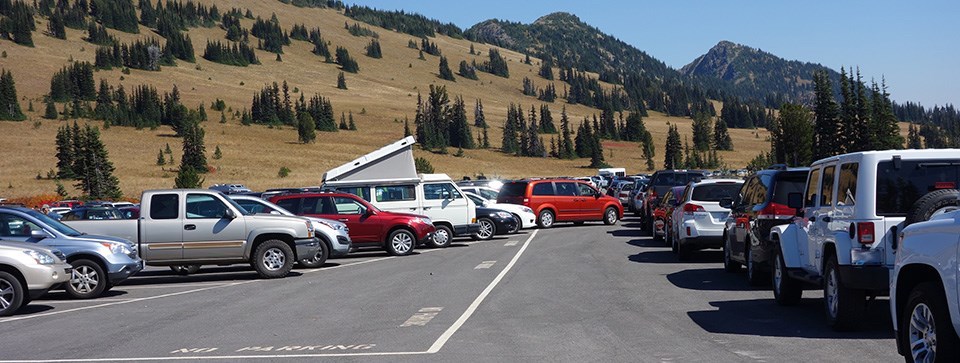
There are times in summer when traffic overwhelms available parking at Sunrise in Mount Rainier, prompting staff to take a "one car out, one car in" approach/NPS
One day while monitoring the backup, Jenkins had a brief conversation with one motorist who, having spent more time than he thought he should in line, told the superintendent that "he was frustrated because he was trapped."
The frustration is boiling over at Rocky Mountain, where Patterson described "parking lot rage ... happening either between visitor to visitor, visitor to staff, visitor to volunteers. Which was really tied to congestion."
"People would be in long lines outside of the park through the surrounding communities, then they would come into the park and they would be in a line at our entrance stations," she explained. "Then they would try to find a parking space somewhere, be very irate that they couldn’t find a parking space, and then either again take it out on other visitors, take it out on each other, or take it out on our volunteers and staff."
The crush of visitors -- Rocky Mountain saw a record 4.5 million in 2016 and could finish 2018 very close to that number -- is taxing facilities, parking areas, and even trails. Trail crews often are finding "either toilet paper, or we’re having people just going to the bathroom, pooping, right on the trails," Patterson said.
Already the park has implemented restrictions on vehicles at Bear Lake, Wild Basin, and the Alpine Visitor Center. What that has done, however, is "push that use to other areas."
“We knew that was going to happen, and that’s happened," Patterson said. "So that’s why as we continue to move forward with looking at what our kind of visitor day use strategies and concepts are, we need to look at the park holistically, for just that reason."
Come spring, the staff hopes to have drafted solutions that can be put to work to improve the visitor experience while ensuring park resources are protected.
"We want to reach out to those people who have told us that they’re no longer coming, and ask would they want to engage in their national park again if some things were in place where they would know that they could possibly have a reservation or have a permit, or be able to plan ahead? Would that enhance their experience," Patterson explained.
At Mount Rainier, Superintendent Jenkins, who has only been on the job there since April, wants to study the problem further and talk with stakeholders before proposing solutions.
“Do they see that there is a problem, too, and how is that problem, what are those problems manifesting?" he said. "What is it that they see? Are they interested in coming to the table to have a conversation about how are we to proceed?"
While there have been suggestions that a shuttle system could alleviate the congestion enroute to Paradise, the superintendent isn't so sure.
"If the shuttle buses are caught in an hour of traffic, that doesn’t make things better," he pointed out.

Heavy traffic flows at Zion National Park has staff moving towards setting visitor capacity caps/Kurt Repanshek
Back at Yellowstone, Superintendent Sholly said he and his staff are looking at a range of potential solutions, ranging from site-specific alternatives, "tiered implementation" of actions to manage visitors, and examining whether an environmental assessment or more detailed environmental impact statement will be needed to consider the alternatives.
"I believe there are things we can do that can utilize our existing transportation infrastructure and operations more effectively - how we mitigate/eliminate impacts to resources, how we route pedestrian and vehicle traffic, how we make parking more efficient, how we handle large crowds in concentrated areas, how our busiest intersections and choke points facilitate traffic flow, and how are we working to ensure our existing personnel and resources are working in the areas we need them most to protect resources and facilitate visitor enjoyment," the superintendent said.
Sholly did acknowledge that there will be added costs involved in achieving success, but how much they might be can't be identified without more planning. The superintendent did say that he and his staff are watching how Zion officials are trying to tackle their crowding issues.
"I'd say Zion has been very progressive on this front for decades in managing visitor use. They were really on the leading edge implementing the shuttle system and other actions they've implemented," said Sholly. "Zion is much further ahead of us in their various planning processes. They have already implemented a very successful shuttle system, and honestly we're probably where Zion was 20 years ago in relationship to where we are in the process of evaluating and managing visitor use in more progressive ways here in Yellowstone.
"Bottom line, like I've said, not every solution that works for one park at one period in time, will work in other parks. We will definitely evaluate what Zion and other parks have done successfully and take what we can from those parks to incorporate into our decision making here," said Sholly. "I'll reiterate that doesn't mean Yellowstone is ready to jump to visitation caps and we are not considering any form of parkwide caps at this point. "
Stories about:
Story Categories:
A copy of National Parks Traveler's financial statements may be obtained by sending a stamped, self-addressed envelope to: National Parks Traveler, P.O. Box 980452, Park City, Utah 84098. National Parks Traveler was formed in the state of Utah for the purpose of informing and educating about national parks and protected areas.
Residents of the following states may obtain a copy of our financial and additional information as stated below:
- Florida: A COPY OF THE OFFICIAL REGISTRATION AND FINANCIAL INFORMATION FOR NATIONAL PARKS TRAVELER, (REGISTRATION NO. CH 51659), MAY BE OBTAINED FROM THE DIVISION OF CONSUMER SERVICES BY CALLING 800-435-7352 OR VISITING THEIR WEBSITE. REGISTRATION DOES NOT IMPLY ENDORSEMENT, APPROVAL, OR RECOMMENDATION BY THE STATE.
- Georgia: A full and fair description of the programs and financial statement summary of National Parks Traveler is available upon request at the office and phone number indicated above.
- Maryland: Documents and information submitted under the Maryland Solicitations Act are also available, for the cost of postage and copies, from the Secretary of State, State House, Annapolis, MD 21401 (410-974-5534).
- North Carolina: Financial information about this organization and a copy of its license are available from the State Solicitation Licensing Branch at 888-830-4989 or 919-807-2214. The license is not an endorsement by the State.
- Pennsylvania: The official registration and financial information of National Parks Traveler may be obtained from the Pennsylvania Department of State by calling 800-732-0999. Registration does not imply endorsement.
- Virginia: Financial statements are available from the Virginia Department of Agriculture and Consumer Services, 102 Governor Street, Richmond, Virginia 23219.
- Washington: National Parks Traveler is registered with Washington State’s Charities Program as required by law and additional information is available by calling 800-332-4483 or visiting www.sos.wa.gov/charities, or on file at Charities Division, Office of the Secretary of State, State of Washington, Olympia, WA 98504.

Comments
I don't go to Times Square on New Year's Eve. At some point, common sense by visitors might be something to consider. Where is the social science that says visitors will not come back - this all seems like conjecture or just comments made here and there.
How many parks are seeing decreasess in visitation. Many of the presidential sites across the system are seeing stagnant or decreased visitation. That would be an interesting article as well.
I agree with Mr. Sholly, you can't put a number on capping visitation at this point. I think it would be dangerous for the park and the NPS to do so at this juncture.
Zion has done well and was part of some cutting-edge thinking abotu 20 years ago as NPS partnered with the Department of Transportation to look at implementing transportation systems in several NPS unites. NPS needs that type of partnership again with DOT to look at some solutions at a national level rather than park by park.
What Zion has demonstrated is that an enjoyable park experience for everyday tourists doesnt have to mean driving your own automobile around. If anything, it frees tourists up to enjoy more things that a crowded parking lot full of cars might discourage otherwise.
Zion canyon is also really conducive for the shuttle because it is a natural cul de sac at the narrows and temple so you come right back out and return to your vehicles. Not every park has that same natural benefit but many do. It is also a reasonable distance traveled from park entrance up canyon and back.
As for capping visitation, Zion has flirted with different ideas but an overall cap is a bad idea. I understand it from a resource protection standpoint. But it would be a public relations disaster. The parks rely heavily on a positive public image and a perception the NPS is widely closing or limiting access on an ongoing basis could backfire.
Now, having a cap or reservation system for the Angel's Landing hike is welcome just for public safety. And I would hate for the park to have to modify that trail to accomodate the crowds.
"As for capping visitation, Zion has flirted with different ideas but an overall cap is a bad idea. I understand it from a resource protection standpoint. But it would be a public relations disaster. "
But what if we went to work to try to EDUCATE the public? Perhaps some TV spots and service ads explaining WHY visitation has to be capped?
Despite everything happening today, I still believe ( or hope ) that most Americans are still reasonably reasonable and intelligent.
We discovered a long time ago that visitors were much more likely to comply with regulations if they understood the REASONS behind them. When they understood that washing dishes at a campground water tap, for example, drew wasps and produced foul smells, the problem nearly disappeared in most campgrounds.
With so much at stake, can we simply surrender to the hordes?
Lee, I agree that at some point, visitation at Zion might have to be capped. There is a point at which the roads simply wont accomodate additional traffic, even buses. However, I think right now an expanded shuttle service is sufficient. But, it has to be expanded. It cant be just a replacement fleet.
y_p_w, I bet there are many historical sites and smaller monuments that would benefit with a system like Muir Woods. And Yosemite is interesting because the valley access reminds me of a larger and more complex version of Zion. Years ago they discussed moving much of the NP facilities out of the park to El Portal and creating a shuttle system(which they did). I was there two years ago in late October and it was a nightmare. Calling it crowded would be a kindness.
I remember taking a Yosemite shuttle bus for the first time in 1983. So the issue has been around for decades and even then the solution wasn't ideal. It was a day trip, and we just circled around for a while until we found ANY parking space that would allow us to get out and use the shuttle.
Yosemite valley was the most unplesant park experience I've had. Circling parking lots is very accurate. 1983.2016. Still the same. I can't imagine what it would be like mid-summer. Tioga Pass was great but not down in the valley.
How can this subject be brought up without mentioning Yosemite?
The reservations system at Muir Woods National Monument May be the model. It’s only a reservation for parking and the incoming shuttle bus, so walking in or bicycling is still allowed without reservations. Marin County also doesn’t allow parking on the street for at least a mile from Muir Woods, or this would be ineffective. One could hike in, and possibly for free since that wouldn’t require using the entrance.
Looks like everyone found their park. Mission accomplished.
Indeed. I wondered when someone was going to realize that this just exascerbated the problem.
Maybe tour busses (filled with foreigners who don't pay our taxes to maintain these parks) should be charged a steep fee and have thier entrance hours limited to the off peack hours early and late in the day. If they want to see the sights badly enough, surely they will still come. If they don't like those hours, maybe they really don't care about the parks all that much, it's just another self-absorbed bucket list item to them or a selfie op, not a respect and wonder of the beauty of nature.
"At some point, common sense by visitors might be something to consider".
Sadly common sense is increasingly hard to find as is basic common courtesy.
I would also suggest that Francine Deason's actually talk to a few "oriental people" and perhaps she could help educate those that are not as familiar with our culture as they should be and at the same time learn they are not all "rubes".
That said, you can count me among those who think our parks have been ruined by overcrowding and while in the past couldn't wait for my next trip now am more apt to avoid them. I also have a number of friends who had never visited our parks finally make a visit only to return and say "never again".
I would not relish being the one responsible to fix this problem but something clearly needs to be done in my humble opinion. Or perhaps the increasingly poor experience people are having will be enough to fix the problem on it's own. I see few options other than a reservation system and there is no doubt whatever solutions are enacted not everyone will be happy.
I'll be visiting several parks next spring and will look at each one and see how they are responding or not to the crowds.
Paid a visit to Canada's Rocky Mtn parks last August(Banff/Jasper/Glacier/Revelstoke/Yoho/Kootenay/Waterton Lakes and they were all unbelievably busy. Granted, it was late Summer so some crowding was expected but they were all very crowded, even the trails.
I've heard that tired old insulting argument in NPT's comments before. In my experience, foreign visitors are no better or worse than Americans who treat national parks as another bucket list item. Yes, that kind of behavior is a serious issue and detraction from the experience, but I don't understanding pinning it on foreign visitors.
I've been to similar parks in other countries, and as an American I was treated as well as any domestic visitor. In addition to that, I'm sure that the people in gateway communities will be thrilled with your suggestion. They don't need their best customers to be discouraged from spending money at their local businesses.
Many foreign visitors are at least as respectful or moreso of our parklands as citizens are. I'm glad the parks I've visited out of country didnt have the attitude that I wasnt welcome.
Highlighting the comment about "busloads of Oriental people" in the article's first few paragraphs is incredibly inappropriate. Racist comments have no place in a discussion about national park policy, and I am disturbed that the author chose to elevate that comment, giving it legitimacy and even elevating it above a bevy of other reader feedback. I hope the park funds and foundations that support the publication reconsider their role in promoting such articles.
Other countries do charge foreigners more for national park visits, such as those in Africa. There is no reason why foreign visitors should be banned or limited in their access to US national parks. US citizen visits to our parks takes precedence.
I agree with the reader above - that's an awfully racist comment to include in this article, which taints the entire article! I've frequently hiked with my Asian American friends and I frequently see Asian and Asian-American people out hiking and I want them to feel as welcome and included in our national parks as I do as a white American. Why did the author include that racist comment?
But, unfortunately, there is some truth to concerns about visitors belonging to tour groups from Asian countries. A couple of years ago, I was on the trail through West Thumb Geyser Basin in Yellowstone along with a couple bus loads of visitors from China.
As they traveled through the basin, they were leaving enormous amounts of trash behind. Kleenex tissues were flying around like autumn leaves along with candy wrappers and bunches of other detritus. I picked up several things and actually took them to the people who had tossed them and tried to let them know as politely as I could that it was not acceptable. Most of them seemed to have no idea why I was handing their trash to them, and a couple actually tossed it onto the boardwalk again even though I'm pretty sure they understood what the word NO means.
Later I spoke with one the tour guides -- a young Chinese man who spoke excellent English. He said (paraphrasing here), "Yes, I know. In China there are no trash recepticles. There are instead many people who sweep the streets. I try to tell them that in America they should hold on to their waste and place it in a trash can, but it is hard for them to understand."
It's not racism -- but a cultural difference. A difference that most Americans probably don't understand. But it's not one that should be tolerated. Education is needed. Maybe we need to make an effort to educate their tour guides so they, in turn, can educate their clients.
The best solution to overcrowding: $6.00 / gallon gas. That is, increase the federal gas tax to levels similar to what it is in many other countries. Use most of the the money for infrastructure improvement, of course, but direct some of it to the NPS for park maintenance and improvement.
As a retired NPS employee who worked on this issue for many years, dating back to the 90s when we deveoped the visitor experience and resource protection program at Arches, I can tell you that the NPS is well aware of the problems associate with increasing visitor use. The interagency visitor use management council is doing great work in trying to address the issue, and I suggest you check out their web site (https://visitorusemanagement.nps.gov/). We can do many things to alleviate congestion, but in some of our popular parks we will have to implement use caps or other more intrusive measures if we want to maintain park resources and quality visitor experiences . The public accepts this kind of action for areas like Disneyland, where reservations are accepted as a matter of course. With the world's increasing population, and the desire of many people to visit and enjoy our parks, we ultimately will have to come to grips with the fact that there are limits to what we can and cannot do--even for our national parks.
I am surprised that the author couldn’t find any other quote to support their opinion other than the one refering to “orientals”. It makes me wonder if their goal in writing this article to blame Asian people. Definitely shows a great deal of ignorance by the author, and by NPT, on the significance of that term and how to convey an appropriate message.
As an Asian American who visits National Parks often, I have definitely seen the overcrowding by all kinds of visitors both foreign and domestic. Blaming one group of people for the problem won’t help solve this issue.
And:
Zion NP will be experimenting with mandatory shuttle service from this coming Saturday through the end of the year:
https://news3lv.com/news/local/zion-national-park-testing-mandatory-shut...
It's more than that. I remember back when some parks were posting notices (in multiple languages) demonstrating how to use sit-down toilets after several Asian visitors had damaged them by trying to use them like squat toilets. However, I've made many visits to Asia, and I still can't figure out who wouldn't know how to use a sit-down toilet. In speaking to many friends originally from China, they explain that there are a lot of people "from the countryside" who have just come into money recently and may not understand these norms. But where would it end? There's the stereotype of the German-speaking tourist crazy enough to hike in Death Valley during the summer, with the inevitable consequences.
I certainly don't believe that policy should be made from ethnic stereotypes of foreign visitors behaving badly. There was a time (may still be) of the stereotype of the "Ugly American" running roughshod in other countries. Does it have to be specific to particular countries, especially with the recent reports of the Canadian "High on Life" group walking over hot spring bacterial mats, waterskiing on the Bonneville Salt Flats, etc. I don't want to be asked to see proof of citizenship just in order to visit my local park, although I may be asked to show ordinary ID to use my annual pass, and senior pass holders might need to show proof of US citizenship/residence.
And I have no idea where your tour guide says that there are no public trash receptacles in China. It sounds more like an excuse for the behavior of his charges than anything else. I've been to China and there is no shortage of places on every sidewalk. If there are people who toss stuff on the sidewalk, it's more individual than collective. I've also visited what's known as the cleanest major city in China - Hangzhou. Almost nobody there litters, and it's apparently out of a sense of local pride. A tour guide claimed that it all started after a prominent foreign visitor was asked what he thought of the city, and he blunty said he thought it was dirty. The story is that ever since then they took it as a sign to take pride in their cleanliness. This article has several photos of trash cans in China:
http://www.urban-family.com/shanghai/post/2817/talking-trash-cans-promot...
YP, you're right. I'm afraid I fell into the very easy trap of categorizing one group of people when there are many out there who are at least equally problematic. All I can do is report on the guide's comment and the behavior I witnessed at Thumb.
On the other hand, I had a GREAT experience with a busload of Chinese visitors in Bryce Canyon last year.
There are really good people everywhere and we just need to be wise enough to realize that fact and to be patient with those who need to be taught better ways.
I get where you're coming from; this is what someone told you. I don't know if it was something he really believed to be true, or if he thought he had to say something to avoid further embarassment.
However, some of what I find great about our national parks is that there are so many people visiting from around the world. It's not just seeing the sights, but meeting intersting people from around the United States, and around the world.
However, in these comments I've seen a proposal to limit access to foreign visitors on the basis that they don't "pay taxes" as well as how they supposedly negatively affect the visitor experience. That's a horrible idea, especially if it ever results in reciprocity around the world. I do know of one NPS site where visitation is limited to US citizens, but that's an active military base with a specific legal reason for that rule.
Why is the obvious so ignored? If there is overcrowding by people, we should consider a voluntary hiatus in the production of more people.
"Find your Parlk" campaign was a waste of money. It contributed to this very problem and that money could have been spent more wisely on the National Park infrastructure. We like to travel without planning ahead and so the changes are not to our liking but we do understand that may be the only choices left. Please don't spend more money on advertising the parks. They are well known!
Cathy, it was a combination of the Find Your Park national campaign and even statewide ones, like Utah's Big Five NPs campaign. Since 2014, when Utah began its campaign, visitation jumped in Zion NP from 2.8 million in 2013 to over 4 million today. And visitation during the one-time down winter season in Zion is up 70% in five years. I agree that nationwide and state marketing campaigns need to be curtailed until at least infrastructure needs are addressed.
As a retired 40 year NPS employee I offer the following advice if you wish to avoid crowds at the most popular parks.
1. Visit inthe off-season or "shoulder" season.
2. If you must visit during the peak season(s), do as much as you early in the morning or late evening. I am always amaxed that a trail that might be crowded from 10AM to 4PM, can be largely empty early or late in the day.
Plan ahead and be patience.
My wife and I have visited our parks for the past 40 years and the past few years have been sadning. Multiple times our visits have been ruined be many busloads of tourists arriving at one time and then being rude and pushy. More then once we have been shoved aside by agressive tourists who seem to have no concern for others enjoyment just to get a selfie. Several weeks ago we visite Zion on a very rainy day and we had to park in Springdale because the park was full. We had thought it was the off season in November. Needless to say so did everyone else. We have been very fortunate to have visited most parks in earlier times. One more fact.....Park personnel have always been upbeat and professional. Thank you for your service.
We only go during the off-seasons. The off-seasons are now crowded. We've been going to National Parks for over 30 years and always durig the off-seasons and there has been a big change and not for the good, unfortunately. We loved the National Parks in our early days of road trips.
Most National Parks are surrounded by thousands of acres of National Forest or BLM land that is just as beautiful. This is a problem that affects just 1% of the parkland. It’s like visiting Times Square and complaining about too many people. EVERY National Park has areas where you can get off the beaten path. Utah parks crowded? What about the Grand Staircase or Glen Canyon? Thousands of pristine acres to explore where you won’t see a soul.
Michael,
What about Grand Staircase or Glen Canyon? Those are crowded too. Glen Canyon overall visitation is up across the NRA nearly 33% in the last five years. Even little Kanarraville Falls north of the Kolobs of Zion NP now has up an an HOUR wait time to even hike the little slot canyon where the falls is. They finally had to implement a $8 per person hiking fee to handle the nearly 45,000 hikers per year that come through the little canyon in order to manage the crowds and mantain the trails.
Cedar Breaks NM's old 600-foot visitor center is packed during peak months to the point you cant even go inside because it is jammed full of people.
I'm not saying there arent places where people can go to get away but when our entire NPS sees an annual number of visitors that meets or exceeds the total population of the U.S., you now have overflow into all of those little spots that were previously hidden gems.
Look at Antelope Canyon. Both the upper and lower canyon can be a joke to hike due to the crowds.
edit: I just looked at the Glen Canyon numbers for last year as mine are from 2013. Wow, were my numbers old news!
Get this: in 2017, Glen Canyon visitation exceeded Zion's by a few hundred thousand. Yes, most of the Glen Canyon visitation is for Lake Powell, but not all. It is up across the board. In 2013, there were 2 million visitations. Last year, the number of visitation exceeded 4.6! That is an increase of well over 125% in four years!
Clearly, something needs to be done. I think we need more protected areas across the board for more visitor choice and alternatives, higher fees, expanded services, and visitation caps.