

I headed up to Idaho to scout out a spot to watch the Great Total Eclipse of the Sun on August 21. Depending upon whom you talk to, there is either fear or anxious anticipation about that coming event. Speculation (probably well-founded) has it that millions of people will make a mass migration across the country and around the world as a band of blackness shoots across all of America from Oregon to Florida.
The expected band of totality will be about 70 miles wide. Within that narrow strip, day will turn to night. Stars will suddenly come out. Birds will fall silent, and night insects will make confused noises.
People who have witnessed a total eclipse say it’s an absolutely awesome experience. And rare. The next total eclipse visible in North America will extend from Texas to Maine on April 8, 2024. The next total eclipse to touch Idaho won’t be until 2169.
The visitor center and campground of Craters of the Moon National Monument and Preserve will be just outside the band of totality, but the town of Arco — 20 miles north — will be under it. Towns, and their businesses, all along the eclipse path are planning for some big doings. Trouble is, no one knows just what to expect. Hotel rooms and campgrounds have been booked full for several years. Businesses and eateries are in quandary. Stock more supplies, food, souvenirs, gasoline — or not? Risk not having enough hamburgers or far too many?
Grand Teton National Park will be directly under the darkest darkness. They are bringing in more rangers from all over the country. County sheriffs are arranging for other counties to send help. Every portapotty in western Wyoming and most of Idaho has been reserved and will be migrating along with people to places where they might be even more important than the town’s mayor. Cities and main highways are expected to become totally gridlocked. Or maybe not.
And so it seemed wise for me to come and locate the very best place in all of Idaho to guide my family. Craters of the Moon’s campground was a good place for expedition headquarters. I spent my first day at CRMO out and on the prowl looking for a spot that will be just right.
I found it. But if you think I’m gonna tell anyone where it is, think again!
Yup. Just the right place. Or maybe not ....
Back to the Craters
There are parts of Craters of the Moon where jumbles of lava make travel so difficult it’s likely that no human feet have ever stepped there. Until the early 1900s, it was largely a blank blob on maps. A blob nearly the size of Rhode Island. But people were intrigued and curiosity abounded. A few tentative explorations were made. An article in National Geographic drew international attention. Thus, in 1924, President Calvin Coolidge used the Antiquities Act to proclaim Craters of the Moon a national monument. Certainly the only such place to contain the word weird in its enabling proclamation — “a weird and scenic landscape, peculiar to itself.”
Speaking of weird ... Craters of the Moon is on Donald’s list of national monuments that Interior Secretary Ryan Zinke is supposed to “review.” It seems that President Bill Clinton added some acreage that qualifies this monument for that exercise.
I found Craters to be filled with pleasant surprises. The first came when I actually found vacant campsites at nearly 8 in the evening. I understood when I noticed later that CRMO is pretty much a one-night stop for most visitors as they travel from one park to another. The campground pretty much empties every morning and — at least in early June — doesn’t quite fill at night.
The place is clean as clean can be, and the campground was just rehabbed last summer. One of the volunteers told me that Craters is small enough that they are able to keep virtually all of their entrance fee money. If that is correct, it explains a lot about the fine condition of the park. It looks like they’ve been able to put it to very good use.
I noticed right off that summer interpretive program offerings seem to have something for everyone, with some extras for kids. Junior Ranger offerings are plentiful, and everyone under age 15 seems to have a Junior Ranger workbook in hand. Visitors receive a printed copy of 2017's summer programs when they arrive at the entrance station. When the entrance station is closed, an Iron Ranger takes over and collects entrance and campground fees.
But as has often been the case lately, it seems that Craters of the Moon, like so many of our parks, is staffed almost entirely by volunteers. For every green and grey uniform I’ve spotted at Craters, I bet I’ve seen three tan ones. Now I notice that many volunteers introduce themselves as “Ranger So-And-So.” I have some serious grumblings with that. Even though every volunteer I’ve met obviously takes real interest and pride in their work, I have also noticed a very distinct dilution of interpretive activities. I can’t help thinking that the title “Ranger” needs to be earned.
It’s often very apparent that volunteer interpreters work not so much from thorough knowledge of the park, but from sets of canned spiels. Too often in several parks, I’ve seen volunteers who are stumped by questions that should be easily answered, and I’ve heard more than a few pieces of real misinformation being handed out. I’m certain that’s a result of constant churning of volunteer helpers. It’s not uncommon to hear them reciting a long list of parks in which they’ve volunteered. Some apparently work more than one park in a single summer’s season, as if collecting volunteer slots is a game, with each park another trophy. It takes a lot of effort — and time — for anyone to become thoroughly familiar with all necessary information about any park.
I’m sure a lot of paid staff time is required to try to train and supervise a nearly constant flow of new people. That staff time means a lot of money is going into supporting volunteer programs. Money that could certainly fund a seasonal ranger or two. And constant turnover precludes essential continuity in park operations. Can a park’s permanent and long-term seasonal staff members handle the workload of constantly trying to train green volunteers?
There are certainly places where volunteers may provide valuable services to visitors and park resources. Campground hosts or volunteer help with some aspects of resource management such as invasive species control or catching up on curatorial tasks are some examples.
Now that I’ve taken a slam at volunteers, I need to turn around and offer a lot of praise. At Craters, I met at least three VIPs who say they are taking part in a cooperative effort between the NPS and the Geological Society of America. Laura Bader and “Ranger Jennifer” are two who are completing geologic internships. Ranger Jennifer explained it’s an effort to recruit more geologists into Park Service positions. (But I wonder what good that does when so few paid vacancies exist?)
Volunteer Luxianna (pronounce that LU-zee-ANNA) Watkins presented a couple of excellent programs on microhabitats. Like some of the other volunteer interpreters, she is a college student specializing in the science she shares with visitors. In addition to interpretation, she also has some duties in resource management.
I can’t forget Sam, the campground host who spent a lot of time and effort helping incoming campers find spots that were just right for whatever size and kind of equipment they had.
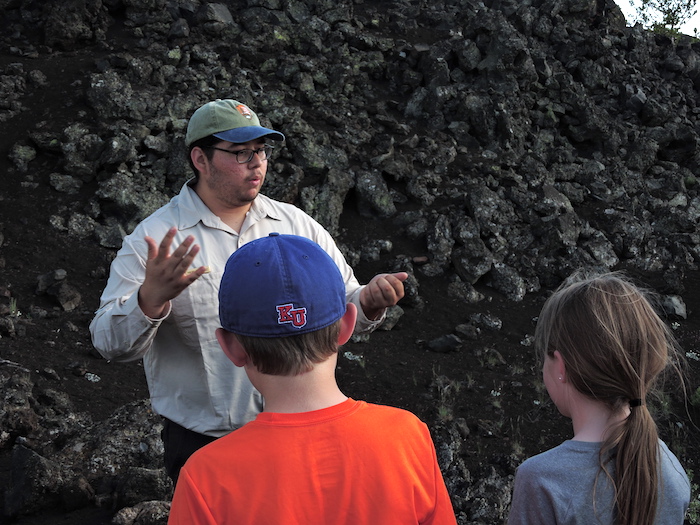
Then there was Mauro Hernandez. A student at University of California at Santa Cruz. He is specializing in bats. He’ll be helping with some bat studies at Craters along with working to educate visitors about these vital and threatened critters. I tagged along on his very first guided walk and attended his first-ever evening program. His evening program — done the old-fashioned way because of computer problems — was simply outstanding. And no canned spiels for Mauro. He knows bats. He doesn’t need anyone telling him what he should say.
Mauro is working with some sound recording equipment that has been installed outside several of the park’s lava tubes. It tries to record sounds of bats with hopes it will enable him to count bats and possibly identify individuals by specific sonic characteristics. He says he accidentally stumbled into his interest in our small, bug-bagging buddies when a professor suggested he write a thesis on them. He became fascinated and now must be one of the best friends a Fledermaus has ever had.
The first time I joined a group of visitors to listen to Mauro, he also explained that he’s part of an effort to diversify our parks. He’s Mexican-American, and it’s hoped that he can open some doors and help others to follow. (But again, who can follow if there are no jobs?)
And Speaking of Bats
Managers of any place that has indigenous bat populations are very worried about white-nose syndrome. WNS is a fungus apparently imported from either Europe or Asia. It first appeared just a few years ago in a cave in New York state and has spread rapidly because North American bats have no immunity, as their overseas cousins have. Until last year, WNS seemed to be restricted to caves and bat populations east of the Mississippi.
But this year, it was detected in a cave bat population in Washington state. No one knows how or when it made this westward jump, but now this frightening and deadly disease is on both coasts. It literally threatens possible extinction of America’s bats.
Bats are not critters regarded as cute and adorable by many people. In fact, they are often feared or hated because so many humans have no idea how vital they are to all of us. If you dislike mosquitoes and other insect pests, you should love bats. They need more friends like Mauro who can act as their public relations agents.
For years now, people entering caves anywhere in national and state parks have been asked to take precautions and try to decontaminate any clothing or equipment that has been previously taken into a cave or mine. But those precautions are not standardized in any way and almost certainly vary widely in effectiveness. The NPS has no standard, and each area with bats and caves have been left to do the best they can.
This has produced a hodgepodge of procedures. In some places, visitors are asked to wipe boots and cameras and other equipment with solutions of hydrogen peroxide or Clorox and not wear any clothing that could be contaminated. When I visited Oregon Caves last fall, I had a pretty young ranger cleaning my boots for me while I worked on my camera. In some places, visitors are simply asked to wipe their feet on a mat containing disinfectant.
When you stop to think of it, those cautions really fall short of any realistic preventive measures. It’s very unlikely that if spores are present on one’s boots, a wiping with peroxide or bleach will kill all of them. Think of all the tiny spaces where microscopic spores can be hiding.
Thus, Craters of the Moon has made a tough decision. They won’t even try to use disinfecting procedures. If you have equipment that has been into another cave or into a mine, you simply may not take it into one of Craters of the Moon's lava tubes.
I have to admit that I was just a titch dismayed when I was told I couldn’t enter any caves here because my boots had visited caves last fall. But after listening to Mauro's and others' explanations and horror stories of how rapidly our bat populations are dying, I changed my mind. Happily, I had a second pair with me that was clean. Mold spores may remain viable for centuries or longer.
As Mauro explained, perhaps the best way to try to protect our little buddies is to educate as many people as possible and gain their cooperation. Then we have to hope that everyone is honest and really does cooperate. The key to that is probably education and an attitude adjustment toward bats.
So by all means, visit one of the lava tube caves. Just come prepared to help protect the bats.

A Wildflower Riot
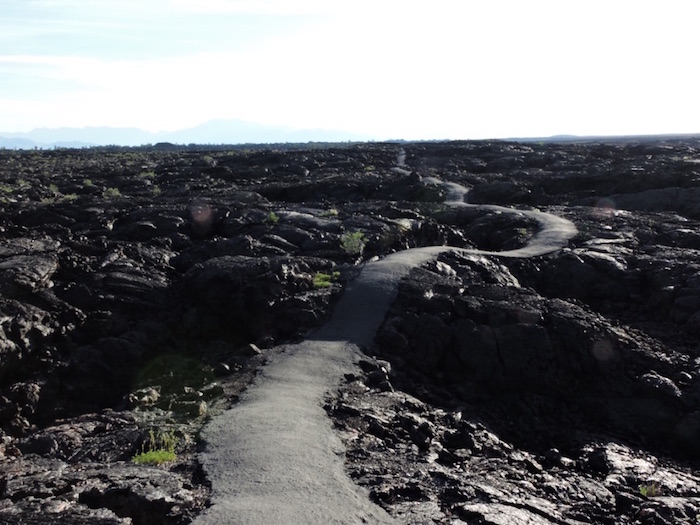
The west had a good wet winter, and now we’re enjoying an explosion of wildflowers. There are places in Craters where you’d expect plants to be growing. Kipukas are places where lava flowed around, instead of over, some landscape. This has left islands of grass and trees where flowers abound. Yet even on jagged jumbles of a’a lava, on smooth stretches of pahoehoe lava, or on cinder cones where it looks as if nothing could possibly take root, wildflowers have found a way. In fact, 660 species of plants are known to exist within Craters of the Moon.
Throughout the park were acres and acres of white and red and yellow and a little blue here and there. Many of the varieties of flowers are miniatures because they live in such a harsh place. Dwarf monkey flowers, for example, look just like the monkey flowers so familiar in Yellowstone. But they are only about one-tenth the size. Yet they turn entire hillsides pink and purple.
Everywhere you looked in the park in mid-June, you’d find people standing, crouching, kneeling, lying flat, and peeking through cameras or phones seeking the most perfect wildflower photo the world has ever seen.
What’s really neat about it is that I’ll bet every one of us went home with at least one photo we all thought was absolutely perfect. It’d be hard not to when there are so many opportunities.
It’s Kind Of A Shame
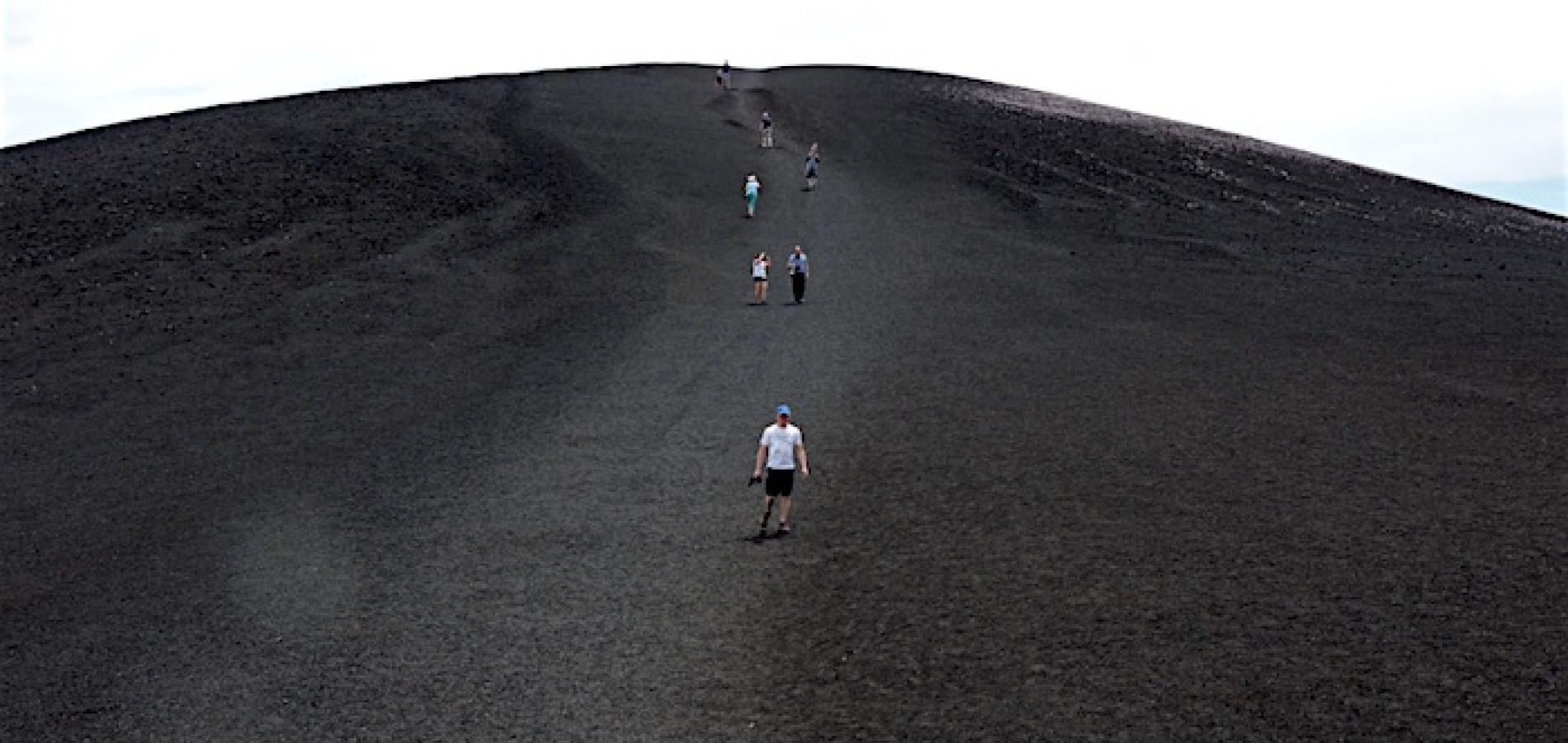
I’m afraid that a lot of people who wander into Craters of the Moon fail to recognize what the park really has to offer. After all, jumbles of black rock aren’t what most people would call scenic. There’s a 7-mile loop road with a couple of short sides. Hiking trails aren’t very long but lead to some really interesting places. Split Top Butte, the Tree Molds area, Spatter Cones, Devil’s Orchard, and North Crater all provide some fine and relatively short hikes. Climbing to the top of Inferno Cone is a bit tough on a very cold and windy day, but definitely worth the effort. Then there are four or five lava tubes open to visitation — if you qualify for a cave permit by certifying that your clothes and equipment are clean.
Most of the park is wilderness. Rough wilderness with little to no water and lava that will tear up a pair of boots in short order. It’s a land much different than most park visitors have ever experienced before. So it’s kind of a shame that so few visitors seem to spend much time exploring and thoroughly experiencing all Craters has to offer.
If I have any advice for anyone, it’s this: Do your homework and then go planning to spend some time hiking, climbing, looking, listening, and just enjoying. One day — or a few hours — won’t do justice to this weird and wild place. People who discover that it’s not all jumbles of black rock can find some real treats.
There’s a Disturbance in the Force
Now comes the hard part. I came away from Craters of the Moon with two terribly disturbing things to think about. I’ve been home for three weeks and have never stopped struggling with deciding if I should even try to write about them — and if I do, how can I try to pass them along to others.
I still haven’t figured it out, but guess the only way is to dive in and try. So here goes .... I just hope I cause no harm to anyone.
Not long after arriving in the park, I began to notice an undercurrent of distress that was hard to pin down.
There are apparently a large number of vacant positions. This leaves remaining staff members trying to fill in and do the work of several. It means that some must try to cover areas in which they’ve had little training or experience. It means they are unable to do justice to what should be their primary duties. Permanent and seasonal ranger staff has been cut to the point where, in the words of one person, “We have only a skeleton crew.” One symptom is an empty dorm that could house as many as 14 seasonals.
As I’ve visited other parks recently, I’ve become aware of some kind of special hiring authority that I do not understand. As near as I can figure out, it’s some kind of administrative track that hires people specifically to become upper-level park managers without having first worked as rangers or in maintenance. They apparently jump directly into headquarters. Some folks feel that people who have come to manage our parks by that route lack certain knowledge and skills needed to fully understand how to best manage these places.
In some parks, the administrative offices have been moved outside the park to a nearby town. That can result from a couple of reasons. One may be simply a lack of facilities in the park to house offices or provide onsite housing. In some cases, it’s been due to political pressures from local chambers of commerce or others to realize some sort of special gains. At CRMO, headquarters is still inside the park, but the superintendent and some other key staff live an hour or more away, outside the park.
I’ve long felt that it’s vitally important for park staff members to actually live in their parks so they can develop the level of involvement — ownership, if you will — that gives them an intimate connection with the special place they are protecting for all of us. There’s a big difference between tackling a job as just a job and seeing it as a very special calling.
Even beyond Craters of the Moon, there are universal pressures that seem bent upon diminishing our parks, if not destroying them. Earlier this year in another park, I met a seasonal whose work was simply outstanding. But she lamented, “I don’t know how much longer I can continue. I have no real future in the Park Service. No matter how much I love what I’m doing, I have nothing lasting to show for it. No benefits. No retirement. No real chance for a permanent job.” Then her voice broke and she turned away from me.
Junior (and Senior) Rangers & Hope for the Future
Let’s end on a note of optimism. There’s certainly a lot of interest in Craters’ Junior Ranger program. Practically every young one I saw was carrying a Junior Ranger booklet, and I think that every time I was in the visitor center, they were in the process of administering the Junior Ranger Pledge to one or two or three kids. Adults, too. I was especially moved when I saw a woman of perhaps 30 years hand in her booklet so she could receive a badge. The volunteer handed her the badge and then asked, jokingly I think, “Do you want to take the pledge?”
The lady looked a bit startled and then replied, “Well, yes. I think I would.” So she raised her right hand and repeated the words.
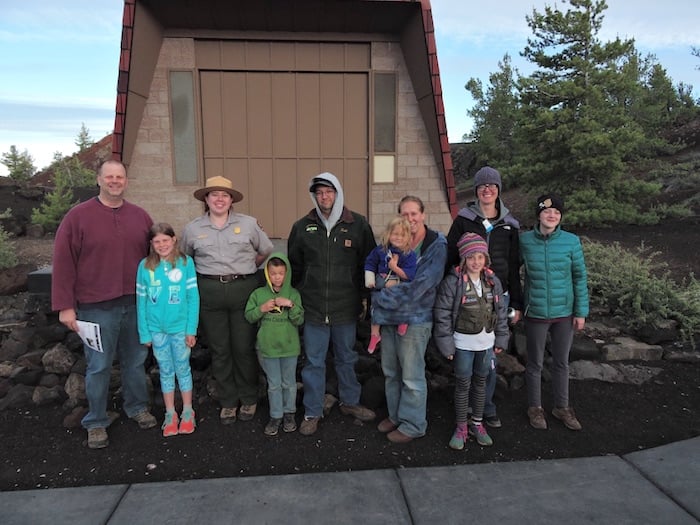
Everyone in the big room watched and smiled as she did. Another time I watched as six parents and three children all raised their hands to become Junior Rangers. Every evening at the amphitheater, kids may bring their parents for a Junior Ranger activity. I tagged along one night and watched as Ranger Hester Mallonee capably met the challenge of keeping four little ones and four older ones engaged and interested. She did an awfully good job of keeping the 3- and 4-year-olds more or less on the job while still maintaining interest of the older ones. In some parks, Junior Rangers are divided into a couple of age groups with appropriate activities and materials for older and younger children. But that probably is limited by the number of interpreters available.
When Ranger Hester had finished, it was time for the whole mob to stand up and recite the pledge, despite some problems deciding which hand was left and which was right.
Personally, I think teaching Junior Rangers is one of the most important things park interpreters are doing these days. Anything that may attract, educate, and help gain continued interest in our parks is vital. This builds the future. I’ve noticed, too, that much of what’s taught is aimed more at parents than their children.
What tickles me most, though, is the very obvious seriousness older kids bring when they make the solemn promise to protect the parks and all they contain. Most of those kids take it very seriously, and I have no doubt the memory will be a lasting one.
I also have no doubt we’ll really need those kids someday.
Stories about:
Story Categories:
A copy of National Parks Traveler's financial statements may be obtained by sending a stamped, self-addressed envelope to: National Parks Traveler, P.O. Box 980452, Park City, Utah 84098. National Parks Traveler was formed in the state of Utah for the purpose of informing and educating about national parks and protected areas.
Residents of the following states may obtain a copy of our financial and additional information as stated below:
- Florida: A COPY OF THE OFFICIAL REGISTRATION AND FINANCIAL INFORMATION FOR NATIONAL PARKS TRAVELER, (REGISTRATION NO. CH 51659), MAY BE OBTAINED FROM THE DIVISION OF CONSUMER SERVICES BY CALLING 800-435-7352 OR VISITING THEIR WEBSITE. REGISTRATION DOES NOT IMPLY ENDORSEMENT, APPROVAL, OR RECOMMENDATION BY THE STATE.
- Georgia: A full and fair description of the programs and financial statement summary of National Parks Traveler is available upon request at the office and phone number indicated above.
- Maryland: Documents and information submitted under the Maryland Solicitations Act are also available, for the cost of postage and copies, from the Secretary of State, State House, Annapolis, MD 21401 (410-974-5534).
- North Carolina: Financial information about this organization and a copy of its license are available from the State Solicitation Licensing Branch at 888-830-4989 or 919-807-2214. The license is not an endorsement by the State.
- Pennsylvania: The official registration and financial information of National Parks Traveler may be obtained from the Pennsylvania Department of State by calling 800-732-0999. Registration does not imply endorsement.
- Virginia: Financial statements are available from the Virginia Department of Agriculture and Consumer Services, 102 Governor Street, Richmond, Virginia 23219.
- Washington: National Parks Traveler is registered with Washington State’s Charities Program as required by law and additional information is available by calling 800-332-4483 or visiting www.sos.wa.gov/charities, or on file at Charities Division, Office of the Secretary of State, State of Washington, Olympia, WA 98504.


Comments
Thanks, Lee, for your insights both hopeful and dreadful.
I share Rick B's sentiment. I have a friend going to Craters this summer. I almost shared this with him, but as a recently retired GS employee, I figured he'd "been there, done that" regarding hiring, personnel, etc.
Paul Fritz left a unique legacy for the Park Service: IN MEMORIAM
Stephen Stuebner Jan. 29, 2001From the print edition
We have reached a time when many conservation legends of the 20th century are disappearing. David Brower, the environmental giant, is a recent example. Now we've lost a lesser-known but very influential conservationist. Paul Fritz died quite suddenly on Christmas Eve from an undiagnosed brain tumor. He was 71.
Fritz's generation possesses a pure conviction for preserving wild places, and a strong sense of duty to their country. They came of age on the heels of the Depression. They watched young friends and family members die from medical maladies that are easily treatable today. Many of them served in the military. They knew that life was precious, and they lived it with gusto.
"The young Americans of this time constituted a generation birth-marked for greatness," wrote Tom Brokaw in The Greatest Generation.
Fritz's fiery personality was a product of growing up in Yonkers, N.Y., where he was a street fighter and high school football player. Every once in a while in later years, Fritz's temper would emerge when a pro-development foe pushed him too far, and he'd threaten to grab the tire iron from the trunk of his car and take him on.
Fritz even looked like a thug - with his broad shoulders, thick neck, bald head and big piercing eyes. "He was like a bull charging through the woods," says Martin Litton, a Sierra Club national board member and Grand Canyon boatman.
He had a soft side, too, and a big heart.
Fritz was bitten by a zeal to protect wild places when he spent his college summers as a fire lookout at Yellowstone National Park. In his 20-year career with the Park Service, he had a major hand in protecting all kinds of parks and monuments in the West, including Redwood, Arches, Canyonlands and Crater Lake National Parks, Craters of the Moon National Monument, and many of Alaska's parks, monuments, refuges and wilderness areas.
Fritz was politically savvy. He hung out with environmentalists at parties. He contributed to the campaigns of moderate and powerful Republicans. He worked side by side with Ed Abbey at Arches National Park. He knew county commissioners, chamber of commerce directors and educators - all of the people it takes to build support for a park.
After Fritz retired from government service, he joined the boards of a number of grassroots environmental groups in the West, including the Alliance for the Wild Rockies, Hells Canyon Preservation Council and the advisory board of the Oregon Natural Desert Association. He gave money to many other groups, including the Southern Utah Wilderness Alliance and Greater Yellowstone Coalition.
Fritz received "The Sargent Award" from the GYC in the fall of 2000 for not only being a founder of the group, but also for the legacy he's left in his wake.
"Paul was one of a kind," says good friend Michael Frome, a widely published conservation writer. "He was independent and outspoken, shall we say, and he got away with it. He was a public servant who really served the public, above all."
I'd never heard of Paul Fritz until right now. It sounds like we need a lot of folks just like him these days. Thanks for introducing us to him.
Lee, what a wonderful article! and, I agree with your insights and about the title Ranger needing to be earned.
Lee,
We knew Paul Fritz as an outstanding Landscape Architect at
Crater Lake NP: Several Memories: when traveling the south road
Hwy 62 from the Entrance Panhandle to Annie Springs, all the
curved pullouts including both Annie Falls, and Lodgepole, etc.
are there today because Fritz spared/saved them when the south
road was being rerouted; they were curvey sections from the earlier road.
Paul worked at Craters of the Moon once Director George Hartzog
asked him to be Superintendent; Paul was truly a 24/7 day workaholic:
"The idea of making Craters of the Moon a national park isn't new. Supporters of the idea point to Coolidge's words when he declared the monument — "now Idaho has its own national park" — as evidence that it was always the intended next step. Craters Superintendent Paul Fritz proposed it in 1969."
http://magicvalley.com/craters-park-advocates-hope-new-name-would-bring-...
Paul was Keyman for The Craters of the Moon Wilderness:
(where his cremated ashes may blow in the wind today)
"Designation of the 43,243 acre Craters of the Moon National Wilderness Area was signed into law on October 23, 1970. With that legislation lands within Craters of the Moon National Monument and Petrified Forest National Park became the first within the National Park System to be designated as wilderness."
https://www.nps.gov/crmo/planyourvisit/wilderness.htm
More Memories: We first knew Paul Fritz during the early years of Redwood NP
borne in Timber Industry Controversy and planned by NPS, Paul, among others,
Save-The-Redwoods League,
Sierra Club and The National Geographic Society locating Tall Trees Grove.
in the Lower Redwood Creek Watershed.
Paul proposed that the RNP Park HQ be placed near both Arcata and Humboldt
State University, but the land swept clean by the Crescent
City 1964 Alaskan Tsunami was donated by the City for Park HQ. Today, many staff
waste precious work hours as "driving yo-yos" on Hwy 101 traveling north and south.
Glad to see Craters of the Moon get showcased, since to me it's one of the best-managed parks I know, even with the financial and staffing issues. They've done some fine leveraging of NPS staff shortages by hiring volunteers like the ones described here - science-oriented people who work with the NPS in a win-win situation. The showcase project is one in which Craters partners with NASA - which will include intepretation during the eclipse by NASA people.
I'm also glad someone is raising some of the long-overdue staff concerns and budget concerns.
The promotion beyond ranks sounds like a variation of the old "Upward Mobility" program in place when I worked as an NPS ranger. Not a bad idea, but when it's imposed for political reasons it almost guarantees politicos will be the ones promoted. Eventually, it becomes an agency in which the Peter Principle rules, and managers are simply not competent. (One of the least-qualified people I ever worked with, who did nothing to earn it, is now a superintendent somewhere - if that's not the Peter Principle at work....) On the other hand, with promotion based on politics, ability and experience counted for little - I, too, left, even though I was Career-Conditional when it was clear that I had no future there - in spite of an MA in outdoor ed, teaching experience, and even a commendation for service above and beyond during the 1989 Quake. (In the pre-Nixon Civil Service days, you didn't even get in the door without a high score on tough exams and a challenging interview, and you didn't get promoted without high evaluations.) (I went to NASA, quadrupled my income, and became one of 40 national educators who worked much like good NPS interpreters, but in the field.)
This is not intended as sour grapes, but a personal example which illustrates the problem. The NPS is now exactly where the national parks were before TR, Lane, and - most of all - Mather, Albright, and company cleaned house. We need another Mather. But until one shows up, we need to return to Civil Service exams, build new and agressive pro-NPS campaigns to get money in and politics out, and make sure hiring and promotion don't encourage Peter and his Principle.
I've also worked as a volunteer for the NPS. I met some fine and dedicated volunteers. I met some deadwood. In parks where the managers were clearly upward mobility people and very political volunteers tended to be politicized deadwood. In parks where managers were talented and dedicated and field-experienced, volunteers worked professionally - and never called themselves "rangers." The truth, however, is that it costs as much to manage volunteers as to hire seasonals to do the same work. So one wonders if the vaunted Volunteer Program, a gift of the first Bush, is not in truth intended to water down the quality of the Rangers' work. Also, with volunteers, you often get what you pay for.
Again, thanks for a profile of a good park, well-managed, and for raising this important issue.