

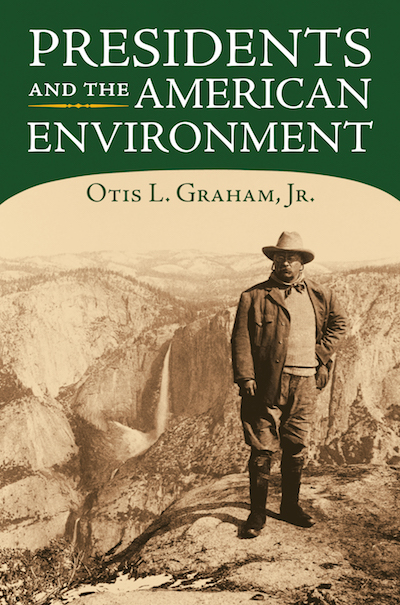
A distinguished historian of the New Deal and American reform, Otis L. Graham, Jr. now offers us a monumental look at the presidency. Nor in preparing this book was he unmindful of the current election cycle. Who will be our next president, and of special relevance, will he or she be concerned about the environment?
It’s a crapshoot, we are left to gather. To be sure, little more than half of our modern presidents, Graham concludes, have boldly set aside portions of the public lands, let alone determined to protect the total environment.
With regard to the public lands, the boldest was of course Theodore Roosevelt, who literally, proclamation by proclamation, tripled the national forests. His distant cousin, Franklin D. Roosevelt, followed closely in his footsteps, then added the conviction (still controversial) that federal regulation should also apply to private lands deemed essential to forests, waters, and soils.
Simply put, those presidents standing highest in our estimation probably served the environment well. Those we think mediocre probably failed it. That is a summation, and no doubt a generalization, but I still think it explains the truth of the presidency. Great presidents live on in the culture.
We thus instantly think of Theodore Roosevelt when it comes to the public lands. We just as immediately think of Harding, Coolidge, and Hoover as disappointments, and yes, Woodrow Wilson for having signed the bill authorizing the damming of Hetch Hetchy.
Now comes Professor Graham to put flesh on the bones of our first impressions. As his critical point of departure, he begins with the Forest Reserve Act of 1891, the first legislation of its kind, he notes, with broad implications for environmental policy.
Including Benjamin Harrison, who was president in 1891, Graham analyzes all 22 presidents since the Forest Reserve Act, ending with Barack Obama. Beyond the public lands, Graham increasingly asks, what did each president understand to be “the environment,” and what actions, if any, did he take to protect it?
Here I will admit to some frustration. Instead of organizing his narrative around the environment, Professor Graham treats each president in chronological order. This makes for a confusing narrative as more “environments” are introduced. What begins simply enough as a discussion of the public lands is suddenly a smorgasbord of major issues.
But yes, it is the reviewer’s obligation to review the book as written, not as the reviewer might have written it. That said, I find my second quibble truly perplexing. The index to this 400-page book is barely three pages long.
I sympathize. Preparing a comprehensive index is a pain. However, for any press, let alone a university press, allowing a shortcut is unacceptable. A book so obviously intended to serve as a reference requires a detailed index.
But enough of quibbling about the format. This will indeed prove a durable book. Professor Graham has assured that by not playing favorites. Yes, he is liberal in his political leanings insofar as the reader can discern. No matter, he lets the action tell the story. This is a solid, professional history. No president gets a “pass” on the “uncomfortable” facts of his administration, whatever those facts might be.
These days, that is difficult for any historian to do — or journalist. Thus we may forgive Professor Graham when he occasionally slips, for example, by noting that every president preceding Barack Obama was somehow a privileged, Caucasian male.
Fine. Let’s get it off our chest. And the moment we do Professor Graham reminds us that Mr. Obama has not been a great environmental president himself.
Other than by joining his predecessors in proclaiming national monuments, he has virtually no environmental record of his own, nor did he when seeking the presidency.
“Obama’s record was virtually nonexistent in state office, where he focused on racial and urban issues. As a US senator he briefly had a position on an environmental committee in which he had no real interests and on which his voting record was made skimpy by frequent trips home to Chicago.” (p. 339).
As for growing up in paradise (Honolulu, Hawaii), it hardly left a mark. “He and his biographers tell of basketball games, long walks through the city, movies seen, hanging out at Mr. Burger’s Drive-In, dabbling in beer, cocaine, and marijuana. It might have been Topeka, Kansas, where his mother was raised.” (p. 339)
Then how did Mr. Obama get elected president? On “fuzzy promises of ‘change you can believe in’,” Professor Graham concludes, quoting the journalist Joseph Lelyveld. Obama “moved many voters, especially the young.” (p. 338)
All of it, Graham admits, proved “a surprise to me — and disappointing for what was not in his story.” Having himself lived on Oahu for three years, Graham had found it “a sensory delight in all days and seasons.” Why had not Obama, beyond a stray remark or two, acknowledged he felt the same?
This is to reveal the honesty that pervades this book. Nor should we naively believe that the environment was ever any president’s priority. Assassination brought TR into the White House; the Great Depression launched FDR. Quite by accident, and purely by virtue of their personalities, both then acted for the good of the land.
A child of the city, Barack Obama never learned how to act in nature. “Obama was and is what his mother and grandfather taught him to be before he started teaching himself in that same direction — a conventional, urban liberal, civil-rights oriented ‘neighborhood activist’ of familiar views and no managerial experience or instincts, who wishes many causes well. Environmentalists should look elsewhere for a leader who has slept under the stars and, if Hawaiian, knows and cares that the islands’ coral reefs are dying underneath the Pacific’s emerald waters as they slide upward across the beaches.” (p. 366)
Then will we ever have such a president? Again, Professor Graham’s assessment leaves many doubts. In Arkansas, Hillary Clinton has already proved herself a major disappointment. “Neither Bill nor Hillary or apparently any of his top aides in the governor’s Little Rock command post had a strong interest in nature — no green lieutenants.” Both Clintons had rather sold out to large corporations, led by Tyson’s foods. (p. 310)
That leaves Donald Trump, who, when this book was published, was barely on the presidential radar. Trump an environmental president, then? Professor Graham hardly thinks so. “The Donald Trump high-end hoteliers or the religious, ethnic, or other private groups would have bought and controlled access to Yellowstone, Yosemite, Grand Canyon, Crater Lake, and many others,” he concludes. (p. 359) Actually, high-end hoteliers did — as railroads. If Mr. Trump were as inclined to protect the parks, he might not be so bad after all.
But that is the parks and not the rest of the environment, which Professor Graham worries about even more. At least he is consistent when addressing climate change. Where do rising temperatures come from? Yes, from CO2. But they are also directly linked to overpopulation, which he is no less willing to criticize and interpret. If you deforest the world, and overpopulate it, there is little sense in just blaming CO2.
Here again, the presidential record is mixed. Most presidents ignored overpopulation or sidestepped it, even to the point of relaxing our immigration laws, such as Lyndon Johnson, or agreeing to amnesty, such as Ronald Reagan.
As I said, this was not an easy book to write. These days, every “safe” history begins with condemning our forebears for their failures. Professor Graham reminds us how we are failing, too.
If we are to remain strong, we need a strong environmental president, he concludes. And yes, that means limiting population, including immigration. After all, every environmental problem now begins with growth. Thus our next president, if intending to protect the environment, will start by addressing that truth.
Story Categories:
A copy of National Parks Traveler's financial statements may be obtained by sending a stamped, self-addressed envelope to: National Parks Traveler, P.O. Box 980452, Park City, Utah 84098. National Parks Traveler was formed in the state of Utah for the purpose of informing and educating about national parks and protected areas.
Residents of the following states may obtain a copy of our financial and additional information as stated below:
- Florida: A COPY OF THE OFFICIAL REGISTRATION AND FINANCIAL INFORMATION FOR NATIONAL PARKS TRAVELER, (REGISTRATION NO. CH 51659), MAY BE OBTAINED FROM THE DIVISION OF CONSUMER SERVICES BY CALLING 800-435-7352 OR VISITING THEIR WEBSITE. REGISTRATION DOES NOT IMPLY ENDORSEMENT, APPROVAL, OR RECOMMENDATION BY THE STATE.
- Georgia: A full and fair description of the programs and financial statement summary of National Parks Traveler is available upon request at the office and phone number indicated above.
- Maryland: Documents and information submitted under the Maryland Solicitations Act are also available, for the cost of postage and copies, from the Secretary of State, State House, Annapolis, MD 21401 (410-974-5534).
- North Carolina: Financial information about this organization and a copy of its license are available from the State Solicitation Licensing Branch at 888-830-4989 or 919-807-2214. The license is not an endorsement by the State.
- Pennsylvania: The official registration and financial information of National Parks Traveler may be obtained from the Pennsylvania Department of State by calling 800-732-0999. Registration does not imply endorsement.
- Virginia: Financial statements are available from the Virginia Department of Agriculture and Consumer Services, 102 Governor Street, Richmond, Virginia 23219.
- Washington: National Parks Traveler is registered with Washington State’s Charities Program as required by law and additional information is available by calling 800-332-4483 or visiting www.sos.wa.gov/charities, or on file at Charities Division, Office of the Secretary of State, State of Washington, Olympia, WA 98504.


Comments
While I was in Lassen Volcanic National Park last week, I met a man from Germany. We had a long and wide ranging talk. He finally asked about our upcoming election. One of his remarks stood out: "In Europe, we don't know whether to laugh at you or cry for you."
Apparently he hasn't been home for a while. His country is a mess.
I will have to read this book to find out for sure, but I think there are several items missing here. The greatest environmental president of modern times is Jimmy Carter, who championed the Alaska National Interest Lands Act which doubled the size of the National Park System. President Carter has also written several books about his environmental interests, and has been an avid fly fisherman, being the last sitting president to sneak away on weekends to go fly fishing on the streams of central Pennsylvania. President Bill Clinton helped enact the California Desert Protection Act in 1994, creating our largest National Park in the lower 48 states, Death Valley. President Clinton also negoatiated an end to most of the timbeer wars in the Pacific Northwest, severley limiting logging in rare old growth forests. His advisor, John Podesta encouraged him and later President Obama to use the power of the executive to create new national monuments, many of which in controversial areas such as southern Utah and northern Maine. The spirit of Teddy Roosevelt might be diminished one hundred years later, but still shines on with these presidential actions.
Dear Ed,
Yes, all of what you mention is in Dr. Graham's book. It's just that, as he notes, national monuments are but one factor in environmental protection. As for me, the poor reviewer, it is virturally impossible to fully summarize everything in a 400-page book. By all means, I urge you and everyone else to read it. You will not be disappointed that you did.
Donald Trump has shown no signs that he has barely stepped foot outside of a temperature controlled concrete bubble. Let's get real. The guy has also proven in his rhetoric that he has little understanding of the scientific method (http://www.scientificamerican.com/article/grading-the-presidential-candi...), and even less regard for environmental protection when it comes to carving up lands for golf courses.
Let's be real. What matters is history and the clintons at least have some decent history in regards to placing a strong conservationist to run the department of the interior. Bruce Babbitt was one of the greatest architects in the DOI. If you think Donald's son is going to be a good head of the DOI, then I just got to shake my head. Can there be anything worse than a system ran on nepotism and despotism?
I do agree that population should be limited, and overpopulation is a threat. But, to limit population growth by handing out birth control like it is candy is perhaps the best of all options. It's proven that women that have access to cheap and affordable birth control limit unexpected births compared to other areas of the world that don't have the same advantage.
No need to create a totalitarian regime that imposes suffering, and giant walls. Europe is still recovering from Hitler and his regime. He had the same sort of opinion on immigrants, and people that didn't look like him.
I don't know if I want to see a planet built on increased fear with the proliferation of nuclear hostilities, which someone like Trump will bring to the table. If we wake up in 4 years, and half the planet is radioactive, or large portions are annhilated, then what good will that do us for conserving what is left?
Thank you Gary Wilson for your comment and Al Runte for an interesting book review. It is a little premature to judge either presidential candidate on their prospective environmental record if elected, but Mr. Trump, as Gary points out, is a stretch to say the least. I must read the book, but I think President Obama, has faced obstructionism without parallel while President, in least in my lifetime, He has a better record on the environment and environmental justice issues than given credit in this review. Alfred, I do agree that discussing population and its effect on the world and its resources is of the utmost importance. It is hard to do when most mainstream politicians have no desire to discuss it. Attacks on efforts to empower women, educate people to a women's reproductive health choices and then throw in education in family planning, are seen as an insurmountable barrier to getting elected to public office. That is a reality.
When republicans are in office, land conservation is generally at a minimum. When a democrat is in office, there are many attempts at conserving many types of habitat. I know because I have 25 years in land acquisition in the Fish and Wildlife Service and have experienced this firsthand.