
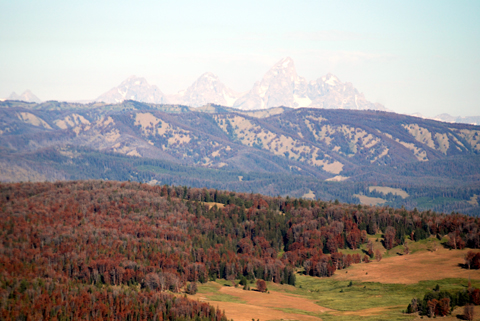
A forest of red between Dubois, Wyoming, and Grand Teton National Park shows the impact mountain pine beetles are exacting on the Greater Yellowstone Ecosystem. Kurt Repanshek photo.
Dubois, Wyoming -- As ecological drivers go, you wouldn't think an insect roughly the size of a rice grain would be that significant in the Greater Yellowstone Ecosystem. And yet, the mountain pine beetle, aided by a warming climate, is poised to send quite a shudder through the ecosystem.
Spanning roughly 20 million acres, the ecosystem that is home to Yellowstone and Grand Teton national parks is renowned for its diversity of wildlife. Bison, elk, pronghorn antelope, moose, mule deer, bighorn sheep, mountain lions, wolverines, martens, wolves, black bears and grizzly bears all can be found in the ecosystem.
The mountain pine beetle long has been another player in the ecosystem, having evolved right along with the lodgepole pine forests. Indeed, forest ecologists view the beetle as a natural agent for thinning forests. But climate change is enabling this beetle to make longer and longer forays into the upper elevations of the ecosystem, inroads that are seriously jeopardizing another key species, one whose disappearance could have dire ramifications for the overall health of the Greater Yellowstone Ecosystem in general and the grizzly bear specifically.
"What's occurring here is the potential loss of an ecosystem," says Dr. Jesse Logan, a retired U.S. Forest Service entomologist who is a leading expert on the mountain pine beetle.
Dr. Logan's comments came during a recent trek into the Wind River Range above Dubois, Wyoming, to see the extent of beetle infestation into the mountains' whitebark pine forests. From the air the impact is easy to spot -- infested trees first turn red as their needles die, and then go a ghostly grey as the needles fall off.
Since lodgepole pine co-evolved with the beetle, that species has developed an on-board defense system that can slow the beetles -- thick, gooey resin that smothers the bugs, and even an odor that drives them away. Beyond that, the trees rapidly reforest themselves.
Whitebark pines, however, did not co-evolve with the beetles and have no similar defenses. They also can take 75 years of growth before they sprout their first pine cone. Plus, they rely largely on the Clark's nutcracker, which feasts on whitebark seeds, to, basically, plant new whitebark pine stands by caching seeds that later go on to germinate.
Barring a dramatic change from the current course of events, the beetles will wipe out the mature whitebark pines. And the ripples of that episode will be felt throughout the ecosystem.
The problem, you see, is that in the Greater Yellowstone Ecosystem the whitebark pine is a key component of the grizzly bear's fall diet. As the days grow shorter and the temperatures fall, grizzlies spend most of their waking hours trying to pack on the pounds. Whitebark pine nuts are particularly nutritious, and in the Greater Yellowstone Ecosystem grizzlies seek out squirrel middens piled high with the pine cones to feast on.
Studies in the ecosystem have shown that when there's a good whitebark pine nut crop, sows gorge on them and head into hibernation both fatter and healthier. A key result is that they have larger, and healthier, cub litters than sows who go into hibernation with depleted reserves, says Louisa Willcox, who has been the Natural Resource Defense Council's Wild Bears Project director since 2003.
"Whitebark pine is the engine that dries the health of this (grizzly) population, and it's in trouble," she said during the visit into the Wind River Range south of Yellowstone and east of Grand Teton to examine the health of the whitebark pine forests.
Unlike the Northern Continental Divide Ecosystem, which encompasses Glacier National Park, Ms. Willcox says Greater Yellowstone grizzlies have fewer choices to obtain their protein and calories from in fall. Glacier has much more extensive berry patches the bears can forage on. Too, the introduction of non-native lake trout into Yellowstone Lake has greatly impacted that body of water's native cutthroat trout population, and its shrinkage has limited that food source for the bears.
While there were extensive outbreaks of mountain pine beetles back in the mid-1930s and again in the 1970s, those were small compared to the one currently under way, according to Dr. Logan. Not only is much of the Intermountain West under siege, but so is a giant swath of British Columbia. When compared to the past infestations, he says, the current one is larger by "orders of magnitude."
Stopping the beetles in the past have been cold snaps. We're talking cold snaps in the range of 40 below zero for ten days in a row. In recent decades those have been very few and very far between, most recently because of the warming climate.
Dr. Steven Running is a terrestrial ecologist from the University of Montana. His primary research interest lies within climatology. A chapter lead author for the 4th Assessment of the Intergovernmental Panel on Climate Change, Dr. Running has more than a passing understanding of what's happening to the Earth's climate. In the Greater Yellowstone Ecosystem, he says, the warming temperatures that benefit the mountain pine beetle likely will doom the whitebark pine forests.
"If you take a regional look there may be some other ridges that are doing better, but to be realistic it's hard to image that these old-growth ones (will survive)," he says. "They're already dead. They're standing dead now. So there's no kind of miracle that can wake them up."
Even if the world's populations somehow managed overnight to vastly reduce the greenhouse gas contributions that are driving climate change, Dr. Running adds, it still would take decades for the warming to stop.
"If emissions dropped to 'stability point' tomorrow, we still have 20, 30, 40 years worth of warming already in the oceans," he says. "And so the trends we're on are going to continue more or less for decades."
Adding to the impact of the beetle's latest outbreak is the rampant spread of white pine blister rust, an invasive disease thought to have arrived in 1910 in British Columbia from France with imported eastern white pine seedlings. More than a few trees along Togowotee Pass between Dubois and Jackson and just south of Yellowstone already are infected with this disease.
While there are efforts under way to establish a strain of whitebark pine trees resistant to blister rust, there's no good solution to halting the mountain pine beetle, short of very, very cold winters. While a synthetic pheremone has been developed to ward off the beetles, its success has been limited.
"Blister rust can take years to kill a tree," says Dr. Diana Six, a forest entomologist at the University of Montana who specializes in bark beetles. "When you have a beetle mass attack, it can take three or four days. It's just amazing because it doesn't take much to kill these trees."
Down through the centuries whitebark pine forests have survived forest fires and droughts as well as previous beetle outbreaks. The current outbreak, however, seems poised to be the species' undoing.
High in the Winds, near 10,000 feet, Dr. Diana Tomback, a professor of biologist at the University of Colorado in Denver whose interests cover evolutionary and behavioral ecology as well as forest ecology, stares at a massive whitebark pine that probably germinated 1,000 years ago. Telltale beetle holes in its bark and "frass," a reddish, sawdust-like excrement beetles kick out of their holes, signal not just the tree's infestation with the pine beetles, but also its death.
Dr. Tomback refers to the tree as a "zombie," the walking dead because the infestation is an incommutable death sentence.
"This is a big boy here. It's another heart-breaker. It's really old," she says. "All the remaining old growth up here are really old. The survivors are not surviving."
Story Categories:
A copy of National Parks Traveler's financial statements may be obtained by sending a stamped, self-addressed envelope to: National Parks Traveler, P.O. Box 980452, Park City, Utah 84098. National Parks Traveler was formed in the state of Utah for the purpose of informing and educating about national parks and protected areas.
Residents of the following states may obtain a copy of our financial and additional information as stated below:
- Florida: A COPY OF THE OFFICIAL REGISTRATION AND FINANCIAL INFORMATION FOR NATIONAL PARKS TRAVELER, (REGISTRATION NO. CH 51659), MAY BE OBTAINED FROM THE DIVISION OF CONSUMER SERVICES BY CALLING 800-435-7352 OR VISITING THEIR WEBSITE. REGISTRATION DOES NOT IMPLY ENDORSEMENT, APPROVAL, OR RECOMMENDATION BY THE STATE.
- Georgia: A full and fair description of the programs and financial statement summary of National Parks Traveler is available upon request at the office and phone number indicated above.
- Maryland: Documents and information submitted under the Maryland Solicitations Act are also available, for the cost of postage and copies, from the Secretary of State, State House, Annapolis, MD 21401 (410-974-5534).
- North Carolina: Financial information about this organization and a copy of its license are available from the State Solicitation Licensing Branch at 888-830-4989 or 919-807-2214. The license is not an endorsement by the State.
- Pennsylvania: The official registration and financial information of National Parks Traveler may be obtained from the Pennsylvania Department of State by calling 800-732-0999. Registration does not imply endorsement.
- Virginia: Financial statements are available from the Virginia Department of Agriculture and Consumer Services, 102 Governor Street, Richmond, Virginia 23219.
- Washington: National Parks Traveler is registered with Washington State’s Charities Program as required by law and additional information is available by calling 800-332-4483 or visiting www.sos.wa.gov/charities, or on file at Charities Division, Office of the Secretary of State, State of Washington, Olympia, WA 98504.


Comments
Is climate change the simple & direct cause of the current outbreak of Mountain Pine Beetle? It might be, but commonly events like this beetle-infestation reflect a set of often complexly-interacting factors, and the precise cause-and-effect train entails a lot of uncertainty ... 'mystery', even.
For example, at this very moment astronomers and a large array of other 'interested professionals' are squirming in their chairs, waiting for the beginning of the next sunspot cycle. The previous cycle hit rock-bottom some months ago and we are now sitting in the trough, or lull. This lull has had an exceptionally (record?) low number of sunspots, leading to speculation that something unusual may be in the offing for the coming cycle. Astronomers are anxious to test several competing models of sun-behavior against the pattern of the new cycle. The tip-off lies in the precise way that the new cycle begins.
Earth-bound natural-science professionals are anxious to see whether any correlations are evident, between the unusual current and potentially coming sunspot behavior, and their respective fields of study. Climatology, zoology, botany, ecology and others all show some degree of linkage between sunspot cycles, and events in these fields. Again, not usually a 'simple & direct' causation, but a complex of interactions.
On the Arctic Ocean this summer, young, thin ice blanketed an almost historically normal amount of the ocean surface well into August. This resurgent icecap coverage would most likely have resisted melting and lasted into fall ... serving to reflect the sun's energy and prevent warming of the ocean's water. As it happened, an unusual and unseasonal windstorm broke apart the ice and expose most of the water that was exposed in recent summers - due previously mainly to unusual melting, which did not take place this summer.
The fact that the new ice held together for much longer this summer, and did not melt (it just broke apart, and will mostly re-freeze as more-compact 'jumble-ice') is a significant deviation from the recent pattern of a progressively thinning & retreating Arctic Ocean summer icecap. We will be watching very closely next summer, to see whether this summer's apparent rebuilding of the Arctic icecap continues, or whether 2008 was just a blip in a otherwise relentless melting of far-northern ice-coverage.
Much has been made of the retreat of Arctic Ocean summer-ice. Many who hold that climate change is driven by anthropogenic CO[sup]2[/sup] have made strong claims for a fairly simple & direct cause & effect. This summer, however, was obviously 'bad news' for those who point to the Arctic Ocean ice and demand, "See? See what humans are doing?".
Well, maybe events in the Arctic Ocean are an effect of climate-change, and maybe it's due to something more complex, and subtle. If it is due to climate change, maybe the cause of that change is human-generated CO[sup]2[/sup], and maybe it's a little more complicated. Whatever the actual case, there is no doubt that proponents of anthropogenic climate change have shoved a lot of chips into the center of the table, betting their credibility that a few summer's melting trend on the Arctic Ocean will continue.
In 2009, we may have the opportunity to see why 'traditional' science professionals are reluctant to make simple cause & effect assertions about large-scale natural phenomena. Buy your tickets early and get a good seat - it could be quite a show!
Normal Plants May Emit Methane - in the open air
This is a story that hit the natural-sciences world like a ton of bricks, in the last couple years. Environmental scientists - not to mention activists & enthusiasts - often reacted with disbelief. Methane is a greenhouse gas, like CO[sup]2[/sup], only much stronger.
It is generally known that decomposing plant matter sealed off from atmospheric oxygen generates methane (anaerobic). That plants growing normally in the oxygenated air (aerobic) can also emit methane is a new & dramatic assertion. If it is true and the quantity is at all significant, there will be serious & fundamental ramifications for climate models and climate-change theories.
The original work was done by Dr. Frank Keppler, at the Max Plank Institute of Germany. Subsequently, Dutch workers who doubted the possibility devised a highly elaborate experimental set-up, which failed to show an emission of methane from plants. Since then, though, additional workers have used simple (conventional) plant-gas measuring set-ups, and they too are finding emissions of methane from living & dead plant matter, in the presence of oxygen.
There is a correlation between the generated methane, and the light that falls on the plant material. Ultraviolet light seems particularly implicated. This would make the effect photosynthetic, rather than metabolic. Another example of an unexpected photosynthetic effect is the generation of hydrogen peroxide from water on the surface of exposed wood. This is why unpainted lumber and dead trees in the forest turn silvery-gray - the hydrogen peroxide bleaches the wood ('peroxide blonds' use the bleaching action of hydrogen peroxide on their hair).
There is a current article updating this topic at the Environmental Research website, titled "Plants emit methane even in presence of oxygen". This article basically confirms the preliminary results found by Keppler.
[hr]
Plants do emit large amounts of reactive hydrocarbons. The 'smoke' of the Smokey Mountains is a haze of terpenes, isoprenes and assorted volatile hydrocarbons emitted by trees. The same effect is visible around the world. Plants give large amounts off materials which would be classed as pollutants, if they originated from human activities. Phytoplankton in the ocean does the same thing.
As the plant-methane story unfolds, perhaps the greatest value it will bring us is to remind that complex systems are full of surprises, and that simple cause & effect acccountings - such as the popular assumption that humans are causing observed climate changes by releasing CO[sup]2[/sup] - are unlikely to hold up well as the situation becomes better-understood.
Kurt, thank you for a beautifully written and thought-provoking piece. I hope you will write more about the effects of global climate change on our national parks. Are you planning on writing more regarding actions the national parks are doing to prepare for climate change or to adapt to it? I understand that response to the issue varies quite a bit among the parks.
Kelly,
Thanks for your kind words. I am indeed planning more climate change pieces. I've several work-related projects tied to climate change, and you'll see the results on the Traveler at the appropriate time.
I wasn't aware that climate change was so serious. I thought we were just talking about a quarter of a degree or so. I don't understand how such a very small change in temperature can change the temperature variances on the mountains.
A very interesting discussion of a complex - and very important - topic. The connection between the beetle and the grizzly was fascinating!
As Kurt notes, the results of mountain pine beetle infestations can be seen in large parts of the west. Another inevitable result will be some dramatic fires in coming years.