
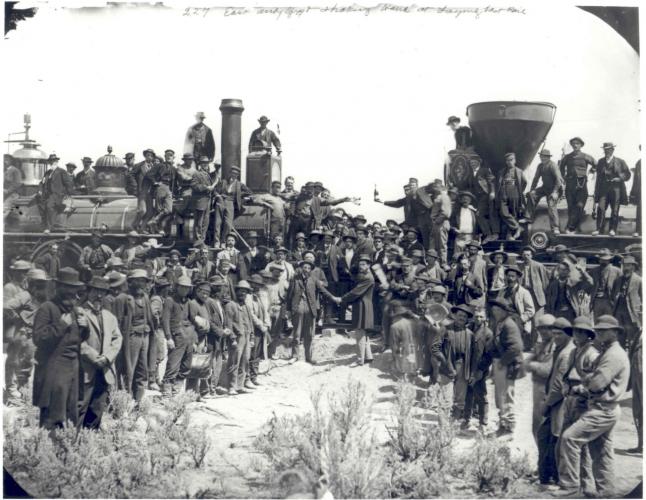
Top to bottom: Historic meeting of the rails at Promontory, Utah, May 10, 1869/Library of Congress; NPS fireman Michael Ostereich primes the refurbished boiler on Jupiter, before the insulation and steel jacket are replaced/Patrick Cone; Locomotive engineer Steve Sawyer/Patrick Cone
This sage-covered valley in northern Utah is not on the way to anywhere, unless you're a railroad and history fan. For it was here, on that May 10th, 146 years ago, that a grand undertaking came to its celebratory conclusion: the meeting of the Transcontinental Railroad, and two grand locomotives.
With the driving of the Golden Spike the Central Pacific, which had clawed its way across the High Sierra and vastness of the Nevada Desert, and the Union Pacific, which rolled across the plains and through the Rocky Mountains, completed a steel artery of commerce and transportation.
Union Pacific No. 119 and the Central Pacific No. 60 (better known at Jupiter) faced each other amidst a crowd of dignitaries, engineers, and railroad workers as the final rails were laid and spikes were driven. President Abraham Lincoln's dream of a transcontinental railroad was complete.
Golden Spike National Historic Site at Promontory, Utah, commemorates this event, and stages daily reenactments of this meeting with two, colorful replica engines. And this May 10th, they'll look and run better than ever after having undergone a thorough refurbishing.
The original two engines were scrapped for their metal in the early 1900s, but in 1979 two massive replicas were built at a cost of nearly $750,000 apiece, in Costa Mesa, California, by inventor Chad O'Connor. He had a passion for steam.
Every 15 years these two locomotives are disassembled, their boilers cleaned and tested, and more than 166 fire tubes replaced. There's more than 500 feet of tubing in each engine, they weigh 62 tons apiece, and make steam from treated water the old-fashioned way: 119 burns coal, and the Jupiter is wood-fired. During this overhaul the boilers are pressure-tested, the gauges and brass bells and whistles are brightly shined, and the funneled smokestack is repainted, ready for their big day. The estimated cost for the refurbishment is $500,000.
Jupiter is red and blue, while No. 119 is mostly red with black. Jupiter has a bright blue cowcatcher and a large funnel, while No. 119's cowcatcher is red with a straight smokestack. The red drive wheels are as tall as most men, and the pistons are shined to a mirror finish. There are hand-painted scenes adorning them from Disney animator Ward Kimball.
Steve Sawyer has been a National Park Service locomotive engineer for eight years and loves driving these classic engines down the track, dressed in period costume. He's one of two engineers who, along with a fireman, fire them up and take them for a short ride at the historic site.
"These engines run eight hours a day for five months from May 1st through October 15th," he said recently, so they need a thorough rebuilding. He'd love to take them cross-country under full steam, but there are no tracks leading from or to Promontory anymore.
Fireman Michael Ostereich methodically painted a rust-proof sealant around the new welds on the boiler, in preparation for a layer of insulation, and the final jacket. It's painstaking work, but the three railroadmen aren't alone. There are more 60 volunteers who help in this grand task. In the end, these shiny machines remind visitors what it meant to be able to travel from coast to coast in style and comfort.
They are huge, noisy, and magnificent works of art. And, they'll both be ready for their debut during the anniversary of the meeting of the rails on May 10th. There will be kids of all ages there, so catch them in action if you can.
Stories about:
Story Categories:
A copy of National Parks Traveler's financial statements may be obtained by sending a stamped, self-addressed envelope to: National Parks Traveler, P.O. Box 980452, Park City, Utah 84098. National Parks Traveler was formed in the state of Utah for the purpose of informing and educating about national parks and protected areas.
Residents of the following states may obtain a copy of our financial and additional information as stated below:
- Florida: A COPY OF THE OFFICIAL REGISTRATION AND FINANCIAL INFORMATION FOR NATIONAL PARKS TRAVELER, (REGISTRATION NO. CH 51659), MAY BE OBTAINED FROM THE DIVISION OF CONSUMER SERVICES BY CALLING 800-435-7352 OR VISITING THEIR WEBSITE. REGISTRATION DOES NOT IMPLY ENDORSEMENT, APPROVAL, OR RECOMMENDATION BY THE STATE.
- Georgia: A full and fair description of the programs and financial statement summary of National Parks Traveler is available upon request at the office and phone number indicated above.
- Maryland: Documents and information submitted under the Maryland Solicitations Act are also available, for the cost of postage and copies, from the Secretary of State, State House, Annapolis, MD 21401 (410-974-5534).
- North Carolina: Financial information about this organization and a copy of its license are available from the State Solicitation Licensing Branch at 888-830-4989 or 919-807-2214. The license is not an endorsement by the State.
- Pennsylvania: The official registration and financial information of National Parks Traveler may be obtained from the Pennsylvania Department of State by calling 800-732-0999. Registration does not imply endorsement.
- Virginia: Financial statements are available from the Virginia Department of Agriculture and Consumer Services, 102 Governor Street, Richmond, Virginia 23219.
- Washington: National Parks Traveler is registered with Washington State’s Charities Program as required by law and additional information is available by calling 800-332-4483 or visiting www.sos.wa.gov/charities, or on file at Charities Division, Office of the Secretary of State, State of Washington, Olympia, WA 98504.


Comments
I've not had a chance to visit this park, but would sure love to see these engines in operation. This park commemorates both a significant, specific event in the nation's history, and the larger story of the railroad's role in the country's growth. These two working steam engines add immeasureably to the effective telling of those stories, and it's nice to read about the role of volunteers in the upkeep of the locomotives.