
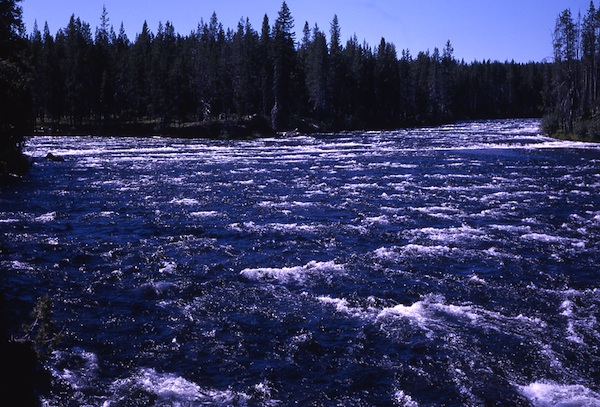
Yellowstone has few backcountry travelers out of its 3-million-plus visitors a year, and an even smaller number see the junction of the Bechler and Falls rivers. Would packrafts greatly impact the setting?/NPS
To be whole and harmonious, man must also know the music of the beaches and the woods. He must find the thing of which he is only an infinitesimal part and nurture it and love it, if he is to live. -- William O. Douglas
Wilderness settings, whether they're officially designated Wilderness, with a capital W, or simply wilderness waiting for that capital letter, help us get away and find out how to live. Some wilderness settings truly test our skills and commonsense approach to challenges, others that are tamer allow us to simply marvel in the beauty of nature. And yet, few Americans venture into these settings, either because they don't have the abilities, the thirst for adventure, or the time.
That shouldn't make these settings less available.
At Yellowstone and Grand Teton national parks, the National Park Service should welcome a discussion into a form of backcountry travel that, if properly managed, need not alter the decades-long experience of visiting these two magnificent parks, but rather enhance it for a small number of wilderness travelers.
The topic of packrafting is among the least of issues these parks face. At a time when soundscapes in the parks are obliterated by the guttural rumble of motorcycles, when wildlife issues, invasive species, and climate change are affecting the natural pulse of the parks, when there are issues of how the human footprint is impacting the geothermal plumbing of Yellowstone and the frontcountry, and backcountry, of Grand Teton, and how far cellphone signals will carry, the image of a small, one-person raft rounding a bend in a river shouldn't shake the parks to their foundations.
Self-contained travel along the watery highways of these two parks can be among the least-impacting form of recreation and exploration of Yellowstone and Grand Teton, certainly less than the muck, mess, and erosion that horseback travel exerts on park landscapes. No footprints are left in the water, existing trails and campsites in many, if not all, instances can be utilized, proper management can maintain the wilderness character of the backcountry. Relatively short seasons tied to runoff would lessen any imprint further.
Travel by packraft dates to at least 1929, when Amos Burg used one to float the Bell and Porcupine rivers down to the MacKenzie River in the Northwest Territories. Dick Griffith ran -- illegally, at the time -- the Colorado River through Grand Canyon National Park in 1991 in a 5-foot-long packraft. Neither gentlemen spurred a landscape-crippling surge in this activity. And with just 900 or so members, we shouldn't expect the American Packrafting Association to overrun either of these two parks or the 20 million acres they fall within, not when there are so many other places in the world to paddle.
Wyoming's congressional delegation didn't help further discussion of packrafting in the two parks. With legislative clumsiness that wasn't well-thought-out or necessary, they took an axe to the Park Service when a phone call or two would have been much better. Instead, the delegation gave us proposed legislation that overlooks the sensitivity of the parks' landscapes, that vastly -- or maybe intentionally -- overlooks the time it takes to negotiate today's bureaucracy and litigators, and which is polarizing.
Of course, the packrafting association also didn't help its cause by creating and publicizing a "river inventory" of more than 615 stream miles in Yellowstone that some of its members appear to already have run, or with a "Packrafting Guide to Yellowstone National Park," two pieces of evidence that perhaps indicate they want access to these corridors regardless of what a Park Service study might conclude.
That said, packrafting deserves an above-board, cards-on-the-table discussion between the Park Service, the congressional delegation, and the packrafters association. If the Park Service truly is concerned about a lack of relevancy with younger generations, this is one small measure that can boost that relevancy and nurture more advocates, and stewards, for the parks in general and backcountry of the Greater Yellowstone Ecosystem specifically.
While the Park Service should agree to such a discussion, the Wyoming congressional delegation should withdraw its legislation and agree to work with the agency on a realistic approach to this issue, and the packrafting association should be willing to agree to limits on where and when streams can be floated and how and where they can be accessed and exited. The integrity of Yellowstone's high-profile streams -- the Yellowstone River through the Hayden Valley, the Grand Canyon of the Yellowstone, and the Lamar River through its valley -- can be protected by retaining the total ban on paddling currently in place. Use elsewhere in the parks' backcountry can be managed through existing backcountry management plans, quotas, and permit systems.
That the Park Service already uses closures, both permanent and temporary, to manage sensitive backcountry areas and wildlife habitat is evidence that the same can be done with packrafting in the parks. And, as the information already out there indicates, packrafters are going to try to run some of these streams anyway. Hashing out a formal regulatory agreement that manages this activity would be better for all involved.
I gave my heart to the mountains the minute I stood beside this river with its spray in my face and watched it thunder into foam, smooth to green glass over sunken rocks, shatter to foam again. I was fascinated by how it sped by and yet was always there; its roar shook both the earth and me. -- Wallace Stegner
Stories about:
Story Categories:
A copy of National Parks Traveler's financial statements may be obtained by sending a stamped, self-addressed envelope to: National Parks Traveler, P.O. Box 980452, Park City, Utah 84098. National Parks Traveler was formed in the state of Utah for the purpose of informing and educating about national parks and protected areas.
Residents of the following states may obtain a copy of our financial and additional information as stated below:
- Florida: A COPY OF THE OFFICIAL REGISTRATION AND FINANCIAL INFORMATION FOR NATIONAL PARKS TRAVELER, (REGISTRATION NO. CH 51659), MAY BE OBTAINED FROM THE DIVISION OF CONSUMER SERVICES BY CALLING 800-435-7352 OR VISITING THEIR WEBSITE. REGISTRATION DOES NOT IMPLY ENDORSEMENT, APPROVAL, OR RECOMMENDATION BY THE STATE.
- Georgia: A full and fair description of the programs and financial statement summary of National Parks Traveler is available upon request at the office and phone number indicated above.
- Maryland: Documents and information submitted under the Maryland Solicitations Act are also available, for the cost of postage and copies, from the Secretary of State, State House, Annapolis, MD 21401 (410-974-5534).
- North Carolina: Financial information about this organization and a copy of its license are available from the State Solicitation Licensing Branch at 888-830-4989 or 919-807-2214. The license is not an endorsement by the State.
- Pennsylvania: The official registration and financial information of National Parks Traveler may be obtained from the Pennsylvania Department of State by calling 800-732-0999. Registration does not imply endorsement.
- Virginia: Financial statements are available from the Virginia Department of Agriculture and Consumer Services, 102 Governor Street, Richmond, Virginia 23219.
- Washington: National Parks Traveler is registered with Washington State’s Charities Program as required by law and additional information is available by calling 800-332-4483 or visiting www.sos.wa.gov/charities, or on file at Charities Division, Office of the Secretary of State, State of Washington, Olympia, WA 98504.


Comments
Agreed. Good article, Kurt. Thank you.
But at the same time, let's avoid the temptation to open every body of water lest packrafts become the next version of ATVs.
Thank you Kurt Repanshek for writing on behalf of packrafting in YNP and GTNP. I just wanted to clarify some of the points you made from the perspective of the American Packrafting Association (APA).
1. The River Paddling Protection Act (RPPA) is a reasonable measure, given the NPS dismissal of a paddling analysis in the Snake River Headwaters CRMP. The bill fairly gives the NPS three years to complete the analysis and maintains full Superintendent powers to protect Park resources. Nobody wants Congress telling the Park Service how to manage the Parks. RPPA is merely checks and balances.
2. APA and other paddling groups approached the Wyoming delegation only after a concerted constituency-building effort with national and regional conservation groups fell mostly on deaf ears. This effort was done mostly by unpaid volunteers in the small timeframe of the CRMP comment period.
3. APA released the river inventory after much discussion in our ranks and with our partners. Our goal was to move the issue away from rhetoric and abstract arguments, and bring it to real on-the-ground places. If you look thoughtfully at the inventory, there is no bias or intent to influence Park policy. There is only data, which was provided with the intent to assist the Parks in their planning work and to make the discussion more tangible. The inventory also was created to bring some solid numbers to navigable river mileage, as that work had not been done to our knowledge, and a variety of erroneous numbers were appearing in the press. Forrest McCarthy’s “Packrafting Guide to Yellowstone National Park” is not an APA publication.
4. APA agrees that a “realistic approach to this issue” is in order. We hope that the NPS and conservation groups will soon come to the table with paddlers and our Congressional delegation to arrive at an administrative solution that works for everyone involved. Everyone agrees that Park resources must be protected. While Yellowstone indeed should require special attention, other National Parks such as Grand Canyon, Yosemite, Canyonlands, Glacier, Dinosaur, and many others have created or are creating workable packrafting management plans.
5. APA couldn’t have said everything else much better than you did, other than that I would simply comment that packrafting history is quite rich, especially if you consider the concept that mankind has always carried portable watercraft back and forth between drainages.
Thomas Turiano
VP APA
I and many others are vehemently opposed to any such proposal. Any waterway that now allows such incursions by watercraft are evidenced by increased trash along the shores, erosion of trails/short cuts/illegal landings along the shores, drunks and those who can't clean up their trash...plus loud/rude people spoiling the serenity of the places the rest of us want to preserve (as is) for all future generations and the wildlife. Wildlife were there first -- learn to respect their space and preserve it. Water sports can go to any number of lakes, rivers, etc OUTSIDE National Parks...
I have floated and kayaked many rivers and have used packrafts. On any river trip females with baby ducks will often be seen swimming rapidly away or attempting to hide on the rivers edge. Other times it will be adults during their flightless stagedoing the same thing. Beaver will often be heard slapping the water with their tails and submerging. Ducks and geese resting on the banks will slip into the water and fly or swim rapidly away. Larger animals such as bison and elk will move away from the banks. Animals flee the presence of fishermen but they are relatively slow moving and do not force individual animals to move very far.
Packrafting may start out on a relatively small scale but with time and publicity will become a steady stream on many rivers. Once well established other boaters will question why they can't join the fun and inevitibly commercial operators will want permits.
There are many examples in National Parks where river runners have driven away much of the wildlife and destroyed the beauty of an otherwise spectacular view. Once established the NPS will be politically unable to resist the demands by commercial and individual users. Like the mountain bikers, the river runners will never be satisfied with anything less than access whenever and wherever they want it, legally or illegally.
The proposed legislation would give the NPS 3 years to study the issue, but research on the impacts on wildlife will take much more time and will involve looking at rivers already open to boaters and trying to figure out what impacts that has had on wildlife.
Well stated Roger. You have captured the essence of the problem and the delayed impact. Its only a matter of time -- before all the self-entitled, no need to heed the rules thrill seekers will overun and ruin the tranquility for all of us. I am vehemently opposed to any measure allowing packrafting, river rafting, etc on National Park waterways. The grounds are too fragile -- too overun with millions of tourists already. Totally agree with you Roger. Well done.
Wise words from Roger Siglin.
Again, my mantra, Whatever we do, use extreme caution.
I think the idea has merrit but with that said it brings questions about cost to impliment. Will you have to build some access points and portage points around waterfalls and dangerous parts of a river? Will you have to install signage of approaching pull out points and dangerous portions of river. Sometimes time of year or rainfall upstream can change the speed and difficulty of a river. Will this cause lawsuits against the NPS when someone is hurt if packrafting is permitted? Will there be limits to numbers on a river? I am sure with a three year study they could answer some of those questions. My reaction would be open rivers a few at a time for packrafting and as Lee said proceed with caution.
Rarely do i find myself in disagreement with the "Travler" features. However on this issue I must agree with Roger Siglin and MRHEM1956. I have experienced opening the door to this type of recreational activity, as delightful as it maybe, the long term results were not good. A very slippery slope, we need to say no, the wlldlife issues are paramount in my view.
It's amazing how many people are on the Henry's fork where rafting outfits have a lot of rafts running at any given time, and then you trek down into the madison, or yellowstone river in the park, and you start to see a lot of bird life all around the place. Around the Henry's fork, it's mostly just tons of bobbing floaters with little wildlife because they've left the area. This sort of thing can be easily documented, just by showing Yellowstone River inside the park, vs what it's like outside the park. Vast difference. I also disagree with this "traveler viewpoint", as ecology isn't taken into account in this article.
Great viewpoint Kurt. Totally agree with NPT on this.
I think Gary Wilson's comment about the Henry Fork says it all regarding wildlife and boating of any kind. It would be a good place to study the effects on wildlife and may show that some areas in both Tetons and Yellowstone that are currently open to boating should be closed. Wildlife should come first in most parks.