
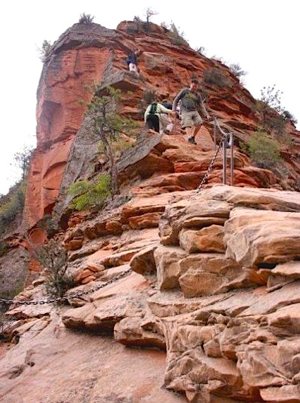
Angels Landing Trail in Zion National Park; Daniel Smith, photographer.
What should the National Park Service do, if anything, with Angel's Landing in Zion National Park?
This question arises every time there's a fatality, and rightly so. The recent death of Barry Goldstein has rekindled the debate, with at least one reader believing the Park Service should, in essence, certify the ability of hikers determined to reach the landing.
Is that reasonable? Does the Park Service have the manpower to station someone at the base of the landing to bear that responsibility? Would it not merely heighten the Park Service's liability for those who are deemed experienced enough to make the hike to the top?
And if the Park Service agreed to such a proposition, which I doubt will ever happen, what of other parks and the risks they present? How do you guard against canoeists, kayakers and rafters drowning while on park outings? What about those who are swept away by avalanches, who are attacked by grizzlies, die from the heat at the bottom of the Grand Canyon, or fall from Half Dome in Yosemite?
What responsibility does the Park Service have to try to prevent these accidents? Just as important, if not more so, what responsibility do individuals bear?
We live in a dangerous world, one where we have to recognize not only the dangers that exist, but our own limits. And those who visit national parks need to appreciate that these are not city parks, not well-manicured and contained. National parks present a host of dangers, ranging from cliffs and rivers to wildlife and even other park visitors.
This is not intended to belittle or minimize the loss felt by Mr. Goldstein's family and friends, or the families and friends of other victims of national park accidents. It's not to question their actions, capabilities, or decision-making. The pain of their untimely deaths cannot be soothed, there is no salve that can erase it.
Rather, this post is simply to acknowledge that there are dangers that exist, both in national parks and beyond their borders, throughout the world we live in, and that we need to accept both the responsibility of our decisions and that accidents do happen.
Might those who fell from Angel's Landing over the years been saved had they had to meet specific qualifications to ascend to the summit or if the Park Service put railings atop the landing to keep hikers a safe distance from the edge? Perhaps. But incredibly qualified climbers have died in accidents in the parks, and folks have clambered over railings, trusting their own judgments, only to die in accidents.
Beyond that, do we really want to sanitize the parks?
I don't think I'm alone in believing that a good part of the allure of places such as Zion, Yellowstone, Yosemite, North Cascades, Mount Rainier and Grand Teton, just to name a half-dozen parks, is their ruggedness, their wildness, of entering them on our own terms and seeing how we match up.
It scared the hell out of me the first time I went up Angel's Landing, when I climbed to the top of the Grand Teton, and to the summit of Half Dome. That adrenalin rush not only heightened my cautiousness, but it also let me know how alive I was. When my time does arrive, I hope it comes in a national park and not while driving down the highway or crossing the street.
Story Categories:
A copy of National Parks Traveler's financial statements may be obtained by sending a stamped, self-addressed envelope to: National Parks Traveler, P.O. Box 980452, Park City, Utah 84098. National Parks Traveler was formed in the state of Utah for the purpose of informing and educating about national parks and protected areas.
Residents of the following states may obtain a copy of our financial and additional information as stated below:
- Florida: A COPY OF THE OFFICIAL REGISTRATION AND FINANCIAL INFORMATION FOR NATIONAL PARKS TRAVELER, (REGISTRATION NO. CH 51659), MAY BE OBTAINED FROM THE DIVISION OF CONSUMER SERVICES BY CALLING 800-435-7352 OR VISITING THEIR WEBSITE. REGISTRATION DOES NOT IMPLY ENDORSEMENT, APPROVAL, OR RECOMMENDATION BY THE STATE.
- Georgia: A full and fair description of the programs and financial statement summary of National Parks Traveler is available upon request at the office and phone number indicated above.
- Maryland: Documents and information submitted under the Maryland Solicitations Act are also available, for the cost of postage and copies, from the Secretary of State, State House, Annapolis, MD 21401 (410-974-5534).
- North Carolina: Financial information about this organization and a copy of its license are available from the State Solicitation Licensing Branch at 888-830-4989 or 919-807-2214. The license is not an endorsement by the State.
- Pennsylvania: The official registration and financial information of National Parks Traveler may be obtained from the Pennsylvania Department of State by calling 800-732-0999. Registration does not imply endorsement.
- Virginia: Financial statements are available from the Virginia Department of Agriculture and Consumer Services, 102 Governor Street, Richmond, Virginia 23219.
- Washington: National Parks Traveler is registered with Washington State’s Charities Program as required by law and additional information is available by calling 800-332-4483 or visiting www.sos.wa.gov/charities, or on file at Charities Division, Office of the Secretary of State, State of Washington, Olympia, WA 98504.

Comments
The park service can't station someone at the trail head to do 10 second physical fitness tests. It would leave the service really wide open to liability not only for falls but also for ADA violations. NPS Rangers aren't have no medical training to determine who is and who isn't fit enough to make the grade or to determine who is subject to dizziness or balance problems, etc. etc.
The only thing the NPS can or should do would be to put up extremely graphic simply worded warning signs or close the area entirely to hiking.
I totally agree with Kath's comment. The only suggestion I would add to it is this: while making that last half mile of the climb, there are areas of large gaps between chains. Some of the gaps are in spots where the chains would certainly add to the stability and safety of the climber. If the chains were continuous to the top, with short or no gaps, I believe the safety would be improved significantly.
When you look at the climb itself, you know where you are getting into. My opinion, be your better judge and know your own limitations in combination with the local conditions. No matter how well you might keep people from doing things. When you say something is not allowed and there are no guards, usually that is what people are going to do, just because it is not allowed. And posting guards at every possible hazzardous place is no option in any park. I agree with Kath, post obvious and plain signs. A prewarned person might be double carefull.
When I climbed Angel's Landing I did so without touching the chains (much to my chagrin there were a couple places where the chain was right where I wanted a handhold). I wanted to take the climb on its own terms, and was extremely cautious--probably much more cautious than someone walking along holding the chains. Do the chains actually make the climb more dangerous by allowing complacency and enticing inexperienced hikers?
No, the chains don't make it dangerous but i see what you mean. I also did the hike without the chains and had no problem, but it does help
I'm having second thoughts about this hike, I have wanted to do for the past couple of years now. I belong to an online Zion group and read posts from people daily about Zion in general.
It was sad to read about this fatality. Then so much sadder to read a post a few days later by Mr Goldstein's sister as she happened upon this group in her struggle to understand how this happened to her brother as family watched in horror.
Bobt,
Don't waste your time on the Landing and hike the Narrows instead (if you haven't already). I think National Geographic rated it as one of the top 100 hikes in the US. Make sure you overnight in the canyon as well.
Survival of the fittest. Hiking the trail is optional and there are plenty of warning signs. Until people stop hiking unprepared (I met one person on Angels landing who hiked it with 16 OUNCES of water in 110 degree heat), people will continue to be at risk. Nature can be dangerous, people (but not as dangerous as driving). Don't like it, stay home.
Sanitize NPS land holdings? You might as well just plow them under, dam the rivers, and open the ecosystem to whatever type of development, be it commercial or residential, whose shadows currently cast a blight on the majority of the nation. Be certain to bear witness to the prospective outcome of any litigation brought against the Park Service, and remove the responsible judge(s) from their office as public servants when their terms expire.
It is unfortunate that one cannot account for the ignorance or sometimes blatant stupidity of the general public. These magnificient sites are NOT a child's playground. They require respect, careful planning and common sense when being approached by even the most skilled outdoorsman, let alone "Joe Vacationer" whose only outdoor pursuits are carried out behind the wheel of his SUV. Maybe the answer lies in signing a document upon entry to any wild terrain, stating that you understand and acknowledge that your own carelessness can result in death, either of yourself or another party, and you both know and agree to abide by the limitiation of your own ability when embarking upon any activity within NPS, BLM, or other public lands. It is a shame that the best way to protect the lands for future generations might be to remove the chain assists from various trails, thereby removing the NPS from any possible role and financial responsibility in the accidental deaths of the unprepared, the unequipped, and the just plain careless who enter the park system each year by the tens of thousands.
my son and i where there on may 20 and may 25 of 2007 we climbed upto scouts' landing just below angels landing and based on the amount of people going up and down, the time of day and the wind chose not to finish the climb up to angels' landing. other people made a similar chose and when either on or backdown. if someone chooses to continue due to a bad decision that is their chose and the have to be helded accounable for it not the park. as forest's mama said "stupid is as stupid does"
I just hiked Angel's Landing last month and it scared the hell out of me. I've spent quite a bit of time in the backcountry, summited multiple mountains (including Rainier and Shasta in Feb.), etc. So, I'm no stranger to risk and adrenaline. The difference is I was prepared for each of these experiences and was properly equipped. I was not prepared for Angel's Landing. This is a climb for someone who is sure footed, in good shape, and knows their limits. Of the 50 or so hikers who we encountered on the trail I can think of only a handful who belonged on that trail. We saw people in flip-flops, hiking w/o water, and even a gaggle of 12 year olds who were too stupid to be scared. One could even make the argument that you'd need to rope up on the last stretch (a little much I know but.....).
I think there's a very simple solution. Close the trail as a "regular" hike and reclassify it as backcountry. You then have to go to the backcountry desk, get a permit (can be free of course), and made aware of what you're getting yourself in to. Just by having a 2 minute conversation with a Ranger I think a few morons would be saved.
I agree with Russ, absolutely! First off, my hub and I, in our late 40's are in good physical shape and had no exertion issues with any of the climbing associated with A.L. or Hidden Canyon, which we had easlily hiked the day before to "warm up" for A.L. My husband (a "retired" mountaineer, who has also climbed Rainier and McKinley, climbed in Nepal and also most of the 14teeners here in CO), was shocked that the chains were the offered assist holds to "climbing" this hike...and that the audio recording on the shuttle up the canyon actually advocated this trail as the "most popular trail" in the system that gets "very interesting" the last half mile, making almost a mockery of this very serious trail hike. This and the absolutely ridiculous chain-as-handrail actually presents an increased risk to the (inexperienced) hiker by allowing a false sense of security and quite reasonably even throwing one's balance off from the natural and inviting fatality. As we descended back down Walter's Wiggles, we met no less than 50 hikers everywhere from 15 to 65 and all levels of fitness and inappropriate attire making their way up to what expectation? People DIE on this trail ("Google" it yourself to confirm)...though not a great marketing strategy, maybe the NP system could consider at least adding this to their pleasantly spoken caution, "your safety if your responsibility" line when making the meandering and otherwise wonderfully educational shuttle trip up the canyon. I could never have watched a child hike this climb after Scout's Landing without mountaineering gear.
These situations are never easily dealt with, but the one factor usually associated with them is "hiker error", underestimating the terrain while simultaneoulsy overestimating your ability. What do people want, elevators, escalators, covered walkways, helicopters? I too have ascended the pinnacle 3-4 times and while certain sections do require an increased attention span, the climb itself is not particularly hazardous given that you pay attention to what you're doing and where you are.......DON"T change the trail, change the hiker's approach to the ascent. Signs aren't the answer. Maybe a permit akin to the registration for the Narrows or the Subway, where rangers check for equipment, planning, and get a general sense of competency prior to anyone attempting the ascent. Obviously, this won't eliminate the possibility of disaster, but it just might keep some of the "recreational" hikers from attempting the climb without at least a cursory looking-over from a staff member. By signing the waiver, at least they've been warned, which is really all you can do to prevent a catastrophic outcome. People will go where they are least adapted or prepared. It's their right, which is exactly why they need to be informed about what they're undertaking. It amazed me to hear the comments on the ascent through Refrigerator Canyon and up Walter's Wiggles, on Scout's Landing, and particularly on the final ascent to the Landing, about "geez, this is a lot harder and more exposed than I thought!". I guess they didn't READ the printed literature. SURPRISE!!
Park visitors who want to protect their trail-climbing privileges at dangerous places like Angels Landing and Half Dome need to be very careful about the safety measures they demand. The climbing community knows all about the perils of asking for too much. With a few notable exceptions (such as at Denali), the rock climbing and mountaineering folks don't pressure the Park Service to invest a lot of money and manpower in protecting climbers or in climbing-related search and rescue operations. They know that making strident demands for protective measures would backfire because the cash-strapped, shorthanded agency would respond by severely restricting or denying access to areas now open to climbers. This is not to mention that safety measures can be overdone, taking a lot of the challenge and interest out of many routes and trails.
I just hiked Angels Landing for the first time on Easter last week and I was more afraid watching the confusion of people not being able to get around each other on the last part than the fact its a long way down. It felt like 'any moment now' something bad is going to happen. And like Lea said about the audio recording on the shuttle, inviting everyone! There were lots of people up there that shouldnt have been. I didnt like the chains either. I didnt need them and didnt like watching people scared and nervous trying to grab a chain thats moving all around!! They just make it that much more tempting for people that have no buisness up there. But I will say what a perfect place to go WHEN its your time.
My husband, two sons ages 16 and 13, and I just returned from Zion. We hiked the Narrows one day, it was our favorite part of the trip, and hiked up to (my husband and sons, not I) Angel's Landing. I stayed at Scout's Landing. I started to hike up Angel's Landing and came back down before I made it to "Chicken Out" point. My husband has ankle and feet problems so I knew it would be a while before he made the trek there and back. We were not fully aware of the strenuousness of this hike or the very narrow parts and gaps in the rock. As I sat at Scout's Landing I saw several people returning from what I assume was a full hike up to Angel's Landing. I saw everyone from older (60's possibly) heavy set women to children who looked to be 5 or 6 holding their parent's hand coming down the first set of chains after Scout's Landing. One little girl looked like a mountain goat as she hopped down holding her dad's hand. I was terrified for her the whole time. When my husband and son's made it back approx. one and a half hours later he commented "That was the most irresponsible thing I have ever done as a parent." He couldn't believe that he allowed his two children to make that hike. He said there were several times that he sat down and contemplated turning back but the boys talked him into pressing on. I was so happy to see them return that I gave them a standing ovation. I'm sure everyone else on Scout's Landing thought I was crazy but I was just so glad that hadn't fallen over the edge.
Maybe there should be an age limit for this hike and the suggestion of making it a permit only hike might also be appropriate. I wouldn't want anyone to miss the opportunity to make their own decision about this hike but they should be more strenuously forwarned of the possible dangers.
With only 5 official Angel's Landing deaths in the parks 100 years, I think there is a little bit of overreacting when this topic is discussed. Don't get me wrong, I have hiked Angel's Landing numerous times, and this is a serious hike, but the scariest part for me, an experienced canyoneer, is always the other hikers you encounter once you pass Scout's Landing, which make maneuvering around the trail almost impossible since they are "white knuckled" to the chain and scared to death to move. I'm heading back to Zion next week, and I think Angel's Landing will be on the agenda for this trip as well.
The 2008 summer map and guide for Zion National Park says on Angels's Landing: "Strenuous, 5 miles/4 hours round trip,
climbs 1,488 feet. Warning! Steep Cliffs. Not for anyone fearful of heights."
I think that sums it up quite well. After you've read this description, it is your responsibility to decide if this is a trip for you and your family. I've seen kids age 5 that were able to do things like that. And there are people in their 20s, who haven't seen mountains, not to mention sheer rock, before and should not even think about it. The NPS is not your nanny. Think for yourself.
Congratulation to all four of you. Your husband gave your kids a tremendous experience, they can cherish for a lifetime. And if you decided not to go beyond Scott's Landing, that was probably the right decision for you. But please don't expect the government to make that decision for you or any other visitor.
Disclosure: Been there, done that. I climbed Angel's Landing many years ago, age 22, when I was an experienced hiker and climber for a number of years.
it is called "scout lookout" not scott's landing
My husband and son are in Zion NP as I write this post. Yesterday the group of boy scouts ranging from 13-17 yrs old hiked Angels Landing. I was terrified all day knowing that they would be ascending upon this hike. Somehow, somewhere my husband got cell service and called me to let me know that my son who is almost 14 and in great physical condition, as is my husband, decided upon arriving to scout landing that he would go no further. I applaud his ability to be aware of his own unsuredness about the hike and not continue on because everyone else was doing it! So he, one other scout and my husband headed back down the path. Bravo to those who are in touch with their inner voice that tells them to do or not to do!
The Naitonal Park Service frequently does "visual inspections" for certain Ranger programs. So it can be done.
Human life is precious. If cost-effective steps can be taken to reduce the loss of human life, then they should be taken. Period. The National Park Service is already involved by virtue of building, maintaining, and advertising the trail to Angel's Landing. Thus, the National Park Service has the responsibility to minimize the loss of human life in any cost-effective way possible.
Sabattis, you've said that
To "cost-effective" I would add, at a minimum, "ecologically responsible" and perhaps "esthetically acceptable."
It isn't the responsibility of the Park Service to ensure your safety. Sanitizing the trails is a poor alternative. The loss of human life, while tragic, isn't the fault of the parks, it is solely the responsibility of those who undertake the trek to various points of interest in the NPS, who then discover too late their vertigo or other associated conditions they might not have even known existed. The parks are to blame for people's fears, lack of skills, over-estimating their ability, under-estimating the terrain, and not taking proper precautions and making proper preparations? You can install all the safety chains you want, carve steps into the sandstone, place enough warning signs to scare off a mountain goat and it will have no effect on the human animal and their inborn bravado. How do you plan on taking "cost effective" or for that matter "ecologically responsible" and perhaps "esthetically acceptable" steps to ensure that some idiot isn't going to attempt a running ascent or worse, descent, in flip-flops or sandals? What measures will guard against the fools who start a July climb at 11:00a with no water, figuring, as I have heard commented on the West Rim Trail that "it'll only be a couple of hours, we'll be alright".
The trail itself is highly manageable without any modifications, unless of course you're intention is to make EVERY trail in the system wheelchair accessible. Go to your local congressman and see how quickly that appeal falls on deaf ears, since they would have to provide the funding. On the other hand, get the hell out of Iraq, spend $100B annually on the parks service and all God's chillins are happy. The point is that currently, to scale this peak, like Half Dome, takes no specialized gear or experience. This isn't like entering the Subway. Unless you plan on stringing safety nets along EVERY cliff in the NPS you cannot possibly hope to be ABSOLUTELY certain that there is never a cost to be paid in terms of human life. Whatever happened to personal accountability? Why are we always seeking to place blame for our failures everywhere but where they belong? Life ain't no video game. You start with one life and there aren't any opportunities to refill your health or pick up any bonus lives. And yet a certain segment of our populace calls us the most advanced species, when we whine and cry about the lack of safety in nature? Instead of sanitizing, try thinking first. It'll save a lot more lives than ANY safety gear you can imagine. It's simply the most cost-effective safety device we have. Sorry, it requires effort on your part, which puts it above the reach on most I guess. Pity.
That's an interesting question, Bob. Let me rephrase your question: if the National Park Service estimates that a given safety improvement reduces, on average, one fatality per year, but causes a reduction in the aesthetics of a place - should it be opposed or supported? I guess maybe it depends on how much of a change to the aesthetics, to which my response would be that "cost-effective" should include ecological and aesthetic costs as well.....
There used to be a trail up to the summit of lady mountain in zion. In fact it was one of the first in Zion, it was similar to the angels landing trail with installed chains/railings to help people through the scary/difficult sections. However the numerous deaths that occurred from falling, prompted them to remove all the chains and official signage from the trail. You however can still "hike" lady mountain, you just need to be competent at exposed scrambling, and know how to use a rope for the few short technical climbing sections. The NPS will never "close" any trail, however they might remove all the hardware they installed on it. Angels landing can be ascended without the chains/railings by people who have adequate hiking experience. You wouldn't see out of shape parents with children trying to hike the route without the chains. If the hike is worth it, then one can gain the experience necessary to safely obtain the summit.
Kent, yeah, I know your comment about Lady Mountain Trail is five years old, but I just saw it. I remember back in 1970 my family was in Zion (I was 18) and their plans for the day didn't look interesting to me, so I asked if I could go hiking (by myself, never a good idea, but...). I looked on a map (old, apparently) and saw Lady Mountain Trail. Looked interesting. So I took off. It wasn't long before I realized "wow, this is a strange trail". In places there were ropes and chains and railings, but most of them were broken, or nothing was left other than the bolts. But I scrambled along without them anyway. Until I reached a place where there was a four-foot gap, with a vertical 1,000+ drop below it (well, it looked like 1,000 feet to me). I actually contemplated attempting it, but I wised up and turned around. When I got to the bottom I found a ranger and told him that the trail was in very poor shape and needed a lot of attention. He said "that trail has been closed for years!" (Actually I don't think it was officially closed until 1978, but his point was that it was no longer maintained.) Well, it would have been nice if they had put up some signs at the trailhead!
This was my second time hiking to Angels Landing with my 9yoa son. I did it when wife was pregnant and waiting down at the parking lot. I ran it when I was 30yoa. I wanted my son to enjoy the experience. He loved it and wanted to do it again. We found it to be more scary by the web-postings than in reality. You need to take your time and concentrate. I feel that if you are in moderate shape you can do this hike.
I have extensive experience and training in mountaineering and rock climbing. I have climbed sheer rock faces and hiked some extremely dangerous trails (including the El Camino Del Rey in Spain). This hike is not for those in "moderate shape", nor is it for children! If I were you sir I would consider the responsibility you bear for the advice that you offer others.
The Zion Park Service shouldn't have to monitor who hikes Angel's Landing or any other major attraction in the main canyon. The vast majority of people who hike that trail come away happy and uninjured, with a newfound or renewed respect for its challenges. If an occasional hiker proves unprepared or unfit for the trail and pays the ultimate price, then their plight should simply serve as a helpful reminder to others that it's a risky trail where people need to be responsible for their own safety (and that of their children). Anyone who undertakes Angel's Landing hike as a proverbial "walk in the park" is just flirting with Darwin.
Hiked the Angel's Landing trail yesterday, January 17 (wintertime, obviously) for the first time. My wife and I are in our mid-fifties, pretty good shape, and didn't have any problems that way, but the ice from this year's extra snowfall made many areas of the trail especially dangerous. The Wally's Wiggles area of the trail was completely snow and ice covered, and without proper crampons, was not easy going, despite the liberal sanding by the Park Service. We got to the Scout's Landing area, started up the Angel's Landing trail with the chains, and turned back after just a few yards because of the ice. Just flat too dangerous in the winter - bad enough in the summer - but there were many that were making the climb. I just decided that the reward just wasn't worth the risk this time - maybe under better conditions.
Mike -
I'd like to commend your good judgment in deciding to turn back when you felt the trail had become too dangerous.
Many of the rescues that I was involved in during my NPS career were the result of people pushing on "no matter what."
"Knowing when to say when" is a big part of responsible use of the out-of-doors.
I didn't find the hike that scary. This is one of those things that if you feel uncomfortable then stop and don't go any further. Why do you think half of the people stop at Scouts Lookout? It is because they know their own limitations. Some activities have more risk than others. Frankly, this is one of my all time favorite hikes. And yes, The Narrows right around the corner are just as great and just as risky. The risk of flash flooding is certainly a possiblity.
Yes, the outdoors is dangerous and people should be responsible for their actions. However, how many people have to die before Zion acts in some fashion? This is a sanctioned trail which is only fit for a small percentage of the mainly tourists who visit the park. Classify AL as backcountry, keep the trail open, but save some lives.
I just completed this hike two days ago. It was strenuous and I am in good shape. One must use common sense in taking a hike like this.
To put this hike in perspective and provide a sense of the hight involved here, ...the elevation from the base of Virgin River to the top of AL is equal to the height of what once was our Twin Towers. This is a fact. Invision hiking 2.5 miles laterally then compund that with an elevation rise equal to that of the World Trade Center. Get the picture now, LOL. This is not Disney folks.
Would you let your 12 year old do this? Think before you act upon the hike. I saw people doing it in sneakers & flip flops, with gallon jugs of water strung to their cutoff jeans. Insane!
I most definitely would let my 12 year old do it!
"...adventure without regard to prudence, profit, self-improvement,
learning or any other serious thing" -Aldo Leopold-
I did Angel's Landing two days ago, I will have to say that there were a couple of spots that were treacherous, and for the most part, I didn't need the chains, but then I knew what I was getting into before I traveled there. I have to agree that you are responsible for your own actions, and the NPS is not your baby sitter. This is not the place to goof off, as I saw several people do. We have to keep treasured places like these here for generations to come, and to do that we have to be responsible! If there has only been 5 deaths in 100 years, why is this even an issue? On Mount Rainier there have been more than that in a years time and still people by the thousands climb this volcano every year. We cannot place the blame on the NPS for the bad actions of those who find out later that they have vertigo, goof off at the ledge for whatever reason, or are not in proper condition or have enough experience. There are sheer cliffs on both sides of this fin, and this is a strenuous hike, and that is all you need to know. The decision then is up to the individual doing the hike. That is your responsibility, the NPS is not forcing you to do this!
Well Said, Christina!
I think this is really a call on personal judgement more than anything else. When you get to Scout's Lookout, you can see the trail required to make it to Angel's Landing. You can see the chains and the cliffs and the narrow pathway. Even if the sign at the bottom doesn't give a real clue as to how dangerous this trail can be, your eyes and common sense should be a good detector.
The thing people like about NPs is that they don't babysit you every step of the way. They require self-determination and intelligence to navigate.
Angel's Landing [as I said before] is a personal judgement call. You see the risks before you take it and you have the FREE WILL to decide whether or not to take it at all.
I hiked Angel's Landing because I trusted myself to be smart and careful. My father, on the other hand, took one look and decided his responsibility to his family was more important than the risk.
Only you know your limits.
My boyfriend and I were at Zion on May 24. He had wanted to do the Angel's Landing hike since we first started planning and I did not. I planned all along not to go further than Scout's Landing and waited there while he went to the top. While I am not particularly afraid of heights (being on the cliff edge didn't bother me) I am not very sure-footed and could really envision myself slipping. Also, it was Memorial Day weekend and there was a tremendous number of people all over those chains. However, when we got most of the way back down the trail and looked back, I had the most awful sense of failure that I hadn't completed the hike. It seems I did all the drudgery of climbing so high for nothing. It has been really hard for me to let go of this and I feel the only way to fix it is to go back and do it. But I can't say I really want to. It's quite a dilemma.
Not a comment on whether or not NPS should do anything, I know.
I completed this hike May 2008 with my husband. I sat down to contemplate the last leg and decided when there was an opening (very busy - midday) I would go for it. At 47 I felt I hadn't challenged myself enough through life, though thoughts of being away from my grown up children and taking risks did come into play. Head down, concentrating on my feet, I/we got there, and there were simply no words for what I felt over the next hour whilst I sat atop Angel's Landing, looking down the valley floor. It was heavenly, made a million times stronger by the fact that I had conquered a fear - a fear of the unknown. Risk taking is individual, dependent on many things, of which no National Park Service can be, or should be responsible. You take a risk the minute you sit in your car without hesitation, that risk is far greater than falling from a trail, difficult/strenuous or not. Sure footing, common sense, a reasonable amount of physical ability and courage will get you to the top of Angel's Landing, and when you arrive you will burst with pride and a sense of deep satisfaction and ponder how we came to be so priviliged to witness such beautiful sights. I am from the UK, I adore Zion with an impossible to describe passion - it gets under your skin, deep in your head and leaves you never really leaving the place behind.
im 14 and my parents decided to chicken out at the last stop. i had never understood what don't look down meant until now. i also realized that life is to precious to waste and if you have even a slim thought of doubt, don't risk it. when i reached up to the point i turned back, it made me realize how much i have to live for.
I've done A.L. many times, and I want to add to some of the above comments. The texture of the hike changes drastically depending on conditions. I've been there in February when glaze ice made the trail technical and dangerous and I didn't dare go past Scout's landing. I've been there alone on blustery days when it felt intimidating and the knife edge was frightening. I've been there on sunny beautiful days when there was a picnic-like stream of hikers of all shape (including the proverbial tofu-shaped person in flip-flops) and it seemed like a walk in the park. Folks who have done it once or twice should consider the weather and "mood" of the day they were there, as it does color their memories quite a bit.
I agree that there is risk here, but there is risk anyplace that a trail approaches an exposed cliff. A.L. merely has the distinction that there is a continuous run of exposure on both sides. The few deaths over the many years it has been open attest to the fact that it really isn't that dangerous -- certainly far less dangerous than the drive to Zion. The chain is probably a good thing to have -- but it is definitely overused by the "white-knuckled" hikers. For smaller hikers (kids), it is considerably more support than for adults, and the presence of the chain made me much happier when I took my son up in his early teens. Adults who feel that they absolutely cannot do the hike without the chain probably shouldn't be on it at all.
I hold with the group that thinks that nothing "should be done" about A.L. The park service already has pretty serious warnings, and the view from Scout's landing is sufficient to turn many others away before they get into trouble.
I hiked Angels Landing back in the late 80's when I was in my 20's. I was and still am pretty fit and a reacreational hiker. I had no idea exactly how dangerous this hike was. I made it to the top. I was not proud or filled with wonder at the view. I sort of felt how you do after you almost get into a car accident, once the adrenaline stops. I think many hikers do not know what this hike is all about. I watched in astonishment as a man hiking before us had a baby in a backpack on his back during this hike. Talk about irresponsible. Anyway, I hope my son chooses not to hike this trail and I will not do it again. The payoff is simply not good enough to risk your life. My view from my deck is more majestic than that.
Of the 50 or so hikers who we encountered on the trail I can think of only a handful who belonged on that trail. We saw people in flip-flops, hiking w/o water, and even a gaggle of 12 year olds who were too stupid to be scared.......
I think there's a very simple solution. Close the trail as a "regular" hike and reclassify it as backcountry. You then have to go to the backcountry desk, get a permit (can be free of course), and made aware of what you're getting yourself in to. Just by having a 2 minute conversation with a Ranger I think a few morons would be saved.
------------------------------------------------------------------------------------------------------------------------------------------------
I couldn't agree more with this post. Angel's Landing is far too accessible to the general public because of the ease of the trail to Scout's Landing. It allows people to get to that point wearing nothing but flip flops, then find themselves on a much more precarious trail but because so many people are around, they dare not turn back lest they be labeled "chicken". There's a psychological bravado factor always present in large groups that pressures people to go along with the herd. Many people who wouldn't otherwise make the hike do, ill prepared or not.
To illustrate, I was talking to a couple of hikers the day I decided not to make the hike beyond Scout's landing because a bus tour of at least 50 french woman had just hiked by (yes, all women, strange as it sounds). I knew there must be at least 100 people up there by then and it was only 8am! When I explained to the couple why I changed my mind, without batting an eyelash the man said "So you were afraid!?" (obviously looking for re-assurance for his own "cowardice"). I just rolled my eyes and left.
Sure, keep things the same and you will continue to have several deaths every season. I also find their published statistics very suspect since there has been another death since this article appeared (I'm writing in response to a woman who died several weeks later than the man named. Maybe she tripped and fell off because there was standing room only up there?).
We hiked Angels Landing on August 10th 2009 the day after a woman fell - our condolences to the family, they must be devastated. (We didn't know about this until after we came down.) This is an absolutely beautiful and exciting hike, but you have to be aware that you are risking death in choosing to do it. We went on this hike as a family, my husband and I (both age 41), a son (age 15) and a daughter (age 13). We have all done other "non-technical climbs". What was scary was that a man in front of us tripped, while trying to take a photo and caught himself 6 inches from the edge. Later we found out about the woman who had died the day before. I would not recommend this unless you also have experience with non-technical climbs, are wearing good shoes, and I think my daughter (age 13) was a bit young for it. Certainly don't take small children with you.
I don't think Zion National Park accurately explains the risk in describing the hike. One ranger in the visitors center described it to me as "very safe". I think perhaps some more photos and/or a more explicit warning might be useful. However, the trail should not be closed. It is a beautiful trail.
Let me compare it to some other hikes in the "rock scramble", "non-technincal climb" category that we've done prior to this one. We live in the Northeast, so the prior hikes we have done in this category are: Breakneck Ridge (NY), Kaaterskill Falls - upper falls (NY), Precipice (Acadia, Maine), Beehive (Acadia, Maine), Caps Ridge Trail (Jefferson Mountain, NH). Only Precipice comes close and is not as dangerous.
Why is this hike more dangerous than the above hikes:
1. Unlike the above hikes, where drops range from 60 to 300 ft and sometimes there is a lower ledge, these drops are 800-1200 ft and therefore there is no chance of surviving a fall.
2. For this hike the "dangerous section" is .4 miles and then you have to return on the same path, so for .8 miles you are always within 1-3 steps from the edge. On most of the above hikes the part in which you are close to the the edge is only a short section.
3. Since there is no "loop", you are passing people going both ways on the same trail. In general people wait in a part without chains and then go forward when the other group passes, but not always. At one point I was decending with my 13 yr old daughter and some people came up a section and we had to pass around them - scary.
4. Cliffs are on both sides, not sure this is more dangerous - just tends to freak a person out more than having a cliff on one side.
5. There is sand present. In the hollow areas, there is a lot of sand. I recommend before going across one of the rock areas, that you "stomp your feet" and make sure to lose the sand so you don't slip.
6. Again, of the above climbs only Precipice (Acadia) is similar to this one. However, if I remember correctly, in Precipice you are usually walking on flat rock (1-2 ft wide) along a sheer face or climbing up iron rungs. On Angels Landing, the rock you are on has a slant down in the direction of the cliff (you need shoes with good traction) or you are scrambling up a section of rock and if you were to fall off of that section the sheer drop would be right behind you. You definitely don't have room for error.
What is nice about this hike:
1. Absolutely beautiful.
2. Exhilerating.
3. Bragging rights.
Not sure if we would do this hike again, or perhaps next time without the kids.
I hiked angels landing twice as a child and then again this last March, 2009 at 33. As I opted out of the last chained and riskier portion at the end of the peak this last time around I felt empowered because as a child I remember it being such a scary experience. Seeing it now, I am resentful that adults hadn't been more responsible for me as a child who didn't have the ability to really judge risk like that reasonably. As I watched a child that looked to be about 7 years old descend the chains crying this last March I was angered that parents were taking these kind of risks with their children's lives. The risk for this trail is documented and yet people are allowed to take risks with their children's lives here everyday. I wish there were a large warning sign posted at the top section at the base of the chains declaring the risk and suggesting that young children shouldn't attempt the climb. Children should be given appropriate warnings so that they can opt out as they wish. Children who decide to proceed after receiving the risk information should only do so with a responsible adult who has carefully assessed conditions and uses rope safeties and careful instruction. Ounce of prevention. Worth a life.
Just returned from a wonderful hike up AL. I've heard about all the warning sings, the accidents, crowds in the summer, howling wind. I brought lots of water, good shoes, light gear for the final ascent, and a buddy. I could see how people are getting unruly during the busy summer season, as I've heard stories of people shoving and pushing to get in front of people. Personally, one of the tougher part of the whole hike is to conserve energy to reach Scout's point. The chains are nice for balancing, but it could provide a false sense of security for some, or even dangerous if someone's swinging it when you actually do need to grab it! The most tricky part for me was actually the first 500 yards or so, as the rocks are slanted, and you need to find a good footing to continue. Once you've begun your actual ascend, the trail is quite clearly marked. Also, the ever changing wind is a concern for some. That's why i hiked with only what I need, so I can carry a lighter, less profile daypack. The most windy spot is on the 2nd part of the ascend, halfway to the final summit, and once you've reached the summit, it's nothing but calm wind, since there's much less pressure differential up top from the canyon draft.
I think if there's anything NPS can do anything about it, is to require all AL hikers watch a 10 minutes video to summarize all the warnings, and also some common sense rules for some of the inexperienced hikers. (Another place that came to mind was Ha'nauma bay natural reserve in Honolulu. You watch a beautifully done 10 min. video explaining what to do, what not to do when you snorkel)
I am a foreigner. I come from France. I am 56 years old. I play basket ball all along the year in Championship for old people. So I know the efforts.
I reached the summit in August 2009. There are enough warnings (with photos and comments) on Internet sites and within Zion park to evaluate the risk.
To my opinion, my advices are the following:
Start early in the morning to avoid high temperatures,
Try to hike in a group because sometimes the trail is not clear. So it is useful to get the first place then to switch when you get tired.
Keep some strength for the return. It's always more difficult to go down than to climb.
But once you succeeded, anybody said "We did it". That's a wonderful experience.
Just went up AL - phenomenal experience. That said, "K" is precisely right - any parent that takes a child up to AL needs to have their head examined. Whatever an ADULT does is fine. But to take a child to AL ????? I am sorry, you are a bad parent and/or an IDIOT !!! I am an experienced hiker and that is NO PLACE FOR CHILDREN. If you are deluded enough to believe that you are developing some type of inner confidence in your child ... there are many ways to do that without putting their lives at risk. Why not give your kid a fifth of liquor and the car keys - same decision.
Just went up AL - phenomenal experience. That said, "K" is precisely right - any parent that takes a child up to AL needs to have their head examined. Whatever an ADULT does is fine. But to take a child to AL ????? I am sorry, you are a bad parent and/or an IDIOT !!! I am an experienced climber and that is NO PLACE FOR CHILDREN.
Pages