

The view from the Cedar Mountain Overlook on the northern end of the San Rafael Swell exposes just some of the reasons why the Swell has been mentioned worthy of national park status down through the decades. Emery Country Travel Bureau photo.
Editor's note: Across the country, there are many spectacular landscapes that would fit appropriately within the National Park System. This article is the latest in an occasional series that looks at some of these places.
In places, the brush strokes are delicate, exquisitely formed, the work of a master. Others, though, are more roughly fashioned, in some cases pecked or scratched into the rock face's thin veneer.
The images, dating back thousands of years, are priceless. So, too, is the scenery in the landscape within which these pictographs and petroglyphs exist. It is a landscape of staggering natural beauty expressed by soaring cliffs, canyons compared to the grandest one in the country, minarets, and reefs of rock that tell a fascinating geologic story.
The plein aire art museum where you can find these works? Central Utah's San Rafael Swell.
Near-Perfect Preservation Conditions
The general aridness of central Utah gets the credit for preserving the rock art forms that, perhaps, date back 7,000 years, and which have been referred to as the state's Sistine Chapel. Though some appear childish, and others have been covered with images from nomadic cultures that followed the original artists through the millennia, the figures tell intriguing, at times hard-to-cipher, stories that still beg explanation.
The images inspired some intriguing names: "Head of Sinbad" was attached to a figure topped by a wriggling snake, while "Black Dragon" was spawned by a pictograph that some think looks much like a winged dragon.
Some of the oldest images fall under the category of "Barrier Canyon" rock art, a folder Dr. Polly Schaafsma, one of the country's most-renowned experts on Native American rock art, assigned the images to in the 1960s when she was part of an effort to catalog what existed in the southern Utah canyons that the pending Lake Powell were about to inundate.
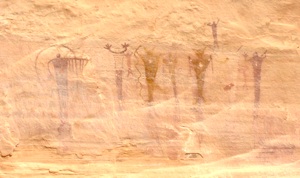
Rock art at Buckhorn Wash in the Swell. Photo courtesy of Emery Country Travel Bureau.
While researching a story for Smithsonian magazine some years ago, I learned that some archaeologists who have studied the Barrier Canyon images believe they were created between 1900 B.C.and A.D. 300. But Alan Watchman, a research fellow at Australian National University, told me his radiocarbon analysis dates some of them to the Early Archaic period, from about 7430 B.C. to 5260 B.C.
Another archaeologist, Phil Geib, also was of the opinion that the earliest image might date to the Archaic period of roughly 8,000 B.C. to 1,000 B.C. He notes that a figurine similar in style to Barrier Canyon rock art was recovered in a cave in Utah above a layer of soil dating to around 7500 B.C. A distinctive style of sandals directly associated with the figurine, he says, dates to around 5400 B.C.
While some Barrier Canyon images can be found in Canyonlands National Park, as well as Glen Canyon National Recreation Area, the San Rafael Swell is rife with them. Though many are not easily found.
But Archaic-era images aren't the only ones within the Swell. There are some from the Fremont Culture that lived in the area from about 700 A.D. to 1300 A.D., and more recent images crafted by Ute artists and Spanish explorers, and even an inscribed name purportedly made by that 19th Century criminal, Butch Cassidy.
More modern history counts structures and roads built by the Civilian Conservation Corps, overly ambitious ranchers trying to coax a living from the spare landscape, remnants of uranium mines tapped during the Cold War.
Taken together, this history -- modern and prehistory -- tell wondrous stories in a demanding landscape.
Spectacular Landscape
Surrounding this graphic history is a landscape that is jaw-dropping.
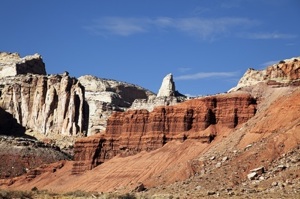
Within the Swell you'll find some spectacular scenery thanks to its underlying geology. Photo via Big Stock Photo.
The San Rafael Swell is an 80-mile by 30-mile bulbous protuberance of rock in south-central Utah that was ratcheted into place by geologic machinations some 60 million years ago. The resulting geology is an open-air classroom, a layer-cake of strata named Coconino Sandstone, Kaibab Limestone, the Triassic Age Moenkopi and Chinle Formations, Wingate, Kayenta, and Navajo Sandstones.
These rockbeds deposited over millions of years have colored the Swell with buffs, reds, tans, greys, blues, yellows, whites, and oranges. And within some of those formations are paleontological treasures -- the Cleveland Lloyd Dinosaur Quarry, which holds a rich cache of fossilized prey and predator dinosaur remains, lies near the northern end of the Swell, and field research elsewhere in the Swell has turned up amazing finds.
According to the Utah Geological Survey, remains of Acrocanthosaurus, a giant carnivore of the Early Cretaceous that was nearly as large as Tyrannosaurus, turned up in the Cedar Mountain Formation not far from Cleveland Lloyd. It possessed "enormous teeth adapted for cutting flesh," the Geological Survey notes.
As the landscape rose, it was transformed into a maze of sorts by erosion. So cut, twisted, and inhospitable appearing is the Swell that when mountain man Jedediah Smith peered into it briefly in 1826, he figured there was no reason to explore it further and kept on going. What the mountain man found to be a barren wasteland is viewed to many today as spectacular.
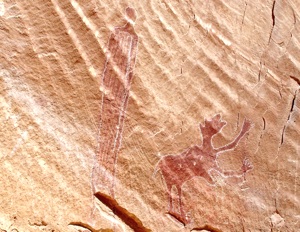
Rock art in Black Dragon Canyon. Photo courtesy of Emery County Travel Bureau.
It was back in 1935 that many Utahans felt the same way, and at the time the Utah State Planning Board briefly lobbied for creation of a "Wayne Wonderland" national park, a 360,000-acre park named after Wayne County, one of the counties that the Swell is found in.
In 1936 Bob Marshall, founder of The Wilderness Society, identified nearly 2 million acres of roadless area in the general vicinity of the Swell that should be protected, and in 1980 the Interior Department identified seven potential National Natural Landmark sites in the same area. More recently, the Emery County Development Council at one point proposed that 210,000 acres of the Swell be set aside as a national park. About in the early 2000s, then-Gov. Mike Leavitt proposed that 620,000 acres be set aside as a national monument.
But the movement never could gain traction in Utah, where 67 percent of the landscape is owned by the federal government, a percentage that in the state's political circles spurs contempt.
Today part of the U.S. Bureau of Land Management landscape, the San Rafael Swell might not carry the "national park" imprimatur as do nearby Capitol Reef and Canyonlands national parks, but it is no less worthy of tag. Those who believe the Swell needs greater protection, perhaps as a unit of the National Park System or else as officially designated wilderness (it currently contains seven Wilderness Study Areas), cite mining, grazing, and off-road vehicle impacts as threats to the landscape. Some rock art panels have served as shooting targets.
Recreational Opportunities Abound
But the lack of a more protective land-management status hasn't prevented recreation in the Swell. Indeed, near the southern end of the Swell stands Goblin Valley State Park, and on BLM lands nearby the beautifully eroded Little Wildhorse and Bell slot canyons wiggle through the Swell.
Along with designated ORV routes, the Swell offers endless miles for horseback use, backpacking edens, mountain biking, and a river -- the San Rafael -- popular with paddlers when runoff swells it, usually from May into mid-June, depending on the previous winter's snowpack. The Green River, which runs through a portion of the Swell, is much more reliable for white-water cowboys and cowgirls looking to buck the rapids.
There's a wonderful BLM campground near the brink of the Wedge Overlook, which looks over a jagged canyon nearly 1,000 feet deep and which is locally referred to as the Little Grand Canyon.
Rock art aficionados appreciate the Swell for being home to some of the Southwest's most curious rock art, such as the renowned Buckhorn Wash Panel, the Head of Sinbad images, the Rochester Panel, or the collection of images found in Black Dragon Canyon.
Venture into the Swell and you'll find buttes and mesas, stone arches and minarets, grassy meadows and box canyons, streams and springs, and possibly be able to retrace routes Butch Cassidy took while fleeing posses. Too, the Swell is home to more than 200 desert bighorn sheep, peregrine falcons, feral horses and burros, Bald and Golden eagles, red-tailed hawks, and prairie falcons.
The prominence of the Swell -- its landscapes and rich archaeological and paleontological resources -- came up when the Obama administration was considering prospective landscapes for protection under the Antiquities Act. That Act allows presidents, without congressional approval, to designate landscapes for protection as national monuments.
"... the San Rafael Swell is a .. . giant dome made of sandstone, shale and limestone -- one of the most spectactular displays of geology in the country. The Swell is surrounded by canyons, gorges, mesas and buttes, and is home to eight rare plant species, desert bighorns, coyotes, bobcats, cottontail rabbits, badgers, gray and kit fox, and the golden eagle," reads an internal draft document prepared for Interior Department officials.
"Visitors to the area can find ancient Indian rock art and explore a landscape with geographic features resembling those found on Mars."
While political push-back from Republicans in the U.S. House of Representatives seems to have squelched the administration's consideration of the Swell, and any other landscapes, for protection as national monuments, it hasn't lessened any of the wonders that you'll find in the Swell.
Story Categories:
A copy of National Parks Traveler's financial statements may be obtained by sending a stamped, self-addressed envelope to: National Parks Traveler, P.O. Box 980452, Park City, Utah 84098. National Parks Traveler was formed in the state of Utah for the purpose of informing and educating about national parks and protected areas.
Residents of the following states may obtain a copy of our financial and additional information as stated below:
- Florida: A COPY OF THE OFFICIAL REGISTRATION AND FINANCIAL INFORMATION FOR NATIONAL PARKS TRAVELER, (REGISTRATION NO. CH 51659), MAY BE OBTAINED FROM THE DIVISION OF CONSUMER SERVICES BY CALLING 800-435-7352 OR VISITING THEIR WEBSITE. REGISTRATION DOES NOT IMPLY ENDORSEMENT, APPROVAL, OR RECOMMENDATION BY THE STATE.
- Georgia: A full and fair description of the programs and financial statement summary of National Parks Traveler is available upon request at the office and phone number indicated above.
- Maryland: Documents and information submitted under the Maryland Solicitations Act are also available, for the cost of postage and copies, from the Secretary of State, State House, Annapolis, MD 21401 (410-974-5534).
- North Carolina: Financial information about this organization and a copy of its license are available from the State Solicitation Licensing Branch at 888-830-4989 or 919-807-2214. The license is not an endorsement by the State.
- Pennsylvania: The official registration and financial information of National Parks Traveler may be obtained from the Pennsylvania Department of State by calling 800-732-0999. Registration does not imply endorsement.
- Virginia: Financial statements are available from the Virginia Department of Agriculture and Consumer Services, 102 Governor Street, Richmond, Virginia 23219.
- Washington: National Parks Traveler is registered with Washington State’s Charities Program as required by law and additional information is available by calling 800-332-4483 or visiting www.sos.wa.gov/charities, or on file at Charities Division, Office of the Secretary of State, State of Washington, Olympia, WA 98504.

Comments
The Swell is in the top 5 of my favorite places to wander. I think BLM is doing a good job managing the area, especially considering that they barely get any money to do it.
If anything, the SRS should be designated as a National Monument and left to BLM to manage like GSENM. Or just designate the wilderness areas once and for all, though we all know the Utah Congressional delegation will never let that happen.
The SRS might make President's Obama's monument list in January, 2017 if he's reelected. But most folks I know this it's okay just like it is now. I tend to agree with them.
Kurt, thanks for a comprehensive story that obviously required a whole lot of work. But this is Utah -- and there's COAL and maybe OIL beneath that beauty.
Remember Utah's environmental motto: Multiply, multiply and pillage the earth.
Tha San Rafael Swell is magnificant and it would be a disgrace if anyone was ever allowed to ruin it's majasty.
That said, this world needs habitat for rare plants and animals set asside permenantly right now. Ancient trees and lots of them, whole forests, millions of acres, to protect species that are endangered right now, in harms way, living on land that will be exploited and divided into islands of habitat that will not function as whole forests do.
The whole Earth will benifit from protected forests and the oxygen they give us, the clean water they provide.
The San Rafael Swell is magnificant, but there's not much oxygen or water being made there.
The Tongas, the Maine Woods, the Klamath Siskiyou Forests are endangered right now, and they are as essential to life on Earth as the Amazon. Don't overlook necessity and the emmense beauty of vast forests while, by it's sheer desolation, the San Rafael desert protects itself.
www.ancientforestnationalpark.org
Lee - I recent took a trip which had me cross Utah twice - 70 to 15 to 80 going west and then Route 50 (named the Loneliest Highway in the US) going east. Some years back I also took the southern route through Four Corners. I didn't see an oil or gas rig, coal mine or "pillaging" of any kind on all three legs. Heck the only civilization was in the Provo/Salt Lake City corridor. I have traveled to nearly every state in the union and Utah is one of (if not) the least developed or exploited in the country. Your whining has no basis.
Driving through a state hardly constitutes any form of evidence of a state's development of it's land. This could mean that you are unobservant, that Utah makes new dirt roads away from highways to build oil and gas rigs, and many other possibilities. Most other states also don't have places like Zions, Canyonlands, Bryce, and Capitol Reef, whose fragile landscapes are easily destroyed but not easily mended. No basis? Think again
I've certainly been through Utah a few times. It's actually pretty hard to miss all the mining going on there. I remember going from SLC to Price (where we stayed overnight) and then to Moab. I would have thought it would have been pretty hard to miss all the open pit mines. At the Holiday Inn in Price, there were people in the lobby openly going over mine plans. We also went to a local store for supplies, and the local BLM mining office was right there.
Anon, I suggest you try living in Utah and listen to some of the nonsense that comes from our loonislature and their development buddies.
As for mining evidence visible from the Interstates, you'll only need to drive a few miles off any of them to find all you want. And if you did indeed drive through the Four Corners area off any of the main roads, you had to have been driving with your eyes closed. (How on earth do you that?)
Your claims have no basis because you simply haven't taken the time to investigate very carefully at all.
Lee, If you drive for an hour or two and don't see a single structure on the state's two major highways and you think your state is being pillaged? You are the one driving blind. Oh, that's right, you don't drive because that would use products from evil "big oil".
It has been 10-15 years since I did the Four Corners route, perhaps things have changed there but there certainly was no pillaging when I was there. Next to Nevada, Utah would appear to be one of the least developed states in the country
Appearances can be deceiving, Anon. Come out here. Spend some time. Learn more.
Remember, there are wise, sound, less harmful ways to use our resources properly. That's all any of on this side of the fence are asking.
Back to the topic at hand...It would be great if the area got Wilderness designation. But at least the WSA's help protect the land in the interim. I, for one, don't think it should be made a National Park. If the BLM is managing the area well and protecting it, then why change it?
The Park Service is stretched thin as it is. They also tend to over-develop their lands to make them accessible to everyone. A surprising portion of National Park visitors only come to get their stamp or drive through. They spend an hour, simply so they can check ‘seeing’ another National Park off their to-do list. Would increasing this type of visitation to the San Rafael Swell help it at all?
This is a special place, however, the National Park Service aren’t the only ones who can care for it properly.
All one needs to do is read the history of Utah towns or even look at the names of two counties to get a better idea. Would there be a "Carbon County" without extensive coal mining? Or "Iron County" without iron mining. Moab and Park City are historic mining towns.
Yeah - there are wide swaths of nothingness, but the state does have lots and lots of open pit mines throughout.
So in your opinion, Moab and Park City are "pillaged"?
It would be too much to say either were pillaged -- and indeed, you're twisting words a bit -- but Park City came close to having a Superfund designation due to mine tailings, and Moab has a Superfund site due to mine tailings.
I'm pretty sure that Lee's use of "pillage" was tongue and cheek.
However, there are some rather long term implications whenever there is mining - especially uranium mining like there was in the Moab area. I understand the cleanup of the Atlas Uranium Mill (now known as the Moab Tailings) is going to be upwards of $700 million. I'm thinking there could be some closed mines that can have their cleanup delayed because there are higher priority sites, but this one is urgent because of the potential for the radioactive materials to leach into the Colorado River. That would be absolutely disastrous if there was a wholesale leach which included uranium. And yes - that water you see right next [about 800 ft] to the pile (with all its leaching radon and other radioactive materials) is the Colorado River.
Here's a different angle, where the height of the pile is more readily noticed:
Here's the site on Google Maps. Just play around with the settings - especially satellite and/or zooming out to see how close this is to Moab and Arches NP. It's maybe a mile from the entrance to Arches NP.
http://maps.google.com/maps?q=38.599727N,109.597612W&hl=en&sll=38.599183...
Park City has issues too, as Kurt said.
http://www.epa.gov/region8/superfund/ut/richardsonflat/index.html
No doubt there were isolated examples of non-envionmentally friendly practices in the past - mostly out of ignorance. But your example of a uranium mine that was closed nearly 30 years ago is hardly supportive of Lee's contention that the current mindset in Utah is to "multiply, multiply and pillage" In fact, turning the mine over to the DOE and working on moving the tailings to a safer place suggests just the opposite.
The fact is that Utah is one of the least developed states in the nation.
Park City residents have been cautioned not to allow children to play in the dirt in some neighborhoods due to the presence of concentrations of various heavy metals from mine tailings. There has been some controversy over just how dangerous those levels might be to children and others. When the Utah Geological Survey tried to publish a hazards map, the developers in that particular area rose up and the state's legislature pressured the survey into filing the map without publication. (About 80%+ of our legislators are involved in land development, construction, or real estate in some way.)
The same tactic was used to kill a map showing unsafe areas to build homes due to the danger of landslides where homes were proposed for construction on hillsides composed of alluvium from ancient Lake Bonneville. As a result, more than a few homes built in those places have slid downhill. (Somewhat to the dismay of their owners, by the way.) But they are left high and dry because two or three years ago our legislators slapped a one-sentence amendment into an old law that prohibits anyone who experiences loss from filing suit against any developer, builder, or realtor due to any problems caused by "siting, construction or design" of the person's home.
To find a good Google Maps view of some of the oil and gas mine pads near Vernal, Utah, enter this location [39.896568,-109.466243] in the "finder box" (or whatever it's called) of Google Maps and then zoom in if necessary. All those little white pockmarks are drill pads. I have no objection to drilling like this. We need the oil and gas these wells produce. But let's be sure it is being done properly. Because if it's not done right, it's "pillaging." And whether or not a land will be "pillaged" or managed properly is a matter of attitude. Utah's environmental motto simply reflects the apparent attitude of an unfortunate number of people who hold power in this state.
I firmly believe that attitude is shown clearly in some of the rhetoric and actions of our state's lawmakers.
To help with the argument of mines in Utah. Lets just look at active mines only, you can just go to a handy site that pulls data from the USGS. http://active-mines.findthedata.org/d/d/Utah I think it listed 131 active mines, For Inactive mines its only estimates but
Approximately 10,697 abandoned hardrock mines exist in Utah according
to the Bureau of Land Management and Forest Service estimates. For more information visit: State of Utah, Department of Natural Resources/Division of Oil, Gas, and Mining
I would say there is plenty of mining in Utah or has been. The only other states that look to be in the same league are Arizona, Nevada, California and possibly Idaho. http://www.abandonedmines.gov/mapdata.html
These just cover counts and dont' discuss impacts of mining like tailings, potential water pollution etc. If you wander any of those states listed above and make the claim there hasn't been much resource exploitation, you just aren't paying attention.
In addition here is the link on oil/gas wells in utah http://mapserv.utah.gov/oilgasmining/
Least Developed in nation.... In terms of what?... what facts? Maybe in terms of Putt Putt golf courses but hardly in terms of mineral extraction.
Paul - good sources. Now lets analyse the numbers.
With 131 active mines, Utah has one mine for every 663 sq miles. Lets look at some other states.
Ohio one mine every 146 acres
TX one per 569
Cal one per 414
Col one per 680
PA one per 154
WV one per 516
Rhode Island 1 per 118
Tennessee 1 per 211
North Carolina 1 per 283
NY 1 per 206
Missouri 1 per 301
Minnesota 1 per 603
Michigan 1 per 379
Compared to many other states Utah is virtually untouched.
Habitat is the biggest thing missing from the national park system; habitat. Clean water, oxygen.
Klamath River, Ancient Forest National Park Proposal
<<span class="start-tag">img src="http://www.ancientforestnationalpark.org/images/Klamath_River.jpg" alt="Klamath River" class="bb-image" />
Statistics are only a small part of it, and you can twist them any way you want to suit your purposes.
The issue with mining in Utah isn't strictly the number of active mines (and the number of closed mines is staggering) but with the scale. The Bingham Canyon Mine near Salt Lake City is the largest open-pit mine in the history of the world.
http://www.youtube.com/watch?v=ceB78tEE_vg
They even charge for tours.
http://www.utah.com/attractions/kennecott.htm
I'm not saying this is necessarily a bad thing. We have needs for the minerals from these mines. However, it's not accurate to imply that Utah is "relatively untouched".
Re: the mining stats for other states compared to Utah.
First question, is that second column of numbers per acre or square mile?
Next question, some of those sure don't look right. Can you provide the source so it can be checked?
Last question, are those all active mines in other states, and if so, what kinds of mines? (Some states include gravel pits as mines and some don't.)
Good catch Lee - that is per square mile not per acre. I used the mine count from the source provided by Paul and http://en.wikipedia.org/wiki/List_of_U.S._states_and_territories_by_area for the square mileage of each state.
From there it was simple division.
And yes, I am concetrating on active mines since your comment was on the current state of Utah thinking. What was done 30, 40 , 100 years ago is moot in this context.
Just for clarification, if the "GUIDE" section had been read, it states quite clearly what is an active mine per this statistic. It is not all inclusive it states that energy materials(coal) are not included in these statistics and the size of the mine must produce a certain amt or it will not be counted(only larger pits are counted) What it does allow is an Apples to Apples comparison if wanted. For more detailed information on mining by state and commodity try http://minerals.usgs.gov/minerals/pubs/mapdata/#valuefig.
The issue was not is Utah more or less exploited than other states like Ohio but whether Utah was a heavily mineral exploited state. The answer is obviously yes based on active/inactive mine count. As Lee did point out size of mine does matter and mining of low density minerals(copper, bauxite, gold etc) require large if not massive mines to make them economically viable. Mining of items like Dimension Stone(marble,granite), Sand/Gravel tend to be much smaller mines.
The mining site does list values of mined materials which Utah is the 4th highest value which indicates that either Utah is mining the most expensive items or its mines are large and mine alot of material or some combination in between but it still is indicative of large mines.