
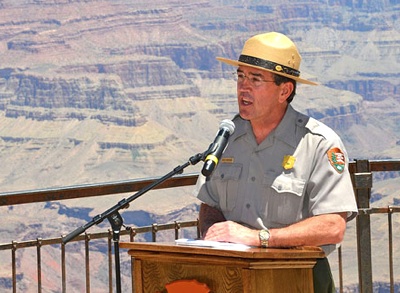
David Uberuaga, now superintendent of Grand Canyon National Park, said he didn't consider it a conflict of interest in 2002 when he sold his home near Mount Rainier National Park for more than three times its assessed value to the park's climbing concessionaire. NPS photo.
What should be construed from the story that a National Park Service superintendent sold his house for more than three times its assessed value to a key concessionaire in his park and didn’t view it as a conflict of interest?
News that David Uberuaga sold his Ashford, Washington, home to the owner of Rainier Mountaineering, Inc., while he was superintendent of Mount Rainier National Park with oversight of the concessionaire, appears to be a troubling conflict of interest.
Atop that are allegations from a watchdog group that Park Service Director Jon Jarvis, at one time Mr. Uberuaga's immediate boss, intervened to see that Mr. Uberuaga was named this past summer as superintendent of Grand Canyon National Park.
John Wessels, the Intermountain Region director who oversees Grand Canyon, on Thursday denied that allegation, saying the final decision was his and that "there was no coercion" in the least from Mr. Jarvis.
The interest in Mr. Jarvis's role, if any, in the appointment stems from the fact that his older brother, Destry Jarvis, has in the past lobbied on behalf of motorized river runners on the Colorado River through the national park.
The transaction between Mr. Uberuaga and the owner of Rainier Mountaineering occurred nearly a decade ago. Park Service officials say they long ago closed the file on the incident -- which the U.S. Attorney's Office in Seattle declined to prosecute after reviewing an investigation by the Interior Department's Office of Inspector General -- with Mr. Uberuaga receiving an unspecified reprimand in his personnel file.
When asked about the matter this week, the agency sent out a terse statement noting that the matter was dealt with three years ago and that Mr. Uberuaga had been exonerated of any wrongdoing.
The National Park Service expects - and the American people deserve - that our employees meet the highest ethical standards.
Illegal or unethical behavior is not tolerated. Allegations of such actions are fully and completely investigated and those found at fault are subject to the most stringent penalties - from dismissal to criminal action. Even the appearance of a conflict of interest is unacceptable and appropriate administrative action is taken.
David Uberuaga is a devoted public servant. Allegations of a conflict of interest regarding a concessioner a Mount Rainier were thoroughly investigated by the U.S. Department of the Interior's Office of Inspector General more than three years ago and resolved.
The matter might have remained silent if not for the Seattle Times, where writer Ron Judd broke the story earlier this week after dogged Freedom of Information Act requests that produced hundreds of redacted pages of the investigation into the deal. Though aged, the story gains traction in light of Mr. Uberuaga's promotion to Grand Canyon.
The promotion went through the Park Service's Intermountain Regional Office in Denver, which has oversight for the Grand Canyon. But Director Jarvis, who in 2008 as the agency’s Pacific Region director signed the reprimand that Mr. Uberuaga received, either "intervened to direct or 'suggest'" Mr. Uberuaga's promotion, maintains Mr. Ruch of PEER.
"The selection committee, appointed by Jon Jarvis, was led by Dan Wenk, Yellowstone superintendent. They winnowed all applicants down to a list of three finalists: (Olympic National Park Superintendent) Karen Gustin, David Uberuaga, and Bert Frost (the Park Service's associate director for natural resources)," says Mr. Ruch.
While it wouldn't be unusual for the Park Service director to overrule a regional director on a personnel matter, Mr. Ruch contends that Mr. Jarvis should have recused himself from the Grand Canyon matter because of his brother's lobbying work in the park.
"Destry Jarvis was (and we believe still is) the paid lobbyist of the organization that represents the motorized river runner companies on the Colorado River in the Grand Canyon National Park," the PEER official said. "These companies provide lucrative commercial services to park visitors under licenses issued and governed by the National Park Service at Grand Canyon National Park. The licensees Destry speaks for have business before the Park Service and adopt and advocate public policy positions regarding the management and administration of the park.
"Destry Jarvis is free to make his living anyway that is legal. However, Jon Jarvis needs to recuse himself from any decision about the Grand Canyon National Park as long as his brother is a lobbyist for nonfederal parties with business before the park and who seek to influence park managers and park management."
If Mr. Jarvis did indeed influence Mr. Wessel's selection of Mr. Uberuaga, that "is more than the appearance of a conflict of interest," says the PEER executive director.
"How do we know, for example, that Jarvis tilted towards Uberuaga may, in part, be because Jon Jarvis wanted someone as park manager who would be receptive to Destry’s lobbying?" Mr. Ruch says. "We don’t know that one way or the other. But, it is possible. This is what a conflict of interest looks like. NPS and the director’s decisions must be above all such suspicions. Sadly, this one is not."
In Washington, David Barna, the Park Service's chief of communications, said the director is careful to avoid involving himself in issues his brother has a role in.
"I spoke with Jon and he is not aware of anything Destry is working on related to NPS because they don't talk about it, nor does he even know about meetings Destry is having," Mr. Barna said. "Jon said that Destry stopped by for lunch the other day after some meeting here with DOI (the Interior Department), but Jon is not sure what the meeting was about. They have been at this for 30+ years and are good at keeping distance."
As for Mr. Uberuaga and his real estate deal, the case appeared "on its face" to be a conflict to investigators with the Interior Department’s Office of Inspector General.
Not only was the OIG troubled by the sheer price of the sale, but it also suggested a possible conflict in that Mr. Uberuaga oversaw park concessions. Also troubling OIG investigators was that the sale wasn't financed the typical way, through a bank. Rather, Mr. Uberuaga held the note on the sale, they came to learn. Too, there was speculation at the time that a transit center for the park was going to be located in Ashford and so the property in question might become more valuable down the road.
According to a transcript of an interview between an OIG investigator and Mr. Uberuaga, the investigator at various times said the sale sounded suspicious to him because of the way it was handled, and he specifically asked if the transaction wasn’t simply “a kickback.”
“I can see how you got to where you’re at,” Mr. Uberuaga replied, “but there was absolutely no business connection, no benefits, no discussion, nothing in terms of that in terms of business kickback or anything.”
A few minutes later the investigator pressed further.
“What we have a hard time understanding is how a property at an assessed value of $125,000, let’s give you the benefit of the doubt and say $40,000, let’s even give you another $60,000 for sweat equity. You’re still at double that sales price. You know, and entering into a real estate contract, while it does sound like it’s a legitimate vehicle to finance, what it suggests to me is that (redacted) couldn’t go to a bank and get a bank to finance that deal, because the property wasn’t worth that much,” he said.
“This was a speculative deal on the promise -- I don’t know if there was a promise, but on the forecast potentially that this is an area that (redacted) can develop based on contracts and awards that (redacted) wins from the mountain. (Redacted) buying from you, the superintendent. I can only tell you how this looks on its face.”
To Mr. Ruch, the message the matter sends to the Park Service's more than 20,000 employees is "that rules are meant to be bent."
Some of the aspects turned up by OIG's investigation:
* Mr. Uberuaga bought his house in Ashford in 1992 for $84,000. In 2002, he sold it to Rainier Mountaineering's Peter Whittaker, at the time the park’s only climbing concessionaire, for $425,000. The property’s assessed value was $122,400, according to the Seattle Times.
* The purchase was not at arm’s length; Mr. Uberuaga held the note. So while Rainier Mountaineering was operating on the mountain and bidding for a new contract, Mr. Uberuaga was taking monthly payments from the company while also overseeing the concessions deliberations.
* Although Mr. Jarvis, Mount Rainier’s superintendent in 2002, early that year removed Mr. Uberuaga from any concessions dealings due to the fact that his children worked in various capacities for Rainier Mountaineering, that recusal did not surface in the OIG’s investigation into Mr. Uberuaga’s real estate deal, nor was a similar recusal letter written when the real estate deal was struck.
* Mr. Uberuaga failed to fully disclose the real estate deal on Office of Government Ethics form. When contacted specifically about his mention of "Real Estate Contract, Fidelity Contract Services," he failed to specify that he had sold his home to Rainier Mountaineering. Also on that form, Mr. Uberuaga said he had no "agreements or arrangements" with any outside entities.
* Mr. Uberuaga's "Conflict of Interest and Confidentiality Statement" specifically asked that he "certify that I am not aware of any matter which might reduce my ability to participate in the proposal evaluation proceedings and activities associated with the participating in the evaluation review panel for the Mount Rainier National Park concession opportunity in an objective and unbiased manner or which might place me in a position of conflict, real or apparent, between my responsibilities as an evaluator or advisor and other interests." He did not mention any conflicts on that form when he signed it in May 2006.
When asked to explain why he didn't alert anyone to the real estate deal before signing the statement, Mr. Uberuaga said he didn't fully understand what the document was, that he viewed it simply as a "confidentiality agreement," the OIG report stated.
While Mr. Wessels wouldn't address any specific matters tied to the investigation, he did say that, "I take these decisions very, very seriously, and I went through a very thorough vetting process for the superintendent of Grand Canyon, very, very thorough, with multiple layers and multiple layers of interviews. I did a ton of work, and I again, based on all the research that I did, and talking to a lot of folks and looking at a lot of applications, I still believe he’s the best person for this job, and I stand behind him. And that you can write.”
At PEER, Mr. Ruch laments the matter.
“It is our perception that ethical standards within the National Park Service are in serious decline during the relatively short tenure of Director Jon Jarvis, and this case fits that pattern,” Mr. Ruch said. “Not surprisingly, Mr. Jarvis declined to speak to the reporters for this article. Instead, he had NPS spokesperson David Barna issue a typically inaccurate and incredible statement: ‘Even the appearance of a conflict of interest is unacceptable.’
“It appears that Director Jarvis does not believe that rules apply to him or his inner circle.”
Story Categories:
A copy of National Parks Traveler's financial statements may be obtained by sending a stamped, self-addressed envelope to: National Parks Traveler, P.O. Box 980452, Park City, Utah 84098. National Parks Traveler was formed in the state of Utah for the purpose of informing and educating about national parks and protected areas.
Residents of the following states may obtain a copy of our financial and additional information as stated below:
- Florida: A COPY OF THE OFFICIAL REGISTRATION AND FINANCIAL INFORMATION FOR NATIONAL PARKS TRAVELER, (REGISTRATION NO. CH 51659), MAY BE OBTAINED FROM THE DIVISION OF CONSUMER SERVICES BY CALLING 800-435-7352 OR VISITING THEIR WEBSITE. REGISTRATION DOES NOT IMPLY ENDORSEMENT, APPROVAL, OR RECOMMENDATION BY THE STATE.
- Georgia: A full and fair description of the programs and financial statement summary of National Parks Traveler is available upon request at the office and phone number indicated above.
- Maryland: Documents and information submitted under the Maryland Solicitations Act are also available, for the cost of postage and copies, from the Secretary of State, State House, Annapolis, MD 21401 (410-974-5534).
- North Carolina: Financial information about this organization and a copy of its license are available from the State Solicitation Licensing Branch at 888-830-4989 or 919-807-2214. The license is not an endorsement by the State.
- Pennsylvania: The official registration and financial information of National Parks Traveler may be obtained from the Pennsylvania Department of State by calling 800-732-0999. Registration does not imply endorsement.
- Virginia: Financial statements are available from the Virginia Department of Agriculture and Consumer Services, 102 Governor Street, Richmond, Virginia 23219.
- Washington: National Parks Traveler is registered with Washington State’s Charities Program as required by law and additional information is available by calling 800-332-4483 or visiting www.sos.wa.gov/charities, or on file at Charities Division, Office of the Secretary of State, State of Washington, Olympia, WA 98504.

Comments
If you take all the information in it's
totality, it doesn't take a rocket scientist to see this was a quid
pro quo.
It's interesting to note that it
appears to have taken 7+ years for the Seattle Times to get this
information through the freedom of information act. I wonder if the
individuals involved thought the details would never go public. That
would explain their sloppy handling of the quid pro quo arrangements.
Lets not kid ourselves, this happens
all the time in business, but if you get caught, be prepared to be
held accountable.
And lets also not kid ourselves that this happens all the time in politics as well. And like the business man, if you are a state or lower level elected politician you will also be held accountable. But if you are Federal, what's the problem? Isn't that a perk?
The time I've experienced with new Superintendent Dave Uberuaga including private office time, has been refreshing. The word and what I've witnessed is that he really does like to engage and encourage very good working relationships with NPS employees, visitors, stakeholders and neighboring tribes. More than just words but in practice. It is very refreshing and that is the breadth of my knowledge of Dave Uberuaga. I certainly know nothing of the real estate issue at the center of the article but recognize a good man.
Grand Canyon suffered badly for the last few years under a superintendent whose reign of terror was marked by callous treatment of employees and complete disregard for rules when applied to himself. Somehow he was coated with teflon and charges never stuck, but employees are still shellshocked.
Superintendent Uberuaga has been a breath of fresh air in his brief time at the Park. He listens respectfully to others, takes the time to understand issues, and has been almost compulsive in following rules and requiring others to do the same. This incident, which happened seven years ago, seems to have left its mark on him in the form of "never again," for himself or others under his supervision.
Time will tell, but Grand Canyon has an opportunity to heal and to move forward with a sadder-but-wiser leader at the helm who has made his mistakes and learned from them.
I have my own opinions about this article and the motives behind it, but will wait to see how it plays out.
Anyone who uses "engage" as an intransitive verb is either a colleague of the person in question or a corporatroid well-versed in biznobabble.
Wrong on both counts, babble:). I do admit I'm not an English Major. In fact my history has had a good bit of adversarial "engagement" when I believe things are going sideways or backwards. Not always a good career move but I can sleep at night. Like I said I know nothing of the real estate deal so I won't comment on that. I just stated my impression of the man. Now would you like me to say something about Solyndra and Fast and Furious?
I saw lots of management's shady behavior and (mostly) petty corruption during my career, but this very disturbing story indicates to me that the NPS's ethics have continued to decline. Quid pro quo is very difficult to prove if the conspirators have rehearsed their stories, but I have no doubt that this was a bribe or kickback for preferrential treatment by RMI.
My only contact with Superintendent Uberuaga was at public meetings, where I thought him very sharp and quick on his feet, if a bit arrogant. His playing dumb for OIG investigators is totally unconvincing, I think he knew what he was doing every step of the way. Peter Whittaker's bleating about "less attention" is even less convincing. RMI's guiding monopoly was going to end in any case. What he got in return was years of delay in implementing the new Commercial Services Plan and a larger slice of the guiding pie than the NPS preferred alternative, together worth millions in revenue.
The Seattle Times story doesn't mention that Uberuagua was the principle author of Mt. Rainier's last General Management Plan, which proposed greatly expanded bus shuttles, with parking in Ashford and a new visitor contact station. After that document was released, Whittaker acquired a bus fleet, partially subsidized by park grant money, and is well-positioned to rake in even more future revenues from parking fees and bus fares. In addition, his bistro and coffee shop would undoubtedly pick up much of the business lost by restaurants between Ashford and the park entrance that would be bypassed by the shuttle system. Was this brilliant business foresight or the concession equivalent of insider trading?
NPS Director Jarvis's actions, or lack thereof, are actually even more disturbing. Those pious press releases about "transparency" seem a bad joke. It wouldn't surprise me a bit if Representative Doc Hastings decides to use this and other NPS scandals to reduce their funding and/or score political points with corruption hearings.
I agree with the Adventure-Journal op-ed accompanying this story that Dave Uberuaga should not be superintendent at Grand Canyon. I'd go further and call for his dismissal and stripping him of his ~$90K pension. Whittaker should also lose his concession contract and join Uberuaga in a new career making license plates.
Just a thought, Tahoma, after reading your post; What would you have the President (US) and his entourage doing in their "next careers?"
I'm guessing the Whitaker you mentioned is probably a member of the Jim Whitaker family that has a huge history at Rainier with Jim being the first American to stand on top of Mt. Everest. Quite a history around those parts and have always heard great things about their operation there.
How about the fact that under Uberuaga's watch at My Rainer Natl.Park the Paradise wastewater plant never had a wastewater discharge permit, which is required of every wastewater plant in the U.S. by the EPA.
And it is I who, as a wastewater operator at the Paradise Plant, was convicted of violating the Clean Water Act by discharging a pollutant into a U.S. waterway without a permit. Such permits cannot be obtained by iindividual wastewater operators, only the owners of the facilities can.
Yes, the NPS does not have to followFederal laws like the rest of America does. No wonder the American populace is fed up with govenment as usual.
If anyone was waiting and hoping for a much needed "agency reset" when our new director John Jarvis was sworn in, think again. He is leading us nowhere.
This case exposes what we all know and deplore about the NPS leadership succession - its corrupt, selections are based upon hiring past friends and subordinates who demonstrate lock-step compliance, rather than real leadership ability. John Jarvis overlooked known major ethical transgressions, suppressing this past performance history, to support one of his good friends and provided a promotion opportunity to his buddy, as he also did with his deputy Mickey Fearn. This is the very thing we have been complaining about. John Jarvis did not bring anything new to his office; he has brought more of the same and has failed to lead the agency anywhere. He is a disappointment, because unlike Mainella, he knows better.
In reply to Anonymous-
Jim Whittaker, the first American to summit Everest, lives in Port Townsend and has no real involvement with Rainier Mountaineering, Inc., so far as I know. His twin brother Lou started RMI in 1969 and passed controlling interest to his son Peter Whittaker about ten years ago. Peter was the lead guide during the worst mountaineering accident in North American history in 1981, when another guide and ten clients perished on Rainier's Ingraham Glacier. For a 2010 review of RMI's "operation", check out: http://www.dailyhiker.com/gear/rmi/
tahoma, I have to be honest and say I was more horrified by your link and it's descriptions of the concession operations at Rainier, specifically RMI then I was with Uberauga's involvement. Perhaps I'm wrong but after his predecessor (at the Canyon) and his string of over the top actions abusing any number of people and processes, it'll takes a lot to blemish my image of Mr. Uberuaga. He is refreshing in his efforts.
I know a good number of guides in other areas outside of climbing and guide myself and what your link describes is a bit to familiar. Personally, I never expected to enjoy my clients as much as I found I did. Of course, I'm older than most and don't need or have the desire to have it all about me. These people we take into the wilds are looking for something transformational. They might not know it but the opportunity for it to happen with considerable personal equity (both physical and financial) contributed deserve something more than what some corporate number cruncher can understand or appreciate. Many times a corporate office is far removed from those guides that are the closest to and carry the most responsibility for their clients. I'm very aware of how this plays out and would like for NPS and the Concessionaires to do more to encourage these experiences in our National Parks to be more personal in nature so that it can be more meaningful and foster the kind of citizenship that these great places contribute to. Supporting the guides would go a long way in fostering the best experiences for visitors, also.
Maybe someone here can post the chain of authority concerning concessions, including those responsible for contracts large and small in our parks.
Kurt, Previous to the real-estate collapse many properties could be sold in many parts of Dare and Hyde County NC for double the closing price paid 2 to 3 years previous. I was wondering how did that sale compare to similar properties sold in that time frame in that area?
I know retired DOD employees that make pretty amazing salaries from defense contractors upon their retirement via the good ole boy network they are a part of. They concede in private that the financial rewards exceed the work they are doing. It seems like payola after the fact to me. My point being that none of the speculation expressed in the comments would shock me. IMO there is a culture of unethical behavior by corporate and government mangers in this county. A recent example being former Massy mine president Don Blankenship’s golden parachute retirement (50 million) after the Massy mine disaster.)
On the other hand uncorroborated discrediting of NPS mangers for carrying out locally unpopular mandated government policy is a popular activity in Dare County, NC. (CHNS) I suspect this happens in other parks as well. Could some of that be the case here?
So, anything wrong with this example at the Federal level? This individual is an ongoing conflict of interest it would seem. While we are on the subject.
http://commonamericanjournal.com/?p=34239
Conflicts at a level unseen before. The RMI/ Superintendent Aberuaga issue seems insignificant, comparatively.
http://abcnews.go.com/blogs/politics/2011/10/obama-jobs-council-stacked-...
It would be more productive if the "Occupy" movement got smart and directed their efforts at the source and not the preferred distraction of those responsible. Certainly difficult to pick through the smoke of deception. I certainly don't include the appearance of a conflict with the RMI issue with the rampant unconcern with conflict interest on display but it is a slight opening the door of true horrors at the highest Federal levels.