
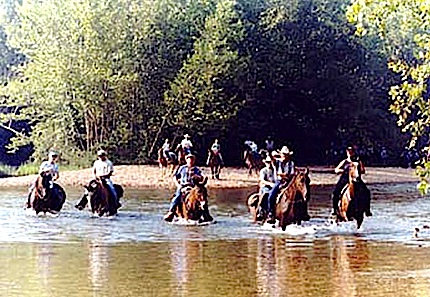
Rampant, unrestricted horse use is leading to high E. coli levels in the Current and Jacks Fork rivers in Ozark National Scenic Riverways, which also is plagued by poorly managed all-terrain vehicle use, according to a new report. Photos and graphic from Friends of Ozark Riverways.
Lack of public education and illegal entry were blamed Tuesday when officials at Ozark National Scenic Riverways were confronted with a report that said they are not properly caring for the national treasure.
Chief of Interpretation Faye Walmsley also questioned the contention in American Rivers' Most Endangered Rivers report that there are hundreds of miles of illegal horse trails and 10 times more river access points for all-terrain vehicles than had been planned for the scenic riverways.
"There are some disputes I have," Chief Walmsley said when presented with the numbers.
The American Rivers report released Tuesday morning portrayed the scenic riverways in Missouri as being strangled by poor National Park Service management. Since 1984 all-terrain vehicles have created a dusty, spaghetti bowl network of trails, some that lead down into the Current and Jacks Fork river corridors and onto gravel bars used by canoeists and other boat campers, states the report.
Additionally, horse use of the park has gotten out of control; while there are only 23 miles of designated equestrian trails in the park, "National park management allows equestrian use on any unpaved roads and trails, and there are now more than 250 miles of horse trails and 80 places where horses cross the rivers in the park, which harm water quality with erosion and manure."
Chief Walmsley, however, questioned those numbers. Regardless, she said off-road use of ATVs in the park was illegal, as was horse use beyond those 23 miles of trails.
"ATVs are not authorized in the park. They’re only allowed on county roads," she said. "So, those in the park that are not on a county road, they’re running their ATVs illegally.”
While Chief Walmsley acknowledged that the park's law enforcement rangers couldn't be everywhere in the park at all times to look for illegal uses, she was of the opinion that the main issue was educating the public as to what they could do in the scenic riverways and where.
Since 2006 the park has been working on a new general management plan, one that will outline ways to manage recreation in the scenic riverways and also evaluate areas for possible designation as official wilderness. Revisions to that draft are ongoing, and officials hope to have a version for public review later this year, Chief Walmsley said.
While the Park Service describes the scenic riverways as home to "two of America’s clearest and most beautiful spring-fed rivers," the American Rivers report paints a decidedly different image.
In 1984, there were 13 developed river access points and public campgrounds. Today, there are more than 130 vehicular river access areas, many characterized by a maze of unmanaged dirt roads that send untold amounts of sediment into the river. Virtually all gravel bars (used for canoe and boat camping) are subject to invasion by all-terrain vehicles (ATVs) and other vehicles. The vehicles destroy vegetation, and contribute to severe erosion and harm water quality.
This is not just the case of a national environmental organization filling out a list. The scenic riverways' local friends group has been working to highlight the various threats to the Current and Jacks Fork rivers as well, stating quite bluntly that "(M)ismanagement of Ozark National Scenic Riverways has degraded Missouri’s premier National Park."
According to Friends of Ozark Riverways, when the unit was added to the National Park System in 1964 to specifically protect a "wild river system," river access points were planned to fall roughly 15-20 miles apart down the length of the Current and Jacks Fork rivers. Today there are more than 130 access points, or almost one every mile along the 134-mile riverways, the group notes.
"This explosion of access has downgraded the user experience and seriously damaged resources. It is virtually impossible to find a secure refuge from motorized vehicles anywhere in this park," the friends group notes on its website.
Horse use in the scenic riverways also is leading to high E. coli levels in the rivers, according to the group.
Even the most recent data from the Missouri Department of Natural Resources Water Protection Program shows that E.coli levels in the lower seven miles of the Jacks Fork have been increasing since 2002. E.coli levels have been linked to increased horse waste in the river and its tributaries. These rivers, the Jacks Fork and the Current, are supposed to be of the highest water quality in Missouri. Their high quality for recreation, especially for swimming in the national park, must not be degraded. In 2002 at river mile 4.5 the annual E.coli geometric mean was 26 and ... in 2009 it was 116. We must reverse this alarming trend.
Groups supporting the Friends of Ozark Riverways in its campaign to reserve these trends include:
* Missouri Coalition for the Environment
* Missouri Parks Association
* Missouri Wilderness Coalition
* Ozark Fly Fishers
* St. Louis Adventure Group
* St. Louis Canoe and Kayak Club
* Missouri Archaeologial Society
* Environment Missouri
Story Categories:
A copy of National Parks Traveler's financial statements may be obtained by sending a stamped, self-addressed envelope to: National Parks Traveler, P.O. Box 980452, Park City, Utah 84098. National Parks Traveler was formed in the state of Utah for the purpose of informing and educating about national parks and protected areas.
Residents of the following states may obtain a copy of our financial and additional information as stated below:
- Florida: A COPY OF THE OFFICIAL REGISTRATION AND FINANCIAL INFORMATION FOR NATIONAL PARKS TRAVELER, (REGISTRATION NO. CH 51659), MAY BE OBTAINED FROM THE DIVISION OF CONSUMER SERVICES BY CALLING 800-435-7352 OR VISITING THEIR WEBSITE. REGISTRATION DOES NOT IMPLY ENDORSEMENT, APPROVAL, OR RECOMMENDATION BY THE STATE.
- Georgia: A full and fair description of the programs and financial statement summary of National Parks Traveler is available upon request at the office and phone number indicated above.
- Maryland: Documents and information submitted under the Maryland Solicitations Act are also available, for the cost of postage and copies, from the Secretary of State, State House, Annapolis, MD 21401 (410-974-5534).
- North Carolina: Financial information about this organization and a copy of its license are available from the State Solicitation Licensing Branch at 888-830-4989 or 919-807-2214. The license is not an endorsement by the State.
- Pennsylvania: The official registration and financial information of National Parks Traveler may be obtained from the Pennsylvania Department of State by calling 800-732-0999. Registration does not imply endorsement.
- Virginia: Financial statements are available from the Virginia Department of Agriculture and Consumer Services, 102 Governor Street, Richmond, Virginia 23219.
- Washington: National Parks Traveler is registered with Washington State’s Charities Program as required by law and additional information is available by calling 800-332-4483 or visiting www.sos.wa.gov/charities, or on file at Charities Division, Office of the Secretary of State, State of Washington, Olympia, WA 98504.


Comments
FINALLY someone is noticing what's going on at Ozarks. Conservation-minded folks who love the park (as well as NPS employees) have witnessed bad resource decisions for far too long . Thoughtful planning and adherence to basic National Park Service guidelines for protection and preservation should have been the norm, but instead they have been very rare for nearly 10 years. A philosophical (and regime) change is in order.
What could one expect from the Bush Administration and republicans in office in MO. The Obama administration is just as bad. Obama has done little to correct decades of neglect in our National parks. By the way either has Congress.
I agree it seems that politicians tend to ignore the national parks. The last major investment in the national parks was mission 66 back in the 60s.
Re: Ranger PaulLast major investment? Didn't NPS receive a 700 Million windfall just year before last?
Leonard Hall would be turning over in his grave if he knew this lovely river and country was being abused !!!!
"National park management allows equestrian use on any unpaved roads and trails, and there are now more than 250 miles of horse trails and 80 places where horses cross the rivers in the park, which harm water quality with erosion and manure."
This seems even to a simpleton like me to be an easy issue to correct. What's the matter park managers, ain't ya got no stones??????
A waterway like the Chicago River (also recently placed on "The List") I can easily understand. It's been nothing short of a glorified above-ground sewer for the past 150 years and for the majority of the past 60 years it has been annually colored green in mid-March to suit the petty nuances of some idiotic mayoral dynasty. But for the Ozark Waterway to achieve this status if truly a sad day for us all. Let's not allow the same thing to happen to the Upper St. Croix when some idiot decides to replace a bridge conveniently instead of responsibly.
Lone Hiker I think you need to get your facts straight! There are not 250 miles of equestrian trails within the park boundaries nor are there 80 river crossings. My family maintains the majority of this trail system and I can accurately say that this is untrue. There are about 250 miles of trail within the trail system near Eminence, however, the majority of these trails lie outside the park boundary on State and privately owned property. The park has no authority over these areas, nor should they!! There are approximately 10 equine river crossing within the entire NPS boundary which includes Jacks Fork and Current Rivers. I believe that this is an insignificant number in comparison to the number of miles these rivers cover. While you may not enjoy sharing the river with other user groups, it is not your decision to make and I don't believe the misuse is nearly as rampant as environmentalists would like everyone to believe.
You are right about the park, let's clean it all up as well as the dirty politics that got it there in the first place.
Admittedly I am not the king, but if I were I'd completely shut down horse and ATV access on all roads - paved or otherwise - until nature recovers on its own. A nice 50-year hiatus oughta show people the consequences of knowlingly ignoring the rules. Yes, knowlingly. This notion of simply needing to "edumacate" the public is a joke. They know what they are doing.
ALL HAIL KING MERRYLAND!!!
I'm right there with ya bud. Simple brains tend to create the most complex problems mainly through ignornace. And this was so easy to avoid it should make one ill to believe that a situation such as this could occur in a "sophiticated" society such as we purport to be.
You've got my vote your royal Highness. Oops, no votes in the kingdom. Sworn allegiances only. My bad.
Your humble servant, LH
In order to properly let nature fully recover motorized boats should be outlawed as well. they pollute the river more than any horse does. Heck just outlaw floating as well since many out of towners come in and pollute the rivers with their trash.
This is my home turf. I have spent hundreds of days on these two beautiful rivers. I began with a ten day trip in the summer of 1970 and float it at least a half dozen times a year. I am headed down again this Sunday for a trip.
What I have observed over the past 20 years is shocking. I have seen major upgrades and enlargements of cabins on scenic easments really impact the wilderness quality on several sections. You cannont go more than a mile or two on a summer weekend without seeing vehicles parked within sight of the river. On the rare occassion that I have floated on a Saturday during the season I have been boobed, mooned and full frontal flashed, observed 4 wd trucks playing in the river, been turned over in my canoe by people who I did not know because I had made it through a tricky run and watched more than a few domestic disputes. While the park service and local law enforcement have made a good effort at getting the rowdy behavior under contoll over the past five years, lots remains to be done.
My main concert is with the horses. The largest of the horse operations has stalls for 3000 horses. Several of these operations are located on a three or four mile stretch that was not included in the park during it's creation. Imagine, the horse droppings and urine from these animals leacing into the river. I have had to wait out strings of over a hundred horses as they crossed the river. This is just from one of many horse operations on the rivers. This stretch of the Jack's Fork in Eminence, MO is lined with cabins, motels, horse resorts, restaurants, private campgrounds and all manner of other developments. This serves as an example of what the entire riverway would look like without NPS protection.
This park is part of my soul and my spiritual well being. It saddens me that many of these problems already have laws to prohibit them, but enforcement is another thing. Lots of local political influence seems to be applied to the park service. Just my two cents worth.
Marty again another commenter who doesn't have a clue! There are not "many" horse operations on the Jacks Fork river and I very much doubt that you had to wait for "hundreds" of horses to cross for you to be able to float. What I hear you saying is that YOU can't enjoy yourself in the way YOU feel you should be able to because there are other users enjoying the rivers also. Well, guess what, that's not going to change. With over a million visitors to this park each year I'm pretty sure the .8% that can be attributed to equestrian users is not the main issue. Since you enjoy floating have you counted how many floaters and swimmers use the river in comparison to the number of horses you have actually witnessed in the length of your float? I wonder if this could have any impact, if there is actually a problem!!
Carolyn Dyer's parents own the CROSS COUNTRY TRAIL RIDE which claims to be the worlds largest trail ride. They advertise that they have over 3000 stalls and the whole operation is in the Jacks Fork river floodplain. This huge operation has put the river on the 303 (D) list of impaired waterways as well as the ENDANGERED RIVERS LIST. They claim they have no control of the thousands of equestrians once they leave their property and they have little to keep the riders on the designated trails and crossings. Large contibutions to CONGRESSMAN EMERSON have enabled them to operate in this heinous manor.
How about Congress woman Emerson? This river is in her district and she sits on the Interior committee that has oversight of NPS..Looks like she is part of the problem!
Studebaker, you are correct. Congresswoman Emmerson has fought many a battle against the best interests of conservation. She is from a very red district and is most likely secure in her position. Lot's and lots of political pressure has come down on the NPS from federal, state and local governments.
Emerson has the problem here foe many years, her campaign has recieved huge contributions for the Cross Country Trail Rides and the Smith family, just go to www.opensecrets.org and lookup zip code 65466.
Im concerned there wont be any Current river in a very few years for anyone to enjoy. The solution would have to be so drastic and complex that it probably will not happen. The streams running into the current such as Big creek or Ashley and many more, are polluted by cattle in the creeks, as a result manure and fly spray are washing down.
Horses are a huge problem now, erosion and pollution are the result, same goes for illegal ATVS. Down on the lower part of the current its the big thing to see who can have the most hp behind their boat and joy ride, the waves are incredible.
of course everyone enjoys canoeing but the traffic is killing the river, this rivers pristine waters and great fishing are advertised all over the world. And now comes a practice the park service does that ive watched for years, the spreading of chat and gravel on access points after a flood, tons of it go washing down the river the next flood and so more is spread. All the deep holes are being filled in.
What about the so called mud dog salamanders we used to have, ugly but harmless, and the sculpines are disapearing, several species of the water are gone. I remember a time when we could drink the water in the Current.
It boils down to the fact that something should have been done along time ago, I just pray that its not too late The line between enjoyment and destruction has got too thin for the Current River.
The answer is community involvement. If we wait for our elected officials to solve these kind of problems we will continue to be greatly disappointed. If there are unauthorized horse crossings and atv accesses in the park-get a group of river cleanup volunteers to post signs and man these areas during peak times. The rangers have no hope of controlling the issue by themselves. But with the community behind them they can begin to make a difference. I know this is not an easy task, the question is...is the river worth it? Surely we have some law enforcement river lovers who recognize the problem as well. A uniform says volumes to those who would break the law when they believe they are not being watched.
the answer is community involvement, the rangers cannot do it by themselves and we will be greatly disappointed if we continue to wait for our elected officials to solve this problem or any other
The miles of new road to a river access ever mile could easily be fixed by a few tree or rangers camping out writing tickets when people find them selves off designated roads. Word of tickets spread fast. And the horses are just rude. the people i have seen riding them dont need trails they literally use the river as their trail. Try canoeing past a group of 50 or 100 horses walking down the river.
How many canoers have floated the river and dumped there canoes full of trash over in the deep holes? Did you even try to recover the debris, or did you leave it in the river? There are way more tourists that come down here and think they can get away with everything and leave us to clean up the mess.