
More than a decade after gray wolves were returned to Yellowstone, they remain a big draw. Grizzly bears look big from a distance, and even larger up close, as this skull held by MacNeil Lyons of the Yellowstone Association Institute shows. Photos by Jane Schneider.
It's a brilliant fall morning and instead of being holed up in my stuffy office cube, I'm out stalking grizzly bears. I've come to Yellowstone National Park to learn more about the wildlife here, particularly its two top predators: grizzlies and wolves.
My guides are MacNeil Lyons, a naturalist with the Yellowstone Association Institute, and his partner, Institute program manager Nick Derene. As we travel together, it becomes evident that their knowledge of wildlife — and the park in general — is nearly encyclopedic.
Today's destination is Lamar Valley, a beautiful, rolling and rumpled swath of the Rockies that sprawls across the northeastern corner of this 2.2-million-acre park. Overhead the sky is a deep, periwinkle blue as we wind our way into the valley, the sun just beginning to peer over the rugged Absaroka mountains that rise above Yellowstone's eastern boundary. We spot bison grazing and the occasional elk in the flats that rim the Lamar River before Mr. Lyons pulls the van over and quickly jumps out. Training his binoculars towards the horizon, he points out a tawny lump barely discernible among the rocks.
“Look, over there. Do you see it?” he whispers, our group gazing into the middle distance. “That's a grizzly bear.”
I can hardly believe our luck.
Approximately 150 grizzlies live within the park boundaries and the bears have been particularly active this year. With hibernation just weeks away, their foraging has taken on a sense of urgency. I watch through the spotting scope as the impressive bruin upends boulder after boulder in search of grubs or moths, intent on sniffing out something for breakfast.
“What do you think a grizzly eats?” Mr. Lyons asks.
This time of year it is grubs, though that diet varies according to the season, he notes. Bears are omnivores, so their food choices are vast and include berries, roots and moths, rodents, fish, and elk and even bison.
The naturalist holds up a grizzly skull he cradles in his arms. It's roughly the size of a football on steroids.
“He's at the top of the food chain here at Yellowstone,” Mr. Lyons says of Ursus arctos horribilis.
Even the wolves won't challenge a grizzly bear for food. Though often seen lumbering, grizzlies can hit top speeds of 30 miles an hour when chasing prey. Once down, a grizzly kill of elk or bison will provide sustenance for a host of other animals as well: Coyotes, wolves, ravens, bald eagles, mice, badgers, magpies, even the occasional mountain lion, all benefit from the grizzly's hunt.
As predators, bears and wolves play an important role in the delicate balance of life here. But it is a balance that is constantly shifting.
“Yellowstone is always in a state of flux,” says Mr. Lyons.
Change, it seems, is the only constant in nature, the only thing that remains certain.
Wolf alert
Now that we've seen a grizzly, our minds are dancing with wolves. “Is that one over there?” someone calls out as we all turn in unison. But we've been fooled. A closer look reveals two coyotes who trot along the perimeter of a bison herd.
As we scan the group with our binoculars, Nick Derene tells us the coyotes know that the pounding of hooves often flush out voles and field mice from the brush, so they're alert and ready. We watch as one coyote crouches, then leaps straight up in the air as he pounces on his prey. No luck this time, though. Mealtime will have to wait, and he lopes off to catch up with his mate.
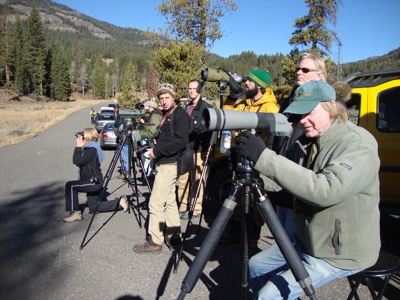
Around the bend, we finally come upon a bevy of spotting scopes and long-lensed cameras, which can mean only one thing: Wolves. Biologist technician Rick McIntyre with the Yellowstone Wolf Project sits attentively as a group of 10 people chat and take turns looking through the spotting scopes.
“Who hasn't seen the wolves yet?” he asks as we approach.
The scopes are trained on the lodgepole pine forest several football fields away where three wolves saunter in and out of the afternoon shadows. Mr. McIntyre remains patient, focused. He's been observing wolves every day since they were first reintroduced to Yellowstone in 1995 and remains fascinated by their behavior.
The animals we see today are part of the newly formed Lamar Canyon pack, he tells us.
The female, bred by two males, gave birth to four pups last spring. Now that the youngsters are more mature, the pack has been roaming this region of the valley. The three adults will likely stay together for life, says the biologist, while the pups will eventually move on to join other packs.
The Lamar Canyon group is one of approximately 11 to 15 packs that have staked out territories at Yellowstone. All are the progeny of the original 31 Canadian wolves brought here from Alberta, Canada to repopulate the park.
I watch as Colby Anton steadies an antenna and points it towards the glade where the gray wolves have gathered. About 20 percent of park wolves wear collars fixed with small, portable radio transmitters. Each transmitter is set to a different radio frequency, so that individual animals can be followed by a signal that beeps from the collar. Mr. Anton, a field technician with YWP, assists Mr. McIntyre in tracking the wolves using telemetry, a data collection method that makes observing these elusive canines easier. While a somewhat inexact science (since radio waves can bounce off rock walls giving false readings), telemetry provides biologists with a much better picture of where animals travel and how they behave.
Mr. McIntyre became interested in wolves while working summers in Denali National Park and Preserve in Alaska. It was research for a book on wolves that led him to Yellowstone and the Wolf Project, which is funded in part by the Yellowstone Park Foundation. Now, he spends every day adding to the body of knowledge about wolves, helping scientists unravel their mysteries.
Understanding Our Past
Back at the van, Mr. Lyons passes around old photographs to illustrate how changes in wildlife management at the park have evolved over time. The story of the wolf is a good example. The canines, once considered a dangerous threat to the park's wildlife, were aggressively hunted and eradicated from Yellowstone during the first half of the 20th century. Now, they've successfully (if controversially) been returned to the park and are thriving. While their success has been celebrated, the steady decline of elk in recent years is raising questions and writing a new chapter in this continually unfolding story. The images lead to a discussion of the importance of conservation and how best to manage the park's natural resources.
Whether participating in wildlife observations or hiking to see the park's many natural wonders, a more informed experience is what the Yellowstone Association works to deliver.
The nonprofit “wants people to understand and enjoy the park,” says Jeff Brown, YA's director of education. “We like to say we're helping people fall in love with Yellowstone.”
Encouraging preservation through education, that's their mission, by helping the public learn more about the majesty and mystery that is Yellowstone National Park.
Story Categories:
A copy of National Parks Traveler's financial statements may be obtained by sending a stamped, self-addressed envelope to: National Parks Traveler, P.O. Box 980452, Park City, Utah 84098. National Parks Traveler was formed in the state of Utah for the purpose of informing and educating about national parks and protected areas.
Residents of the following states may obtain a copy of our financial and additional information as stated below:
- Florida: A COPY OF THE OFFICIAL REGISTRATION AND FINANCIAL INFORMATION FOR NATIONAL PARKS TRAVELER, (REGISTRATION NO. CH 51659), MAY BE OBTAINED FROM THE DIVISION OF CONSUMER SERVICES BY CALLING 800-435-7352 OR VISITING THEIR WEBSITE. REGISTRATION DOES NOT IMPLY ENDORSEMENT, APPROVAL, OR RECOMMENDATION BY THE STATE.
- Georgia: A full and fair description of the programs and financial statement summary of National Parks Traveler is available upon request at the office and phone number indicated above.
- Maryland: Documents and information submitted under the Maryland Solicitations Act are also available, for the cost of postage and copies, from the Secretary of State, State House, Annapolis, MD 21401 (410-974-5534).
- North Carolina: Financial information about this organization and a copy of its license are available from the State Solicitation Licensing Branch at 888-830-4989 or 919-807-2214. The license is not an endorsement by the State.
- Pennsylvania: The official registration and financial information of National Parks Traveler may be obtained from the Pennsylvania Department of State by calling 800-732-0999. Registration does not imply endorsement.
- Virginia: Financial statements are available from the Virginia Department of Agriculture and Consumer Services, 102 Governor Street, Richmond, Virginia 23219.
- Washington: National Parks Traveler is registered with Washington State’s Charities Program as required by law and additional information is available by calling 800-332-4483 or visiting www.sos.wa.gov/charities, or on file at Charities Division, Office of the Secretary of State, State of Washington, Olympia, WA 98504.

Comments
Wolves are the sharks of land, who do casually and cruelly kill over and over just for fun. Our deer family population and other preyed upon animals are declining precipitously. They should be regulated, not celebrated.
Sharks of the land? how about a king pin species. The land without the wolf is not vibrant or healthy. Returning to balanced levels of all species, including plants is what the wolf brings. A little education and less old hatred, goes a long way. And yes, I put my name down! No need to be anonymous here! Wolves are part of the natural web of life. Humans are the ones who's populations need to be watched. But hey, that's another story.
I have been celebrating the wolves everyday since I first saw them in Yellowstone 10 years ago. I travel 2000 miles one way to catch a glimpse of them every year. They are the very image of the song in my heart and I could never regulate that melodie!!!!!
Humans are the apex predators not wolves. If ungulate populations are "falling" it is from heights never intended by mother nature, to a level more in line with what an be supported. If bubba misses his elk for one season because of it, so be it.
I disagree with the above comment. The reintroduction of wolves into Yellowstone is only putting back what was wrongfully removed over many years. Wolves are pack animals and live in a strong social network. When the wolf kills it not only benefits the wolf and his family but also many other animals and birds. Often deer and other animals die from disease and starvation because of overpopulation. The wolf belongs back in Yellowstone and will help keep the checks and balances.
Thank you Jane Schneider for a well-written and informative article on the goings-on at Yellowstone National Park, and on the works of the Yellowstone Association. This article makes me want to visit the park and witness the beauty of it and the majestic animals at my earliest convenience. Well done!
Obviously you know nothing about wolves. Wolves do not kill "just for fun" they kill what they eat and to survive unlike humans who do "kill just for fun". If the deer and other animals are declining so precipituously then all hunting should be discontinued.
If you think wolves only "kill what they eat"...you are the one who obviously knows nothing of wolves. Sure, that's what the folks at Defenders of Wildlife would like for you to believe...that's what greenie biologists, such as Yellowstone's Doug Smith, would like for you to believe...and that was a very false claim in the error riddled Environmental Impact Statement filed by Ed Bangs, of the USFWS, prior to the introduction of non-native and non-endangered Canadian wolves into the Greater Yellowstone Area in 1995 and 1996. It is one of the "Big Lies" that plague bringing those wolves into the Northern Rockies.
Fact is, wolves kill nearly as much for "sport"...for "fun"...as they do for consumption. And we now know that the average wolf will kill 25 to 30 elk, deer, moose, or other large anaimals every year just for food...and nearly as much just for the sake of killing. One great example is the 133 domestic sheep killed near Dillon, MT in November 2009, in one night. Most of the kills were attritubed to one wolf. And absolutely nothing was eaten.
Much of Yellowstone and the surrounding area has become a pretty sterile environment, nearly void of the great game herds that made the park famous. And that is due to the excessive killing by wolves. Had major predators such as wolves not been eliminted back about 1900, the large elk herds, multitude of bison, and large numbers of moose, and other big game, which made the park such a draw would not have been possible. And once the wolves reach the "mythical balance" many continue to speak about, the wolves will begin to disappear, and so will the grizzly bears - due to the loss of adequate food supplies. Yellowstone is doomed to become nothng more than a lot of pretty, and very empty, real estate.
The reintroduction of the wolves in Yellowstone, in my mind, is symptomatic of the tension that has always existed between man and nature. What and whose purpose do we serve? The wolves were originally killed off because of the threat they brought to ranchers, farmers, and to a lesser degree, the park. With their reintroduction, we face similar issues. Ranchers and the hunting industry both have valid concerns about the wolves' reappearance, and both play an important role in the Yellowstone region's economy. Elk numbers are dropping in some areas, which directly impacts hunting. How the issue will be addressed is still being grappled with.
To Toby Bridges,
And once the wolves reach the "mythical balance" many continue to speak about, the wolves will begin to disappear, and so will the grizzly bears - due to the loss of adequate food supplies. Yellowstone is doomed to become nothng more than a lot of pretty, and very empty, real estate.
Hmmm . . . Strange that the balance existed before there was a park or ranches there.
There will always be a controversy about the wolves no matter where they are located or relocated. But, all of you need to realize that the Lord put them here for a reason. That reason is to keep balance whether it is killing for food or "killing for fun."
There is a system in the animal kingdom that some people forget about. Killing is part of that, but not to the point of extinction. Wolves and other animals have been over hunted in several areas that should still have them. To reintroduce them to Yellowstone National Park was a wonderful idea since they were oringally here many, many years ago.
If they kill the weak and sick bison or elk, that will help eliminate the hazing of bison our government does each year to the Yellowstone herd. That folks is another debate that will never go away!
What a great "fairy tale" spin to the complete destruction of our natural wildlife from a "top king" predator that should be considered by everyone as the greatest disaster of our eco system in modern times. May you please take a honest look at this one simple fact about your beloved "furry icon"! THERE NOT NATIVE!!! Get over your criminally protective selves once and for all. It is nothing more than an invasive non native element. Trout or other invasive elements such as weeds are controlled to prevent spreading. So should this "EXPERIMENT" !!!
This specie, in its home range of Canada, has been proven throughout time to reduce ungulate population's by a staggering 90%. So we need to see 90% less wildlife in our region because of your illegally conceived "Project"? Wrong !!! PROJECT FAIL.
Complete and timely removal of this invasive specie must happen and with or without some people with 'criminal minds' approval. Our regional economy has been controlled by this "project" way too long. Time for our region to snap out of this nightmare and take back control of our heritage and our economy.
Save a herd of elk this year, Kill 1 'Canadian' wolf !!!
The gray wolf isn't native? My information is that they used to range all throughout North America. Perhaps the current population reintroduced to Yellowstone is Canadian, but there aren't that many healthy population of wolves.
A lot of reintroduced wildlife comes from elsewhere. The current California condor population can only be traced to captive bred birds. Bald eagle reintroductions often come from birds taken from Alaska.
Various bison populations have been reintroduced via relocated or captive populations.
It should be pretty obvious that the gray wolf is very much native to the area, before they were hunted out of existence.
"Wolves Not Native!"
This wolf myth is old and retold so often as to become trite.
Belief might be stagnant, knowledge is not..
Kevin Watson,
Not much of what you're saying is accurate.
y_p_w is correct that the wolves restored to Yellowstone are native: they are Northern Rocky Mountain wolves, a subspecies of the gray wolf (Canis lupus). To suggest that they are not "native" because they were relocated from Canada is to confuse a biological definition of "native" with a political one.
To argue that wolves respresent "a complete destruction of our natural wildlife" is obviously absurd (I assume you might even be joking here). The reintroduction of wolves has led to the restoration of vegetation, beaver (which had also become extinct from the park), red fox, and there is even the suggestion that disease transmission among elk may decline because of their disseminated population.
As for the dwindling of the elk herd, there is conflicting science as to how much wolves have contributed to this. (A Google Scholar search provides one with a convenient bibliography on the research.) In any case, the elk did fine a century ago when there were a lot more wolves roaming Yellowstone.
Sorry to burst your bubble wolfaboo's, however this specie of grey wolf, (CL occidentalis) has never been native to our region below the Canadian border.( Never even close, by hundreds of miles).The native wolf of our region, (CL irremotus) has been wiped out by this "Experimental" specie. This is a fact you people seem so proud of ignoring. Ignorance is no excuse. Face this fact and you too can help restore our native wildlife that this specie has been put here to destroy. So did the elk survive in Yellowstone without this specie? That answer is yes. Since introduction of CL occidentalis, not surviving at all from what the reports of our local residents claim. Total removal of wildlife from an ecosystem, except for your wolfies, is a failing ecosystem. Like it or not wolfaboo's. That is the truth.
Here is one bit of truth you wolfaboo's like to ignore,
This wolf, (CL occidentalis) needs to kill a minimum of 26 elk or equiv. each and every year to survive. Not including the amount of sport kill's this specie is so famous for in it's home range,(Northern Canada) or calf elk ripped from the womb of cow's about to give birth, just to eat the fetus's tiny beating heart, and leave. Cow elk are now left to die slow traumatic death. This happens at an unacceptable rate.
I know how some of you wolfaboo's are just smiling at this description of cruelty, and for that reason alone is why I tell every pro human American I see and talk to on a daily basis.....
Save a herd of elk this year, Kill 1 'Canadian' wolf !!!
Boy, the semantic value of these discussions sure drops when an overuse of "quotation marks" "not sure if I'm sarcastic or emphasizing" gets thrown on on top of cutsie wootsie names to attack other with.
Boo.
Irremotus and occidentalis are identical down to every gene. That ridiculous, made-up argument didn't work in court, and no thinkihng person will buy it here.
Furthermore the person agonizing over the waves of ungulates of yesteryear now eaten must not actually live in the area, otherwse he would trip over the abundant elk and bison that I continue to see weekly.
The wolves were originally reintroduced in Yellowstone and Idaho. How come the elk population hasn't crashed (and it hasn't?)
Kevin Watson: "The native wolf of our region, (CL irremotus) has been wiped out by this "Experimental" specie>."
However, by the 1970s, scientists found no evidence of a wolf population in Yellowstone; wolves persisted in the lower 48 states only in northern Minnesota and on Isle Royale in Michigan.
Is there any evidence at all of wolves romain Yellowstone and then being wiped out in the mid-90s by the reintroduction of wolves to Yellowstone? That somehow there were already wolves in the Yellowstone area, but the park decided to bring new ones in anyway?
What or who is paying you to repeat such lies as these 2 entirely different specie of wolves be genetically identical? That is the lie. They are not genetically identical? Here is a thought. How about we trap every one of the wolves, test their genetic's, and if they are not 99% wolf or above, removed from the gene pool. I predict that every single dog that is roaming our region does not even come close to matching genetics. There may however be somewhere, somehow 1 or 2 remaining wolves from the native genetic's (CL irremotis) from pre-introduction of CL occidentalis, however very slim chance of that even being true.
You Could not dispute this fact of reality. So for the truth to come out and prove your genetics theory, what other source could there be? None. Lets pass a bill to prove this dog is not genetically pure wolf. Simple solution.
As for the elk population, that too is a lie. Here is a story of truth coming from life long resident's of Montana...
http://www.youtube.com/watch?v=aIM4R9Sd3ew
Surely you are kidding when you say such. Elk populations in infested area's are way down since introduction. This has even sparked county officials from Idaho to issue a state of emergency due to lack of elk and overpopulation of this injected specie. (occidentalis)
These are facts you seem to ignore. Why? Why put our region at greater risk of exposure to this non native element being used to end sporthunting. This specie is known for it's disease carrying, and spreading. here is a list to refresh your mind....
The following list of diseases carried by wolves, while not totally comprehensive, represents over 30 infections that have been credited to wolves. Those that can infect humans are followed by an (H), those that affect other animals are followed by an (OA).
1. Rabies (H) (OA)
2. Brucellosis (H) (OA) Hydatid Disease:
3. Echinococcus granulosis (H) (OA)
4. Echinococcus multilocularis (H) (OA)
5. Anthrax (H) (OA)
6. Encephalitis (H) (OA)
7. Great Lakes Fish Tapeworm (H) (OA)
8. Smallpox (H) (OA)
9. Mad Cow (BSE) (OA) (H)
10. Chronic Wasting Disease (OA) From Ticks Carried by wolves:
11. Anemia (H)
12. Dermatosis (H)
13. Tick paralysis (H)
14. Babesiosis (H)
15. Anaplasmosis (H)
16. Erlichia (H)
17. E. Coast Fever (H)
18. Relapsing Fever (H)
19. Rocky Mtn. Spotted Fever (H)
20. Lyme Disease (H) From Fleas:
21. Plague (H)
22. Bubonic Plague (H)
23. Pneumonic Plague (H)
24. Flea-Borne Typhus (H)
25. Distemper (OA)
26. Neospora caninum (OA)
27. 2 Types of Mange (H) (OA)
28. GID (a disease of wild and domestic sheep) (OA)
29. Foot-and -Mouth (OA)
Of the 29 diseases and infections listed, 24 affect humans and many of these are deadly. Whether it is a child ingesting tapeworm eggs from a ranch house floor rug or a jogging soccer Mom encountering wolves as a
schoolteacher did recently in Alaska that resulted in a horrible death, the fact that these human health hazards have been given short-shrift by wildlife agencies and their veterinarians is nothing short of scandalous.
SCANDALOUS, he writes.
If you do not come from an ag. background, don't talk about ranching. If you are not a geneticist, don't "explain" the genetics. If you don't live near Yellowstone, don't speak about seeing or not seeing how many elk/deer there are. If you have never seen a cow killed by wolves, don't talk about it not mattering. If you care about open space, don't dismiss the value of hunting, since many of the ranches that keep open space from being developed are supported by guiding hunters.
Those of us who live in these areas are pretty refined and balanced opinions about this situation. Most intelligent, mature people, who are directly affected by these and similar questions realize that wolves have value and will remain to be on the landscape regardless of the yelling. We also realize that their existence affects the livelihoods and lifestyles of those who live here and work here and preserve the land and way of life we all love.
Real answers come from talking, not yelling. Speaking with respect will allow people to listen. That's what we actually do here. Those represented on both sides of the situation (illustrated above) who stand to the fringes of the arguments provide no value to their side or to resolving the concerns. That is how wars are fraught, not how solutions are found.
Quoting google and youtube do not constitute facts. Nor does "I've heard." Come here, live here, watch wolves in the wild, talk to ranchers, find a job in winter, talk with Yellowstone visitors who spend millions in the area because wolves are here, take a class on wildlife disease and genetics, but above all else, think don't just react!
If you do not come from an ag. background, don't talk about ranching. If you are not a geneticist, don't "explain" the genetics. If you don't live near Yellowstone, don't speak about seeing or not seeing how many elk/deer there are. If you have never seen a cow killed by wolves, don't talk about it not mattering. If you care about open space, don't dismiss the value of hunting, since many of the ranches that keep open space from being developed are supported by guiding hunters.
Those of us who live in these areas are pretty refined and balanced opinions about this situation. Most intelligent, mature people, who are directly affected by these and similar questions realize that wolves have value and will remain to be on the landscape regardless of the yelling. We also realize that their existence affects the livelihoods and lifestyles of those who live here and work here and preserve the land and way of life we all love.
Real answers come from talking, not yelling. Speaking with respect will allow people to listen. That's what we actually do here. Those represented on both sides of the situation (illustrated above) who stand to the fringes of the arguments provide no value to their side or to resolving the concerns. That is how wars are fraught, not how solutions are found.
Quoting google and youtube do not constitute facts. Nor does "I've heard." Come here, live here, watch wolves in the wild, talk to ranchers, find a job in winter, talk with Yellowstone visitors who spend millions in the area because wolves are here, take a class on wildlife disease and genetics, but above all else, think don't just react!
We have come to a corner in this wolf war. This is where the wolfaboo's start calling people names, throwing out the door facts of how hunters, ranchers, farmers, etc, etc, see the truth unfolding right before their very eyes. Truth wolfaboo's will fight tooth and nail to hide. Truth about a specie wrong for the region from the very start as warned by professional wolf bio's. ( Will Graves, Dr. Val Geist, et all). Truth that kills your idea of having a balance in nature. Invasive specie's will never balance nature. They destroy the native part of ecosystems throughout history. Here is an letter that pretty much sums up why you're into lying about this touchy subject....
http://www.greatfallstribune.com/apps/pbcs.dll/article?AID=201011130356
Putting a wolf, that is questionable if it is even wolf at all, above human constitutional rights, and lively hoods, let alone human life itself really is sad, not to mention questionable mentality.
Why do you keep on using the word "specie"? The definition of "specie" is of coin money or something that is of a "like kind". It's also a nonstandard variation on "species", but that frankly wouldn't apply to different variations of wolf species.
I'm guessing you're trying to say "subspecies". Or is the use of "specie" deliberate?
Well, how about this: My family owns a ranch in Nevada near the Idaho line. We mostly hay but we have a modest cow/calf operation too. I now live in the Yellowstone area, and though I have given up hunting elk for the meat (because I can't eat it all anymore) I still go for a deer when I can.
I have never seen a cow being slain by a wolf, true, but I don't think many ranchers have either. I have seen wolves take down elk, bison, and moose, live and in person. I can't imagine it is much different with cattle.
And I think that the "facts" posited by Mr. Watson above are a bunch of hooey. Those subspecies designations of wolves were dreamed up by expert witnesses in the pay of plaintiff's attorneys.
I think that for far too long the mountains of south central Montana and western Wyoming have been overpopulated by elk, and not much has changed with the reintroduction of wolves. I will admit I know less about the situation in Idaho, but I will repeat that humans are the apex predators and are ultimately responsible for any "crash."
Mr. Watson appears to be the type that slept through history, biology, and current events class. First off I will call upon one of the most lacked skills these days and it is called "common sense". It is evident and common sense that if wolves were these "sharks" slaughtering "90%" of the wildlife population then there would be next to no herds of bison, elk, deer, coyotes, grouse, moose, etc? Yet this mysterious and magical thing happened to me...I have seen LARGE herds of bison, pronghorn, and elk. I have seen many mule deer and the occasional moose. How can this be? Wolves are slaughtering....killing everything in sight!! I don't even know how you can seriously type that kind of BS. If you seriously feel that way then i begged you and any other ignorant and lack of knowledge person to go back to 7th grade. Kevin, i am calling you and any other "hater" out. Before ranchers, cowboys, regulators, and park rangers how did wildlife "survive" the wolf? Please enlighten us all. Did the pronghorns and turkeys have blunderbusses to keep the wolf in its place? If wolves were these sharks and killers it is COMMON SENSE that populations would be EXTINCT. I don't have to Google sites that 85% are false or Wikipedia to try and make a point because "SO and SO said so and it must be true!". I use my basic nature skill: COMMON SENSE.
If you hate wolves, that is your prerogative, but please don't feed the rest of the community these lines that common sense would tell you is a wad of horse do do. Please do not promote "killing" things because YOU do not like them. There are many people that I do not like that have passed me in my travels through life but, i do not shoot them, poison them in their homes, or try to slander them to turn everyone against them. Please use the "superior intelligence and morality" that humans are attributed with and stop condemning a species because you do not like them.
Instead of everyone arguing back and forth, why don't you take your time to come up with a way to handle the conflicts between wolf, ranchers, and wildlife that isn't KILLING. We send people to the moon, send information at super fast rates across continents, do bone marrow transplants, create military jets, yet no one can come up with something better than gassing wolves out of their homes and kos'ing them?
Ps.
In addition with AIDS/HIV, STDS, cholera, measles, mumps, chicken pox....most of those listed above are carried and transmitted by humans as well. And lets not forget leukemia carried by felines!! Actually now that i think of it, most animals are noted for carrying those diseases including your fluffy wuffy kitty and mans best friend. We going to shoot all of them too?
Toby Bridges and Kevin Watson are correct. Read their posts for some factual education about this issue. In the long run, what I see happening is an ESA that will become useless because of this. Those who have used a non-endangered, non-native sub-species of wolve and this Act to line their pockets will need to move to plan B.
In the meantime, SSS
These people are exhausting. Get off your butts and do some research instead of whining at your keyboard. Solution!!! Think of One....
In recent news, the wolves are being talked about being removed from the Endangered Species list.
And when someone tries to justify their point in yelling/name calling is uneffective. wolfaboo?...