
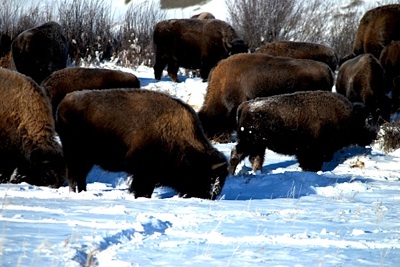
How can we ensure wildlife in our national parks have room to roam? Kurt Repanshek photo.
After much debate, discussion, and consideration, elk culling operations are scheduled to get under way in Theodore Roosevelt National Park in November, when the first of 240 volunteers will be guided into the park's South Unit with instructions to kill as many cow elk as they can.
There are, as comments to our story Monday clearly showed, folks who are vehemently opposed to this operation....and there are those who believe there should be an annual elk hunt, not a culling.
Whichever side you stand on, what's disappointing to see is that politics apparently swayed the National Park Service to this plan, one that will be much, much more costly -- roughly $1.5 million over the 15-year life of the program vs. $654,000 -- than the park's environmentally preferred alternative. That plan would have led to the rounding up of elk that would then be shipped -- after they were cleared of being infected with chronic wasting disease -- to other state, federal and local agencies willing to take them to start their own elk herds.
But U.S. Sen. Byron Dorgan, a North Dakota Democrat, wanted a public hunt, and the volunteer culling -- an option picked by top Interior Department officials, not Theodore Roosevelt managers -- seems to be a compromise. And while park officials are calling it a culling operation, Sen. Dorgan sure makes it sound more like a hunt when he says, "some good, qualified hunters in North Dakota are going to have some good days tromping through the Badlands."
Regardless, the problem Theodore Roosevelt's managers are confronting -- too much wildlife, too little habitat -- is one spreading across parks, and not just those in the United States. Here's a snippet from a story concerning wildlife in East African parks.
Today, parks and reserves in East Africa, large or small, are islands in a sea of humanity.
They are isolated and wildlife is trapped in habitats that lack the requisite diversity of resources.
Historical migration corridors that predate parks and reserves and that hitherto enabled spatial and temporal distribution of resource utilisation are either threatened or no longer accessible.
Spatial connectivity among currently isolated parks and reserves has the best chance to preserve ecological memory, optimum diversity, and adaptive self-renewal, a key component of ecological resilience.
Resilience in this context is the capacity of parks or reserves to absorb disturbances — drought, floods, habitat degradation, disease epidemics — and reorganise while undergoing change, so as to retain essentially the same function and structure — savannah, forest, wetland).
Designing spatial connectivity among parks and reserves must take a holistic ecosystems approach.
This means that the location and connectivity of parks and reserves must be based on a dynamic understanding of how wildlife uses landscape components, especially pasture and water.
This is a long-running, and understood, problem here in North America, and not just with elk. For more than a decade there have been efforts under way to create a "Yellowstone to Yukon" wildlife corridor that would benefit bears, elk, moose, and now wolves, and most recently a team of international scientists pointed to the need to strengthen and protect wildlife corridors leading north from Glacier National Park into Canada.
Rocky Mountain National Park in Colorado is suffering its own elk over-population woes due to a lack of an apex predator that could tamp down the herds, as is Wind Cave National Park in South Dakota. While Yellowstone National Park's elk herds have been trimmed by wolves that were returned to the park in the mid-1990s, the park's bison herds are suffering from Montana ranchers' opposition once they leave the park.
There are other examples, including some that don't involve charismatic mega-fauna. The point is there's a growing problem across the National Park System as more and more wildlife corridors are not just squeezed by development, but severed. How this dilemma is solved will go along way to not just better management options for biologists in places such as Theodore Roosevelt, but healthier wildlife populations.
Story Categories:
A copy of National Parks Traveler's financial statements may be obtained by sending a stamped, self-addressed envelope to: National Parks Traveler, P.O. Box 980452, Park City, Utah 84098. National Parks Traveler was formed in the state of Utah for the purpose of informing and educating about national parks and protected areas.
Residents of the following states may obtain a copy of our financial and additional information as stated below:
- Florida: A COPY OF THE OFFICIAL REGISTRATION AND FINANCIAL INFORMATION FOR NATIONAL PARKS TRAVELER, (REGISTRATION NO. CH 51659), MAY BE OBTAINED FROM THE DIVISION OF CONSUMER SERVICES BY CALLING 800-435-7352 OR VISITING THEIR WEBSITE. REGISTRATION DOES NOT IMPLY ENDORSEMENT, APPROVAL, OR RECOMMENDATION BY THE STATE.
- Georgia: A full and fair description of the programs and financial statement summary of National Parks Traveler is available upon request at the office and phone number indicated above.
- Maryland: Documents and information submitted under the Maryland Solicitations Act are also available, for the cost of postage and copies, from the Secretary of State, State House, Annapolis, MD 21401 (410-974-5534).
- North Carolina: Financial information about this organization and a copy of its license are available from the State Solicitation Licensing Branch at 888-830-4989 or 919-807-2214. The license is not an endorsement by the State.
- Pennsylvania: The official registration and financial information of National Parks Traveler may be obtained from the Pennsylvania Department of State by calling 800-732-0999. Registration does not imply endorsement.
- Virginia: Financial statements are available from the Virginia Department of Agriculture and Consumer Services, 102 Governor Street, Richmond, Virginia 23219.
- Washington: National Parks Traveler is registered with Washington State’s Charities Program as required by law and additional information is available by calling 800-332-4483 or visiting www.sos.wa.gov/charities, or on file at Charities Division, Office of the Secretary of State, State of Washington, Olympia, WA 98504.


Comments
Once again, politics trump good sense. But I guess this is a better situation than the alternative pushed by President Cheney -- privatization of our parks.
It was interesting to note that while Traveler usually doesn't shy away from stories which may produce debate, there was no option for adding comments to yesterday's report of Dirk Kempthorne's appointment to the NPCA board of directors. I'm sure any comments would have been INTERESTING, to say the least. I wonder how much political pressure on NPCA was involved in that situation?
Lee, technical woes that we didn't notice turned off the comment option on the NPCA-Kempthorne story. We typically encourage comments on each and every one of our stories. If you ever see a story with no comment option, please contact us immediately so we can correct the problem.
We have fixed the problem with the NPCA story's comment section, so feel free to leave your thoughts there on the appointment of Mr. Kempthorne to the group's board.
The National Park Service has also previously implemented elk-culling operations in Rocky Mountain National Park. They employed professional sharpshooters to perform the culling operation, with a lottery to distribute the resulting meat, after testing to exclude chronic wasting disease, free to the public. Approval was granted to remove 100 cows from the RMNP herd. Elk are NOT stupid, however. After only 19 cows had been removed, the entire elk herd decamped from the lower elevations of RMNP into the privately-owned lands surrounding the eastern edge. The town of Estes Park was full of elk, safely out of the sharpshooters' reach. I expect a similar result in Badlands. They'll take off for the Black Hills. Only resident natural predators, such as the wolves reintroduced into Yellowstone, can effectively reduce the size of the elk herd to what the available range will carry.
This is a note to the reply sumitted by Lee.
The Elk will take off for the Black Hills? Like they did in Rocky Mountain National Park? Maybe you haven't been out that way lately. Quite a bit different up in the Dakota's. Take a look at a map. :>))) I camped at TR Nat'l park last year, and RM Nat'l Park this year. I doubt the elk will make it. If they head north or south, they would get into the Nat'l grasslands. That might give them a shot at survival. Personally I hope the Elk ditch the hunters.
All I can say is where do I sign up? This type of management is a needed fact of life. More elk than the habitat can support leads to disease and awful deaths for animals. Hunting is the cleanest and safest way to lighten the burden on the park lands. Glad to see they have enough sense to allow it! They should go one step further and CHARGE 250-500$ for a place on the volunteer team and make the state some cash!