
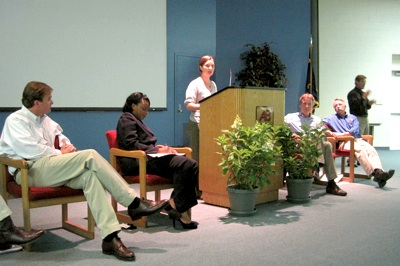
Judy Judkins, of the Appalachian Trail Conservancy's Southern Office, gathered suggestions from young adults age 14-20 on how to reconnect society with the great outdoors. Photo by Danny Bernstein.
Noting that the younger generations are "taking on the mantle of the outdoors," National Park Service Director Jon Jarvis and other officials solicited suggestions on how to connect people with the outdoors during a North Carolina stop on the nationwide tour of America's Great Outdoor Initiative.
The listening session Thursday in Asheville was just the latest as the Obama administration goes coast-to-coast to collect input on how to reconnect Americans with their natural landscapes.
President Obama launched this national dialogue about conservation in America to learn about some of the smart, creative ways communities are conserving outdoor spaces. At the White House Conference on America’s Great Outdoors in April, the president established the America’s Great Outdoors Initiative to reconnect Americans with our great outdoors. As the nation’s largest land manager, the federal government has a responsibility to engage with its partners in order to help develop a conservation agenda worthy of the 21st Century. But more than two-thirds of the land in the U.S. is privately owned, so protecting and restoring the lands and waters that we love must be community driven and supported.
At that time, the president directed the secretaries of Interior and Agriculture, the administrator of the Environmental Protection Agency, and the chair of the Council on Environmental Quality to lead this effort and to listen and learn from people all over the country.
“Even in times of crisis, we’re called to take the long view to preserve our national heritage — because in doing so we fulfill one of the responsibilities that falls to all of us as Americans,” President Obama said.
Public listening sessions are being held nationwide, most of them in large cities, but Washington obviously realized what treasures Western North Carolina holds in public lands - Great Smoky Mountains National Park, Blue Ridge Parkway (celebrating its 75th anniversary), the Pisgah and Nantahala national forests, as well as the Appalachian Trail and the Mountains-to-Sea Trail -- when it scheduled the Asheville session.
How can we make all this wonderful parkland relevant to a diverse audience, especially young people and folks who usually don't camp and hike in our parks? More than 230 adults from the outdoor community registered but many more came. In addition, a youth session was held in the morning.
Tom Strickland, assistant Interior secretary for Fish and Wildlife and Parks, extolled Asheville's natural setting as well as its conservation groups.
Park Service Director Jarvis explained to the audience that "we want to listen to young people - their ideas and experiences. They're taking on the mantle of the outdoors. Yes, we all know that we're in tough economic times now but the federal budget is driven by people."
Their agencies are charged with writing a report for the president with specific recommendations on reconnecting people with the outdoors. The president asked for this early in his tenure. This report will help drive President Obama's budget request to Congress. "We can learn a lot about outdoor activities that work here," Director Jarvis said.
Director Jarvis grew up in the Shenandoah Valley and has been with the National Park Service for 35 years. He used the Blue Ridge Parkway that runs 469 miles south from Shenandoah to Great Smoky as an example of a valuable landscape that public and private organizations and agencies must come together on to see endure.
"The parkway is a ribbon park. The federal government owns a narrow strip. How do we protect the viewsheds? We can't buy all the land as far as the eye can see. We need the cooperation of other organizations," he said
Dee Freeman, head of North Carolina's Department of Environmental and Natural Resources, representing Gov. Bev Perdue, was very pleased that the Great Outdoor Initiative came to North Carolina. "It's an important event for North Carolina and the nation," Mr. Freeman said. "There are lessons that they'll take away from the state. You'll see North Carolina in this report."
The theme of tough economic times was repeated several times during the Asheville session. Assistant Secretary Strickland invoked history to remind the audience that Abraham Lincoln protected Yosemite during the Civil War, that Teddy Roosevelt held the first outdoor summit in 1908 when others wanted to mine the Grand Canyon, and that the Blue Ridge Parkway was started during the Great Depression.
Mr. Jarvis, who has spent the past six weeks dealing with the Gulf of Mexico oil spill crisis, reminded the audience that human ecology and nature are linked. Julie Judkins, of the Appalachian Trail Conservancy's Southern Office in Asheville, reported on the youth session that attracted 60 people ages 14 to 20. Suggestions included Turn off TV Day and parks for older children, as some were of the opinion that most parks are aimed at children younger than 10 years old. Smokey the Bear needs to be updated - give him an iPhone, was another suggestion.
Then it was time for the government park and forest leaders to listen. The audience was broken up into groups, based on the interests they specified when they registered. Each breakout session was led by a high-level official, assisted by a scribe with a laptop. In each session, we discussed:
1. What works: What are the most effective strategies for conservation, recreation, and reconnecting people to the outdoors that you have used?
2. Challenges: What obstacles exist to achieve your goals for conservation, recreation, or reconnecting people to the outdoors?
3. Federal government role: How can the federal government be a more effective partner in helping to achieve conservation, recreation, or reconnecting people to the outdoors?
4. Tools: What additional tools and resources would help your efforts be even more successful?
Marisue Hilliard, supervisor of National Forests in North Carolina, led one of the recreation sessions. Many outdoor programs are working, she said.
* Muddy Sneakers (www.muddysneakers.org) is a program for 5th graders in public schools which got them outdoors and connecting with nature.
* Nantahala Hiking Club uses the Appalachian Trail as part of the school curriculum.
* Outdoor recreation planner discussed that his town, Boone, and county, created a continual revenue stream for outdoor infrastructure with a hotel tax
* Carolina Mountain Club has several large volunteer crews that maintain over 400 miles of trail.
In the Stewardship session headed by Director Jarvis, ideas were flying.
* Ken Voorhees of Great Smoky Mountains Institute at Tremont described a 3-to-5 day in-depth programs for children. This was described as having more impact than serving a larger number of kids for just an afternoon.
* Bill Van Horne of the Nantahala Hiking Club was concerned about the perceived liability problem of volunteer adults taking children in the woods.
* Several Student Conservation Association interns pointed out that there's too much paperwork to get interns in park.
* Many first-time visitors don't know what to do when they get in a park. Maybe the parks could rent out camping equipment, canoes, and bikes, was one suggestion.
* The government should create a national register of outdoor events, similar to American Hiking Society's National Trail Days. Though www.recreation.gov is an attempt at this, it's not very clear or comprehensive.
You can find more information on the America’s Great Outdoors Initiative and submit comments on-line at: www.doi.gov/americasgreatoutdoors.
A report summing up all the listening sessions is due out on November 15 of this year.
Story Categories:
A copy of National Parks Traveler's financial statements may be obtained by sending a stamped, self-addressed envelope to: National Parks Traveler, P.O. Box 980452, Park City, Utah 84098. National Parks Traveler was formed in the state of Utah for the purpose of informing and educating about national parks and protected areas.
Residents of the following states may obtain a copy of our financial and additional information as stated below:
- Florida: A COPY OF THE OFFICIAL REGISTRATION AND FINANCIAL INFORMATION FOR NATIONAL PARKS TRAVELER, (REGISTRATION NO. CH 51659), MAY BE OBTAINED FROM THE DIVISION OF CONSUMER SERVICES BY CALLING 800-435-7352 OR VISITING THEIR WEBSITE. REGISTRATION DOES NOT IMPLY ENDORSEMENT, APPROVAL, OR RECOMMENDATION BY THE STATE.
- Georgia: A full and fair description of the programs and financial statement summary of National Parks Traveler is available upon request at the office and phone number indicated above.
- Maryland: Documents and information submitted under the Maryland Solicitations Act are also available, for the cost of postage and copies, from the Secretary of State, State House, Annapolis, MD 21401 (410-974-5534).
- North Carolina: Financial information about this organization and a copy of its license are available from the State Solicitation Licensing Branch at 888-830-4989 or 919-807-2214. The license is not an endorsement by the State.
- Pennsylvania: The official registration and financial information of National Parks Traveler may be obtained from the Pennsylvania Department of State by calling 800-732-0999. Registration does not imply endorsement.
- Virginia: Financial statements are available from the Virginia Department of Agriculture and Consumer Services, 102 Governor Street, Richmond, Virginia 23219.
- Washington: National Parks Traveler is registered with Washington State’s Charities Program as required by law and additional information is available by calling 800-332-4483 or visiting www.sos.wa.gov/charities, or on file at Charities Division, Office of the Secretary of State, State of Washington, Olympia, WA 98504.


Comments
Danny - great write-up. BTW, Smokey the Bear has just recently been updated. The Ad Council has a full blown marketing effort using various formats to get the new PSAs out to the public, in particular, to younger people. Here's a link to an extended PSA that was recently launched:
http://hikinginthesmokys.blogspot.com/2010/07/smokey-bear-stars-in-new-p...
Jeff
HikingintheSmokys.com
Kudos for the great article, Danny, and thanks for caring and sharing.
What a wonderful idea! However, with a push for more "urbanites" to come enjoy the outdoors is scary. I have visited several areas that people without a true love of the land and it's natural beauty have done nothing but trash it, disrespect it and destroy it. Even in privately managed park areas - where you would expect more time and money could be spent on clean up - the land is littered, vandalized and pilfered. There just isn't enough money to cover the costs of repair that city lovers cause.
Renting camping equipment to people that have no clue on the basics of camping would promote more fee's and taxes for those of us that due simply because the parks will need to recover the increased cost of their liability insurance. Attorney's will have a field day the first time a novice tenter stabs his/her foot with a tent stake or causes a forest fire with a lantern that the park rented him/her.
And heaven forbid that a novice outdoorsman have to manuver in the darkest of dark. Before long all the parks will be required to have street lights EVERYwhere because dark is a "safety hazard". There goes the joy and romance of seeing stars that glisten like diamonds on velvet!
After years of enjoying the outdoors because there is such a small percentage of the population that pertakes in it regularly, I would hate to see a bigger surge to campgrounds, lakes, hiking trails, etc. When that happens there will be no place left to escape to. It will be a crowded city street hampered with rules and regulations and restrictions in order to manage the influx of inconsiderate and ignorant.
As it is, at least here in N. Texas, finding a trail, lake or nature perserve where you can actually indulge in the advertised outdoor activities it's getting near impossible because of all the people. We can't camp because all the campsites are reserved all season long, boating becomes a rush hour commute, and the hiking is like a walk down a mall corridor. The animals are few and far between and the best overlooks have been closed due to people treating them like massive landfills!
Granted the government needs more money and is going to advertise all possible avenue's in order to receive it but don't put the natural beauty of our country at stake. To preserve our "heritage' we need to limit it's access to experienced, respectful participants.
similarly, as we learn in life, we cant make anyone feel, think, believe, do anything they don't want to on their own....live & let live people but,,,respect
Kristy,
Some parks do a great job already of introducing neophytes to the great outdoors. Shenandoah and Mount Rainier are two that come immediately to mind with their family camping programs. And organizations such as the North Cascades Institute and the Yellowstone Association also offer programs to make folks feel more comfortable in the outdoors and learn how to navigate them.
If anything, the national parks need more people -- not fewer -- who appreciate their wonders and what they offer. And those who might be unfamiliar or uncomfortable initially can be taught how to enjoy these places respectfully.
The danger of greater park populations is definately not due to the Parks Dept. lack of vigilance on introducing the value of the areas granduer on newbies. And, perhaps, in areas with such grand beauty as the ones you mentioned that also have smaller local populations the mind-set is totally different. However, there are other areas without the magnitude of granduer but beautiful just the same that are, unfortunately, in very close proximaty to large city areas. By their mere location these parks are used more as a source of inexpensive entertainment - without the usual restrictions of urban areas - rather then convenient places to escape and enjoy the local beauty of the land. Even with programs and organizations working to educate the novice in considerate enjoyment of these areas the influx of those that either don't attend such classes or just simply don't care about the information shared the natural beauty of local areas are being ruined. The parks office and its volunteers, rangers, directors, etc can impliment many options for learning but if the intention of the visitor is merely to experience the feeling of unrestricted self-discretion then no amount of classes will change the level of damage they will carelessly inflict on the area. Therefore, the push to invite more and more of the population into the outdoor experience is a scary campaign to those of us who do enjoy and respect the land but cannot afford a 2 day trip in order to reach an area where the majority of the partakers are of the same respectful mindset.
Kristy, I understand what you are saying, but what this issue comes down to is that you can't "limit access" because these national parks and public lands don't just belong to people that live in rural areas but to all Americans. City dwellers have just as much a right to experience our public lands as you do. In order to truly appreciate these lands, people must go there and explore them. By trying to limit access, you would be denying many people the opportunity to develop a relationship with nature.
Why would people vote to protect something they have never seen and know nothing about?
Education and experience is the Key to getting more people outdoors while preserving what we have. Although it has been said and repeated many times before, it bears repeating until people get it. "In the end, we will conserve only what we love, we will love only what we understand... understand only what we are taught." Baba Dioum