
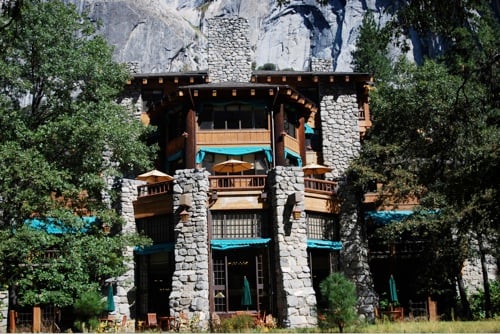
Rates at national park lodges, such as The Ahwahnee in Yosemite, rise at a pace faster than inflation. NPT file photo.
Regular guests of national park lodges have undoubtedly noticed persistent increases in room rates. Although we no longer have the receipt, it seems that we paid $225 per night during our 1996 stay in Yosemite National Park's Ahwahnee for a room that now goes for approximately $500 per night. It probably doesn’t surprise you to learn that during the past decade, lodging rates in national parks have risen faster than the Consumer Price Index. It might be surprising that rates for some lower-end park accommodations increased faster than lodging rates for high-end accommodations
These are some of the findings that jumped out when we compared national park lodging rates in effect for the just-completed 2009 high season with rates charged for the same category of rooms ten years ago.
Curiosity into how rate increases for high-end lodges such as The Ahwahnee and Grand Teton National Park’s Jenny Lake Lodge compared to more modest facilities such as Far View Lodge in Mesa Verde National Park led us to pull out some of our old data and compare them to current rate schedules.
Specifically, we matched rates charged during our 1999 national park lodging trip with those charged for an equivalent room at the same lodging facility in 2009. Keep in mind that concessionaires occasionally upgrade facilities and alter room classifications, thereby making it more difficult to compare rates over time.
We have done our best to choose similar rooms for the rate comparisons. For example, Far View Lodge did not offer upgraded Kiva rooms during our 1999 trip. Thus, we compare the rate for the current Standard rooms with the rate for the class of room we stayed in at Far View during the 1999 trip.
You also need to keep in mind that the National Park Service must approve prices charged for lodging, as well as other goods and services offered in most national parks. In general, the NPS attempts to keep in-park prices similar to those charged in gateway communities. Understandably, remodeling generally results in NPS approval of a larger-than-average rate increase compared to years when no remodeling has occurred.
Big remodeling projects in recent years include Xanterra Parks & Resorts' substantial work on Old Faithful Inn in Yellowstone National Park. Paradise Inn in Mount Rainier National Park was closed for two years during which the historic structure received a new foundation and supporting walls. The Inn also got new wood flooring in the lobby and new bathrooms on the second floor. Grand Canyon National Park’s South Rim lodging facilities are regularly remodeled on a rotating schedule. In any case, we have attempted to make relevant comparisons.
Lodging rates in the study are based on double occupancy for 1999 and 2009. Rates for these two seasons are utilized to calculate the overall change in lodge rates expressed as a percentage, plus the annualized rate increase during the decade. For example, a room rate that doubled during the ten-year period is the equivalent of a 100 percent overall increase, which converts to an annualized increase of slightly over 7 percent. The annualized rate is comparable to the widely-reported Consumer Price Index that is calculated and published by the U.S. Department of Commerce.
Well, sort of comparable as we shall discuss shortly.
We have also included a comparison index for “lodging away from home,” a statistic compiled by the Bureau of Labor Statistics that tracks the inflation rate for lodging in commercial hotel and motels. This statistic includes a relatively minor weighting for the cost of student housing, but is generally comparable to the rate increases listed for national park lodges.
The study certainly isn’t perfect and would not withstand academic scrutiny. For example, it uses a sample of approximately one-third of the nearly 90 national park lodges. In addition, only one room category is generally used for each lodging facility. For example, in Curry Village we include only the tent cabins, the most prevalent type of lodging here, although Curry also offers motel-type rooms plus cabins with and without a private bath.
We have pricing information available for all the lodging options but utilizing a sample requires less work. No particular methodology was used in selecting lodges for the study other than making certain that a wide range of facilities is included, and the major parks are represented.
Heavily visited parks including Grand Canyon, Yellowstone, and Yosemite each have three lodging facilities represented in the study. There is no reason to believe that using all the lodges rather than the sample would produce a significantly different result. Another caveat is that each lodging facility receives equal weighting. Thus, Bluffs Lodge along the Blue Ridge Parkway, with only 24 rooms, below-average room rates, and open seasonally, is weighted equally with the Ahwahnee that is open year round with 123 rooms that rent for a little over four times as much as rooms at Bluffs Lodge.
A more accurate lodge price index would take account of the number of rooms available, the price at which those rooms rent, and the length of season, and the occupancy rate. Thus, based on the amount of money travelers spend at each facility, the Ahwahnee should be weighted at nearly 50 times that of Bluffs Lodge. We might have considered doing the extra work if we had lots of time and were getting paid, but we don’t and we’re not, so we took the easy way out.
The study indicates an average annual rate increase at national park lodges during the last decade of 4.6 percent, slightly less than double the annualized increase of 2.5 percent in the Consumer Price Index and a little more than double the 2.1 percent increase for overall lodging prices as calculated by the U.S. Bureau of Labor Statistics. Keep in mind that the Consumer Price Index can be a misleading measure of inflation, in part because it includes the volatile components of food and energy. Still, the CPI offers a base from which to compare changes in lodging prices.
Somewhat surprisingly, the average annual rate increase for three high-end lodges (Ahwahnee, Furnace Creek Inn, and Jenny Lake Lodge) is 4.6 percent - exactly the same as for the entire sample. As is often the case with a small sample, a single component can produce a misleading result. Although the average rate increase for high-end properties was the same as for the overall index, the range of price increases for the three properties was quite large. In this case, an average annual increase of 6.2 percent at the Ahwahnee compares to an annual rate increase of 2.9 percent at Furnace Creek Inn.
Interestingly, we discovered that the average annual increase in price for rooms without a private bath was 5.1 percent, a higher rate of increase than for room rates for the overall sample. On the surface this is somewhat surprising in that it seems as if both the concessionaire and park superintendent would prefer to maintain some lodging at a price that is affordable by a large segment of the traveling public. As with high-end lodging, the average here was tipped by the relatively large 8.7-percent annual rate increase at Yosemite’s Curry Village tent cabins. This was the largest increase of all properties included in the overall sample. The lowest average room rate increase among all the lodges in the sample was 2.1 percent at Far View Lodge in Mesa Verde. The results of the study are presented below.
Average Annual Increase (1999-2009)
National park lodge room rates (sample of 31 properties) ........................................4.6%
High-end national park lodge room rates (3 properties) ...........................................4.6%
National park lodge room rates for facilities without a bath (5 properties) ..................5.1%
Range of annual rate increases for sample .............................................................2.1% to 8.7%
Consumer Price Index (U.S. Bureau of Labor Statistics) ..........................................2.5%
Lodging Away from Home Index (U.S. Bureau of Labor Statistics) ............................2.1%
Disposable personal income per capita (U.S. Bureau of Economic Analysis)................4.0%
David and Kay Scott are the authors of Complete Guide to the National Park Lodges (Globe Pequot). They live in Valdosta, Georgia, and have traveled America’s national parks for 40 years.
Story Categories:
A copy of National Parks Traveler's financial statements may be obtained by sending a stamped, self-addressed envelope to: National Parks Traveler, P.O. Box 980452, Park City, Utah 84098. National Parks Traveler was formed in the state of Utah for the purpose of informing and educating about national parks and protected areas.
Residents of the following states may obtain a copy of our financial and additional information as stated below:
- Florida: A COPY OF THE OFFICIAL REGISTRATION AND FINANCIAL INFORMATION FOR NATIONAL PARKS TRAVELER, (REGISTRATION NO. CH 51659), MAY BE OBTAINED FROM THE DIVISION OF CONSUMER SERVICES BY CALLING 800-435-7352 OR VISITING THEIR WEBSITE. REGISTRATION DOES NOT IMPLY ENDORSEMENT, APPROVAL, OR RECOMMENDATION BY THE STATE.
- Georgia: A full and fair description of the programs and financial statement summary of National Parks Traveler is available upon request at the office and phone number indicated above.
- Maryland: Documents and information submitted under the Maryland Solicitations Act are also available, for the cost of postage and copies, from the Secretary of State, State House, Annapolis, MD 21401 (410-974-5534).
- North Carolina: Financial information about this organization and a copy of its license are available from the State Solicitation Licensing Branch at 888-830-4989 or 919-807-2214. The license is not an endorsement by the State.
- Pennsylvania: The official registration and financial information of National Parks Traveler may be obtained from the Pennsylvania Department of State by calling 800-732-0999. Registration does not imply endorsement.
- Virginia: Financial statements are available from the Virginia Department of Agriculture and Consumer Services, 102 Governor Street, Richmond, Virginia 23219.
- Washington: National Parks Traveler is registered with Washington State’s Charities Program as required by law and additional information is available by calling 800-332-4483 or visiting www.sos.wa.gov/charities, or on file at Charities Division, Office of the Secretary of State, State of Washington, Olympia, WA 98504.

Comments
Connie
In 2005 we stayed at Waterton's Prince of Wales Hotel (Granted it's in Alberta, Canada but it is the International Peace Park connected to Glacier NP). I will admit the views were incredible but I felt it was too steep of a price to pay for the room we had! Like anything we live and learn! I would rather spend the same amount of money for one night's stay at the Prince of Wales and stretch that into a few days stay at the Old Faithful Inn's, "Old House" section. There are others who have loved their experience at Prince of Wales and I think that's great! I think it's a personal preference as we have spent more money staying at Many Glacier Hotel or at Sperry Chalet; there will always be folks who are willing to pay the price for staying at their favorite places! When our kids were little we camped the entire time, never having once stayed at the NPS Lodges or even the OFI! It simply wasn't an option! Now that the kids are grown, we still love to camp but now we get the chance to stay at the Lodges since it's just the 2 of us! El Tovar is probably the next Lodge on our list of NPS Lodges to visit! The Ahwahnee is definitely impressive but I have only been in the lobby and dining room areas. That one may eventually be one we visit as well. The Chateau Fairmont in Lake Louise however, only if I win the lottery! Ha ha!
Connie Hopkins
Denton, Texas
Camping is a lot cheaper and a LOT more fun than just staying in a hotel. You can relax in a hammock, sit around a campfire at night, socialize with the other campers, and then slip into your tent and sleep on a comfortable Thermarest pad.
We have started a love affair with the lodges, and partially because my arthritic body can no longer handle rougher camping. As a former Army medic who spent a lot of time out with the infantry, and also as a younger man put on tens of thousands of miles backpacking around North America, I miss it a lot, but it's where the wheel has turned for me now.
In October I took my wife to the Lake Quinnault lodge for her birthday weekend. We invested in one of the lodge rooms with a fireplace and had a view of the beautiful hillside sloping down to and across the lake. Dinner was exquisite. As a romantic get away, it was exactly what we needed and wanted.
Also obvious was that things are rough, in the offseason at least, for lodges and those who are dependent upon them. It looked like the dining room was staffed by a chef and one waitress/hostess. They were advertising lots of gimmicks for getting people in for the dining room and/or the lodge itself.
We couldn't do a stay in a lodge all the time, but as a special treat to save up for it was wonderful.
I only camp in national parks because of the cost of concession lodging. Pretty bad when a retired NPS employee can't afford to stay indoors in parks. And the ground has gotten a lot harder since I was a young camper.
We cannot say these are "the people's" parks when everyday working class Americans can't afford to stay in them. To suggest that camping is good enough for the working-class is, I think, not a solution in a democratic society. How can a family, stressed out and in need of the park's good medicine, afford $93-95 a night for an unheated tent cabin in Yosemite? If the Park Service wants to attract a caring constituency to the parks, they are going to need to rethink the way the concessions cater to the "haves" while ignoring the "have nots."
I'd note that for some popular places like Yosemite Lodge book a year in advance (the earliest they can be booked) for the peak season. I talked to one of the employees who said that even for the Winter months they'll typically sell out maybe 3-4 months in advance for most dates.
The Ahwahnee is generally fully booked from Spring to Fall. However - it may not be fully booked in Winter. I've heard that one might be able to find a half-price walkup rate during the Winter months. A newspaper reporter wrote some article where he said he was staying outside the park but found a room at the Ahwahnee and cancelled his other reservation.
I am curious why Glenn makes the correlation between being able to call national parks "People's Parks" and choosing to not stay overnight in them. My taxes pay for roads which I may not be able to afford to drive on. Help me understand the correlation.
I guess it's a matter of perspective. Frankly the costs of lodging in many NPS units are in line with similar properties outside NPS areas. Some are really high demand areas (especially Yosemite) and don't believe that there should be any sort of artificial price control. Many type of in-park lodging are actually cheaper than accommodations outside the park and not surprisingly book extremely quickly.
Camping is still an option. One can rent a small RV.
Prices do vary. The Colter Bay tent cabins at Grand Teton NP are $50. There are summer options for indoor lodging at SEKI for under $100. I stayed in Yellowstone one night for under $60 in a cabin. Maswik Lodge at the Grand Canyon is very reasonable - about $80 night with a TV and telephone. That's actually cheaper than most places in Tusayan, just outside the park.
I was wondering how the whole process of concessionaires works. Do they bid on the ability to run the lodges for a number of years and decide to charge whatever they feel like? I am glad camping at state parks isn't run like that or I couldn't camp there. I never camp at front country campsites within the National Park System, as they are all trashed compared to my favorite state parks. It seems if they ran Yosemite right (for the people), they would limit the cost of rooms, and not just track the rate of increase. You know how some cities have low cost housing, why not a block of rooms at the Ahwahnee that are affordable for the middle class visitor?
Richard,
In short, companies bid for the concession contracts. In the case of lodges, those contracts typically run for 10 years. Towards the end of that period they put the contract up for bid again. For instance, earlier this year Xanterra Parks & Resorts lost the concession to Bryce Canyon Lodge to Forever Parks.
As for pricing, from what I've been told it's somewhat of a complicated formula, but the rates are supposed to be comparable to the nearest commercial property outside the park. But you also have to factor in upkeep of the facility, the cost of employees, the percentage that goes to the park, taxes, etc. Comparables seemingly can create problems for places like Grand Teton National Park, in which case the nearest lodging outside the park is Jackson, Wyoming, where some of the properties are pretty high-end.
That said, it would be of wide interest, I would think, to take a close look at lodging rates across the park system and all the factors that go into their determination.
As for state-run campgrounds vs. park-run campgrounds, I think the state of the campgrounds is pretty much like everything else -- some are well-kept, some aren't. I remember checking out a state campground in Oregon a decade or so ago and there was all sorts of garbage...and there was another that was gorgeous.
While I don't typically stay in front-country campgrounds, preferring to head into the backcountry, the ones I've seen in Yellowstone, Grand Teton, Arches, Canyonlands, Natural Bridges, and Glacier, just to name a handful of parks, have been pretty well-kept. I also know that the folks at the Yellowstone Foundation have budgeted nearly $50,000 to do front-country campground restoration in Yellowstone to remove social trails and install tent pads to protect the landscape, among other things.
Also, don't be bashful about telling park officials about what you find in the campgrounds. More and more these are being turned over to concessionaires, who need to be accountable. Some years ago I stayed at Colter Bay in one of the cabins, which are located in bear habitat. One morning I found the housekeeping staff bagging up garbage from the cabins and leaving it out front for staff to collect later in the day. In light of the bear habitat, you can image the problem this could have caused. A quick call to the park corrected the problem overnight.
Doesn't Xanterra run the campgrounds at Yellowstone one behalf of the NPS? I remember reserving a campsite at Mazama Campground at Crater Lake, and that was also handled by Xanterra.
In many ways I've found that the concessionaire run campgrounds are very well maintained. Bathroom facilities seem to be cleaned on a faster schedule than many NPS run campgrounds. Of course sometimes I've found better service at the entrance kiosk with some NPS campgrounds staffed by enthusiastic volunteers/retirees who return every year or park rangers, while some of the concessionaire campgrounds have been staffed by bored-looking college students.
Sometimes NPS sites are near other public lands with lodging options. Sequoia/Kings Canyon is heavily dependent on the facilities available in Sequoia National Forest. They've got fine campsites at Stony Creek, Princess, and Hume Lake as three examples that supplement the NPS campgrounds. There's sometimes excellent cooperation between the FS and NPS. I remember visiting the Grant Grove visitor center to report a bear with cubs sighting (just check the photo in my profile page) and I was told the wildlife expert there was the Forest Service ranger on duty.
As for Grand Teton lodging rates compared to Jackson - there are some really cheap options in Jackson. They do have a Motel 6 on the outskirts of town. Yellowstone probably gets compared to West Yellowstone and Gardiner. I remember booking a motel at West Yellowstone in the peak summer season for $75 before canceling the reservation after someone in my party managed to get one night at a Roosevelt Lodge Roughrider cabin. The original plan was to drive from the Roosevelt Old West Cookout to West Yellowstone at night. The change in lodging allowed us to drive across those windy mountain roads to the exit in the morning on the way to Utah.
Xanterra handles some, but not all, of the Yellowstone campgrounds: Bridge Bay, Canyon, Fishing Bridge RV Park, Grant Village, and Madison. The rest, I believe, are handled by the NPS.
There are indeed some inexpensive lodging options in Jackson...but also some very high ones. I'm not sure how the NPS folks blend them all together to come up with Grand Teton's rates.
Sounds like you had a great experience with the Roughrider cabin. It is wise to check when you're in the park for rooms/cabins that might have opened up through cancellations. We'll address some of the "tricks of the trade" for bagging a room down the road.
I liked the Roughrider cabin, although the whole place smelled of smoke after we burned 4 logs in the stove. I didn't think the two they supplied were enough and requested more at the front desk. I also had the toughest time getting the thing to stay on fire. I had some alcohol gel hand sanitizer and used that when we had no more of those firestarter chunks. We could also park our car right next to the cabin.
The way we got it was from my father - a former travel agent - and his persistence. This was a trip I'd promised my folks. We were staying at one of the Canyon Lodge cabins and he inquired about availability at Roosevelt for that night we were at the cookout. He really didn't want us to take that road to West Yellowstone at night. He gave them his old IATA number and apparently they were able to take us for one night and wrote up a reservation confirmation at the Canyon Lodge front desk. The hardest part was canceling our reservation. I had the phone number and it was a national chain, but we had to find a pay phone to make the call.
I was talking to one of the employees whose wife handled group tours for Xanterra. He relayed that apparently some people complained about the quality of accommodations with the Roughrider cabins. They didn't quite understand that "rustic" should mean bare bones basic and not luxury cabins like (let's say) at Jenny Lake.